The Three Foot Line Where Quiet Common Sense Crushed a Glossy Suburban Power Play
CHAPTER 1: THE POST HOLES
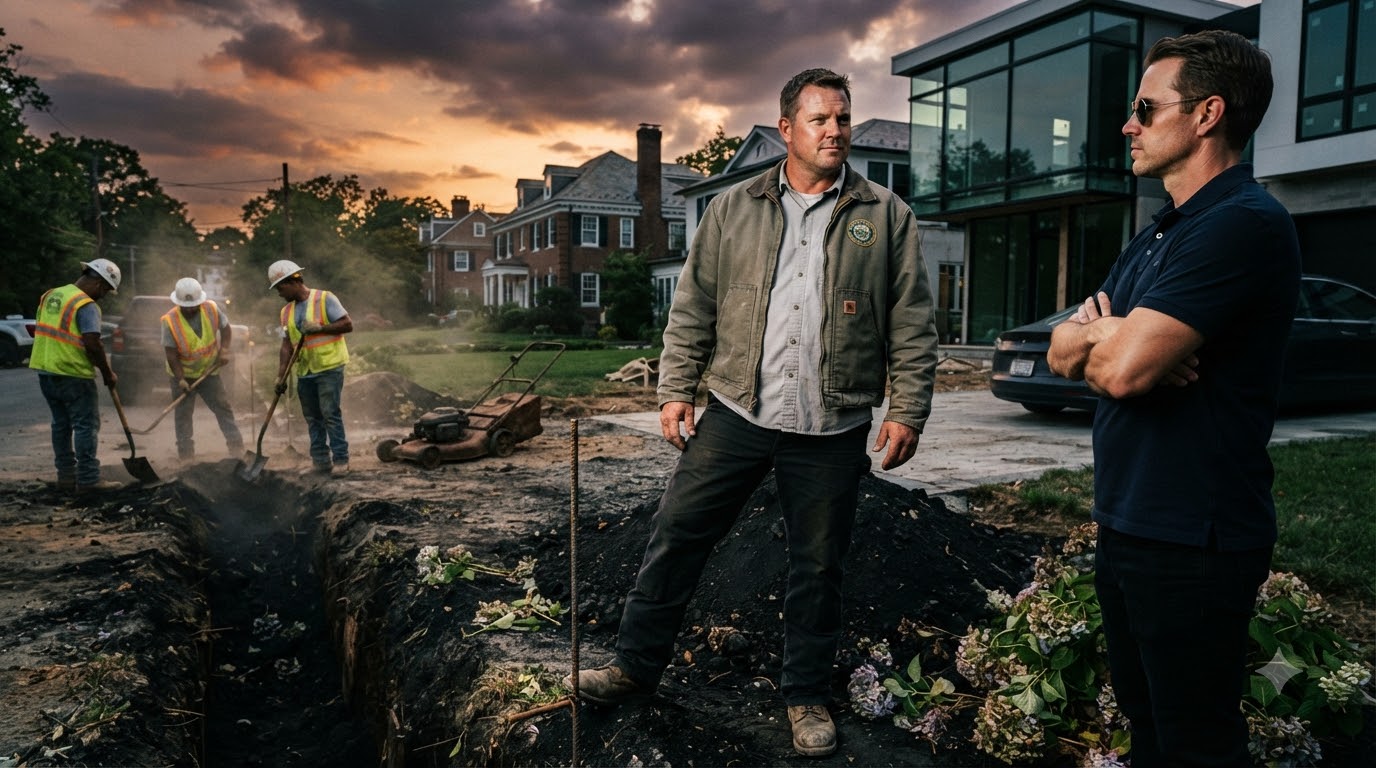
The sun was dropping low behind the tree line, spilling a harsh orange light across the asphalt. I stood at the edge of my own driveway, boots heavy with the dust of a long Tuesday, staring past the rusted lawnmower. Three men in high-visibility vests were sweating over long-handled shovels. They weren’t near my garden. They were deep inside it. Three full feet past the old iron rebar stake my uncle drove into the dirt back when George Bush was in office.
Grant Holloway stepped out from the shadow of his matte black Tesla parked next door. He wore aviator sunglasses despite the fading evening, his arms crossed over a sleek designer polo. He didn’t look like a man trespassing. He looked like an executive touring a newly acquired warehouse.
I walked slow, letting the gravel grind under my work boots.
“Evening, Grant,” I said, keeping my hands flat at my sides. “Care to explain why your crew is trenching my hydrangeas?”
Grant didn’t blink. He reached into his back pocket, pulled out a tightly rolled tube of heavy bond paper, and tapped it against his palm with a dry, rhythmic pop.
“Not your hydrangeas anymore, neighbor,” Grant said, his smile stretching tight across his face without reaching his eyes. “Survey came back fresh this morning. The old property markers were off by a solid thirty-six inches. We are just correcting a decades-old error.”
A few months ago, Grant had blown into our quiet, comfortable Ohio subdivision like a weather system nobody asked for. He bought the old Miller place, bulldozed the modest brick structure, and erected a towering glass-and-steel monstrosity that looked like an airport control tower landed among our modest colonials. Security cameras blinked red eyes from every soffit. Landscape lighting glared into my bedroom windows every night. He treated the neighborhood like an asset portfolio waiting to be optimized.
I looked down at the trench. Fresh black dirt spilled over the petals of my blooming flowers.
“My uncle built this house,” I said, my voice dropping into a flat, steady register. “He was a county civil engineer. He drove that rebar stake himself. There was no error.”
Grant unrolled the paper with a sharp snap, pinning the edge down with a heavy silver signet ring. “Times change, old man. Technology changes. Laser measurements don’t lie. My consulting firm relies on precision. You’ve been enjoying free land for twenty years. Consider the lease expired.”
He turned his back before I could answer, walking back toward his oversized deck without a shred of doubt. He was banking entirely on the fact that I was tired, alone, and too exhausted to fight a paper tiger.
CHAPTER 2: THE BASEMENT ARCHIVE
The air down here smelled of damp concrete, old cardboard, and decades of forgotten tax returns. I dropped a heavy stack of yellowed folders onto the scarred wooden workbench.
My uncle’s desk chair creaked as I sat down, the springs protesting under my weight after years of gathering dust.
A single drop of condensation from the overhead pipe struck the workbench with a flat, hollow pop. I brushed it aside with the side of my thumb, my eyes scanning the stacked drawers of the filing cabinet he had left behind.
“Whole street only works because of what you can’t see,” his voice drifted back to me from some long-ago cookout, half-mocking, half-serious.
My fingers sifted through stiff manila folders, passing mortgage deeds and plumbing invoices until they caught on a thick, canvas-bound roll tucked into the back corner. I pulled it free, a thick layer of gray dust puffing up into the pale shaft of light cutting through the high basement window.
I unrolled the heavy paper across the scarred wood, weighing down the curling corners with an old stapler and a heavy can of wood stain.
It was the original master civil blueprint of the subdivision, hand-drawn in ink back in 1982 when the county first mapped the valley.
My index finger traced the inked contour lines, moving past the grid of property plots until it hit a thick, shaded corridor cutting diagonally right through where Grant Holloway’s matte black Tesla was currently parked upstairs.
There it was, marked in precise architectural hatchings—a designated municipal drainage easement.
Right under the three-foot strip of dirt Grant had stolen for his cedar post holes.
I leaned in closer, squinting against the dim overhead bulb. Someone had added a sharp, aggressive note in crimson red ink right along the margin of the easement line.
Maximum structural load: zero tolerance.
Grant thought he was just bullying a tired neighbor over a garden border. He had no idea he was driving steel stakes directly into the hydraulic backbone of the entire subdivision.
CHAPTER 3: THE BUREAUCRATIC GRIND
I didn’t storm across the lawn to trade shouts with a man in aviator sunglasses.
Instead, I dialed the local public records line from the rotary phone in the hallway, letting the harsh electronic hum of the automated queue drone on against my thumb.
“County engineering and zoning compliance,” a weary voice finally crackled through the static.
“I need to file an official public inquiry regarding an unpermitted obstruction over a recorded utility corridor in phase one of the northern subdivision,” I said, keeping my tone flat, dry, and entirely devoid of emotion.
The keyboard on the other end began a steady, rhythmic clacking, like a woodpecker on dry timber.
Without direct fast-track executive contacts, every single line of verification had to grind through the slow, public administrative queue.
I didn’t ask for a favor, and I didn’t beg for an expedited review.
I simply read out the lot numbers, the plat book index numbers, and the specific section coordinates stamped onto my uncle’s old blueprints.
“Sir, standard public review for an easement dispute typically takes fifteen business days,” the clerk muttered, her voice muffled by the sound of shuffling paper.
“Check the watershed protection clause under municipal code eight-four-B,” I replied, tapping my knuckle against the wooden desktop. “If a permanent structure alters a designated stormwater grade, the inspection window drops to twenty-four hours.”
A sharp pause filled the line, followed by a sudden, frantic clatter of keys.
“Oh,” the clerk said, her tone shifting from routine boredom to sudden caution. “That… that’s a primary flood control corridor. Who authorized construction there?”
“My neighbor,” I said quietly. “With a fresh commercial survey and a lot of confidence.”
CHAPTER 4: THE CLIPBOARD ARRIVAL
The gravel driveway crunched under heavy work boots as two inspectors stepped out from the lead truck.
Neither man looked at Grant’s matte black Tesla or the sprawling glass-and-steel architecture of the new house.
They walked straight toward the property line with quiet, methodical purpose, unfolding identical blue-backed maps against the late-morning wind.
Grant stepped off his oversized deck immediately, his designer sunglasses sliding down the bridge of his nose as a confident, half-amused smirk pulled at the corner of his mouth.
“Morning, gentlemen,” Grant said, his voice carrying easily across the dead grass. “If you’re here about the retaining wall permits, my legal team already submitted the architectural waivers to the downtown office.”
The lead inspector didn’t glance up from his clipboard. He pulled a yellow steel tape measure from his belt, letting the metal tongue snap out with a harsh metallic ring.
“No waivers on file for this corridor,” the inspector said flatly.
He locked the tape at the exact boundary marker and pulled it tight across the freshly dug post holes in my hydrangea bed.
Grant’s smirk tightened into a hard, defensive line. He strode over, tapping a rolled document against his thigh.
“My survey says thirty-six inches of leeway under the new residential expansion code,” Grant snapped, his voice rising in pitch. “Check Section Twelve.”
The inspector folded his arms over his chest, looking down at the cedar posts buried deep in the mud.
“Section Twelve applies to private boundary lines,” the inspector replied, his tone remaining ice-cold and mechanical. “It does not override a recorded municipal drainage easement.”
That single sentence dropped onto the lawn like a sledgehammer.
Grant’s jaw tightened, his fingers digging white into the paper roll.
“That’s drainage,” Grant barked, pointing a shaking finger toward the back corner of the lot. “That runs fifty feet away near the creek line, not through my landscaping.”
The inspector pulled a folded copy of the 1982 master development map from his chest pocket and laid it flat across a stack of stacked fence panels.
Right there, highlighted in bright yellow marker over the exact red ink annotation from my uncle’s basement, was the truth.
The entire three-foot strip sat squarely on top of the primary stormwater conduit for the entire block.
CHAPTER 5: THE VARIANCE WALL
Grant let out a sharp, breathless laugh that sounded entirely hollow in the afternoon air.
He stepped back toward his matte black Tesla, his hand hovering over the door handle before dropping back to his side as the municipal inspectors marked off another violation along the edge of his oversized deck.
“This is ridiculous,” Grant snapped, his voice cracking slightly around the edges as he turned to face the two county officials. “We can just file for an emergency variance. I’ll pay whatever fee the board requires this afternoon.”
The lead inspector didn’t look up from his metal clipboard, his pencil scratching a neat, final line across the violation log.
“Variances require public review periods, structural impact clearances, and neighborhood consent forms,” the inspector said, his tone flat and immovable.
“I have capital,” Grant shot back, his jaw clenching so hard a muscle twitched near his temple. “I can retain counsel to expedite the paperwork before tomorrow morning.”
The inspector finally raised his eyes, fixing Grant with a cold, level stare.
“Drainage easements tied to subdivision flood control are legally ineligible for variance,” the inspector replied. “No exceptions, no grandfather clauses, and no executive overrides.”
The color drained entirely from Grant’s face, leaving him standing rigidly on the dead grass in his designer polo.
He wasn’t dealing with a neighborhood dispute anymore. He had run straight into the immovable wall of municipal infrastructure law.
And infrastructure law didn’t negotiate with corporate titles, sleek sports cars, or unearned confidence.
CHAPTER 6: THE RESET BORDER
The work took three solid days of dust, sweat, and heavy machinery groaning against the Ohio clay.
Contractors hired by the city moved systematically through the front yard, ripping down the expensive cedar panels and tearing apart the oversized deck frame that had loomed over our properties for half a year.
Grant stood inside his floor-to-ceiling glass windows every morning, watching the heavy equipment dismantle his luxury expansion piece by piece.
He didn’t come outside to yell. He didn’t wave his designer papers or try to negotiate from his porch.
His desperate counter-moves had evaporated the moment the environmental insurance claim was denied and the structural fines topped three hundred thousand dollars.
By Friday afternoon, the noise died down, leaving behind a raw expanse of leveled earth and packed brown soil.
The city surveyor arrived right on schedule, unrolling a fresh strip of yellow tape before driving permanent, city-stamped concrete markers flush with the ground.
Exact. Immovable. Thirty-six inches precisely where they had always been, restoring the true boundary line of the property.
That fall, the matte black Tesla disappeared from the driveway, and a modest “For Sale” sign went up by the sidewalk without a single word of friction.
I walked out to the edge of the lawn with a ceramic trowel in hand, sinking down on one knee in the afternoon sun.
With quiet, steady movements, I replanted my hydrangeas right along the fresh concrete markers, right where they belonged.