The Weight of Nine Pounds: A Marine’s Silent War Against the Architecture of Failure
CHAPTER 1: THE WEIGHT OF NINE POUNDS
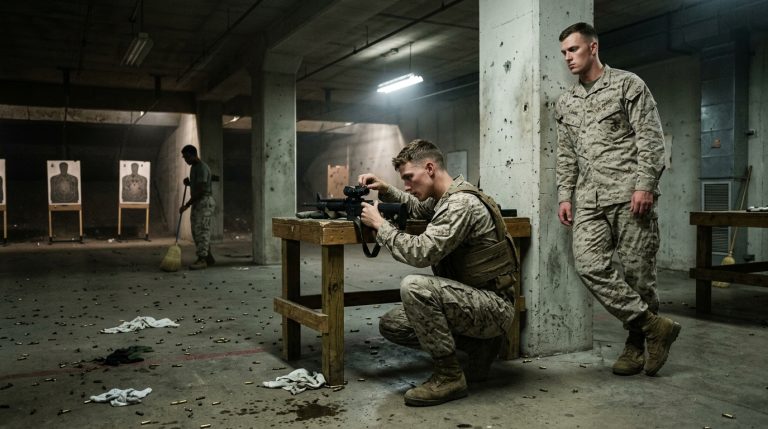
The M1 Garand lay on the concrete like a discarded spine. It was nine-and-a-half pounds of wood and blued steel, a weight that had become the total measure of Lance Corporal Darius Webb’s existence. At 8th and I, you didn’t carry a rifle; you wore it. It was supposed to be a living extension of the arm, a rhythmic pulse of wood against bone.
Darius didn’t move. He kept his heels locked, his gaze fixed on the horizon line where the gray sky met the stark, unyielding walls of the Barracks.
Gunnery Sergeant Ray Okafor stepped into his peripheral vision. He didn’t scream. The silence was heavier than any shouting, pressing down on the back of Darius’s neck like a physical weight. Okafor’s boots made no sound on the practice pad, yet his presence was a vacuum, sucking the oxygen out of the space between them.
“The bolt,” Okafor said. His voice was a flat, low-frequency hum. “It stalled again. Ninth time today, Webb.”
Darius kept his eyes forward. His knuckles were white, his grip still locked in a phantom position. “The action is jamming, Gunny. It’s consistent. It feels… stiff.”
“It’s not the rifle.”
Okafor stepped closer. Darius could smell the faint, sharp metallic scent of gun oil and the stale coffee that seemed to cling to the Gunny’s fatigues. He waited for the reprimand, for the lecture on discipline, for the command to drop and push until his heart gave out. Instead, Okafor reached down with a slow, deliberate motion and picked up the Garand.
He didn’t inspect it for maintenance issues. He didn’t check the gas cylinder or the op-rod. He simply weighed it in his hands, his thumb tracing the receiver with a strange, lingering intensity. He looked at Darius, his eyes dark, unreadable, and devoid of the usual drill-field fire.
“You’re playing a game, Marine,” Okafor whispered, barely audible over the distant hum of Washington traffic. “But you’re playing it against a house that has already marked the cards.”
Okafor turned to walk away, the rifle tucked under his arm like a trophy.
Darius felt a cold, jagged shiver trace the line of his spine. It wasn’t just the failure of the drill. As Okafor retreated, he stopped near the edge of the pad and tossed the rifle back. It didn’t clatter; it hit the concrete with a dull, sickening thud.
Darius looked down at the weapon. The bolt was slightly retracted, but as he bent to pick it up, he noticed something that hadn’t been there a second ago. A small, brass-colored filing—a fresh shaving of metal—sat perfectly positioned in the track of the slide. It hadn’t come from the rifle’s wear and tear. It had been placed there.
His pulse thrummed in his ears. He realized, with a sudden, sinking clarity, that someone had jammed the mechanism from the inside, and they had wanted him to see it.
CHAPTER 2: THE ANATOMY OF A SHADOW
Darius stood motionless on the practice pad, the late afternoon sun casting long, distorted shadows of the barracks across the concrete. The filing was microscopic, a tiny, jagged splinter of brass that had no business being in the receiver of an M1 Garand. It was a surgical placement. It wasn’t meant to destroy the rifle; it was meant to ensure it failed at the exact moment a soldier expected perfection.
He slid the bolt forward. The resistance was unnatural—a soft, grinding friction that felt like teeth gnashing against steel. He didn’t force it. He knew the internal geometry of the weapon as well as he knew the rhythm of his own heartbeat, and this movement was wrong.
He didn’t look up. He knew Okafor hadn’t just walked away; the Gunny was likely observing from the second-story window of the barracks, counting the seconds until Darius realized he was being hunted in plain sight. Every instinct urged him to rip the rifle apart, to scour the internals for more sabotage, but he held his composure. He kept his posture rigid, his face a mask of iron-willed obedience. If he started ripping the rifle apart in public, he was admitting that the machine was broken, and in this unit, a broken machine was a discarded one.
Darius tucked the rifle under his arm, the weight suddenly feeling predatory. He turned and began the walk back toward the barracks, his boots striking the concrete with a rhythmic, measured cadence. Each step was a calculation. He felt the phantom pressure of eyes on his back, a prickling sensation at the base of his skull that made the air feel thin and static-charged.
The walk from the practice pad to the barracks entrance was usually a three-minute transit, a time to clear his head and prepare for the evening’s cleaning rotation. Today, the distance felt distorted. The lines of the brickwork seemed to lean inward, the shadows elongated and jagged, turning the familiar architecture into a corridor of potential ambushes. Was it the light? Or was his own mind, conditioned by years of internalizing the “Oldest Post” discipline, beginning to fracture under the weight of this invisible game?
He pushed through the heavy steel door of the barracks. The interior was cool, smelling of floor wax and the pervasive, lingering scent of stale sweat and gun oil. The common area was mostly empty, save for a few recruits hunching over their own gear in the dim glow of the overhead fluorescent lights.
Darius moved directly to the armory cage. The armorer, a quiet, spindly man named Miller who seemed to possess a preternatural ability to ignore the world around him, looked up from a ledger as Darius approached.
“Log it,” Miller said without checking his watch.
Darius placed the rifle on the counter. He didn’t hand it over; he laid it down, handle-first, his hand lingering for a fraction of a second longer than necessary.
“The action is sticking,” Darius said, his voice level. “Friction in the receiver. Op-rod might be bent.”
Miller narrowed his eyes, pulling the rifle toward him. He cycled the bolt once, twice. The sound was clean—a sharp, crisp snap of steel that echoed through the small cage. Miller paused, his brow furrowing as he looked at Darius.
“She cycles fine, Webb. You’re ghosting the movement.”
Darius felt a sharp jolt in his chest. Ghosting. The accusation that he wasn’t pulling the bolt back with enough intent, that he was the variable of failure. He looked at the receiver. The brass filing was gone.
He looked back at Miller. The armorer’s face was unreadable, his gaze fixed on the rifle with a clinical, detached interest. “Maybe it’s the heat,” Miller continued, his voice devoid of malice but dripping with the crushing weight of dismissal. “The metal expands. You’re overthinking the machine, Lance Corporal. Just drill.”
Darius turned away before he could offer an excuse. He realized then that the sabotage wasn’t just physical; it was designed to isolate him. If he reported the malfunction, he was a whiner. If he struggled with it, he was incompetent. And if he told anyone what he had seen, he was paranoid.
He walked toward his rack, the silence of the barracks suddenly feeling aggressive. Every interaction was a chess move he hadn’t yet learned how to play. He reached his bunk and sat down, staring at the empty space on the wall where his gear was stowed. He needed to think, but his thoughts felt like the sabotaged bolt—grinding, sticking, refusing to move forward with any real clarity. He reached into his pocket and his fingers brushed against his dog tags. They were cold, biting into his skin, a steadying, brutal reminder of who he was.
He wasn’t going to report it again. He was going to watch. He was going to find the hand that had placed that filing, and he was going to catch it in the act. He leaned back against the frame, closing his eyes, listening to the ambient sounds of the barracks—the muffled footsteps, the hum of the ventilation, the distant, sharp bark of an order outside—all of it now sounding like a threat.
CHAPTER 3: THE WEIGHT OF THE ARCHIVE
Darius didn’t move from the edge of his rack. The barracks around him had transitioned into the low-light hum of evening, a time when the camaraderie of the daytime was replaced by a hollow, watchful silence. His eyes were fixed on the polished floorboards, but his mind was back in the armory, replaying the exact movement of Miller’s hands—the way the armorer had handled the M1 Garand with a practiced, almost dismissive ease that felt entirely too polished to be accidental.
He closed his eyes, and the image of his father’s old, weathered service jacket flooded his mind—a memory so vivid it felt like a hallucination. He saw the way the brass buttons used to catch the light, the frayed cuffs, and the absolute, terrifying precision his father had demanded of him before everything had fallen apart. The thought was an intrusive, jagged phantom, a ghost of a standard he was currently failing to meet.
If Miller was lying—if the rifle truly functioned perfectly in the armory but sabotaged itself in his hands—then the issue wasn’t the mechanics of the weapon, but the environment in which he operated. He had to assume that the “Oldest Post” had become a theater where every actor was playing a role he didn’t understand.
He rose from the bunk, his movements fluid and quiet. He needed to verify the rifle’s state without the armorer’s eyes on him. He knew the inspection schedule; the rifles were moved to the transit racks at 2200 for the morning cleaning detail. If he could access the rack during the quiet hour, he could inspect the internals himself, away from the judgmental gaze of the armorer.
Darius walked out of the sleeping quarters, his boots feeling too loud on the linoleum. The corridor was bathed in the sickly yellow hue of emergency lighting. He kept his shoulders squared, his gaze forward, projecting the persona of a Marine simply returning to the heads or checking gear. He reached the armory wing and pressed himself into the shadow of a storage closet, his breath shallow, controlled.
The security here was rigorous, but he had spent months observing the patterns. At 2215, the night-watch duty officer would take a routine lap through the lower deck. That left a three-minute window of complete anonymity. He stood there, counting heartbeats, his pulse hammering against his ribs. The weight of his own uncertainty was a physical thing—a heavy, leaden pressure that made his joints ache.
He heard the heavy, rhythmic thud of boots approaching. He didn’t peek. He tracked the sound, visualizing the officer’s path through the mental map he’d built over weeks of drills. The sound receded, moving toward the far end of the wing.
Darius waited. One, two, three. He moved.
He slipped into the armory staging area. The smell of gun oil here was thicker, almost cloying. He found the transit rack where his platoon’s rifles were stored. They stood in perfect, terrifying alignment, rows of steel and wood that looked like a row of soldiers standing at eternal attention. He found his own, designated by a small, scarred tag on the buttstock.
His fingers trembled slightly as he reached for it. He lifted the rifle, the weight familiar, grounding. He didn’t cycle the bolt. Instead, he pulled the trigger group from the stock—a delicate, rapid disassembly he had practiced a thousand times in the dark.
He inspected the receiver, his thumb tracing the metal with agonizing precision. There was no filing. But as he squinted under the faint, ambient light, he noticed a minute, microscopic alteration to the op-rod spring—a slight, deliberate tension shift that wouldn’t be visible to a casual glance, but would be catastrophic under the rapid-fire vibration of a drill.
It was a masterclass in subtlety. A mechanic’s sabotage.
A floorboard creaked somewhere in the darkness behind him. Darius didn’t gasp. He didn’t freeze. He instantly slotted the trigger group back into place with a soft, metallic click, the sound sharp enough to shatter the silence of the room.
“You’re not supposed to be in here, Webb,” a voice said. It wasn’t the duty officer. It was Okafor.
Darius didn’t turn around immediately. He kept his grip on the rifle, his heart racing, calculating the distance to the door and the weight of the steel in his hands. He took a breath, the air tasting of stale copper and fear, and turned to face the shadow standing at the edge of the rack.
“I wanted to be sure,” Darius said, his voice as flat and hard as the steel he held.
“Sure of what?” Okafor’s shadow didn’t move. He remained an outline against the darkness, unreadable, his voice lacking the usual cadence of command.
“That the rifle wasn’t the problem,” Darius replied.
Okafor stepped into the faint light. He looked tired—his eyes heavy, his uniform slightly disheveled, a stark contrast to the perfect, rigid soldier he presented on the pad. He looked at the rifle in Darius’s hands, then back at his face.
“You think you’ve found the truth,” Okafor said softly, a ghost of a smile playing on his lips. “But you’re only looking at the machine, Lance Corporal. You haven’t looked at who’s pulling the strings.”
Okafor turned and started toward the door, stopping only for a second to look back over his shoulder. “If you want to survive, you need to stop looking at the parts and start looking at the people. And you need to do it before tomorrow morning’s inspection.”
He left without a sound, leaving Darius alone in the hollow silence of the armory, the cold, manipulated steel of the rifle still warm in his grip.
CHAPTER 4: THE SILENT OBSERVATION
Darius remained in the armory for a long beat after Okafor disappeared. The silence was no longer empty; it was heavy, pressing against his eardrums like deep water. He looked down at the M1 Garand in his hands, then back at the empty aisle where the shadow of the Gunnery Sergeant had vanished. His hands were steady, but a cold, rhythmic thrum had settled into his chest—a warning.
He carefully placed the rifle back into its transit slot, ensuring the alignment was perfect. Any deviation would be noticed during the morning count, and he couldn’t afford to be flagged for a minor procedural error now. Not when he had stumbled onto something much larger.
He stepped out of the armory and back into the dim, yellow-lit corridor. The barracks were breathing in the rhythm of the late-night hours—distant, muffled sounds of a snoring recruit, the hum of the HVAC, the occasional creak of metal settling. He moved with a predator’s caution, his footsteps silent on the industrial floor. He didn’t head straight back to his rack. Instead, he made a slow, tactical circuit of the common area.
He needed to see if anyone else was awake. He needed to know if the atmosphere in the barracks had shifted in response to his presence, or if he was still just another face in the platoon.
He passed the washroom, the smell of damp concrete and antiseptic hanging thick in the air. Through the open door, he saw a recruit scrubbing a pair of boots in the sink, his movements frantic, almost desperate. Darius didn’t acknowledge him. He simply continued his patrol, his eyes scanning the periphery.
He reached the end of the hall and leaned against the wall, peering into the shadows of the secondary transit room. Nothing but stacks of gear, the smell of dust, and the oppressive, stagnant heat. He found himself thinking about Okafor’s words again: Stop looking at the parts and start looking at the people.
Who were the people? Miller, the armorer, with his unsettling, clinical detachment? The duty officer, whose movements were so predictable they were almost algorithmic? Or perhaps someone further up the chain, someone who had the reach to dictate the conditions of his training, to pull strings that he couldn’t even see?
He realized then that he had been viewing the Barracks as a place of instruction. He was wrong. It was an environment of surveillance.
As he rounded the corner back toward his own sleeping quarters, he caught a flicker of motion near the platoon office. A door closed—not the sharp, metallic slam of an official exit, but a soft, intentional click that suggested someone was trying to avoid detection. Darius flattened himself against the wall, holding his breath until his lungs burned.
He waited. Five seconds. Ten.
No one emerged.
He didn’t run, and he didn’t call out. He walked toward the office, his heart hammering against his ribs like a trapped bird. He reached the door and pressed his ear against the cold, metal frame. Silence. He reached for the handle, his fingers hovering over the cold steel, wondering if the door was locked or if it was bait.
He didn’t turn the handle. Instead, he looked down at the floor. In the harsh, yellow light of the hallway, he noticed a faint, dark smudge on the tile—a footprint, fresh and wet, leading away from the door. It wasn’t the standard issue boot print of a Marine. It was smoother, the treadpattern distinct and non-regulation.
He pulled back, his mind racing. Someone had been inside the office at 2230, and they weren’t in uniform.
The realization hit him with the force of a physical blow. He wasn’t just being tested; he was being monitored. The sabotage of his rifle, the pressure from Okafor, the late-night activity in the office—it was all part of a single, coherent narrative that he was failing to read.
He turned and walked back toward his bunk, his pace deliberate, steady. He needed to be invisible. If he was being watched, then every action he took from this point forward had to be a performance. He had to be the struggling, frustrated Lance Corporal who was just trying to pass his drills. He had to be the broken part in the machine.
He reached his rack and began to prepare his uniform for the morning, his movements practiced, rhythmic, and perfectly standard. He felt the weight of the barracks around him—the thousands of tons of concrete, the rows of sleeping men, the history of the “Oldest Post”—and for the first time, it didn’t feel like a foundation. It felt like a cage.
He lay down on his bunk, staring at the underside of the rack above him. He didn’t sleep. He lay there, listening to the shift change in the distance, his mind a hive of activity, tracing the potential paths, analyzing the leverage, and preparing for the morning. He knew now that the inspection wasn’t just a hurdle. It was the moment where he would either be consumed by the system or find a way to break it from the inside. And as he drifted into a light, uneasy state of watchfulness, he held onto the cold, hard memory of that boot print, a piece of evidence that the world in which he functioned was far more complex, and far more dangerous, than he had ever allowed himself to believe.
CHAPTER 5: THE THRESHOLD OF DECEPTION
The morning air in the barracks was sharp, tasting of floor wax and the underlying, metallic tang of the armory. Darius stood at his rack, his movements methodical as he finished the final polish on his brass. His mind, however, was miles away, anchored firmly to the image of that dark, wet smudge on the office floor. He hadn’t slept, yet his body felt coiled, alert with a nervous, electric energy that made the skin on his arms crawl.
The platoon was beginning to stir—a cacophony of zippers, boots hitting the floor, and the low, grumbling murmur of men surfacing from the darkness. Darius kept his gaze fixed on his own gear. He couldn’t afford to be seen watching.
He moved to the rack where his M1 Garand had been returned, sliding it out with a controlled, fluid motion. He needed to be certain. He didn’t check the receiver in the open; instead, he waited for the lull when the majority of his platoon headed toward the mess hall. As the room emptied, leaving him in a momentary, breathable silence, he stripped the trigger group.
His eyes scanned the internals. He felt the cold realization wash over him: the tension in the op-rod spring had been reset. It was perfect. The sabotage had been corrected overnight by the same ghost who had placed it there.
His jaw tightened. This wasn’t just interference; it was control. They were managing his failures and his successes like a puppeteer manipulating a string. They wanted him to struggle, but not to fail entirely. They were calibrating his performance.
He reassembled the rifle and slung it over his shoulder, his pulse a steady, insistent thrum. He walked toward the platoon office, not with the furtive caution of the night before, but with the measured, purposeful stride of a Marine fulfilling a duty. He carried a stack of drill logs in his hand, a thin, flimsy excuse to be seen near the door.
The hallway was quiet, the light still dim. As he approached the office, he saw the door was slightly ajar. He didn’t hesitate. He pushed it open, his expression one of polite, professional inquiry, as if he were simply there to drop off the paperwork.
The office was empty. The air felt stale, smelling of ozone and ink. He stepped inside, his eyes scanning the desk. The duty officer’s logbook lay open, filled with the neat, vertical handwriting of the night watch. Darius approached the desk, his heart hammering against his ribs. He scanned the entries, looking for anything—a name, a time, a deviation—that didn’t align with the reality of the previous night.
He found it.
The log entry for 2230—the exact time he had seen the shadow at the door—indicated that the office had been vacant. The duty officer had signed off for a perimeter check, leaving the office officially unstaffed for twenty minutes. But the log also noted a “Routine maintenance check: Armory ventilation.”
Miller.
Darius traced the entry with his finger. The handwriting was Miller’s. The armorer had been in the office, not the ventilation shafts. And the reason was buried in a small, cryptic notation at the bottom of the page: Project 8th & I – Subject: Webb.
He felt the blood drain from his face. It wasn’t just a test of his rifle. He was the subject.
He didn’t have time to process the weight of the realization. Footsteps echoed in the hallway—heavy, rhythmic, authoritative. Okafor. Darius quickly placed the logs on the desk, his hands steady, his breath controlled. He turned just as the Gunnery Sergeant stepped into the doorway, his eyes sweeping the office with the intensity of a searchlight.
Okafor looked at the logs, then back at Darius. “Looking for something, Lance Corporal?”
“Just dropping off the logs, Gunny,” Darius said, his voice level. He didn’t look away. He kept his gaze fixed on Okafor, meeting the intensity with a cold, hollow resolve.
Okafor stepped into the room, the space between them shrinking until the air felt heavy and charged. He didn’t comment on the logs. He didn’t comment on Darius’s presence. He walked to the desk, his hand hovering over the logbook, his thumb tracing the spine.
“Curiosity is a dangerous trait, Webb,” Okafor said softly, his voice a low, gravelly vibration. “In this place, it can get you promoted, or it can get you erased.”
“I’m just doing my job,” Darius replied.
“Are you?” Okafor turned, his eyes narrowing. “Then tell me, Webb. What do you see when you look at the rifle? Do you see a tool, or do you see the evidence of your own inability?”
Darius felt the trap closing. If he said he saw the sabotage, he was exposing himself. If he said he saw his own failure, he was capitulating to the narrative they had built for him.
He took a step forward, closing the distance. “I see a machine,” he said, his voice echoing in the small room. “And I know that every machine, no matter how precise, is only as good as the person who maintains it.”
Okafor’s expression didn’t flicker, but for a split second, the tension in his shoulders seemed to dissipate, replaced by a strange, flickering shadow of approval. He turned back to the desk, closing the logbook with a soft, final thud.
“We’ll see on the practice pad,” Okafor said, his back to him. “But remember this: the rifle doesn’t lie, Webb. Only the people holding it do.”
Darius walked out of the office, his legs feeling like lead. He had the name—Miller. He had the project. But as he stepped out into the hallway, the realization crystallized: he was still inside the cage, and the walls were only getting tighter. He didn’t look back. He kept his eyes on the floor, his mind calculating, searching for the one lever he could pull to break the cycle.
He walked toward the mess hall, his stride uniform, his posture perfect. He was a Marine. He was a piece of the machine. But for the first time, he knew exactly how the gears were set, and he was starting to realize that if he could find the right tension point, he might be the one to stop the entire mechanism from turning.
CHAPTER 6: THE STRATEGY SHIFT
Darius moved through the mess hall with a mechanical, practiced grace. He accepted the metal tray, the clatter of silverware against tin echoing with a dissonant, grating frequency. He sat at the far end of a table, keeping his posture rigid, his gaze neutral. The realization that Miller—the quiet, unassuming armorer—was the architect of his struggles forced a fundamental recalibration of his internal compass. Every person in this room was now a potential node in a web he couldn’t see, and every casual conversation was a potential interrogation.
He didn’t eat. He pushed the rations around his plate, his mind mapping the armory’s layout against the timeline of the previous night’s duty log. If Miller was using the armory as a front for “Project 8th & I,” it meant the sabotage was not an isolated act of malice, but a controlled, systematic test of his limits. The question wasn’t why they were doing it; the question was what happened the moment he stopped failing.
A sudden, sharp rasp of a chair pulled back broke his concentration.
“Webb. You’re quiet today.”
It was Corporal Vance, a man who lived and breathed the protocol of the barracks with a frightening, unthinking intensity. Vance sat down across from him, his eyes sharp, searching for any sign of fracture.
“Just focusing,” Darius replied, his voice steady. He kept his eyes on his plate.
“Focusing,” Vance repeated, the word dripping with skepticism. “The Gunny’s got a special eye on you, Lance Corporal. You know what they say about the ‘Oldest Post’? You’re either the marble they build the statue with, or you’re the dust they sweep off the floor.”
Darius felt the familiar, cold prickle of pressure at the base of his neck. “I’m not dust, Vance.”
“We’ll see,” Vance said, standing up and leaning over the table. “Drill is moved up. 0900. Practice pad. No excuses, no malfunctions. The Gunny wants a perfect count, and he wants it from you.”
Vance walked away before Darius could respond, leaving him alone with the cold reality of the order. The schedule change was a direct, tactical escalation. They were pulling the timeline forward, forcing his hand before he could gather any more intel on Miller or the office logs. It was a pressure move, designed to induce the very mechanical failure they were engineering.
Darius stood up, his tray rattling in his hands. He discarded the untouched rations and walked out of the mess hall, his stride measured. As he stepped onto the parade deck, the air felt crisp, almost biting, the morning sun casting long, thin shadows that seemed to point toward the practice pad.
He didn’t head to the barracks. He headed toward the maintenance shed, a small, corrugated building tucked away near the rear of the compound. If he was going to walk onto that pad, he needed to know if the spring tension was truly fixed or if it was just another layer of the mask.
He entered the shed, the space dim and smelling of dry, oxidized metal. He didn’t have his rifle—he had checked it back into the rack—but he found a small, high-tensile spring in a scrap bin that mirrored the specifications of the M1’s internals. He began to twist it, testing the resistance, his fingers flying with a muscle memory that bypassed his conscious thought.
He wasn’t just a soldier anymore. He was a mechanic of his own fate.
A shadow darkened the doorway.
Darius didn’t drop the spring. He looked up, his face a mask of neutral, professional focus. Okafor stood in the frame, his silhouette sharp against the blinding morning light. He didn’t speak. He watched Darius for a long, silent moment, his expression unreadable.
“The practice pad isn’t for tinkering, Webb,” Okafor said finally, his voice low, lacking the usual authority of command. It sounded almost like a warning.
“I’m just preparing for 0900, Gunny,” Darius said, holding the spring up. “Making sure I understand the machine.”
Okafor stepped into the room, the space between them shrinking again. He looked at the spring, then back at Darius’s hands. “You think you’re fixing it. You’re only learning how to mimic the failure.”
Darius didn’t back down. He met Okafor’s gaze, his own eyes hard, cold. “If I have to mimic it to find out who’s pulling the strings, then that’s what I’ll do.”
Okafor laughed—a short, sharp sound that held no humor. He turned to leave, stopping only when he reached the door. “Be on the pad at 0900, Webb. And if you’re looking for Miller, don’t bother. He’s already been reassigned.”
The floor beneath Darius’s feet seemed to shift. Reassigned. The target was moving.
Okafor stepped out into the light, leaving Darius alone in the center of the shed. The urgency of the situation hit him with a sudden, overwhelming force. Miller was gone. The evidence was being erased. The game wasn’t just escalating; it was closing. He dropped the spring, his heart hammering against his ribs, and walked toward the door.
He had forty minutes until 0900. He had no mentor, no lead, and a rifle that was still effectively a question mark. He stepped out onto the parade deck, the expanse of concrete stretching out before him like a vast, empty stage. He was the only one on it. He took a deep breath, the cold air filling his lungs, and began the walk toward the pad. The final act was beginning, and he had to be ready to perform the only role that mattered—the one he chose for himself.
CHAPTER 7: THE UNMASKING OF THE PAD
Darius stepped onto the concrete. The practice pad at 8th and I was a vast, unforgiving expanse, and today it felt like a theater stage where every movement was being critiqued by an invisible audience. The air was thin, smelling of dew and the harsh, antiseptic sting of the morning. His platoon stood in formation, a wall of rigid, unblinking statues. Okafor was at the front, his posture a masterclass in controlled, predatory stillness.
Darius took his place in the line. The M1 Garand felt different today. It didn’t feel like a tool. It felt like a trap. Every time he gripped the wood, he imagined the microscopic adjustments, the hidden tensions, and the deliberate flaws someone—Miller, or whoever had inherited Miller’s ledger—had installed within the receiver.
“Form up!” Okafor’s voice cracked through the silence, a low-frequency hum that vibrated in Darius’s marrow. “We are here for one reason. Excellence. If you cannot master the machine, you are not a Marine. You are a liability.”
Darius snapped to attention, the rifle coming up in a clean, sharp arc. He felt the weight shift, the balance point perfectly aligned, yet he knew the betrayal was waiting. He waited for the signal, his heart hammering against his ribs in a rhythmic, desperate tempo. He was no longer trying to drill. He was trying to survive.
“Port arms!”
Darius executed the movement. The sound of the metal was crisp, but in his mind, he heard a phantom grind—the friction of the bolt, the slight drag of the internal mechanism. He forced himself to move, his eyes tracking the horizon, his focus split between the external rhythm of the drill and the internal, microscopic check of the rifle’s performance.
He was looking for the flaw. He was looking for the moment where the “system” would decide to trigger the failure.
They ran through the series—shoulder, order, inspection—a relentless, punishing cycle of motion. Darius was faster than the others, his movements fueled by the cold, sharp resolve that had been hardening in his chest for days. He didn’t blink. He didn’t stumble. He kept his rhythm, a perfect, lethal mimicry of the standard.
But the machine wasn’t failing. That was the terror.
He had expected the jam, the grind, the catastrophic stoppage he had come to anticipate. Instead, the rifle was singing. It cycled with a precision that was almost supernatural, each movement of the bolt snapping back with a clean, metallic clack that sounded like a warning.
They were changing the game. If the rifle didn’t fail, then the “Project” wasn’t about the drill. It was about him. They were watching to see if he would push, if he would break, if he would finally succumb to the weight of his own suspicion.
“Halt!”
The command echoed across the pad, sudden and sharp. The platoon froze.
Okafor stepped into the center of the formation, his boots hitting the concrete with a sound like a gavel. He walked the line, his gaze scouring every face, every stance. He stopped in front of Darius.
“You’re fast today, Webb,” Okafor said. His voice was low, intimate, a private conversation held in the middle of a public execution. “Faster than the drill manual. Faster than your brothers.”
“I’m just doing the work, Gunny,” Darius replied, his voice a steady, disciplined hum. He didn’t look down. He locked his eyes on the wall of the barracks behind Okafor, his peripheral vision tracing the Gunny’s every twitch.
“The work,” Okafor repeated. He reached out and grabbed the barrel of Darius’s rifle, his grip firm, uncompromising. “You think you’re performing for me. You think this is all about the Barracks.”
He leaned in closer, his voice dropping to a whisper that barely reached Darius’s ears. “But you’re not the center of this story, Lance Corporal. You’re just the echo. Your father played this game. He learned the cost of the truth. And now, you’re walking the same path, oblivious to the fact that the trap was set twenty years ago.”
The name hit Darius like a physical impact, an internal collision that sent a shockwave through his focus. His father. The disgraced Marine. The silence in his head shattered.
“My father is irrelevant to this,” Darius said, his voice tightening, the restraint finally starting to fray at the edges.
“Is he?” Okafor pulled the rifle away, a small, dark smirk touching his lips. “Check your receiver, Webb. Look at what you’re really carrying.”
Darius didn’t move. He didn’t drop his stance. He held the position, the adrenaline coursing through his veins, a cold fire that burned away the fear and replaced it with a hollow, crystalline clarity. He had the connection. He had the reason. Miller was just the distraction; the real ghost was in the past, and he was currently standing in the middle of a parade deck, holding the very weapon that was meant to be his ruin.
He looked at Okafor, his eyes burning with a silent, lethal intelligence. He knew what he had to do. He wasn’t going to finish the drill. He was going to expose the mechanism. He shifted his stance, his fingers tightening on the trigger guard, the weight of the rifle suddenly feeling very real, very heavy, and very, very dangerous.
CHAPTER 8: THE PRICE OF SILENCE
Darius didn’t break. He didn’t drop the rifle, and he didn’t stumble. He kept his eyes fixed on the horizon, his breath a disciplined, rhythmic flow that masked the frantic, erratic beating of his heart. The revelation—that his father’s past wasn’t a shadow, but a roadmap—cut through the noise of the drill field, leaving him with a clarity that was both terrifying and absolute. He wasn’t being tested for his skill. He was being tested for his compliance.
“Carry on,” Okafor commanded, his voice devoid of any lingering heat. He stepped back into the line, his presence once again fading into the cold, gray geometry of the formation.
The drill resumed. The rhythmic clatter of rifles hitting palms and the sharp, synchronized stomp of boots on concrete became a deafening roar in Darius’s ears. He was moving, but he wasn’t there. He was back in the cluttered, dimly lit workshop of his childhood, watching his father polish a set of old, tarnished dog tags with a desperation that had always looked like love, but was actually fear. He finally understood the silence his father had kept, the way he would wake up in the middle of the night, staring at the wall as if he could see the faces of the men he had traded his own honor to protect.
They hadn’t failed his father. They had used him, just as they were currently using Darius.
He executed a precise, perfect turn, the M1 Garand slicing through the air with a clean, lethal arc. The mechanical sabotage he had been anticipating never came. The rifle worked because they didn’t want him to fail today; they wanted him to succeed, to pass the upcoming inspection with such flying colors that he would be cemented into the very machine they controlled.
His eyes darted to the edge of the pad, where the command staff was gathering. He saw a man in a crisp, dark suit—not a Marine, but something else, something detached and sterile, holding a clipboard that looked less like a drill sheet and more like a ledger of assets.
Darius didn’t know who he was, but he knew what he represented. He was the auditor.
The drill ended. The formation dissolved into a scattered, weary regrouping. Darius didn’t head for the mess hall. He moved toward the equipment storage lockers, his mind racing through the options. He had the connection, he had the target, and now, he had the urgency.
He reached his locker and spun the combination, his fingers moving with a swift, calculated efficiency. He pulled out his field kit, his eyes scanning for the small, hidden compartment where he had tucked the few scraps of evidence he had managed to pilfer from the office logs.
“Webb.”
The voice was soft, coming from the shadows of the locker aisle. He didn’t jump. He froze, his hand still inside the locker, his fingers closing around the cold, crumpled paper of the duty log.
It was a fellow recruit, one he had barely spoken to, a man whose name he could barely recall. The recruit was pale, his eyes wide and vacant, as if he were looking at something that wasn’t there.
“You shouldn’t have been in that office,” the recruit whispered, his gaze fixed on a point somewhere over Darius’s shoulder. “They know. They don’t want you to succeed, Webb. They want you to break. That’s what the machine does. It grinds you down until you’re just the right shape to fit in the gears.”
Darius didn’t pull his hand from the locker. He turned his head, his face a mask of iron-willed calm. “Who is they?”
“The people who keep the records,” the recruit said, his voice trembling. “The ones who don’t exist, but hold everything that does.”
The recruit turned and walked away, his boots silent on the concrete.
Darius let out a long, slow breath. The threat was no longer abstract. It wasn’t just Okafor; it was the Barracks itself, a system designed to identify and exploit the weaknesses of the men it held. He pulled the paper from the locker, the cold, stiff document a tangible piece of the conspiracy he was unraveling.
He didn’t need the drill. He didn’t need the inspection. He needed the leverage.
He looked at his own reflection in the small, scratched mirror on the inside of the locker door. He saw a Marine, the uniform perfect, the face cold, the eyes hard with a new, dark resolve. He wasn’t going to be the dust they swept off the floor. He was going to be the grit that stopped the machine.
He slipped the paper into his boot, his movements swift and sure. He had one chance to play his hand, and the inspection at 1400 was the only place where all the pieces—the auditor, the command, and the truth—would be gathered in one room. He closed the locker with a sharp, echoing snap, the sound a final, decisive note in the silence. He was ready.
CHAPTER 9: THE COLLISION OF GEARS
The afternoon sun hung low and heavy over the parade deck, casting long, bruised shadows that stretched toward the inspection staging area. Darius moved through the ranks with a stillness that felt synthetic. Every muscle in his body was coiled tight, a spring wound to its breaking point. The air in the compound was thick, charged with the static of imminent finality. He reached the inspection line, his boots crunching on the loose gravel with a sound that felt like thunder.
The auditor stood at the head of the formation—a man with a face like polished granite, holding a clipboard that caught the light with an offensive, clinical brightness. Okafor stood a few paces behind him, his gaze fixed on Darius with a terrifying, absolute neutrality. There was no fire in the Gunny’s eyes today, only the cold patience of a man watching a trap finish its cycle.
Darius’s hands didn’t tremble as he brought the M1 Garand to his shoulder for the final inspection. He felt the weight of the rifle, the familiar, cold texture of the wood and the unyielding mass of the steel. He knew that inside that receiver lay the evidence of a system that had been manipulating his every move, a machine designed to curate his failure to ensure his silence. But he also knew the truth behind it: the shadow of his father, the leverage, and the cold, transactional nature of the men who kept the records.
“Lance Corporal Webb,” the auditor said, his voice a flat, dead sound. He didn’t look at Darius. He looked at the rifle.
Darius didn’t blink. He held his posture, the iron-willed discipline of his training clashing with the volatile, burning truth he kept hidden in his boot. He waited. He watched the auditor’s hands move with a surgical, practiced efficiency. The man checked the op-rod. He checked the gas cylinder. He cycled the bolt with a sharp, aggressive snap that echoed across the quiet parade deck.
The rifle didn’t jam.
It worked with a terrifying, mechanical perfection that was more damning than any failure. It was the proof of the manipulation—that the mechanism was only ever as “broken” as they needed it to be.
The auditor looked up, his eyes meeting Darius’s. For a split second, the mask of the machine slipped, and Darius saw something underneath—a flicker of calculation, a recognition of an asset that had become too intelligent to be left in the field.
“The weapon is in order,” the auditor said, his voice devoid of warmth. He stepped aside, gesturing toward the command office. “Report to the office for your debriefing, Lance Corporal.”
Okafor stepped forward, his eyes locking onto Darius. “Move, Webb.”
Darius didn’t argue. He turned, the rifle held in a crisp, formal carry, and began the walk toward the office. The sound of his own boots on the concrete was the only thing in the world. He felt the weight of the evidence in his boot—a piece of paper, a few lines of ink—but as he moved, he realized that the document wasn’t the leverage he had thought it was. It was a decoy, a tactical distraction designed to lead him into the very room where they expected him to surrender.
He reached the office door and pushed it open. The room was empty, save for a single chair positioned in the center of the floor, facing a desk occupied by a man he had never seen before. The man looked up, his face an echo of the auditor’s, cold and perfectly maintained.
“Sit, Webb,” the man said.
Darius sat. He placed his rifle across his knees. He didn’t reach for the paper in his boot. He didn’t make a move. He simply waited, his pulse slowing to a glacial, deliberate beat. He realized then that the only way to break the machine wasn’t to fight the gears, but to stop the power that drove them.
“We’ve been watching your performance, Lance Corporal,” the man said, his voice a smooth, liquid tone. “You’ve shown a remarkable aptitude for identifying inconsistencies. It’s a trait that your father possessed as well.”
The silence in the room became absolute. Darius looked at the man, his eyes steady, his resolve finally coalescing into a singular, burning point.
“My father is irrelevant,” Darius said, his voice echoing in the small, sterile room. “And your machine is already failing.”
He looked at the rifle on his knees, then back at the man. He felt the shift—the moment where the trap stopped being a cage and started being an anvil. He was ready.
CHAPTER 10: THE WEIGHT OF THE TRUTH
Darius sat in the center of the room, the M1 Garand resting on his knees like a judge’s gavel. The man across the desk—a bureaucrat whose suit was as sterile as his expression—watched him with a predatory, detached patience.
“You think you’ve uncovered a conspiracy, Lance Corporal,” the man said, his voice a smooth, flat blade. “But you’ve only discovered the cost of continuity. Your father didn’t fail because he was weak. He failed because he was honest. He tried to report the misappropriation of funds meant for the renovation of this post. When that failed, he tried to leak the logs regarding the ‘Project’—the very one you’re currently standing inside. We didn’t destroy him, Webb. We gave him a choice: his silence in exchange for your future. He chose you.”
Darius didn’t flinch. The cold, crystalline reality of it settled into his bones. His father hadn’t been a coward; he had been a martyr. And the “Project” wasn’t a test of his drill proficiency, but a stress test of his loyalty to the system that had consumed his father.
“And now?” Darius asked, his voice steady.
“Now,” the man said, leaning forward, “you’re at the same threshold. You can walk out of this room, accept the commendation for your ‘improvement,’ and continue your service as a model Marine, or you can walk out the gate and disappear, just like he did.”
Darius looked at the man, then at the rifle. He reached into his boot and pulled out the crumpled log he had pilfered. He didn’t hand it over. He opened his palm, letting the paper fall to the floor. It was a small, insignificant scrap, but it held the names, the dates, and the signature of every officer who had presided over the blackmail of his father.
“I’m not him,” Darius said.
He didn’t make a scene. He didn’t shout. He stood up, his movements slow, deliberate, and entirely his own. He picked up the rifle and turned toward the door.
“The records are already public, Webb,” the man said, his voice sharpening. “You think that scrap of paper is leverage? It’s a suicide note.”
“Then let it be,” Darius replied. He walked to the door, his hand resting on the handle. He knew that the moment he stepped out, the entire structure of the Barracks would come down on his head. But for the first time in his life, the weight of the rifle wasn’t a burden—it was a ballast.
He stepped out into the hallway, moving toward the front gate. He didn’t head to the barracks. He headed to the main armory entrance, where the civilian auditors and the MPs were congregating. He held the rifle in his hands, not in the formal carry, but with a casual, devastating ease.
He approached the main gate. The MPs stepped forward, their hands resting on their sidearms. Darius stopped. He held the rifle out, hilt-first, offering it to the lead MP.
“I have a report to file,” Darius said, his voice ringing across the deck, clear and undeniable. “Regarding the misappropriation of assets and the systematic coercion of personnel at the Marine Barracks.”
The silence that followed was total. Okafor was standing by the gate, his face a complex map of regret, exhaustion, and a sudden, violent flicker of pride. He looked at Darius, the man he had been tasked to break, and he did something that had never been done in the history of the “Oldest Post.”
He stepped aside.
The mechanism didn’t grind to a halt because of a single gear. It stopped because one man refused to turn.
Darius walked past the gate, the sun hitting his face, the air smelling not of oil, but of a sudden, terrifying freedom. He reached the edge of the property, the world beyond the fence a blur of gray and green. He stopped, looking back at the stark, unyielding walls of the Barracks one last time. He reached into his pocket, took out his dog tags, and dropped them into the dust of the road.
He didn’t look back. He kept walking, the weight of the truth finally balanced by the lightness of his own choices. He had repaired the damage, not by fixing the machine, but by finally, finally, letting it break.
The walk down the road was long, but for the first time, he didn’t need a rhythm. He was moving to the sound of his own breathing, and that was enough.