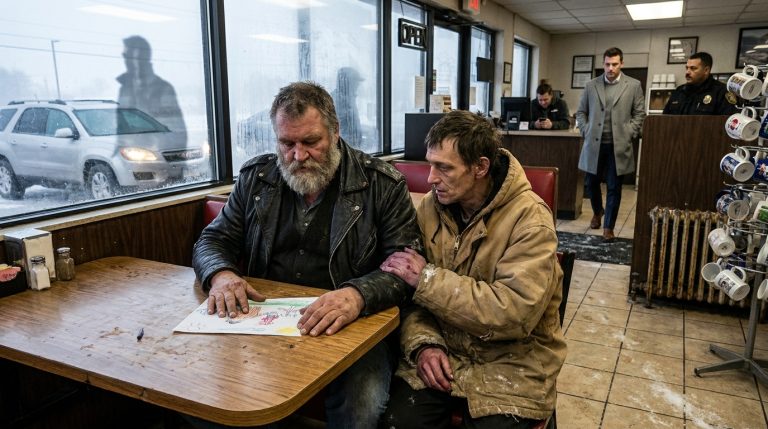
A Weary Outlaw Face-To-Face With A Silent Cry For Help On Desert Highway
CHAPTER 1: THE SILENT PLEA
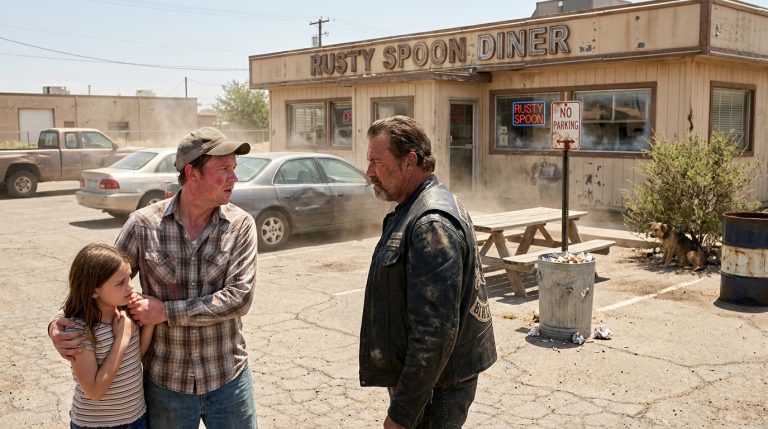
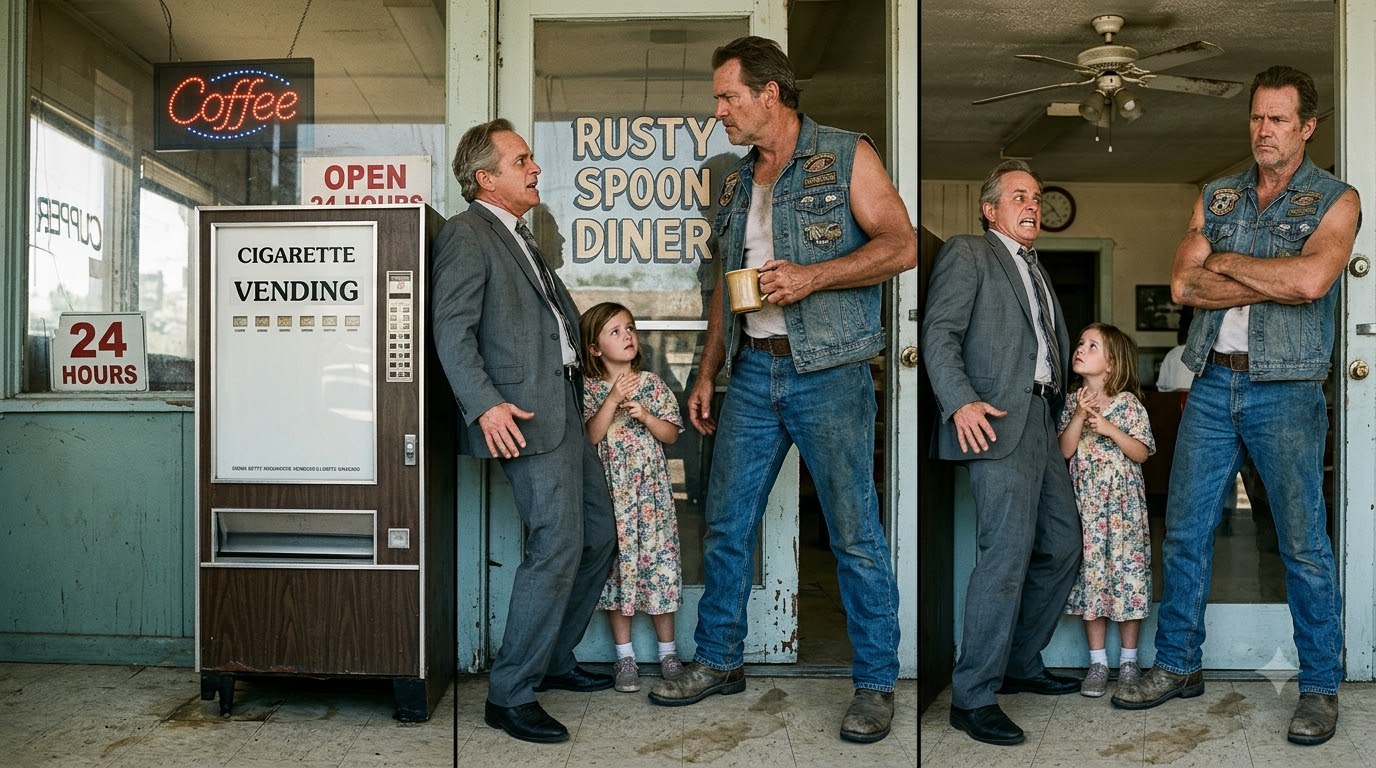
The vinyl booth seat squeaked under my weight as I reached for the lukewarm ceramic mug. Heat hung over the Rusty Spoon Diner like a wet blanket, smelling of burnt vegetable oil and stale exhaust from Route 66. Outside, the midday glare off the blacktop hurt the eyes.
The bell above the glass front door rattled.
A man stepped inside, dragging a little girl by the upper arm. His gray suit was rumpled, dark circles of sweat blooming under both armpits. He didn’t look at the waitress popping her gum behind the counter, nor the old trucker sleeping over a plate of dried gravy. His eyes hit my heavy leather vest, lingered on the faded ink stretching up my neck, and immediately darted away.
He crammed the girl into a booth near the hallway leading to the restrooms. His fingers stayed locked on her bare forearm, squeezing until the skin turned pale.
“Stay still,” he muttered. The words barely carried over the hum of the ceiling fan, but the tension in his jaw radiated across the room.
The girl wore a faded pink sundress two sizes too big. Her blonde hair was a snarled mass around her shoulders. She didn’t cry. She didn’t flinch when her knee hit the edge of the Formica table. She just stared straight down at her own lap, her shoulders pinned tight against her ears.
The waitress dropped two greasy menus on their table. “Coffee?”
“To go,” the man snapped. He pulled a rolled wad of bills from his pocket, his knuckles white. “Black. Give us whatever muffin you’ve got in plastic. We’re on a clock.”
He turned his head toward the register to watch the waitress pour the pot.
In that split second, the little girl lifted her head. Her blue eyes swept the empty counter, passed the sun-bleached posters on the wall, and locked directly onto mine.
I didn’t move. I kept my hand wrapped around the warm mug, letting the dead silence stretch between us.
Her chest heaved. Slowly, with her hands kept low beneath the edge of the table, her thumbs tapped her forehead with fingers splayed wide. Then she brought both wrists down, shaking her head in a tiny, sharp motion.
Father, no.
Next, she pressed her closed right fist onto her flat left palm, raising them together in a stiff, trembling burst.
Help.
Finally, a single finger pointed straight at her own sternum.
Me.
A cold spike drove down my spine, instantly killing the desert heat in my veins. My jaw set hard. I hadn’t seen those signs since I buried my sister Sarah twenty-two years ago. I didn’t speak the language out loud; I kept it locked in the dark with the rest of my past. But the shape of those small, desperate hands was unmistakable.
He is not my dad. Help me.
The man grabbed the paper coffee cup off the counter, shoved a twenty at the waitress, and yanked the girl out of the booth by her wrist. “Up. Now.”
She stumbled, her small sneakers slipping on the greasy floor. Her eyes stayed glued to mine, wild with silent terror as he dragged her toward the exit.
I stood up. The heavy wooden bench groaned under my six-foot-four frame. I didn’t reach for a weapon or shout. I just moved across the linoleum, my heavy boots thudding against the floorboards.
Just as the man pushed against the glass door, my boot slammed flat against the frame.
The heavy glass snapped shut with a hard crack that rattled the metal hinges.
The man recoiled, his shoulder bouncing off the frame. He spun around, his sweat-slicked face flushing dark red as he looked up into my chest.
“What the hell is your problem, buddy?” he rasped, trying to puff out his chest beneath his damp suit jacket. “Get out of the way.”
“Let go of her arm,” I said. My voice was a low rumble in the tight entryway.
“She’s my daughter,” he spat, his grip tightening on the girl’s shoulder. “She’s having a meltdown. Step back before I call the law.”
I looked down at the girl. I brought my right hand up to my chest, forming the slow, careful shapes I hadn’t used in two decades.
I am here. You are safe.
The little girl let out a ragged breath. A single line of clear water cut through the dust on her cheek, and she gave one quick, sharp nod.
The man’s eyes went wide, a flash of raw panic breaking through his angry front. “What are you doing with your hands? Stop touching her!” He violently shoved the girl behind his hips, his hand reaching instinctively toward the inside of his coat.
Behind the counter, the landline receiver clattered against the base. “I’m calling the sheriff!” the waitress yelled, her voice shaking. “You two take it outside!”
“Good,” I said, leaning my weight against the glass door. “Let him come.”
CHAPTER 2: PAPER SHIELD
The bell above the diner door didn’t ring when it opened. It crashed back against the aluminum frame as Officer Pete Evans stepped in, his sun-faded uniform dark with sweat across the shoulder blades.
His hand didn’t rest on his belt. It hovered two inches above the snapped leather retention strap of his service holster, his thumb flicking against the steel snap.
“All right, big guy,” Evans barked, his voice echoing off the plastic ceiling tiles. “Back it up. Step clear of the glass right now.”
I didn’t move fast. In my world, fast movements get you shot by tired cops who already made up their mind on the highway. I slowly pulled my boot off the frame, letting the heavy door settle back into its rubber seal with a soft hiss.
“Officer, thank God,” the man in the suit sobbed out. The panic in his voice was thick, almost convincing, but his left thumb kept twitching against the seam of his trousers. “He cornered us. He’s out of his mind. He was trying to grab my daughter.”
Evans glanced at my heavy leather vest, taking in the three-piece patch, the faded ink creeping up my neck, and the scuffed steel toes of my boots. His lip curled up on the left side. “I know what you are, biker. You’re a long way from LA to be causing trouble in my county.”
“Ask him for his paper,” I said. My voice stayed down in my chest, flat and dry. “Ask the girl who he is. She signed to me. She isn’t his.”
“She has selective mutism from trauma, Officer,” the man interjected instantly. He reached into his coat with two fingers, pulling a slim leather billfold from his breast pocket. “Her name is Lily. My name is Gregory Harrison. We’re on our way to a clinical specialist in Phoenix. My wife passed eight months ago.”
He handed the driver’s license over. As he pulled his hand back, the inner lining of his suit coat parted for half a second.
A heavy, rectangular outline sat in the deep pocket—a thick satellite phone battery casing, scuffed around the charging pins from constant field use. No middle-management dad driving a dusty sedan through Barstow carries a field-rigged sat-comm battery.
Officer Evans looked at the license. He ran his thumb over the raised state seal, checked the laminate edge with a dirty thumbnail, and flipped it back. “Checks out. Matches the registration on that four-door outside.”
“Check his phone,” I said, pointing a calloused finger toward Greg’s chest. “Check his gallery.”
“I don’t take orders from 1% trash,” Evans spat, stepping into my space until the brim of his campaign hat nearly brushed my chin. “He showed me a full family album right on his screen. Christmas, birthdays, the whole nine yards. The child is terrified of you, you giant freak.”
I looked over Evans’ shoulder. Lily was pressed against the cigarette machine by the hallway. Her little hands were tucked deep into the oversized pink dress, her knuckles rigid against her ribs. She wasn’t looking at the cop. She was looking at me, her lower lip caught between her teeth, shaking so hard her knees knocked together under the cotton hem.
“He’s running a line on you, Deputy,” I said softly. “Look at the girl’s face. Look at her posture.”
“One more word out of you and you’re going on the hot asphalt in irons for disturbing the peace,” Evans growled, his hand finally dropping onto the rubber grip of his Taser. “You get on your iron, you head west, and if I see your cut on Route 66 before nightfall, I’m booking you into county.”
Greg pulled the little girl toward the door, his hand locked like a steel vise around her upper wrist. As he passed me, his eyes met mine for a fraction of a second. The terrified-father act vanished, replaced by the flat, cold stare of a man who did this for a living.
The glass door clicked shut behind them.
I stood in the center of the diner, listening to the gravel crunch outside as the gray sedan reversed out of the space and turned its nose east toward the open desert.
“You heard the law, mister,” the waitress whimpered from behind the register, holding the heavy black landline like a weapon. “Just… please go.”
I turned my back on her, pushed open the door, and walked out into the blinding white heat of the Mojave.
CHAPTER 3: THE HIGHWAY STALK
Deputy Evans stayed parked across from the diner lot, his white-and-green SUV idling beneath the dead shade of an billboard, watching my mirrors. I popped the clutch, rolled west toward the county line for half a mile, and waited for the patrol cruiser to drop off my tail.
The second Evans turned back toward Barstow, I swung the front tire through the loose gravel, spun the bike one-eighty, and opened the throttle east.
The heat off the asphalt hit my face like an open oven door. I didn’t have my club riding beside me—no pack to box him in, no road captain to cut off his flank. Just six hundred pounds of iron beneath me and a trail of dust floating over the salt flats.
Twenty minutes at ninety miles an hour closed the gap.
The gray four-door was holding a rigid seventy-five in the slow lane, riding the dotted line like a man trying desperately not to draw a ticket. I pulled into his blind spot, matching his speed two bike-lengths back.
Through the rear window, I saw the little girl’s blonde head tucked down low against the door panel.
I kicked the engine down a gear, the exhaust bellowing off his rear bumper. Greg’s head snapped up in his rearview mirror. His hands jerked on the wheel, sending the sedan drifting across the rumble strip with a dry, mechanical thrak-thrak-thrak.
He hammered the gas. The sedan’s tail dipped as it surged toward eighty-five.
I twisted my throttle, pulling flush with his driver’s side door. The desert wind tore at my leather vest, but I kept my head turned, staring directly through his tinted glass.
Greg looked over. The fake composure he’d put on for Deputy Evans was gone. His eyes were wide, his mouth open as he yelled something I couldn’t hear over the roar of the V-twin engine. He swerved left, intentionally crowding my lane to push my front tire into the loose gravel median.
I didn’t flinch. I let the bike drop half a foot back, matched his axle, and executed a sharp, deliberate lean, sweeping directly in front of his chrome grille.
I squeezed the front brake, engine-braking hard.
The sedan’s nose dropped violently. Rubber squealed on the superheated blacktop, sending a plume of white tire smoke rising into the blue sky. Greg swerved right to avoid plowing into my rear fender, lost traction on the sandy shoulder, and slammed his brakes to the floor.
The sedan skidded forty feet through the desert scrub, kicking up a blinding wall of sand before rattling to a dead stop against a rusted culvert pipe.
I swung the bike around, dropping the kickstand into the dirt before his engine even died. The silence of the desert rushed back in, heavy and thick.
I unclasped my helmet, let it drop into the sand, and walked toward his door.
Inside, the central locks clicked into place. Greg was scrambling across the console, his fingers digging frantically into the glove box. Through the dust-coated glass, I saw the dull black frame of a heavy handgun emerging from beneath a stack of vehicle manuals.
He didn’t have time to rack the slide.
I planted my left boot into the dirt, drew my right fist back, and drove the heavy steel toe of my boot directly through the driver’s side window.
CHAPTER 4: BROKEN CONTRACT
I yanked his head flat against the metal door panel. The impact rattled his jaw, sending the uncocked pistol skittering under the passenger seat.
“You’re dead!” Greg screamed, his voice pitching high into a ragged shriek. Blood trickled from three tiny glass cuts along his cheekbone, but his eyes were wide with pure, unadulterated entitlement. “You think you can touch me? You’re a dirty outlaw! I have federal contacts! I have paper that says I’m her legal guardian!”
“Your paper is trash,” I growled, pulling his arm up until his wrist wedged tight against the door frame. “And your satellite battery is warm.”
I reached inside his breast pocket with my free hand, ripping out the thick sat-comm unit along with a slim leather pouch. Five passports tumbled onto the dusty floorboards—each bearing his face, each showing a different name from three different countries.
Layer 1 was a lie. This wasn’t a custody dispute or a fake corporate cover. This was a high-value human asset courier carrying five separate burn identities.
Greg thrased, kicking blindly against the steering column. “I’m securing her! Her father is cartel! I’m taking her out of state to protect her!”
“You’re a middleman,” I said, leaning my full body weight against the door to pin him flat. “You’re delivering a silent kid to a buyer at the Ivonpa dry lake bed at 2:00 a.m.”
His face drained of color. The violent thrashing stopped instantly, replaced by a sudden, shallow quiver in his chest. “How… how do you know that?”
“Because brokers always run the same timeline when they’re hiding from local law,” I said.
I picked up his satellite phone from the console. I didn’t call my club. I didn’t request a pack of bikes to handle my dirty work. I dialed three digits directly into the encrypted sat-line—the direct federal field desk number I’d memorized years ago.
“Agent Vance,” a calm voice answered through the speaker.
“I’ve got a gray sedan pinned on the Route 66 shoulder, ten miles east of the Spoon,” I said into the mic. “Driver has five forged identities, a suppressed nine-millimeter under his seat, and a mute girl in the back. He’s scheduled for a human asset exchange at the Ivonpa solar strip tonight at two.”
Greg let out an unhinged roar, clawing at my knuckles. “He’s lying! He assaulted me! He’s a gang member holding us hostage!”
“Verify the sat-phone serial, Vance,” I added flatly, holding the unit close to Greg’s panicked panting. “It’s pinging off an offshoreHub in Belize.”
There was a heavy three-second pause on the line, followed by the rapid clack of a keyboard. “Unit verified. Stay right there, Miller. State patrol and federal transport are five minutes out.”
I snapped the satellite phone in half over my knee and tossed the pieces onto Greg’s lap.
He didn’t move. He collapsed back against the leather seat, staring up at the roof of the car as the distant wail of sirens began to cut through the heavy desert silence.
I walked to the rear door and pulled it open.
Lily sat huddled in the far corner, her small knees pulled tight to her chest. Her eyes were wide, but the terror was gone, replaced by a quiet, steady stillness.
I didn’t offer a speech. I didn’t offer a dramatic promise. I raised my large, calloused hands into the dry air and signed two simple shapes.
Safe now. Finished.
A faint, tremulous smile touched the corner of her lips, and she gave one slow, definitive nod.
The sun was dropping low over the Mojave, painting the salt flats in deep shades of amber and rust.
I sat on the tailgate of my Harley, watching two unmarked federal sedans pull away toward the interstate, their red and blue strobe lights flickering softly against the darkening horizon. Lily was in the backseat of the lead car, wrapped in a clean wool blanket, watching me through the rear glass until the dust swallowed the road.
I pulled my brass Zippo from my pocket, flipped the heavy lid open, and struck the wheel. The small flame flickered steady against the cool evening draft.
I snapped it shut, slid the lighter back into my vest, and kicked the V-twin engine to life.