The Geometry of Memory: A Veteran’s Quiet Return to the Echoes of Khe San
CHAPTER 1: The Weight of the Echo
The silence on the Piney Creek Range wasn’t peaceful; it was heavy, the kind of stillness that pressed against the eardrums like a mounting storm. Harwick stood at the edge of the firing line, his boots sinking slightly into the soft, rain-dampened earth. In his hands, he held the M1A rifle Jessup had just returned. It felt lighter than it should have, as if the old man had stripped the very soul of the mechanics out of it during those ten impossible shots.
Beside him, the spotting scope remained tilted toward the target three hundred yards away, the white paper marred by the singular, perfect puncture of the X-ring. Harwick didn’t look through the eyepiece again. He didn’t need to. The image was burned into his retinas: a perfect, terminal geometry that defied every manual of arms he had taught for two decades.
He turned his head slowly. Walter Jessup was sitting on a folding chair near the pavilion, his back to the longleaf pines. The old man’s canvas bag sat open at his feet. Harwick took a step toward him, his own gait suddenly feeling clumsy and unpracticed compared to the deliberate, cautious movements of the man in the faded green jacket.
“Mr. Jessup,” Harwick began, but the words felt thin, insufficient. He stopped a few feet away.
Jessup didn’t look up immediately. He was busy cleaning his hands with a rag that had seen better decades, the fabric frayed at the edges. His fingers, which had been steady as stone on the firing mat, were trembling now—a low-frequency vibration that seemed to originate from deep within his bones.
“You’re looking for the how,” Jessup said. His voice was soft, barely a rasp beneath the rustle of the pines. He didn’t offer a smile, nor did he look toward the firing line. He looked at the horizon, where the sun was beginning to lose its warmth, turning the sky the color of a bruised plum.
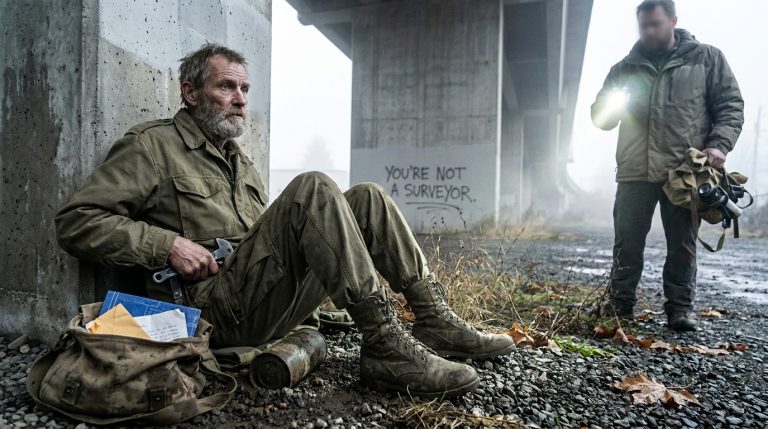
Harwick shifted his weight, his military posture failing him. He found himself looking not at the man, but at the contents of the open canvas bag. Tucked beneath a box of oil-stained cleaning patches was a stack of photographs. They were black and white, corners curled and cracked, depicting terrain that was stripped of color, craters and mud, a landscape of absolute devastation. There were no people in the photos, only the geometry of destruction.
“I’m looking for the why,” Harwick corrected, his voice dropping. “Nobody shoots like that at seventy-eight. Not unless they’re still fighting the war.”
Jessup’s eyes snapped to his. They were clear, piercingly so, but for a split second, the blue seemed to cloud over, as if a sudden fog had rolled in behind his irises. “The war didn’t end at the tree line, Sergeant Major. It just got quieter.”
The old man reached down, his trembling hand hovering over the bag, then pulling back as if the photos inside were searing hot. He stood up, the movement agonizingly slow, each joint protesting the effort. He took a single step toward Harwick, and for a terrifying moment, the smell of damp earth and copper intensified until it was choking, as if the range had physically dissolved into the mud of a place fifty years in the past.
“And,” Jessup whispered, his gaze drifting past Harwick to the empty firing line, “it’s not a question of talent. It’s a question of what happens when you realize you never actually left the post.”
He brushed past Harwick, the fabric of his faded jacket rough against the sergeant’s arm, and started toward the gravel lot. Harwick stood frozen, looking back at the bag on the ground. A single photograph had slipped from the top, face up. It wasn’t of the war. It was a recent picture of a regional marksmanship trophy, but someone had crossed out the date with a heavy, jagged ink line, and in the margins, written in an unsteady, frantic hand, were coordinates that didn’t belong to any range in North Carolina.
CHAPTER 2: The Geometry of a Debt
Harwick stood motionless, the gravel beneath his boots shifting with a dry, abrasive rattle that seemed loud enough to startle the pines. He stared at the photograph. It was a mundane image of a trophy, but the ink used to cross out the date was dark, thick, and seemed to vibrate against the paper. The coordinates scrawled in the margin were not military; they were local, pointing toward a stretch of abandoned industrial land near the coast that Harwick knew well—a place where the salt air rotted everything to the marrow within a year.
He looked up. Jessup was walking away, his gait rhythmic but labored, a slow pendulum swinging toward the dirt track that led back to the main road.
“Mr. Jessup,” Harwick called out. He didn’t intend to shout, but the wind among the longleaf pines caught his voice and stretched it thin.
The old man didn’t stop. He didn’t even turn his head. He just kept walking, his shoulders hunched slightly forward, his canvas bag swinging in time with the uneven hitch in his stride. He looked like a man disappearing into his own shadow.
Harwick didn’t think; he reacted. The sergeant major’s discipline—that rigid internal architecture that had defined his life—was currently experiencing a structural failure. He left the bag where it lay, a dark patch of fabric against the gray gravel, and walked toward the man. He kept his pace steady, avoiding the aggressive march of a superior officer, but he closed the distance with a speed that felt like a betrayal of his own restraint.
“You dropped something,” Harwick said, his voice coming out tighter than he wanted.
Jessup stopped. He didn’t turn around for a long beat, just stood there, his back a wall of faded olive drab. When he finally rotated, it wasn’t the fluid motion of a younger man; it was a sequence of careful, deliberate movements. His face was a map of exhaustion, the lines around his mouth deeper than they had been when he first walked out of the fog that morning.
He looked at the photograph in Harwick’s hand. There was no flicker of panic, no attempt to snatch it back. There was only a profound, hollow fatigue.
“Keep it,” Jessup said. His voice was cracked, like dry parchment. “It’s not mine anymore. Nothing in that bag is.”
“Those coordinates,” Harwick said, gesturing toward the scrawl in the margin. “They’re near the old terminal. Nobody goes there. The ground’s unstable, and the company pulled out twenty years ago.”
Jessup’s eyes settled on Harwick, and for a moment, the blue gaze regained that unsettling, piercing clarity. “Debt doesn’t care about stable ground, Sergeant Major. It’s a weight. You carry it until you find a place to set it down, or until you realize you’re just part of the architecture you’re trying to defend.”
“You came here to qualify,” Harwick pushed, ignoring the abstraction. “You want to compete in the regional match. Is that what this is? A debt?”
The old man let out a sound that might have been a laugh if there was any air behind it. He looked at the vast, empty space of the range, his eyes tracing the line of the firing positions as if he were measuring the distance between his own past and the present reality.
“I came here to see if I could still feel the air,” Jessup replied. He turned back toward the road. “Don’t follow me. You have a range to run, and your people are waiting for you to tell them why they just watched something they’ll never understand.”
“They’re waiting for me to tell them you’re a fraud,” Harwick said, the words slipping out before he could catch them. “Or a miracle. I don’t know which.”
Jessup stopped again, but this time he didn’t turn. “In the end, there isn’t a difference. Both are just stories people tell to avoid looking at the geometry of what’s actually happening.”
He walked on. Harwick watched him until the old man merged with the shadows at the edge of the tree line, his silhouette blurring into the jagged lines of the pines. Harwick looked down at the photograph again. The coordinates were still there, tauntingly clear. He thought about the rifle he was holding—the borrowed M1A—and the absolute, terrifying precision of that final shot in the X-ring.
He didn’t return to the pavilion. Instead, he turned back to the firing line, his feet crunching on the gravel. He needed to be back where the logic was tangible, where a target was a target, and where the wind didn’t hold a thousand ghosts. But as he reached the shooting mat, he saw Castellano, the competitive shooter, still standing there, staring at the empty position four.
Castellano turned. His expression wasn’t one of disappointment, but of a man who had lost his faith in a religion he had practiced for years.
“He didn’t have a spotting scope,” Castellano said, his voice barely a whisper. “He didn’t have a ballistic calculator. He had a bag of trash and a rifle that wasn’t even his.”
“I know,” Harwick said.
“He’s going to do it again, isn’t he?” Castellano asked. “The regional match. He’s going to go there and make every one of us look like we’re playing with wooden blocks.”
Harwick looked at the X-ring one last time, then tossed the rifle onto the rack. It landed with a hollow, metallic clang that echoed across the clearing. “I don’t think he’s going to do anything at all, Castellano. I think he’s finished.”
Harwick walked past the pavilion, his eyes tracking the dust cloud rising where Jessup had disappeared. He knew, with a sudden, sinking certainty, that if he didn’t find out what was waiting at those coordinates, the echo of that final shot would never stop ringing in his ears. He wasn’t running a range anymore; he was chasing the geometry of a ghost.
CHAPTER 3: The Physics of Grief
Harwick stayed on the firing line long after Castellano had packed his gear and departed. The range was an industrial ghost town now, the concrete slab stained with decades of oil and bullet brass. He knelt and picked up the canvas bag. It was heavier than it looked, weighted not by ammunition, but by the sheer density of a life lived in increments.
He didn’t open the bag immediately. Instead, he walked toward the pavilion, where Finch, the retired physics teacher, was still sitting at a folding table, nursing a thermos of coffee that had long since surrendered its heat. Finch was staring at a notepad covered in scribbles—ballistic coefficients, wind drift calculations, the dry arithmetic of a life governed by equations.
“It’s not in the math,” Finch said without looking up. He sounded like a man trying to solve a puzzle that had missing pieces. “I’ve been running the numbers on that last shot for twenty minutes, Dale. A 300-yard, 10-ring X-hit with a borrowed M1A? It’s not just skill. It’s an anomaly.”
Harwick sat down across from him, setting the bag on the plywood table. “It’s not an anomaly. It’s a habit. A habit he couldn’t break if he wanted to.”
Finch finally looked up, his glasses sliding down his nose. “What do you mean?”
“He told me he was a forward observer at Khe San,” Harwick said, his voice flat. “He didn’t just fire rounds; he redirected the world. He lived in the middle of a collapsing reality, and he survived by becoming the calculation.”
As Harwick spoke, the wind picked up, rushing through the longleaf pines bordering the range. It wasn’t the usual rustle of needles. It sounded, for a split second, like the high-pitched, metallic whine of incoming mortar fire. Harwick’s heart did a strange, erratic stutter, a sudden surge of adrenaline that he hadn’t felt since his last deployment. He saw the world shift: the pavilion roof for a heartbeat seemed to buckle, the sunlight bleached out into a harsh, sterile glare. He wasn’t in North Carolina. He was back in a hole, the air smelling of cordite and wet, churning earth.
He blinked, the sensation receding as quickly as it had arrived, leaving him breathless. He looked at Finch, who hadn’t noticed the shift.
“Finch,” Harwick said, his throat dry. “If a man spends fifty years doing that—living in the gap between the trigger and the impact—what does that do to the machinery inside his head?”
Finch went quiet, his eyes dropping back to his scribbles. “It depends on the brain, I suppose. Some people crack. Some people just… harden. They become a vessel for the memory. If the trauma is deep enough, the brain stops trying to process it and starts repeating it. It becomes an anchor. But an anchor only holds you in one place. Eventually, the chain wears through.”
Harwick looked down at the canvas bag. He felt a sudden, irrational urge to protect what was inside. He reached out and touched the coarse fabric. “I’m going to find him, Finch. Those coordinates on the photo. I need to know if he’s still out there or if he’s already drift.”
“You’re overstepping, Dale,” Finch warned, though he didn’t try to stop him. “You’re a retired sergeant major, not a social worker. You go to those coastal terminals, you’re walking into a place where the law stopped caring years ago.”
“Maybe that’s why he went,” Harwick said, standing up. “Maybe he wants to find the place where the math finally balances out.”
He took the bag and headed for his truck. The gravel crunched under his boots, a harsh, rhythmic sound that reminded him of marching in formation. He opened the truck door, but instead of starting the engine, he sat in the silence, letting the weight of the bag rest on the passenger seat. He pulled out the photograph he’d retrieved earlier.
He realized now that it wasn’t just the coordinates in the margin that were frantic. The entire photograph had been systematically marked. Someone—Jessup, presumably—had been tracking something. Not a target. A progression. There were dates scrawled in the corners, the handwriting becoming progressively more erratic, the letters struggling to stay on the line.
He was looking at a man who was meticulously documenting his own erosion.
Harwick started the truck. He didn’t head for the main gate, but toward the perimeter of the range, his mind racing through the logistics of the coast. He had spent his life believing that order was the only defense against chaos. But as he turned the truck toward the salt air and the rusted terminals of the coast, he realized that he had spent his entire career teaching people how to aim, while Walter Jessup had spent a lifetime learning how to hit a target that had been moving for half a century.
He felt the bag shift against the seat. It was just canvas and memories, but it felt like he was transporting a live round—something volatile, something that could shatter if it hit the wrong surface at the wrong angle. He drove out of the range, the pines blurring into long, dark streaks, and for the first time in his life, he didn’t care about the destination. He only cared about the trajectory.
CHAPTER 4: The Uninvited Mirror
The drive to the coast was a study in sensory deprivation. The North Carolina landscape flattened into a desolate stretch of marsh and rusted industrial skeletons, the salt air beginning to strip the interior of the truck of its familiar, dry scent. Harwick kept his eyes fixed on the taillights ahead, though there were few to follow. His hands gripped the steering wheel, his knuckles white, the leather of the wheel feeling unnaturally smooth against his calloused palms.
He wasn’t alone.
Three miles back, a low-slung, performance-tuned sedan had pulled onto the road, maintaining a consistent, polite distance. It was Castellano’s car—Harwick recognized the silhouette, the aggressive stance of a machine built for speed and precision. The competitive shooter was a shadow in the rearview mirror, an uninvited echo of the range.
Harwick didn’t accelerate to lose him. He didn’t pull over. He simply drove, the weight of the canvas bag on the passenger seat acting as a physical anchor. Every time the sedan hit a bump, the bag shifted, the contents—those jagged, marked-up photographs—seeming to vibrate with a life of their own.
He reached the turnoff for the old maritime terminal just as the sun began to dip below the treeline, casting long, bruised shadows across the cracked concrete. The terminal was a graveyard of ambition. Massive cranes stood like skeletal sentinels against the darkening sky, their cables swaying in the coastal breeze with a sound like whistling wire.
Harwick pulled his truck to a stop beside a warehouse with corrugated siding that rattled in the wind. He killed the engine. The silence that followed was heavy, punctuated only by the distant, rhythmic slap of tide against rotting pylons. He sat for a moment, listening. A second engine died a hundred yards back. A car door opened and closed.
Castellano walked toward him. He wasn’t wearing his sponsorship-laden jersey today; he was in dark, tactical-leaning gear, his expression stripped of the competitive bravado he had displayed at the range. He looked diminished, his eyes darting toward the rusting terminal buildings as if he were trying to solve a complex equation.
“You’re not going to find him,” Castellano said, not bothering with a greeting. He stopped ten feet from the truck. “I’ve been tracking the registration sites for the regional qualifiers. Jessup never signed up.”
Harwick stepped out of the truck, the cold air immediately biting at his skin. He felt a sharp, hollow ache in his chest—a physical manifestation of the uncertainty he had been suppressing since he left the range. “If he didn’t sign up, then what is this? Why the coordinates? Why the precision?”
Castellano gestured vaguely at the rusted cranes. “I think he’s looking for something he lost. Or maybe he’s looking for the place where he finally stopped being an observer.”
“He said he was an observer at Khe San,” Harwick said, leaning against the cold metal of his truck door. “That’s a specific kind of survival, Castellano. It’s not about fighting. It’s about witnessing the world being erased so you can tell the artillery where to land.”
Castellano took a tentative step forward. “He’s in there. I saw the light move in the warehouse near the dock. But he’s not alone, Harwick. There’s someone else. Someone who’s been following him for days.”
Harwick felt his muscles coil. He wasn’t trained for tactical pursuit in an environment like this—not anymore. He was a creature of ranges and clear lines of sight. This place, with its deep shadows and shifting, metallic groans, felt alien.
“Why tell me?” Harwick asked.
Castellano looked at him, his face illuminated for a second by the harsh beam of a distant lighthouse. “Because you’re the one who apologized. Because you’re the only one who realized that what we saw back there wasn’t a trick. It was a dying man trying to show us the pattern before the pattern disappears.”
The realization hit Harwick with the force of a physical blow. The terminal, the coordinates, the erratic dates on the photographs—it wasn’t a training schedule. It was a timeline of a life coming apart at the seams. He looked at the warehouse Castellano had pointed toward. A single, flickering light pulsed in the gloom, a heartbeat of electricity in a dead building.
“Stay here,” Harwick ordered, his voice shifting into the command tone he hadn’t used in years. It was an automatic response, a reflex to re-establish order in the face of encroaching chaos.
“Like hell I will,” Castellano retorted.
Harwick didn’t argue. He moved toward the warehouse, his boots silent on the damp sand that had crept over the concrete. He didn’t know what he was looking for, but as he reached the rusted door, he felt the weight of the canvas bag in his hand. He had left the truck, but he had brought the evidence.
As he nudged the door open, the smell hit him—not of salt, but of stale, dry rot and old metal. Inside, the terminal was an expanse of shadows. In the center of the floor, sitting on a folding chair identical to the one at the range, was Walter Jessup. He was holding a rifle, but he wasn’t looking at the door. He was looking at a wall covered in taped-up documents, his eyes wide and vacant, staring at a target that existed only in the geography of his own mind. He was moving his lips, murmuring numbers in a low, rhythmic cadence that matched the sound of the wind outside.
He was calling fire on a memory.
CHAPTER 5: The Trembling Hand
The transition was instant. One moment, the flicking overhead bulb cast a sickly, jaundice-colored light over the documents taped to the wall; the next, the darkness was so thick it felt physical. Harwick held his breath, his hand instinctively reaching for the bag, his fingers brushing the cold, metallic strap of the rifle Jessup had discarded in his lap.
“Stay down,” Harwick hissed, though he couldn’t see Castellano.
A moment later, the silence was shattered by the rhythmic clack-clack-clack of a bolt-action being worked—a sound as clean and sharp as a guillotine. Jessup wasn’t just sitting there anymore. The movement of the chair against the concrete floor signaled a shift in posture.
“Left 200,” Jessup whispered. The voice wasn’t aimed at Harwick. It was aimed at the void, at the ghosts he had been tracking for fifty years. “Drop 50. Fire for effect.”
“Mr. Jessup, it’s Harwick,” the sergeant major said, keeping his voice low, steady, and devoid of any threat. He knew, with a sinking dread, that the old man’s internal reality had fully breached the present. He wasn’t in a warehouse in North Carolina; he was back in the red clay of Khe San, and any sudden move could be interpreted as a breach of his defensive line.
“Enemy at the perimeter,” Jessup murmured, his voice hardening. “They’re moving through the bamboo. Can’t you see the movement? There, behind the shadow.”
Harwick crept forward, his hands outstretched, feeling the cold, rusted surface of a work table. He needed to reach the chair. He needed to break the loop. Beside him, he could hear Castellano shifting, his breathing shallow and quick—the panicked breathing of a man who realized that his fifteen years of competitive, sanitized shooting had never prepared him for this level of raw, unfiltered trauma.
“There is no bamboo, Walter,” Harwick said, taking a cautious step. His boot struck a discarded tin can, the sound echoing like a gunshot in the cavernous space.
Jessup flinched. The rifle swung—a heavy, sweeping arc in the dark. “Who’s there? If you’re with the battery, confirm target coordinates! We’re losing the light!”
“I’m with you,” Harwick insisted. He reached out and found the back of the chair. It felt fragile, vibrating with the old man’s tremors. “I’m the observer now. You’re off the line, Walter. The mission is over.”
“The mission doesn’t end until the grid is clear,” Jessup snapped. He stood up, his knees cracking, the rifle barrel grazing Harwick’s chest. The metal was icy. “You don’t understand the math. If I don’t hold this line, the whole battery goes dark. Can’t you feel it? The weight of the earth?”
Harwick stepped into the space, his hands grabbing Jessup’s wrists. They were thin, like bird bones, and they were shaking with a violence that made Harwick’s own teeth ache. He felt the cold sweat on the old man’s sleeves.
“Castellano, get a light,” Harwick barked.
“I can’t,” Castellano whispered from the dark. “I think… I think I’m going to be sick.”
Harwick tightened his grip on Jessup’s wrists. The old man was straining against him, not with physical force, but with a desperate, psychic intensity. Jessup’s heart was hammering against his ribs, a frantic, irregular beat that Harwick could feel through the thick wool of his jacket.
“Walter, look at me,” Harwick demanded, though he knew Jessup couldn’t see him. “Look at the horizon. It’s not a grid. It’s just a coastline. We’re in North Carolina. The war ended. It ended decades ago.”
“Liar,” Jessup hissed, his voice breaking. “The echoes never stop. They just wait for you to blink.”
He wrenched his wrists free, the movement surprising in its sudden, desperate strength. He tripped, his heels catching on the uneven concrete, and he went down hard. The rifle clattered away, sliding into the darkness, its report echoing as it hit a pile of rusted metal.
The warehouse went dead silent.
Harwick waited, his lungs burning, his skin crawling. He expected a shout, a movement, the sound of Jessup rising to continue the fight. Instead, there was a wet, hitching sound—a sob, ragged and deep, that didn’t sound like a man, but like a structure finally collapsing under the weight of too many years of neglect.
“I can’t find the coordinates,” Jessup whispered into the dark, his voice now small, lost. “I’ve lost the line. Sergeant… I’ve lost the line.”
Harwick knelt, reaching out into the void until his hand found the slumped weight of the old man’s shoulder. He felt the trembling again, but it was different now—a slow, rhythmic dissolution. Harwick pulled him in, shielding him from the cold, the dark, and the ghosts that had finally, mercilessly, won the ground.
“It’s alright,” Harwick said, his voice thick. “I’ve got the line now, Walter. You can let go.”
CHAPTER 6: The Weight of Testimony
Harwick held him there for a long time. The warehouse was cavernous, and in the profound quiet that followed the emotional collapse, the sound of the tide against the rusted pilings outside seemed magnified, a metronome counting down seconds that had lost their traditional value. Castellano remained huddled in the darkness a few feet away, his breathing ragged, his earlier bravado replaced by the hollow shock of a man who had realized the limits of his own world.
“He’s cooling,” Harwick whispered, the words barely audible. He didn’t know if he was speaking to Castellano or to the ghosts that Jessup had been fighting.
He carefully laid Jessup down on the cool concrete, his movements as gentle as if he were handling a stack of old, brittle glass. He reached into his own coat and pulled out a clean, folded handkerchief, pressing it against the old man’s forehead. The skin was damp, clammy, and unnaturally pale in the dim light filtering through the high, grimy windows of the terminal.
“We need a medic,” Castellano said, his voice straining to regain its usual composure. “Or an ambulance. Harwick, he’s not just… he’s not just confused. Look at his eyes.”
Harwick turned to look. Jessup’s eyes were open, fixed on a point somewhere above the rusted ceiling, the pale blue irises glazed, tracking movement that Harwick couldn’t see. There was no focus there, no recognition of the present. He was staring into a landscape of pure, unadulterated memory.
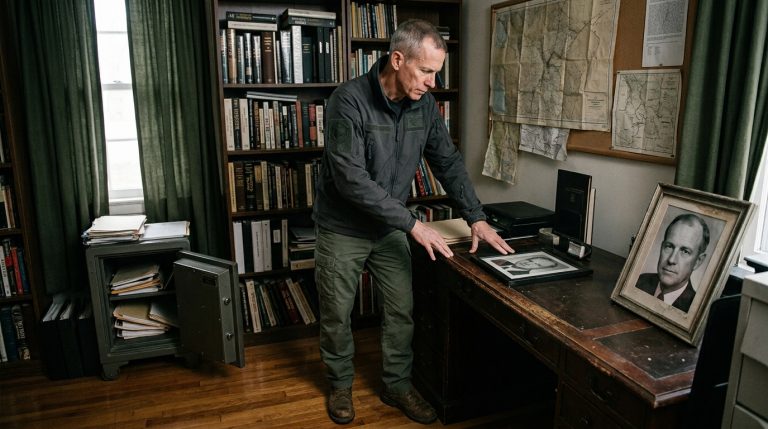
Harwick stood up, his legs stiff, and walked toward the wall where the documents were taped. He needed to know. He had avoided looking closely before, deterred by the frantic, illegible scribbles that had repelled his sense of order. Now, he forced himself to focus.
The documents were not just records of coordinates. They were hospital discharge papers, layered one on top of the other, each bearing a different date but the same clinical header: Neurological Assessment. The margins were filled with notes—not military logs, but a log of cognitive disintegration. Dates, times, and a recurring, jagged notation: The drift.
“It’s not debt,” Harwick said, his voice hollow, the realization settling into his bones like lead. “It’s not a competition. He wasn’t training for a match, Castellano. He was recording his own descent.”
Castellano moved closer, his flashlight beam shaky as he scanned the wall. “Discharge papers? For what? He was a forward observer. If he had a condition, the VA would have—”
“They would have flagged him,” Harwick interrupted, his gaze landing on a specifically marked entry—a date three years ago, noting the onset of memory fragmentation. “But look at the dates. He didn’t come here to compete. He came here to find the last place where he felt… anchored.”
As he looked at the wall, the flicker of a distant neon sign from the terminal yard cast a pulsing, irregular light into the warehouse. The patterns of shadows on the wall seemed to shift. For a fleeting second, the papers appeared to rearrange themselves into a map of the Khe San perimeter, the ink bleeding into shapes that looked like trenches and artillery arcs. Harwick rubbed his eyes, his heart hammering against his ribs. The confusion was contagious; he felt his own sense of place eroding, the industrial warehouse blending into the damp, stifling heat of a jungle fifty years gone.
“Harwick, look,” Castellano said, grabbing his arm. His grip was tight, desperate. “The photographs in his bag. The ones you picked up. They aren’t just terrain. Look at the back of the trophy photo.”
Harwick retrieved the canvas bag from where he’d dropped it and pulled out the photograph of the marksmanship trophy. He turned it over. In a neat, military hand—a hand that had obviously been steady long ago—there was a simple, heartbreaking note: The only target I never hit was the one that stayed behind.
The weight of it was suffocating. Harwick understood now. The “geometry” Jessup had mastered wasn’t a technique; it was a cage. He had been so obsessed with the precision of his past—the precise timing, the precise impact, the precise way to call fire to save others—that he had built his entire reality around the accuracy of that trauma. He had been “honing” his life into a bullet, and now, in his terminal decline, that bullet was finally hitting the mark, dissolving the observer and leaving only the impact.
“He’s not fighting for his life, Castellano,” Harwick said, his voice barely a whisper in the echoing dark. “He’s fighting to hold the line for a memory that’s finally run out of ammunition.”
He turned back to where Jessup lay. The old man had shifted, his hand reaching out to touch the cold concrete as if it were the earth of a trench. He wasn’t trembling anymore. The stillness that had defined him at the range—that terrifying, absolute stillness—had returned. But this time, it felt like the stillness of a closing door.
Harwick knelt beside him again, placing his hand over Jessup’s. He didn’t try to pull him back to the present. He realized, with a clarity that stung, that “the present” was the last place Jessup wanted to be. He was finally, mercifully, closing the distance to the only target he had ever truly cared about.
CHAPTER 7: The Final Correction
The warehouse was a cathedral of rust and shadow, and for a moment, Harwick felt as though he were the only living thing within its hollowed-out ribcage. Jessup had finally gone still, the tension that had held his body in a permanent, defensive posture for fifty years finally unraveling like a spent spring.
Harwick slowly uncurled his fist. In his palm lay a dog tag, the metal so oxidized it felt rough, almost sandy, against his skin. It wasn’t Jessup’s. The name embossed into the metal—Miller, E.J.—was barely legible, the letters softened by decades of exposure to salt and sweat. It was a souvenir of a debt that had never been settled, a piece of a man who hadn’t made it out of the siege.
“He wasn’t fighting his own ghosts,” Castellano whispered, stepping into the edge of the light. His voice lacked its usual polish, cracking under the weight of the realization. “He was holding a vigil.”
Harwick stood, his knees protesting the movement. He tucked the tag into his pocket, the metal biting into his thigh with every step. He looked at the wall of documents one last time. In the shifting light, the “drift” Jessup had been tracking wasn’t a decline in memory, but a deliberate, obsessive attempt to map the final moments of everyone who had been with him in the post at Khe San. The coordinates weren’t just map points; they were the last known positions of the men he had been responsible for calling fire upon. He had been “correcting” the historical record, trying to place their souls back onto the grid before he lost his own ability to see it.
“We can’t leave him here,” Harwick said. His voice was steady, though it felt like he was speaking from a great distance.
“We don’t have to,” Castellano replied. He moved toward the back of the warehouse, where an old, heavy-duty utility cart sat against the wall.
They moved with a synchronized, silent efficiency born of shared trauma. There was no need for instruction. They wrapped Jessup in a heavy, canvas tarp found near the loading bay, treating the bundle with a reverence that felt almost liturgical. As they lifted him onto the cart, Harwick caught a glimpse of Jessup’s face. The exhaustion was gone. The deep, carved lines of his struggle had smoothed out, leaving him looking—for the first time—like the man he might have been if he had ever truly left the jungle.
They wheeled him toward the truck, the wheels of the cart protesting against the cracked concrete with a rhythmic, screeching protest. Outside, the night air was biting, a clean, sharp contrast to the suffocating rot of the terminal. The fog had rolled in, swallowing the rusted cranes and turning the warehouse into a floating, formless island in the dark.
“Harwick,” Castellano said as they reached the tailgate. “What do we tell them? At the range? About the precision? About the ‘impossible’ shots?”
Harwick looked at the black sky, where the stars were obscured by the heavy, coastal mist. He thought about the X-ring—the perfect period at the end of a sentence that had lasted fifty years. He thought about the math, the wind, and the man who had lived in the gap between trigger and impact.
“Tell them he was an observer,” Harwick said, his voice quiet. “Tell them he was the best there ever was, and that he spent his life making sure nobody else had to be.”
He climbed into the truck, and Castellano followed, their movements heavy with the quiet exhaustion of a mission concluded. As Harwick turned the key, the engine sputtered into life, the sound an intrusion on the profound stillness of the coast. He looked at the dashboard, then down at his palm, where the impression of the dog tag still lingered.
He didn’t head back toward the range. He didn’t know where he was going, but he knew he couldn’t go back to the world of targets and scoreboards. That world was built on the assumption that you could eventually hit the center of things. Jessup had proven that the center was always moving, and that the only thing you could really do was bear witness to the wind.
The truck pulled away, its headlights carving a narrow, flickering path through the fog. The terminal receded into the dark, a rusted monument to a war that never quite ended for the people who had actually watched it burn. Harwick drove, his hands light on the wheel, finally letting the geometry of the world settle into its own, messy, and beautiful truth.
CHAPTER 8: The Horizon
The journey back toward the Piney Creek Range wasn’t a return; it was a slow, deliberate folding of the world. Harwick kept the truck at a steady forty miles per hour, the headlights struggling against the heavy coastal mist that seemed determined to erase the road entirely. Beside him, in the cargo bed of the truck, the bundle held the weight of a man who had finally surrendered his post. Castellano sat in the passenger seat, his eyes fixed on the dash, the silence between them no longer charged with suspicion or competitive tension, but smoothed over by the gravity of what they had witnessed.
They didn’t speak. There was nothing left to calibrate. The “drift” that Jessup had documented was complete, and Harwick felt the corresponding shift in his own internal architecture. The need for order, the compulsion to measure and correct—all of it felt suddenly, profoundly obsolete.
When they arrived back at the range, the first light of dawn was just beginning to bleed through the longleaf pines, turning the fog the color of bruised pearl. The gate was unlocked, as if the range itself were waiting for a resolution. Harwick drove to the center of the concrete slab, the tires crunching against the gravel with a finality that felt like the closing of a heavy iron book.
They retrieved the bundle, the weight of it manageable now, and carried it toward the edge of the clearing where the tree line met the forest floor—a place where the earth was soft and shadowed, untouched by the artificial lines of the firing range. They laid him down, the canvas tarp blending into the damp, dark loam.
Harwick knelt in the dirt. He reached into his pocket and pulled out the rusted dog tag. He held it for a moment, the metal biting into his palm, before placing it carefully against Jessup’s chest, hidden beneath the folds of the tarp. He didn’t say a prayer—he wasn’t a man for rituals—but he touched the fabric over the tag, a final, silent acknowledgment of the “grid” that Jessup had held together for so long.
“He never really left the war, did he?” Castellano asked, his voice raw. He was standing a few paces back, his hands shoved deep into his jacket pockets.
“He didn’t leave because he was the only one who remembered where everyone was,” Harwick said. He stood, his joints stiff, the damp cold of the North Carolina morning sinking into his bones. “He wasn’t fighting for himself. He was fighting so they wouldn’t be lost to the geography of the past. And he did it until the math wouldn’t hold anymore.”
They took turns with the shovel, the work slow and rhythmic. There was no hurry. The world felt suspended, the early morning birds still hesitant to break the silence. Every scoop of earth felt like the closing of a ledger, a methodical, final settlement of an account that had been open for fifty-seven years.
When the mound was finished, Harwick stepped back. He looked at the range—the jigsaw puzzle of gray and white concrete, the scarred wooden dividers, the pavilion where the coffee was likely still sitting in the thermoses. It looked different now. It didn’t look like a place of instruction or discipline. It looked like a clearing in the woods, a place of temporary transition.
“What now?” Castellano asked, looking at the quiet grave, then back toward the empty firing line.
“Now?” Harwick looked toward the horizon, where the sun was beginning to burn the last of the fog away. “Now, I think I’m going to take that rifle apart. Not to clean it. To see if I can understand how it was meant to be used when you aren’t trying to aim at anything.”
He reached into his back pocket and pulled out his keys. He didn’t look at the range again. He didn’t need to. The internal architecture he had lived by—the rigid, defensive, forward-thinking structure—had been replaced by something quieter. He realized that the “truth” wasn’t found in the precision of the shot, but in the decision to finally set the burden down.
He walked to the truck, his pace easy, his shoulders relaxed. Castellano followed him, and for the first time, the younger man didn’t look like a competitor. He looked like someone who had just learned that there are things in this world more important than the grouping of a shot.
As they drove away, the range vanished in the rearview mirror, swallowed by the rising sun and the long, deep shadows of the pines. Harwick kept his eyes on the road, not checking the mirror, not measuring the distance, not calculating the drift. He drove into the quiet, and for the first time in his life, he was exactly where he was supposed to be: in the present, moving at his own speed, with the echoes finally, mercifully, left behind in the dark.