The Echo of the Reaper: A Legacy Unveiled in the Quiet Corners of a Forgotten Life
CHAPTER 1: The Weight of Stale Air
The bar smelled of yesterday’s rain and the sharp, metallic bite of a neon sign that hummed with a failing capacitor. Richard sat on his usual stool, the leather worn smooth by a decade of quiet evenings. To anyone watching, he was just a collection of fragile bones and liver spots, a relic fading into the background of a town that didn’t know his name.
The amber whiskey in his glass was a steady, immovable point in a day that had been far too long. He liked the stillness here. He liked that nobody asked about the limp in his hip or the hum in his right ear. He just liked the way the condensation pooled on the wood, a slow, deliberate migration.
Then, the silence broke. It didn’t crack; it shattered under the weight of five men who moved with the kind of synchronized, predatory grace that only comes from years of killing in shadows.
“You sure you’re in the right place, old-timer?”
The voice was crisp, cutting through the low murmur of the room. It was the sound of a blade leaving a sheath. Richard didn’t look up. He focused on the glass, watching the light catch the golden liquid. He knew the type. He’d seen them in a thousand variations, from the sweltering humidity of jungles to the frozen, lightless valleys of forgotten wars. They were young, they were hungry, and they were desperately searching for a fight.
“Just having a drink,” Richard said. His voice was a low rumble, the sound of gears turning in a clock that hadn’t been wound in years.
A stool scraped against the floorboards, an ugly, grating sound. Marcus slid into the seat beside him. The air around the man was thick with the scent of cheap cologne and the restless, coiled energy of a predator who had forgotten how to stand down.
“This isn’t exactly the VFW Hall, Pops,” Marcus said, his grin not reaching his eyes. Those eyes were searching, cataloging, stripping Richard down to his constituent parts.
Richard finally turned, just enough to catch the younger man’s gaze. His own eyes were a pale, washed-out blue—the color of a winter sky after a blizzard. He held a weariness that went beyond the physical, a deep, resonant exhaustion that Marcus clearly mistook for weakness.
Marcus shifted, his gaze snagging on the faded field jacket draped over the back of the stool. He leaned in, his finger hovering near the frayed, circular patch on the sleeve. “What’s that supposed to be? You pick that up at a flea market trying to impress people?”
Richard felt the sudden, sharp prickle of a memory—not a thought, but a physical sensation—of cold rain on his neck and the taste of ash. He reached over, his movements slow and deliberate, and pulled the jacket closer to his body. It was a reflex, as natural as breathing.
“It’s just an old patch,” Richard murmured.
The air in the bar seemed to vanish. Marcus stiffened, the playful arrogance in his expression curdling into something sharp and dangerous. He leaned in, his voice dropping to a whisper that vibrated with suppressed rage. “An old patch? Men have died for less than what you’re wearing. What unit?”
Richard didn’t want this. He hadn’t come here to be a ghost in a room full of soldiers. But as he looked at the group forming a semicircle around him, he saw the flicker of something terrifying—a total, absolute certainty that they were the heroes, and he was the lie.
He took a breath, and for a split second, the bar lights blurred. He wasn’t sitting on a stool. He was back in the belly of a bird, the floor vibrating with the scream of turbines, and the man next to him was grinning, slapping a brand-new, skull-adorned patch onto his shoulder in the dim red light.
The memory hit him with the force of a physical blow, leaving him momentarily breathless. When he blinked, the bar returned, but the shadow of that memory lingered, darker and heavier than the room itself.
“It doesn’t matter,” Richard said, his voice barely audible.
Marcus’s hand shot out, his fingers gripping the frayed fabric of the jacket with a sudden, violent finality. “Oh, it matters,” Marcus hissed, his eyes hardening into flint. “We’re going to find out exactly what kind of game you’re playing, old man.”
CHAPTER 2: The Echo of Rotors
The fabric of the field jacket was coarse, aged by years of wash and wear, but under Marcus’s bruising grip, it felt suddenly like live wire. Richard didn’t flinch. He couldn’t. To pull away would be to acknowledge the aggression, and to acknowledge it was to give it life. Instead, he forced his breathing to remain shallow, a measured count of four in, four out—a rhythm he had learned in dark places where a sudden gasp could draw a sniper’s fire.
“You’re making a mistake, son,” Richard said. His voice was a thin, dry reed, but it held a core of something immovable.
Marcus didn’t let go. His face was inches from Richard’s, his pupils dilated, swimming in a cocktail of adrenaline and liquid courage. The smirk had hardened into a mask of righteous indignation. “Mistake? I’m cleaning up, old man. People like you—you wear the skin of heroes because you’re too pathetic to earn your own. I’m just giving you the chance to tell the truth before I call the MPs.”
Richard’s gaze drifted past Marcus’s shoulder, back toward the darkened corner of the bar where the television flickered with silent highlights of a game no one was watching. But he didn’t see the screen. The flickering light—a rhythmic, strobe-like pulse—dragged him backward.
The smell of stale beer dissolved, replaced instantly by the acrid, metallic tang of JP-8 fuel and burning oil. The low hum of the bar’s cooling system morphed into the deafening, bone-shaking thrum of Blackhawk rotors. He was no longer in North Carolina. He was twenty-five, strapped into a vibrating bench, the cabin bathed in that harsh, unforgiving red light that made every face look like a skull.
The man sitting opposite him had been laughing, a soundless motion in the center of the storm, as he clapped a fresh patch onto Richard’s shoulder—the same patch that was now being twisted and humiliated by Marcus’s fingers.
“Reaper,” the man had shouted over the roar, his voice just a vibration in the air. “Don’t you dare die before the extraction, you son of a bitch.”
The memory was a ghost, cold and clinging. It forced a muscle in Richard’s jaw to twitch, a involuntary tic he hadn’t felt in forty years. The weight of the equipment—the vest, the sidearm, the unstated responsibility of the lead—pressed down on his chest with a crushing gravity.
“You’re not listening,” Richard whispered, the words intended for the ghost of the man on the helicopter, though Marcus heard them as a plea.
“I’m listening to a liar,” Marcus spat, his grip tightening. He gave Richard’s arm a sharp, jerking tug, forcing the old man to slide further off the stool. “Start talking. Who were you really? What unit? Give me a name, a commander, a deployment—anything that isn’t a fairy tale.”
The sudden movement jarred Richard, the pain in his hip flaring like a hot needle, but the physical sensation was grounding. It pulled him out of the red-light cabin and back into the dim, wood-paneled reality of the bar. He saw Sarah behind the counter, her knuckles white as she gripped the edge of the laminate, her eyes darting between the door and the group of operators. She was terrified, not for herself, but for the fragile peace she had tried to curate here.
Richard knew that if he spoke, if he gave them the names or the truth, he would be burning down the only sanctuary he had left. He would be admitting that he was still the Reaper, and once you admitted to being a monster, you could never pretend to be a man again.
“It was a long time ago,” Richard repeated, his voice devoid of color. “And it’s buried. That’s where it belongs.”
“Buried,” Marcus echoed, his laughter brittle and sharp. He gestured to his four comrades, who had crowded closer, their presence creating a suffocating pressure in the small space. “He says it’s buried, boys. Probably because it never happened. You’re nothing but a fraud, living on stolen valor. I’m doing the guys who actually bled a favor by dragging you into the light.”
The air in the bar turned electric. The patrons were silent now, their drinks forgotten. The tension was a physical thing, a taut cable stretched to the point of snapping. Richard looked at the finger Marcus had pressed into the threadbare fabric of the patch—the very center of the skull.
He didn’t see a boy with a grudge anymore. He saw the inevitable. The past was a tide, and no matter how high he built his walls, it was eventually going to reach him. His hands remained steady, resting on the worn surface of the bar. He felt the cold wood, the sticky residue of a spilled drink, and the weight of the silver ring on his finger—the only real relic he had left.
“If you rip that thread,” Richard said, his voice terrifyingly calm, “you aren’t just damaging a jacket. You’re unraveling a silence that has kept a lot of people safe.”
Marcus’s hand froze. For the first time, he saw something in Richard’s pale blue eyes—not fear, not age, but a vast, empty indifference that made the younger man’s own ego seem small and foolish. But it was too late to back down. The momentum was a runaway train, and Marcus had his hand on the throttle.
CHAPTER 3: The Generals Line
The air in the bar was no longer just oxygen and nitrogen; it was heavy with the ozone of an impending storm. Marcus’s thumb hovered over the frayed edge of the patch, his skin pale against the dark, worn fabric. He was waiting for a reaction, a flinch, a denial—anything to confirm his own narrative. But Richard remained as still as an old oak in a drought.
“You’re shaking, son,” Richard said. It wasn’t a taunt. It was a clinical observation.
Marcus jerked his hand back as if burned. The sudden movement drew a sharp, collective intake of breath from the men in the booth. Derek, the broad-shouldered operator who had been enjoying the show, pushed himself away from the table, his posture losing its casual slouch. The game had shifted. The air of bored superiority had evaporated, replaced by the jagged reality that they were encroaching on something they didn’t understand.
Richard didn’t look at them. His eyes were fixed on the far end of the bar. He saw Sarah, the woman who had poured his whiskey for a decade, retreating. Her face was a pale mask of resolve, her hands moving with a practiced, almost rhythmic urgency as she turned away from the counter and slipped into the small, shadowed office behind the bar. The click of the door latch was barely audible, yet in the sudden silence of the room, it sounded like a heavy iron gate locking shut.
He knew what she was doing. He had seen that look before—the look of someone who knew the thin line between a tragedy and a massacre. He felt a pang of profound, weary regret. He had tried so hard to remain an island, a solitary ghost moving through the periphery of their lives, and now, because of his own stubborn anonymity, he had forced a civilian into the line of fire.
“He’s not going to talk, Marcus,” Derek said, his voice lower now, devoid of the earlier sarcasm. “Let’s just leave it.”
“No,” Marcus snapped, though his voice lacked its previous bite. “He’s a fraud. I just want to know why he’s wearing that.”
Behind the closed door of the office, Sarah’s world had narrowed down to the wooden desk and the drawer that never saw the light of day. Her pulse drummed against her temples, a frantic, uneven rhythm. She didn’t think about the law or the police. The local authorities were for broken windows and bar fights; they were not for the kind of cold, calculated violence that currently radiated from the men at the bar.
Her fingers felt stiff as she pulled the drawer open. There, tucked beneath a stack of old manifests, lay the small, yellowed laminated card. It was a relic of a different time, a promise made by a man who now moved in the higher orbits of power—a man who had once leaned against this very bar and spoken of ghosts.
If he ever has trouble he can’t handle, the General had said.
Sarah’s hands were shaking so violently that the card rattled against the wood. She dialed the number, her gaze fixed on the sliver of light beneath the office door. Through the thin walls, she could hear the muffled, angry cadence of Marcus’s voice. She heard the scrape of a stool, the sharp, authoritative tone that meant a boundary was being crossed.
“Operation Center,” a voice replied—clipped, precise, and entirely devoid of emotion.
“My name is Sarah Bennett,” she whispered, her voice barely carrying the weight of the words. “I’m calling about a man named Richard Cain.”
She didn’t wait for a greeting. She told them everything: the men in the jeans and T-shirts, the way they moved, the way they had cornered him. She spoke of the faded patch, the look of profound exhaustion on Richard’s face, and the way the room had gone dead quiet. She was the anchor, holding the line while the world outside began to tilt.
“I don’t want any trouble,” she repeated, her eyes closing as she leaned her forehead against the cool, painted wood of the door. “But they think he’s a fake. They won’t leave him alone.”
On the other end of the line, the silence was total. Then, the rhythmic tapping of a keyboard began, a sound like a heartbeat made of data. She waited, her heart hammering against her ribs, the time stretching out until it felt like hours had passed in the span of a few seconds.
The duty officer’s voice returned. It was different now. The professional boredom was gone, erased by a sudden, sharp clarity. “Ma’am,” he said, his voice lowering to a hushed, intense whisper. “Keep them there. Do not let them leave. Help is on the way. Now.”
Back in the bar, Richard shifted his weight, the movement causing a sharp, familiar ache in his hip. He didn’t look at Marcus. He didn’t look at the other men. He was listening to the silence of the bar, waiting for the inevitable shift in the wind. He could feel the weight of the years, the accumulation of every secret he had ever kept, pressing against his shoulders. He had spent a lifetime fighting to be invisible, and yet, here he was, at the center of the storm he had always known would come.
He raised his glass, finishing the last of the amber liquid. The taste was sharp, lingering on his tongue like a final, bitter truth. He didn’t know what was coming, but he knew that when it arrived, the peace he had curated—that quiet, unassuming life of routine and shadows—would be gone forever.
CHAPTER 4: The Sentinels Alarm
The silence in the bar was no longer empty; it was pressurized. Richard remained seated, his hands still resting flat on the scuffed mahogany of the bar. He could feel the grain of the wood, a rough, tactile reminder of a life defined by small, quiet things. But beneath the surface, the familiar, dormant rhythm of combat awareness was beginning to pulse—a low, insistent hum in his marrow that he hadn’t invited back.
Marcus shifted his weight, his boots scraping harshly against the floorboards. He was still standing over Richard, but the initial, jagged certainty had frayed at the edges. He wasn’t looking at the patch anymore. He was looking at Richard, really looking at him, and for the first time, he seemed to be struggling with the dissonance between the man he saw and the story he had constructed.
“You’re not going to defend yourself, are you?” Marcus asked. His voice was quieter now, lacking the performative edge he had used to cow the room. It was a question born of genuine, if deeply misplaced, professional curiosity. “A man who earned that kind of insignia… he wouldn’t just sit here and take it. He’d have broken me by now.”
Richard didn’t move. He kept his focus on the empty glass in front of him. “The problem with being a hammer, son, is that you start seeing everything as a nail. You think the only way to prove a thing is real is to break it.”
“And you?” Marcus leaned in, his voice a low, gravelly rasp. “What do you think you’re proving?”
Richard finally turned his head. The movement was slow, deliberate, as if he were fighting the gravity of his own age. His pale blue eyes were clear, holding a depth that made Marcus recoil, just a fraction. It was the look of a man who had seen the end of all things and had chosen to walk back into the light.
“I’m not proving anything,” Richard said softly. “I’m just trying to have a drink in a place that used to feel like home.”
While Marcus wrestled with the impossible reality of the old man’s calm, the atmosphere in the Joint Special Operations Command Operation Center, miles away, was a mirror image of the tension in the bar, only amplified by the cold, sterile efficiency of high-level intelligence. Staff Sergeant Rodriguez sat before a bank of monitors that looked like the nervous system of a beast. His hands were damp as he navigated the restricted architecture of the Command’s internal database.
He was looking for a name—Richard Cain—and the system was fighting him. Each time he entered the credentials, the screen would flash a warning in sharp, crimson text: Level 5 Clearance Required. Access Logged.
Rodriguez’s heartbeat was a rapid, shallow drumbeat against his ribs. He had never seen a file like this. It didn’t just contain records; it contained a void. He managed to breach the first layer, revealing a document titled Project Shadow Forge. The header was a jagged, ugly thing of redacted lines and stamp-marks that felt like they belonged to a history they had tried to erase.
The Reaper of Kandahar. The words sat on the screen, cold and immutable.
Rodriguez felt a cold sweat break out across his brow. He looked at the live feed he had pulled from the area’s local surveillance network, which was currently focused on the exterior of the bar. Three black, unmarked SUVs were tearing down the access road, their speed impossible for the dark, winding pavement. They weren’t driving; they were manifesting, a dark, kinetic force cutting through the night.
He didn’t care about the consequences of the unauthorized search. He didn’t care that he was effectively committing career suicide. He picked up the direct line to the Commanding Officer’s private residence, his voice barely steady as he spoke.
“Sir, this is Rodriguez at the Ops Center. I apologize for the time, but we have a code-red situation. We have a contact… a primary contact at the location provided by the local informant.”
“Elaborate, Sergeant,” the voice on the other end was steel, waking instantly to the tone of a soldier in distress.
“Sir, the file… it just opened. It’s him. It’s the Reaper. And he’s currently in a non-permissive environment with five active-duty assets who have initiated a confrontation.”
There was a pause on the line, a silence so profound it seemed to draw the air from the room. When the Commander finally spoke, his voice had changed—it was no longer a question of protocol, but a command born of ancient, shared gravity.
“Where are the teams, Rodriguez?”
“Closing in, sir. Estimated arrival: two minutes.”
Back at the bar, the air suddenly grew cold. The front door hadn’t moved, but the shift in the room was palpable—a change in pressure, a sense of something inevitable and vastly powerful arriving at the doorstep. Richard felt it before anyone else. He stopped, his breathing hitching, and for a fleeting, terrifying moment, he wasn’t eighty-one. He was twenty-five, and the mission was back on.
He reached up, his fingers brushing the hearing aid in his right ear, and turned it down, silencing the world. He preferred the quiet. The quiet was where the truths lived, and he knew, with the weary certainty of a man who had survived a thousand battles, that the truth was about to walk through that door.
CHAPTER 5: The Unstoppable Force
The silence was shattered not by a sound, but by a vibration—the deep, rhythmic thrum of heavy engines idling just beyond the storefront glass. The bar, previously a place of sleepy indifference, became a pressure chamber. Richard stood slowly, his movements hindered by the stiffness in his hip, but his posture carried a lethal economy of motion. He didn’t look toward the entrance. He didn’t have to. He could feel the shift in the air, the way the atmosphere curdled as three black SUVs pulled to the curb outside, their headlights cutting through the grime of the windows like dual, blinding searchlights.
Marcus, who had been leaning over the bar, straightened up instantly. The arrogant smirk had vanished, replaced by a look of bewildered annoyance. “Who the hell is that?” he muttered, his hand instinctively dropping toward his waistband—a reflex he couldn’t control.
Richard said nothing. He turned his stool, his feet finding the floor. He felt the cold draft as the front door swung wide, the hinges groaning in protest. The air that rushed in was cool, crisp, and smelled of asphalt and suppressed urgency.
Six men stepped into the bar. They were not wearing uniforms, but they wore authority like a second skin. Their movements were fluid, predatory, and entirely synchronized. They didn’t glance at the patrons or the empty tables; their eyes were fixed on the group at the bar, their gaze moving with the precise, sweeping motion of a radar array.
At their head was a man with short, iron-gray hair and a face that seemed to have been chiseled from granite. He was taller than the others, and he moved with a weight that commanded every inch of the floor. He didn’t shout. He didn’t announce himself. He simply walked, his footsteps making no sound on the dusty wooden planks.
Marcus’s bravado finally broke. He looked at the man, then down at his own hands, and the realization hit him with the force of a physical blow. He began to back away, his chest heaving, his face drained of all color. “Colonel?” he whispered, the name catching in his throat like broken glass.
Colonel Anderson did not acknowledge Marcus. He did not acknowledge the other operators who stood there, their bravado evaporating in the presence of their commanding officer. Anderson walked straight to the bar, his gaze locked on Richard. The tension in the room was now so thick it felt as though it could be sliced with a knife. The other patrons sat paralyzed, watching as the man who had been a quiet, unassuming fixture of their neighborhood was suddenly bracketed by the highest echelons of power.
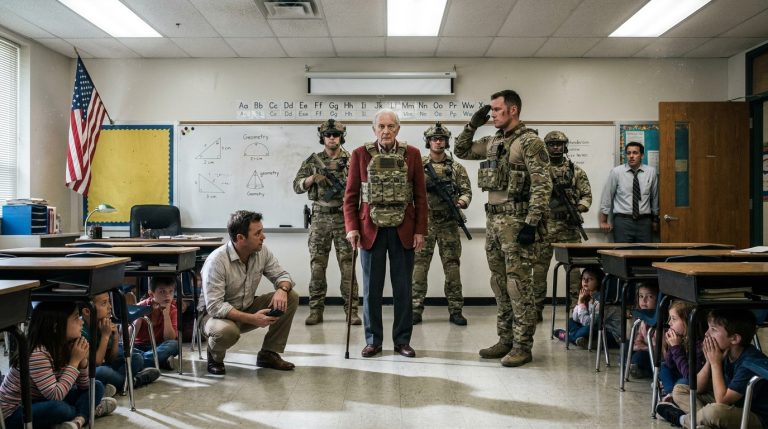
Anderson stopped three feet from Richard. The silence that followed was total. Then, the colonel did something that made the onlookers stop breathing. He snapped his body into a perfect, rigid posture of attention, his heels clicking together with a sharp, echoing thwack. He raised his right hand in a salute that was as crisp and unforgiving as a gunshot.
“Mr. Cain,” the colonel said. His voice was not the shout of a man in power, but the low, resonant tone of a man paying respects to a superior. “It is an honor, sir.”
Richard looked at the salute. He looked at the man—a man he remembered as a lieutenant in a war that had never officially existed—and felt the weight of his own identity pressing down on him. He didn’t return the salute; his hand remained resting on the edge of the bar, gnarled and steady. He simply gave a slow, tired nod.
“Colonel,” Richard replied. His voice was little more than a rumble, but it carried across the room, cutting through the shock and the sudden, jagged reality of the moment.
The reaction from Marcus and his team was visceral. They were staring at the scene, their mouths slightly agape, their bodies trembling. They had spent the last hour trying to strip this man of his history, only to see that history arrive in the form of a man they worshipped as a god.
Anderson finally broke the salute, his face turning toward Marcus and his men. The transition was seamless. The reverence he had shown Richard evaporated, replaced by a cold, crystalline fury that made the operators flinch. He took a single, measured step toward them.
“What,” the colonel asked, his voice a whisper that felt like a blade against the throat, “do you think you are doing?”
Marcus tried to speak. He tried to articulate the logic of the unit, the pride, the self-righteousness, but the words died in his throat. He looked at the floor, at his boots, and then up at Richard, who stood there—frail, aged, and somehow infinitely larger than anyone else in the room.
The physical discrepancy was clear now. The operators were physically superior, trained, and at their peak—but they were children playing with matches in the presence of a mountain. Richard remained on his stool, his presence a void, a dark space in the room that seemed to absorb the light and the noise. He watched them with that pale blue gaze, not with malice, but with a weary, profound pity.
He had wanted to be invisible. He had wanted to die without his name being carved into any wall. But as the colonel waited for an answer that would never be good enough, Richard knew that the facade was shattered. The ghosts had come home, and they were bringing the war with them.
CHAPTER 6: The Salute
Colonel Anderson did not look away. He kept his gaze fixed on the five operators, his eyes narrowed into slits of icy blue. The silence in the bar had shifted; it was no longer the heavy, anticipatory quiet of a standoff, but a vacuum of pure, unadulterated shame. Marcus, Derek, and the others stood frozen, their shoulders slumped, the invisible armor of their elite status stripped away by the single, devastating act of the colonel’s salute.
Marcus looked at the floor, the wood grain blurring beneath his eyes. He felt a profound sense of vertigo, as if the floor had fallen out from under him. The man he had been mocking—the “old-timer,” the “fraud,” the “Pops”—wasn’t just a veteran; he was a monument. And in his arrogance, Marcus had tried to dismantle it.
“I asked you a question,” Anderson said, his voice dropping into that terrifying, calm register that signaled the end of a career. “What are you doing here?”
“We thought, sir,” Derek stammered, his voice cracking. “We thought he was… stolen valor. We saw the patch. We didn’t know.”
Anderson took a step closer, and the five men instinctively flinched, a collective motion of fear that was entirely uncharacteristic for Delta Force operators. “You thought,” the colonel repeated, his voice dripping with acid. “You are trained to observe, to evaluate, and to act with intelligence. Instead, you acted like children with a grudge. You have harassed a citizen in a place of business, and in doing so, you have managed to insult the very legacy that allows you to draw breath.”
He paused, his eyes sweeping over them. “Do you have any idea who you were talking to?”
Marcus remained silent, his heart hammering against his ribs. He felt sick—a cold, hollow nausea that rose from his stomach. He knew, with a sinking dread, that he was about to hear something that would rewrite his entire understanding of the world.
Anderson turned slightly, his posture softening as he looked at Richard. The change was abrupt, a jarring shift from the predator he was to the men to the protector he was to the veteran. “This man,” Anderson said, his voice lowering with a reverence that made the hair on the back of Marcus’s neck stand up, “held the northern flank at Takur for seventeen hours, alone. He went into Cambodia in ’71 on a mission that never existed in the logs. He designed the very techniques you use to breach doors, to clear rooms, and to stay alive in the dark.”
The room seemed to tilt. The patrons were motionless, their faces etched with shock. Sarah, standing behind the bar, had her hands over her mouth, her eyes fixed on Richard.
“And this patch,” Anderson continued, gesturing toward the frayed fabric on Richard’s sleeve, “is not a flea market trinket. It is the symbol of MACV-SOG. It is the marker of a unit of ghosts who did the impossible. And inside that unit, there was a select team—the best of the best—called Shadow Forge.”
Anderson looked at Richard, his eyes shining with a sudden, sharp intensity. “There were only four of them. Isn’t that right, Reaper One?”
The call sign hung in the air like a thunderclap.
Reaper One.
Marcus felt the blood drain from his face. The nickname was a myth, a bedtime story whispered in the barracks during training—the ghost of Kandahar, the man who had supposedly turned the tide of an entire war before he was thirty. It was a name that carried a weight of legend. To hear it spoken, here, in a dive bar in North Carolina, felt like a breach in reality.
Richard didn’t respond immediately. He sat there, his frame hunched, his hands still resting on the bar. He looked at the younger men, not with the fire he had once possessed, but with a weary, profound sadness. He slowly raised his hand and brushed a stray, loose thread from the frayed patch—a small, physical act of maintenance that felt like a quiet confession.
“It doesn’t matter,” Richard said, his voice steady, devoid of anger. “They’re young, Colonel. They’re full of fire. I remember being that way. That fire is what makes them good at their job. You just have to teach them where to point it.”
He looked over at Marcus, whose head was bowed so low his chin touched his chest. The shame was absolute; it was a physical weight, a burden that seemed to be crushing the man into the floor.
“You’re not a fraud, Marcus,” Richard added softly. “But you’re not a sentinel yet, either. A sentinel watches. A sentinel protects. You were just looking for something to break.”
Colonel Anderson didn’t wait for Marcus to respond. He signaled to his aide, a tall, imposing man who had remained silent in the doorway. “Take care of the gentleman’s tab. Ensure it’s covered for the next year.”
He turned back to his men. “My office. 0500. You are all on report.”
It was a dismissal more profound than any prison sentence. Marcus didn’t look up as he and his team turned and began the long walk toward the door. They moved slowly, their usual confident gait replaced by a hesitant, stumbling rhythm. The world they had occupied an hour ago—a world of certainty, of rank, of easy heroism—had vanished, replaced by the crushing reality of their own insignificance.
Richard remained on his stool. He felt the phantom vibration of the rotors in his hip, the ache of a war he could never fully leave, but for the first time in years, the silence of the bar felt different. It wasn’t the silence of a man hiding. It was the silence of a man who had finally been seen.
CHAPTER 7: The Lesson of the Flame
The door clicked shut, leaving behind a silence so absolute it felt heavy. Richard remained on his stool, his shoulders slumped as if the sudden absence of the operators’ aggressive energy had left a vacuum only he could fill. He stared at the spot where Marcus had been standing, at the scuff marks on the floorboards that looked like wounds.
Colonel Anderson didn’t move to leave. He stood at the edge of the bar, his rigid posture slowly beginning to mirror the weariness that radiated from the old man. The granite of his face cracked, just a little, revealing the man beneath the commander. He leaned forward, resting his hands on the mahogany, the polished surface reflecting the dim, amber light of the bar.
“They’ll be in the archives until their eyes bleed, sir,” Anderson said. His voice was low, devoid of the command-center authority he had wielded just moments before. “They’ll read the records. They’ll see the cost. They’ll understand that the silence you kept wasn’t a mask—it was a mercy.”
Richard finally turned his head. His eyes, pale and depthless, held no judgment. “They were just looking for a villain, David. Everyone needs one. It makes the world smaller, easier to manage.”
“They needed a lesson,” Anderson countered. He looked down at the bar, his gaze landing on the worn, scarred surface. “We all need a lesson, now and then. The world thinks we’re the edge of the sword. They don’t see the hilt. They don’t see the hand that has to hold the steel.”
Richard reached into the pocket of his jacket and pulled out a small, tarnished Zippo lighter. He turned it over in his hands, the metal cool and smooth. He didn’t strike it; he just let the weight of it ground him. “I didn’t want them to know, David. I didn’t want anyone to know. A ghost is only useful if he stays in the dark.”
“You haven’t been a ghost for a long time, sir,” Anderson replied softly. “You’ve been a sentinel. Even if you didn’t want the title, you’ve kept the watch.”
Outside, the engines of the SUVs flared to life—a deep, rhythmic throb that pulsed through the walls of the bar. Anderson straightened, his expression hardening back into the mask of the commander. He reached into his coat and produced a small, leather-bound notebook, placing it gently on the bar in front of Richard.
“The archives are being updated,” Anderson said. “Not for the public. For the unit. They need to know the foundation they’re standing on. You don’t have to talk, and you don’t have to show your face. But you can’t keep carrying the weight of the shadow alone.”
Richard looked at the notebook. He didn’t touch it. “And what happens when the next Marcus comes along? What happens when someone else wants to test the steel?”
“Then they learn,” Anderson said. “And if they don’t, they don’t belong in the unit.”
The colonel turned and walked toward the exit, his movements as precise and disciplined as a heartbeat. He stopped at the door, his hand on the handle. He didn’t look back. “I’ll see you when the dust settles, sir.”
The door swung shut, the jangle of the bell echoing through the empty space like a funeral knell. Richard sat in the stillness, the scent of the colonel’s expensive cologne mixing with the stale, familiar smell of beer and dust. He felt an odd, hollow ache in his chest—a sudden realization that the armor he had been wearing for forty years was finally, irrevocably broken.
He looked at the notebook. It was just paper and binding, yet it felt like a mountain. He thought about Marcus, back at the base, staring at dusty files, finally beginning to understand the difference between being a soldier and being a protector. The realization didn’t bring him joy, but it brought a quiet, hollowed-out kind of peace. He had spent his life trying to bury the flame, terrified it would burn everything he cared about. But as he looked around the silent, dim room, he realized that the fire hadn’t been a threat—it had been a beacon.
He stood up, his hip protesting the movement with a dull throb. He gathered his jacket, the frayed patch feeling different now under his touch—less like a secret, and more like a scar he could finally stop hiding. He walked toward the door, his steps slow and measured. The street outside was bathed in the cold, blue light of the coming morning, and for the first time in years, the path forward didn’t look like an exit. It looked like a responsibility.
CHAPTER 8: The Weight of Memory
The morning sun bled over the horizon in streaks of bruised purple and pale gold, illuminating the quiet street where the SUVs had vanished only hours ago. Richard stood on the cracked sidewalk, his breath hitching in the frigid air. He felt the jacket—the faded field jacket—hanging heavy on his frame. It no longer felt like a disguise; it felt like a map, every frayed thread a coordinate to a place he had spent a lifetime trying to outrun.
He started walking. The limp in his hip was a constant, dull throb, a rhythmic reminder of the price paid for that long-ago flank at Takur. He passed the closed storefronts, the shadows long and stretched, and found himself thinking not of the war, but of the silence. For decades, he had believed that silence was empty—that it was the absence of sound, the absence of witness. But tonight, listening to the echoes of the colonel’s voice and the quiet, crushing shame in Marcus’s eyes, he realized he had been wrong. The silence had been a vessel, holding everything he couldn’t afford to say.
He reached his apartment building, a modest structure of weathered brick and peeling paint. Inside, the hallway smelled of floor wax and old coffee. He navigated the stairs, his movements deliberate, every step an exercise in endurance. When he reached his door, he paused. He looked at the key in his hand, worn smooth by years of routine, and realized he didn’t want to go in. Not yet.
He turned and continued to the end of the hall, where a small, dusty window looked out over the quiet town. He pulled the leather-bound notebook from his pocket—the one Colonel Anderson had left on the bar.
He didn’t open it immediately. He stood there, watching the town wake up. A delivery truck rumbled in the distance; the first lights flickered on in the kitchen windows of his neighbors. They were just people, living lives defined by the mundane: rent, groceries, the weather. They didn’t know the name Reaper One. They didn’t know the geometry of a kill box or the taste of cordite on a dry morning. They were the world he had fought to protect, and as he watched them, a strange, profound sense of gratitude washed over him. He hadn’t been fighting for the patches, or the unit, or the legend. He had been fighting for this—the right of a quiet morning to remain quiet.
He opened the notebook.
The pages were filled with names. Some he recognized instantly, the faces leaping off the paper with the clarity of a flashbulb—men he had bled with, men he had buried in places that weren’t on any map. Others were names he had heard in the distance, or heard spoken of in the hushed, reverent tones of the operations center. It was a history of shadows.
His thumb traced the ink of a name—Kandahar, 1982. It was a date, a place, and a scar. He remembered the rain. He remembered the smell of the mud. He remembered the feeling of the trigger against his finger and the absolute, terrifying clarity of the mission. He hadn’t been a hero that day; he had been a machine, a tool for a reality that required someone to stand in the dark.
He looked at the frayed patch on his sleeve one last time. He reached up, his fingers steady, and pulled the loose thread he had been obsessing over for years. He didn’t tear it; he gently tucked it away, mending the edge. Symbolic closure. He wasn’t mending the jacket; he was mending the man.
The door to the hall opened, and a neighbor, a young woman with tired eyes and a heavy bag of groceries, stepped out. She looked at Richard, a flash of recognition—not of the legend, but of the neighbor she saw three times a week.
“Morning, Mr. Cain,” she said, her voice soft. “It’s cold out, isn’t it?”
Richard smiled. It was a rare, small thing, a genuine unfolding of features that had been tightened by suspicion for too long. “It is, indeed,” he replied. “But the light is coming.”
She nodded, distracted by her keys, and continued down the stairs. Richard watched her go, a simple, human connection that carried more weight than any salute.
He returned to his apartment, the lock clicking home with a final, definitive sound. He placed the notebook on his kitchen table, right beside a chipped mug of coffee, and sat down. He didn’t feel like a legend. He felt like an eighty-one-year-old man with a bad hip and a lot of memories. But the burden was gone. The secret was still his, but it was no longer a weight—it was a legacy.
He took a sip of the coffee, its warmth spreading through his chest, and looked out the window. The sun was fully up now, casting a sharp, bright light across the room. He picked up his pen, opened the notebook to a blank page, and began to write. He wouldn’t write about the kills. He wouldn’t write about the tactics or the mission parameters. He would write about the people. He would write about the names in the book, one by one, until their shadows were finally brought into the light where they belonged.
The war was over, but the watch was still being kept. And for the first time in his life, Richard Cain didn’t mind the silence. He finally knew how to fill it.