The Price of Mercy and the Frozen Line Left Behind in the Bitter Winter Snow
CHAPTER 1: THE BITING FROST
The icy slush soaked straight through the canvas of my sneakers with every step across the rear parking lot. I kept my chin tucked down into my collar, counting the cracked asphalt lines to keep my mind off my empty stomach.
Four hours remained until my dishwashing shift at Big Grant Holloway’s diner. Four hours meant I could sit in the back corner of the groundskeeper’s shed, out of the wind, and work through two pages of standard algebra homework.
Then the sharp snap of a car door slamming shut cut through the howling gale.
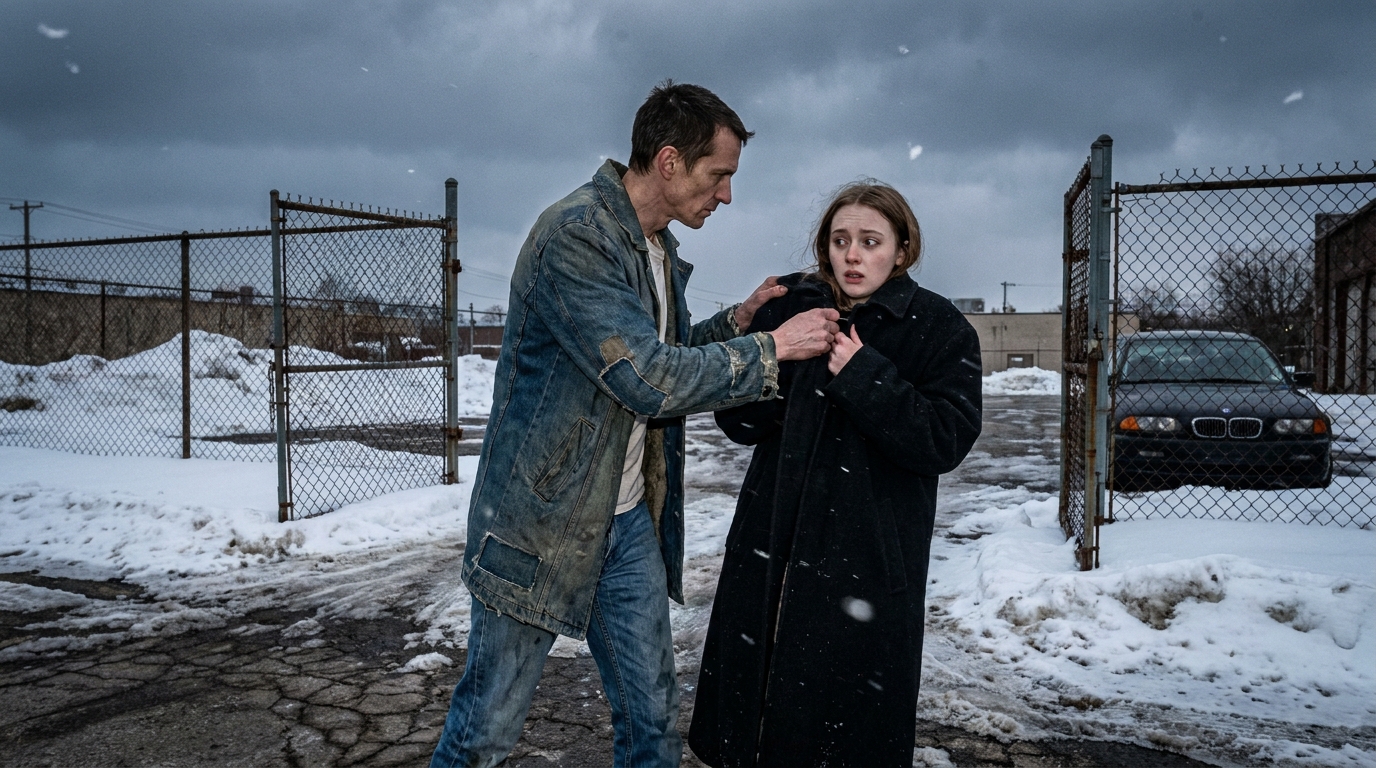
A black BMW churned through the grey drifts near the rusted chain-link gate, its rear tires throwing up dirty slush. Engine roaring, the car peeled away toward the main road, leaving a cloud of exhaust floating in the freezing air.
Right beside the gate, a small figure crouched low in the snow.
It was Lily Moore. Her navy cheerleading skirt whipped violently in the Arctic wind, leaving her bare legs fully exposed to the stinging ice.
She was digging furiously into a four-foot drift with her bare hands. Her fingers were already swollen and bright crimson, her breath coming in ragged, white gasps.
I stopped ten feet away, my hand gripping the stubborn brass zipper of my oversized jacket. The metal was cold enough to bite through the worn denim of my pocket.
“You lost something?” I asked, my voice barely carrying over the wind.
Lily flinched, pulling her arms tight against her chest. Her teeth chattered so hard I could hear the rhythmic clicking from where I stood.
“M-my phone,” she forced out, her lips a faint, unhealthy shade of blue. “Logan… he threw my keys. He took my phone.”
I looked down at the snow drift, then at her paper-thin shell top. The temperature was dropping by the minute, and the sky had turned the bruised color of lead.
“The back doors lock automatically at four,” I said, pointing toward the heavy steel exit behind us. “There’s nobody inside.”
Lily tried to push herself up using the fence post, but her knees buckled under her weight. She slid back down into the slush with a soft gasp.
“I can walk to the gas station,” she whispered, though her eyes were unfocused, staring right through me. “It’s only… two miles.”
“You won’t make two hundred yards,” I said cleanly. “Your core temperature is already dropping.”
I pulled my right hand out of my pocket and reached for the brass slider on my chest. The zipper caught on a frayed patch near my ribs—the spot my mother had mended with double-stitched fishing line two winters ago.
I yanked the metal slider down. The cold hit my thin cotton t-shirt like a bucket of ice water poured down my spine.
“What are you doing?” Lily stammered, her eyes widening as I pulled my arms out of the sleeves. “No… Evan, don’t.”
“I weigh a hundred and forty pounds and I’ve got five miles to walk,” I said, stepping closer and wrapping the heavy, insulated coat around her shoulders. “You weigh less than a hundred and you’re already shivering in place. It’s simple math.”
The oversized fabric swallowed her whole, the heavy down lining instantly trapping the faint heat left from my body. She instinctively pulled the collar up to her chin, a single shudder running through her frame as the wind died against the thick canvas.
“Wait,” she called out, her voice muffled by the collar as I turned toward the road. “You’ll freeze!”
“I live close,” I lied, stepping out into the whiteout without looking back.
CHAPTER 2: SIMPLE ARITHMETIC
The frost hit my bare chest with a force that knocked the air straight out of my lungs. Every breath felt like inhaling ground glass, searing down into the center of my ribcage.
Behind me, the heavy chain-link gate rattled violently in the gale. I didn’t turn around to check on Lily. If I stopped to look back, my body would calculate the odds of surviving the next fifty yards and simply refuse to move.
“Simple math,” I muttered under my breath, my lower jaw shivering so hard the words came out smashed together.
The sidewalk leading away from the school was already buried under four inches of fresh powder. I forced one sneaker in front of the other, watching the wet canvas turn white, then stiff, then hard as cardboard.
By the time I crossed the second intersection, the feeling in my toes was completely gone.
It wasn’t a slow numbing. It was a sudden, absolute detachment, like my feet belonged to someone else three paces behind me.
The wind howled down Maple Street, picking up loose ice from the snowbanks and driving it straight into my eyes. My vision blurred around the edges, dark grey spots blooming in the whiteout like spilled ink on a fresh page.
Four blocks to the abandoned auto shop.
Four blocks was nothing on a warm afternoon. Today, four blocks felt like swimming through wet concrete with an anchor strapped to my spine.
I reached into my jeans pocket and felt for the small, notched key to the shop’s side door. My thumb was so rigid it wouldn’t bend against the brass. I had to pinch the metal between my palm and my hip just to keep from dropping it into a drift.
A sudden, sharp crack echoed from the alley to my left.
A discarded wooden pallet had tipped over in the wind, crashing against a rusty dumpster. The sound shattered the dull hum in my ears, bringing the immediate, ugly reality back into focus.
My lungs weren’t taking in oxygen anymore; they were just taking in cold.
The skin on my arms had turned a mottled, sickly purple, the fine hairs frozen solid into tiny white needles. I tried to curl my fingers into fists, but the tendons in my forearms felt stiff, like cold rubber bands on the verge of snapping.
Don’t sit down.
The thought was dry, plain, and entirely devoid of panic. Panic required energy, and I was running on a empty tank.
If I sat down in the snow, I wouldn’t get back up. The groundskeeper at school had told us a story once about a hunter who froze two miles from his truck because he stopped to untie a wet boot. He just got comfortable, closed his eyes, and let the white take him.
My right knee buckled without warning.
I hit the frozen curb hard, the impact jolting up through my hip, but there was no pain—just a dull, hollow thud, like hitting a sack of flour against the pavement.
I dragged myself up using the icy rim of a street sign, the metal skin sticking to my bare palm for a sickening second before tearing free.
Ahead, through the blinding curtain of white, the rusted corrugated roof of the old auto shop crouched in the dark like an overgrown iron beast.
Ten more steps. Just ten more thuds against the snow.
My hand reached the rusted door handle. The metal didn’t even feel cold anymore. It felt completely blank.
I jammed the brass key into the lock, leaned the full weight of my shoulder against the green wood, and tumbled into the dark silence inside.
CHAPTER 3: THE COLD ALLEY
The smell of dried motor oil and stale dust filled my nostrils, but I couldn’t expand my chest enough to draw a deep breath.
My body was locking up. The shivering had stopped entirely—a bad sign, the kind of shift they warned about in safety manuals. When the involuntary muscle tremors end, your core has officially surrendered to the dark.
Pull the string, I told myself.
My index finger wouldn’t contract. It lay flat against the rough twine, completely disconnected from my brain.
Outside, the wind tore loose a sheet of rusted siding, sending it screeching down the brick alley. The noise faded into a dull, underwater hum. The darkness in the room felt thick, almost heavy, pressing down on my eyelids like wet wool.
Two miles away, at the plastic shelter on Maple and Fourth, a heavy leather glove slammed onto the frozen payphone receiver.
Silas Stone held the plastic phone to his ear, his grey eyes fixed on his daughter shivering beneath the oversized, patched denim coat. His jaw muscles clenched hard as the line crackled with static.
“He left on foot?” Silas’s voice dropped to a low, gravelly rasp that cut right through the howl of the storm. “Walking into a negative-ten wind chill in a cotton shirt?”
Lily nodded against the collar, her teeth grinding together as she held the coat tight around her chest.
“He said he lived close,” she forced out, her lips barely moving. “Dad… he didn’t have another layer. He gave me his only coat.”
Silas didn’t waste breath on an answer. He turned to Rook, his quiet vice president standing beside the idling pickup truck, and threw a flat hand toward the cab.
“Get her in the heater,” Silas said sharply, his voice carrying zero panic, only cold, tactical focus. “Call the city dispatcher. Tell them we have a kid down on foot between the high school and the industrial rail line.”
“We using the club network, Boss?” Rook asked, his hand already on the truck door handle.
“No,” Silas cut in, grabbing the truck’s side mirror to hold Rook’s eye. “No crowds. No parade. We use official channels and local police logs. If we roll up fifty deep, the school board hides behind their lawyers before we even find out who locked those gates.”
Silas turned his face into the biting snow, his eyes scanning the empty, white-out expanse of the industrial corridor.
In the dark corner of the auto shop, my vision narrowed down to a single, pinpoint speck of grey light filtering through the cracked transom window.
The cold didn’t hurt anymore. It felt almost warm—a dangerous, lying heat spreading out from the center of my chest.
I let my grip slip off the kerosene lamp string, my cheek resting flat against the frozen floorboards, as the sound of distant sirens began to mix with the howling wind.
CHAPTER 4: PAPER TRAILS AND SCARS
The skin felt tight, like dry leather stretched over thin wire. A clear fluid dripped rhythmically into my vein from a bag suspended above the stainless steel frame.
A shadow cut through the harsh fluorescent glare.
Silas Stone stood at the foot of my bed, his thick leather jacket unzipped to reveal a plain black t-shirt underneath. He wasn’t hovering, and he wasn’t pacing. He just stood there like an iron post anchored three feet deep into the concrete.
“Core temp is ninety-one,” Silas said, his voice flat, low, and stripped of drama. “Doctor says you keep all ten toes. The shop door was open three inches when the patrol car found you.”
I swallowed, my throat feeling like it was lined with dry sawdust.
“The key turned,” I rasped out, my jaw still aching from the hours of involuntary clenching. “Just took a second.”
Silas reached into his pocket. He didn’t pull out a weapon or a roll of cash. He pulled out a folded yellow slip of carbon paper and laid it flat on the rolling tray beside my bed.
It was an official city police incident log.
“Lily’s sitting in the waiting room,” Silas said, resting his hand on the steel tray rail. “She gave a full statement to the desk sergeant. The boy—Pierce—told his friends you stole her coat off the bleachers before the storm hit.”
I stared at the black ink on the yellow carbon paper.
“The back lot gate was chain-locked,” I said, my voice steadying as the warm saline worked its way through my arm. “The school board policy says emergency egress routes stay clear until five o’clock.”
Silas’s eyes narrowed slightly, a quiet, dangerous spark lighting in the grey depths.
“You know school district maintenance policy?”
“I clean the administration office during second period work-study,” I replied, pulling myself up an inch against the stiff pillows. “I file the facility inspection reports. If a gate is locked before five, the building supervisor signs the logbook.”
Silas looked down at the yellow incident sheet, then back at me. He didn’t offer a dramatic speech or promise to run anyone off the road. He simply reached out with one thick thumb and smoothed the crease in the paper.
“The principal is filing a report in the morning,” Silas said softly. “He thinks this vanishes if he calls it a student misunderstanding.”
“It doesn’t vanish,” I said, eyeing the official case number printed at the top right corner of the slip. “Not if the municipal safety inspector gets a copy of that logbook before nine a.m.”
Silas let out a short, quiet exhale through his nose—the closest thing to a smile I’d seen on his face.
“Get some sleep, kid,” he said, turning toward the heavy privacy curtain. “The paper trail starts at eight.”
CHAPTER 5: THE WEAPONIZED RUMOR
Logan held court surrounded by three guys from the varsity roster, his varsity jacket unzipped just enough to show off his tailored shirt underneath. He was laughing, loud and rhythmic, making sure his voice carried over the din of clattering lunch trays.
“—so she panics over a few flurries, hands the kid her coat to make a scene, and runs off,” Logan sneered, tossing a plastic bottle cap from hand to hand. “Sparrow here probably thought he was in a movie until his feet froze to the pavement.”
Two guys in his circle snickered on cue, shifting their weight to block the narrow path toward the library doors.
I didn’t slow my stride. My sneakers made a dull, wet squeak against the polished linoleum, my left hand still throbbing under the tight white bandage beneath my cuff.
“You left a girl in a wind chill that drops skin temp in four minutes, Logan,” I said, stopping three paces out. My voice didn’t carry drama—just flat, practical numbers.
Logan’s smirk tightened, his knuckles whitening around the plastic bottle cap.
“She walked out there herself, street rat,” he spat, stepping away from the brick wall until he was inches from my frame. “And if you keep spreading lies about my car being back there, my dad’s office will file a defamation notice with the district board before homeroom.”
“Your father’s office can file whatever they want,” I said softly, tapping the edge of my cardboard binder against my hip. “The municipal safety officer pulled the back gate security logs forty minutes ago.”
Logan’s eyes flicked down to the binder, his confidence wavering for a fraction of a second as a bead of sweat broke near his hairline despite the chilled hallway air.
“That gate was open,” he muttered, though his voice dropped an octave, no longer broadcasting to the crowd.
“The gate was padlocked,” I corrected, looking him dead in the eye. “And the facility supervisor didn’t sign the lockout sheet.”
Logan took a half-step back, his hand instinctively dropping into his right jacket pocket, where a heavy, hard object pulled the fabric down into a sharp angle.
I didn’t point at his pocket. I didn’t need to. The outline of a bent brass padlock pressed visibly against the leather trim.
CHAPTER 6: PAPERWORK AND EVIDENCE
Principal Bennett adjusted his gold-rimmed glasses, his thumb nervously smoothing the edge of a mahogany pen holder. Across the table, Marcus Pierce—Logan’s father—stood with one hand buried deep in his charcoal trousers, tapping a silver Parker pen against his forearm.
“This entire proceeding is an absurdity,” Marcus declared, his voice booming with legal practice. “My son is a senior, an honor student, and a captain on the athletic roster. You’re holding an administrative hearing over a locker room rumor and a weather disruption.”
Silas didn’t raise his voice. He didn’t even shift his weight in the chair. He reached forward and slid a single sheet of paper out of my manila folder.
It was the municipal fire marshal’s emergency access audit, stamped in red ink at 8:15 A.M.
“Section 4, Paragraph B of the county safety code,” Silas said, his gravelly voice cutting cleanly through Marcus’s posturing. “All secondary perimeter gates must remain operable from the interior during school hours. If an interior padlock is applied, a master key must be logged in the supervisor’s physical registry.”
Principal Bennett cleared his throat, his face flushing a blotchy red as he glanced down at the red-stamped paper.
“Mr. Stone,” Bennett began, his voice wavering slightly. “The facility supervisor reported that the padlock on the back lot gate went missing from the maintenance shed around three o’clock on Friday.”
“It didn’t go missing,” I said, tapping my knuckle once against the wooden table. “It was removed without an entry in the maintenance ledger.”
Marcus scoffed, taking a sharp step toward the table.
“And what does that have to do with my son? You’re a work-study student who cleans chalkboard trays, Reed. You don’t manage facility logs.”
“I filed the weekly inventory sheet on Thursday,” I replied smoothly, looking up into Marcus’s cold glare. “The brass padlock was logged in locker pocket 12-B. The exact same locker assigned to Logan Pierce for varsity gear storage.”
Principal Bennett froze, his hand dropping away from his mahogany pen holder.
Marcus opened his mouth to deliver a practiced objection, but the office door clicked open behind us.
A uniformed officer from the municipal safety division stepped inside, holding a sealed evidence envelope containing a bent brass shank and a printed time-stamped video file from the parking lot’s overhead security camera.
Marcus’s silver pen stopped tapping. He looked at the sealed envelope, then at Principal Bennett, the color slowly draining from his polished jawline.
CHAPTER 7: THE CORNERED TRAP
Marcus’s hand wasn’t resting on his son’s varsity jacket for comfort; his thick fingers dug sharply into the wool collar, his face a pale, tight mask of contained rage.
Logan pulled away, his right hand still hovering near the pocket holding the bent padlock.
“You can’t suspend me over a locker search!” Logan practically spat, pointing back toward the heavy oak door we had just walked through. “That safety guy didn’t have a warrant for my gear. It’s an illegal search, Dad. Tell them!”
“The school owns the lockers, Logan,” Marcus hissed, his voice dropping to a gravelly whisper. “You signed the athletic compliance waiver in August. They don’t need a warrant to open school property when a safety hazard is reported.”
I leaned my back against the cool brick wall, my left hand resting flat on the cardboard binder against my ribs.
“The suspension is just district policy,” I said evenly. “The reckless endangerment citation from the municipal office is what goes on the permanent background check.”
Logan whipped his head toward me, the veins in his neck standing out in sharp relief against his flushed skin. The arrogant, untouchable smirk he wore in the cafeteria was gone, replaced by the frantic, wide-eyed glare of someone who realized the floor had just given out beneath him.
“You set this up!” Logan lunged forward, closing the space between us in two heavy strides. “You took that lock from the maintenance shed, bent the shank, and tossed it through my vents!”
I didn’t flinch. I just watched the panicked sweat bead on his upper lip.
“The security footage shows you standing at the back gate at 3:15,” I stated, tapping the edge of the cardboard binder against my hip. “It shows you locking it from the outside, getting into your BMW, and driving away. I was washing dishes at the diner on the other side of town until four.”
Logan’s chest heaved. He looked back at his father, desperate for the usual legal magic that made his problems disappear.
Marcus wasn’t looking at him. Marcus was staring at the floor, his silver pen sliding back into his coat pocket.
“We’re leaving,” Marcus said flatly, turning on his heel toward the double exit doors. “Do not say another word, Logan.”
“Dad—”
“I said we are leaving!” Marcus barked, his voice echoing sharply down the empty linoleum hall. “The university admissions board requires notification of any municipal safety citations within forty-eight hours. We have phone calls to make.”
Logan stood frozen, his varsity jacket suddenly looking two sizes too big on his shrinking frame. He turned back to me, his hands clenching into tight fists at his sides, his jaw working furiously as he tried to find one last piece of leverage.
“This isn’t over, street rat,” he growled, the threat sounding thin and hollow in the quiet hallway.
“It actually is,” I replied softly, sliding the cardboard binder under my good arm and turning back toward the library.
CHAPTER 8: THE PRICE PAID
Steam rose from the stainless steel basin, smelling of lemon detergent and hot water. My left hand still throbbed slightly when I gripped the heavy stoneware, but the swelling had settled down into a dull, manageable stiffness.
The kitchen door swung open with a quiet squeak.
Big Grant Holloway stepped through, holding a folded copy of the afternoon county gazette. He set the paper face-up on the metal prepping counter beside my drying rack.
“Front page of the local section,” Grant said, his voice deep and calm as he adjusted his apron strings. “School board accepted the supervisor’s audit. The Pierce kid’s athletic waiver got revoked.”
I didn’t pause my drying rag.
“Did his father file the appeal?” I asked, setting a dry plate onto the stack.
“Tried to,” Grant replied, picking up a clean mug from the rack. “Safety board held firm on the municipal code. The reckless endangerment citation stays on the record. He’s doing eighty hours of crossing-guard duty down at the elementary school before he can request his transcript.”
Through the small glass window in the swinging kitchen door, I saw Silas Stone sitting at the corner booth.
Lily sat across from him, wearing a dark blue sweater, her school notebook spread wide open between two coffee cups. She wasn’t staring out the window or checking her phone; she was quietly working through three pages of geometry proofs.
My old, patched coat hung on the brass coat rack near the diner’s front entrance—the zipper replaced with a clean steel slide Silas had installed himself.
I set the last warm plate onto the stack, wiped the moisture from my palms against my apron, and picked up the fresh pot of coffee.
The heat of the pot warmed my fingers through the damp handle as I pushed through the kitchen door into the quiet, steady rhythm of the floor.