The Quiet Cadence of Mercy: A Novel of Broken Textures, Shared Burdens, and the Weight of Light
CHAPTER 1: THE WEIGHT OF THE SCRUBS
“Step away from the gurney, Nurse Carter,” Ellanar Green’s voice did not rise, but it carried the cold, calcified weight of twenty years of institutional compliance. “He has no chart, no verification, and no insurance allocation. You touch that line, and you are stepping outside the protocol of this hospital.”
The corridor of St. Jude’s Hospital always smelled of parched bleach and the faint, sweet tang of industrial adhesive. It was a dry, sterile air that caught in the back of the throat, especially under the flickering noon radiance of the fluorescent tubes. Rachel Carter kept her fingers pressed flat against the old man’s forearm. Beneath her palm, the skin felt like ancient parchment—dry, thin, and radiating a fierce, localized heat that signaled a deep systemic infection.
The old man, whose frayed olive jacket smelled of damp earth and stale tobacco, let out a low, rattling wheeze. His eyes were milky, unfocused, staring at some distant point beyond the chipped acoustic tiles of the ceiling. A dark, slow stain was spreading across the left sleeve of his jacket, turning the faded green fabric to a heavy, sodden black.
“He’s slipping into septic shock, Ellanar,” Rachel said. She didn’t look up. Her focus remained on the irregular, thready leap of the pulse beneath her thumb. “The blood pressure is dropping beneath eighty. If we wait for the admissions desk to clear the queue, his organs will start shutting down before he gets a registration band.”
“We have seven people in the waiting area who have been cleared by triage,” Ellanar replied, her leather heels clicking twice on the linoleum as she moved closer. Her tailored blazer was crisp, devoid of a single crease, a stark contrast to Rachel’s faded, sea-foam green scrubs. “There is a process. If we bypass the verification protocol for every unregistered arrival, the liability insurance for this wing is compromised. We don’t know who he is, Rachel.”
Behind the reception counter, Nancy had stopped typing. The frantic clack of the mechanical keyboard died away, leaving only the low, rhythmic hum of the ventilation system. Linda, standing by the medicine cart, slowly lowered a tray of saline vials, her eyes darting between the administrator and the gurney. The entire station had grown small, crowded with a heavy, watchful silence.
Rachel felt the old watch in her pocket—the one her father had carried—give a tiny, metallic click against her hip as she shifted her weight. She remembered the way her father’s lungs had sounded in the quiet hours of the morning, that same dry, desperate rasp. She looked down at the old man’s hand. His fingers were shaking, twitching with a fine, neurological tremor. As he moved his arm, a tattered photograph slid from his loose grip, falling face down onto the white tile floor. It was worn at the corners, the paper backing yellowed and split with age.
“Linda, bring me a line and a hundred milligrams of ceftriaxone,” Rachel said, her voice dropping into a quiet, flat cadence that left no room for negotiation.
“Rachel,” Ellanar warned, her hand reaching toward the small plastic clipboard at her waist. “This is your final administrative notice.”
“I am starting the line,” Rachel whispered, her thumb finding the collapse of the vein, her mind completely tuning out the click of the administrator’s pen. The needle gleamed briefly under the harsh light before she slid it home.
CHAPTER 2: THE ANATOMY OF DEFIANCE
The sharp steel bevel of the needle slid beneath the old man’s skin with a faint, clean resistance, the tactile snap of the vein walls communicating itself directly into Rachel’s fingertips. For a single heartbeat, the universe narrowed to the tiny clear plastic hub of the catheter. A dark, slow drop of deep crimson blood bloomed within the chamber—the flashback. She held her breath, her left thumb anchoring the vein while her right hand advanced the soft Teflon sheath into the vessel.
Ellanar Green’s pen did not click a second time. The silence that followed the clinical violation of her order was heavy, thick with the smell of scorched ozone from the older fluorescent ballasts overhead. It was the kind of silence that gathered in the corners of St. Jude’s before a structural shift—the quiet before a lay-off, the stillness after an unresolvable code.
“Secure that line, Linda,” Rachel said, her voice dropping into the low, practiced register used to keep pediatric patients from flinching. She did not look at Ellanar. Her fingers were already reaching for the transparent dressing, smoothing the adhesive down onto the old man’s weathered forearm. The skin was remarkably cool now beneath the feverish heat, the superficial veins shifting easily under the slightest pressure.
Linda didn’t move for three long seconds. Her gaze remained fixed on the white plastic clipboard in Ellanar’s hand, her breathing shallow enough that the small plastic badge on her lapel barely stirred. Then, with a soft, dragging scrape of her rubber-soled shoes, she stepped toward the gurney. Her hands shook slightly as she tore the paper backing from the tape.
“Rachel,” Linda whispered, so low the sound was nearly lost beneath the dull rattle of the ventilation shaft. “The chart. There’s nothing to attach the order to.”
“Use a temporary emergency identifier,” Rachel replied, her focus shifting to the yellowed photograph that lay face down between her clogs on the linoleum floor. She bent slightly, her knees popping in the quiet of the bay, and retrieved the small square of paper. The back was blank, save for a series of light, silver-colored linear indentations—not ink, but the deep pressure of a heavy mechanical typewriter that had long since faded into gray smudge.
When she flipped it over, she didn’t see a family. There was no image of grandchildren or a small house with a porch. Instead, it was a grainy, high-contrast monochrome portrait of three men standing before a non-descript brick wall, their features slightly blurred by age and poor focus. One of them, younger and with his jaw set in a hard, straight line, bore the unmistakable shadow of the scar near Sam Brooks’s temple. The other two had their faces systematically scratched out—not with ink, but with the deliberate, repeated gouging of a sharp metal point that had torn through the paper’s emulsion.
“Leave the photograph, Nurse Carter,” Ellanar said. She had shifted her weight, her shadow falling across the stainless-steel margin of the medicine cart, cutting off the dim play of the fluorescent light. “You have crossed the threshold of clinical discretion. Linda, step away from the infusion.”
“The ceftriaxone is already hanging, Ms. Green,” Rachel said, straightening her spine. The old mechanical pocket watch in her uniform pocket felt heavy, its erratic, staccato ticking sending a tiny vibration through her ribs. “If we stop the infusion now, the loading dose is wasted and the risk of bacterial resistance triples within the hour. The patient is under our care.”
“The patient is a legal non-entity within this facility until he is processed,” Ellanar countered. Her voice remained smooth, entirely devoid of anger, which made it far more dangerous. It was the tone of an auditor closing a ledger. “We have legal definitions for emergency admissions, Rachel. This man does not meet the criteria for unverified triage override. Look at him. He is conscious. He is non-communicative by choice, not by deficit.”
As if responding to the cadence of his name, Sam Brooks’s eyelids fluttered. The milky glaze in his eyes didn’t clear, but his gaze shifted slowly from the ceiling tile down to Rachel’s face. His mouth moved, the lips dry and white, splitting slightly at the corners as he tried to form a word. No sound came out—only a small, hot puff of air that smelled of copper and old wool. His good hand, still trembling with that fine, neurological vibration, reached out and brushed against the fabric of her sea-foam green scrubs, leaving a faint, greasy smudge from the fraying cuff of his jacket.
“He’s trying to speak,” Rachel murmured, leaning down until her ear was inches from his cracked lips.
“He is entering administrative exclusion,” Ellanar said, her fingers finally bringing the tip of her pen down against the paper of her clipboard with a sharp, decisive scratch. “You will accompany me to the office now, Nurse Carter. Linda will monitor the patient until security arrives to facilitate his transfer to the county clinic.”
Rachel didn’t move. She could feel the pulse under Sam’s jaw—it was still too fast, a frantic, desperate rhythm that felt like a bird trapped behind a stone wall. But beneath the panic, there was a strange, calculated stillness to the old man’s posture. He wasn’t thrifting or flailing like a typical septic patient. His fingers had closed around the small silver badge she had tucked into her pocket earlier, his grip surprisingly firm for someone whose blood pressure was failing.
“The transfer will kill him,” Rachel said, her voice remaining perfectly level as she looked directly into Ellanar’s eyes for the first time. “And we both know the county clinic has a six-hour wait for an open bay on Saturdays.”
“That,” Ellanar said, turning toward the exit of the treatment bay, “is a systemic issue. Our issue is compliance. Follow me, Rachel.”
The walk down the corridor toward the administrative wing was longer than Rachel remembered. Every step felt magnified by the rhythmic, hollow click of Ellanar’s heels against the floor tiles. The nurses at the station didn’t look up as they passed; Nancy was suddenly very busy with a stack of old discharge files, and the young resident who had been reading a journal by the coffee machine turned his back completely to study the notice board. It was the institutional erasure—the silent quarantine that happened before the formal severance. Rachel kept her hand inside her pocket, her fingers resting against the cool, engraved silver of the silver badge and the rough, torn edges of the scratched-out photograph.
CHAPTER 3: THE COLD ARCHIVE
The heavy oak door of the administrative suite clicked shut, cutting off the low, ambient murmur of the hospital floor. Inside, the soundscape shifted instantly. The hum of the ventilation was louder here, vibrating through a row of tall, gray steel filing cabinets that smelled faintly of old carbon paper and chemical floor wax. Ellanar Green walked behind her desk, her movements fluid and entirely unhurried, before placing the white plastic clipboard down on the dark laminate surface.
“Sit down, Rachel,” Ellanar said, her fingers unlacing briefly to adjust the small silver pen holder sitting precisely at the center of her desk.
Rachel remained standing. Her hand was still tucked into her pocket, her skin absorbing the subtle warmth of the engraved silver badge. She could feel the uneven, jagged edges of the photo she had retrieved from the floor, the rough fiber of the torn backing pressing against her knuckles. “The patient is stabilized, Ellanar, but he needs monitoring. If security handles the transfer without an explicit clinical sign-off, the hospital assumes direct civil liability for whatever occurs in transit.”
Ellanar looked up, her expression fixed in a quiet, analytical mask. There was no heat in her eyes, only the deep, faded exhaustion of a bureaucrat who spent her life balancing columns of numbers against human depreciation. “The hospital assumes liability the moment a clinical practitioner administers a restricted antibiotic without a validated physician order or an emergency triage allocation code. You know the regulatory framework, Rachel. We walked through this after the incident with the cooling blankets last November.”
“That man was shivering,” Rachel whispered, the room feeling smaller, the corners of the office draped in the heavy shadows of late afternoon light filtering through the vertical blinds. “He was ninety years old and his family hadn’t arrived yet.”
“And the protocol dictated a medical officer’s validation before any external thermal adjustments were documented,” Ellanar countered, her tone level, dropping into the rhythm of an unyielding manual. “You are an exceptional nurse, Rachel. Your chart notes are meticulous. Your technical execution is flawless. But you operate under the delusion that your individual conscience can insulate this institution from structural ruin. Every decision you bypass leaves a trail of audit discrepancies that threaten our federal funding.”
“A trial of numbers against an infection,” Rachel said.
Ellanar reached down, opening the top drawer of her desk with a dry, metallic scrape. She drew out a crisp, white administrative notification form, pre-populated with Rachel’s employee identification index. “This is a formal suspension pending a full review by the executive medical board. Effective immediately, your clinical access credentials are deactivated. You will surrender your proximity badge and leave the premises through the eastern employee egress.”
The words arrived without violence, yet they carried the structural finality of a lock falling into place. Rachel looked at the white document. The paper was clean, its texture smooth and devoid of the wrinkles that marked the lives of the people on the gurney outside. The erratic, broken cadence of her father’s old pocket watch seemed to grow louder against her hip, a frantic, stammering ticking that refused to align with the quiet ticking of the digital clock on Ellanar’s wall.
“Linda cannot handle that wing alone if the pediatric intake increases this evening,” Rachel said, her voice remaining steady even as a cold, hollow weight settled behind her ribs.
“Linda is compliant,” Ellanar replied simply. She slid the paper across the desk, her manicured nail tapping the signature line. “She understands that the system survives by its rules, not its exceptions. Sign the acknowledgment, Rachel. Don’t make the security transition more complicated than it needs to be.”
Rachel reached into her pocket. Her fingers passed over the old man’s silver badge, lingering instead on the smooth, cold edge of her own plastic security card. She pulled it free, the woven lanyard trailing behind it like a dead thread, and laid it flat onto the laminate surface beside the suspension order. The small plastic portrait on her badge showed a younger version of herself, smiling with a confidence that felt distant now, faded under the glare of countless twelve-hour shifts.
“I won’t sign the acknowledgment,” Rachel said quietly. “Not until the medical board reviews the laboratory telemetry from the intake gurney. The infection was real, Ellanar.”
Ellanar didn’t flinch. She simply took the plastic proximity card, dropped it into the open drawer, and slid the drawer shut with a final, hollow click. “That is your right. But your access is gone. You have ten minutes to retrieve your personal belongings from the staff locker before the security detail verifies your departure.”
Rachel turned toward the door, her scrubs rustling against the synthetic wood grain of the door frame as she stepped back into the silent, dim hallway. The air outside the office felt colder now, stripped of the brief warmth she had carried from the treatment bay. She began the slow walk toward the breakroom, her hand sliding back down to grip the silver piece Sam Brooks had left behind—a hidden weight that now felt like the only solid object left in her world.
CHAPTER 4: THE ISOLATION CORRIDOR
The transition from the administrative corridor to the staff breakroom felt less like a physical walk and more like a gradual thinning of the world. Rachel’s rubber clogs made no sound on the floor, yet the quiet felt heavy, pressed against her ears like water. When she pushed open the swinging door of the locker room, the air grew instantly stale, holding the familiar, tired scents of old coffee, stale menthol lozenges, and the sharp, powdery dust of laundry detergent that never quite rinsed clean from the hospital-issued linens.
She walked straight to locker forty-two. Her hands moved with a dull, practiced precision, her thumb finding the cold, notched wheel of the combination dial. She spun it twice to the left, then once to the right, the internal iron pins falling into place with a series of small, oily clicks that echoed too loudly inside the narrow metal bay.
When she pulled the door outward, the rusted hinge groaned. Inside lay the spare blue scrub shirt, a box of compression socks she had never opened, and a worn cardboard shoe box containing a few personal tokens—a hand-lotion tube with a cracked cap, a pack of black ballpoint pens bound by an old rubber band, and a handwritten postcard from Monica dated three summers ago. Rachel reached in, her fingers lightly tracing the soft, fibrous edge of the cardboard box before lifting it out.
She sat down on the narrow wooden bench that ran through the center of the room. The wood was old, its surface scratched by thousands of locker keys and stained by damp towels, the varnish long since rubbed raw in the middle where generations of tired nurses had leaned forward to unlace their shoes after a graveyard shift. She placed the box on her knees, the weight of it familiar yet entirely insignificant.
From her uniform pocket, she pulled out the silver piece Sam Brooks had given her, along with the damaged, high-contrast monochrome photograph. Under the dim, hum-heavy glow of the locker room’s single fluorescent tube, she turned the silver badge over. It was lighter than she expected, the edges worn smooth by the constant friction of grease and skin, but the engraving on the back remained distinct: HOL CLASS 1968.
She ran her thumb across the letters, noticing for the first time that the metal around the inscription was slightly darker, as if a previous engraving had been carefully ground down before these new characters were stamped into the silver alloy. It had the distinct, dull sheen of old military-issue identification plates—not decorative jewelry, but a functional tag built to survive a heavy impact or intense heat.
She flipped the grainy photograph over once more. The linear indentations on the backing paper were deeper than they had appeared in the treatment bay. By holding the paper at an angle to the overhead bulb, the faint shadows revealed the ghostly shapes of typewritten characters pressed through from whatever document the image had once been clipped from. They weren’t names or locations. They were alpha-numeric strings: Q-SECTOR / ACTIVE / 09-REDACT.
The door to the breakroom creaked open. Rachel didn’t jump, but her fingers instinctively closed over the photograph, sliding it flat beneath the bottom of the shoe box on her lap.
Jenna stood in the doorway, her small frame looking swallowed by her oversized navy scrubs. Her face was pale, her nose slightly red from the cold air of the pediatric wing. She didn’t step fully into the room; she remained balanced on the threshold, one hand holding the heavy metal edge of the door open as if she were afraid she might be pulled into the administrative exile if she crossed the line.
“Rachel,” Jenna whispered, her eyes wide and wet as they swept over the cardboard box on Rachel’s knees. “Linda told us. She said Ellanar took your badge. Everyone’s just… everyone’s just staring at their screens at the station. No one’s saying anything.”
“They have charts to clear, Jenna,” Rachel said quietly, her voice sounding remote even to herself. “The pediatric intake always peaks after four. If the asthma cases start coming in from the lower valley, Linda will need someone to prep the nebulizer bays.”
“It’s not right,” Jenna said, her chin trembling as she took a single, hesitant step forward. The rubber soles of her shoes made a small, wet squeak against the linoleum. “You saved him. I saw his vitals before they moved him to the holding bay. The white cell count was over eighteen thousand. If you hadn’t hung that bag of ceftriaxone when you did, he wouldn’t have made it to the evening shift. He was going under.”
“The system doesn’t measure what didn’t happen, Jenna,” Rachel replied. She stood up slowly, the cardboard box held against her ribs, the old pocket watch in her scrub pocket giving a faint, erratic thud against her hip. “It only measures the variance in the ledger. Remember that when you’re charting. Write down every syllable the resident says, and never use a temporary code unless you have a second signature.”
Jenna stepped closer, her arms coming around Rachel in a quick, tight hug that smelled faintly of strawberry lip balm and hospital antiseptic. “We’re going to call the union rep, Rachel. Frank Morales—the vet from the hip surgery room—he’s still down in the lobby waiting for his discharge ride. He’s already yelling at the receptionist because he heard what they did to you.”
“Tell Frank to go home,” Rachel whispered, squeezing Jenna’s shoulder briefly before breaking the embrace. “He needs his rest. The incision is still raw.”
She pulled her winter coat from the locker hook, the heavy wool fabric smelling of the cold rain that had fallen the previous night. She slid her arms into the sleeves, the cardboard box clutched tightly under her left arm, her right hand remaining firmly planted inside her coat pocket where Sam Brooks’s silver badge lay heavy and cold against her thigh. She walked past Jenna, leaving the rusted locker door swinging slightly on its frame, its dull click marking her departure as she entered the long, sterile concrete stairwell that led toward the employee exit.
CHAPTER 5: THE WATCHING SHADOWS
The heavy door to the concrete stairwell clicked into its frame behind her with a definitive, metallic thrum that vibrated through the soles of her shoes. The air here was instantly structural—cold, holding the scent of damp lime, rusted rebar, and the gray water leaking down from the rooftop drains. Rachel adjusted her grip on the cardboard box clicthed under her left arm, her fingers curling tighter around the smooth, worn paper backing where the typewritten code remnants lay hidden.
Each step down the raw concrete utility stairs felt long. The damp chill of the late afternoon crept through her wool coat, settling into the fabric of her sea-foam scrubs underneath. She focused on the mechanical rhythm of her descent, the steady clack-thud of her rubber soles against the non-slip metal treads. In her right pocket, the silver badge of Sam Brooks rubbed against her father’s old pocket watch, the broken internal gear giving its irregular, stammering skip like a small, trapped heart trying to find a steady pulse.
She pushed through the heavy panic hardware of the eastern employee egress. The outside air hit her face, thick with the wet, charcoal-gray mist of an impending rainstorm. The small staff parking lot was mostly empty, the vehicles looking like desaturated shapes parked under the sickly amber glow of the high-pressure sodium fixtures. The asphalt was black, slicked over with a thin film of oil and rainwater that caught the reflections of the hospital signs in elongated, bleeding smears of red and white.
Rachel did not walk toward the bus stop immediately. Instead, she adjusted her collar against the wind, her active focus tracking the perimeter wall of the facility. At the far edge of the lot, near the overgrown line of broadleaf maples that separated St. Jude’s from the lower railway spur, an dark, unbadged utility truck sat with its lights extinguished. The tailpipe exhaled a thin, rhythmic plume of white exhaust that dissolved instantly into the damp air.
She pulled her keys from her coat pocket, the small brass rings jingling softly in the empty space between the utility bays. She could feel a quiet change in the atmosphere—the subtle friction of eyes from a distance. The truck did not move, but the low, industrial purr of its diesel engine intensified slightly, a vibration that rolled across the wet asphalt to rattle the bottom of the empty trash bins by the gate.
Her phone vibrated in her left coat pocket. The pulse was sharp, three short bursts against her hip that broke the cadence of her father’s ticking watch.
Rachel stopped two paces from the perimeter sidewalk, her back to the brick wall of the generator housing. She balanced the cardboard box on her hip and pulled the device free. The screen illuminated her face with a pale, cold luminescence, the digital clock showing exactly five fourteen. The message arrived from an unlisted number, a string of digits devoid of a area code or routing origin.
Do not clear the photo, the text read. The file is flagged at the municipal junction. Stay away from the main avenue.
She looked up quickly, her eyes scanning the dark glass of the utility truck’s windshield fifty yards away. The mist had settled thickly onto the glass, distorting the interior into an unreadable gray mass, but a small, momentary speck of green light flickered from the passenger side—the distinct reflection of a mobile terminal or an optical tracker shifting its orientation in the dark.
Her throat went dry, the taste of institutional bleach replaced by the metallic tang of adrenaline. She did not reply. Her thumb cleared the screen, but the words remained burned behind her retinas, aligning perfectly with the typewritten text pressed into the backing paper of Sam Brooks’s picture: Q-SECTOR / ACTIVE.
The old man wasn’t just an uninsured patient who had slipped through the safety net of the state clinic. He was a marker. And by sliding the ceftriaxone needle into his vein, she hadn’t just bypassed Ellanar Green’s corporate liability guidelines; she had altered the trajectory of a quarantine that had already been set in motion long before Sam Brooks ever stumbled through the sliding glass doors of the lobby.
She turned left, away from the wide, illuminated lanes of the main avenue where the transit buses ran. She kept her shoulder close to the rough concrete blocks of the retaining wall, her feet finding the narrow, cracked sidewalk that led toward the old warehouse district—the lower road where the buildings were old, their brick facades dark with industrial soot, and the streetlights were spaced far enough apart to leave wide, breathing spaces of shadow in between.
With every step, the weight of the cardboard box seemed to grow. The old watch in her pocket caught again, its erratic balance wheel spinning twice before stopping entirely, leaving her with only the sound of her own breathing and the distant, wet hiss of tires on the avenue behind her.
CHAPTER 6: THE MILITARY CONVERGENCE
The gravel shifted under Rachel’s shoes with a sharp, grinding grit as she pressed her spine flat against the cold brickwork of a defunct loading bay. Her phone screen had gone black, but the warning text seemed to vibrate within the tissue of her hand. Across the street, the dark utility truck had vanished from the perimeter wall, its exit so silent it left only a lingering pocket of pressurized diesel exhaust hanging in the wet fog. She stood motionless in the deep shadow of the overhang, her fingers buried inside her coat pocket, checking the mechanical cadence of her father’s pocket watch. It remained stubborn and completely silent.
Then came the sound. It wasn’t the single hum of a tracking vehicle, but a synchronized, low-frequency rumble that vibrated through the foundation of the concrete retaining wall.
From the upper junction of the main avenue, six black SUVs rolled through the mist in perfect, tight formation. They did not slow down for the drainage ruts; their heavy suspensions absorbed the uneven dips of the lower road with a dull, pneumatic hiss. They turned in unison toward the circular drive of St. Jude’s Hospital, their polished flanks catching the amber glare of the streetlamps like rows of wet slate. They didn’t park; they formed a sweeping, defensive crescent right across the main entry plaza, completely blocking the path of the public transit lanes.
Rachel moved instantly. She left the shelter of the loading bay, her feet finding the slick asphalt of the alley as she retraced her path toward the hospital’s eastern perimeter. The rain was beginning to harden, cold drops drumming against the cardboard shoe box tucked against her ribs, softening the edges of the lid. Her heart pounded in a fast, frantic rhythm that matched her rapid pace, her instincts as a clinician overriding the sudden cold knot of fear in her belly. Sam Brooks was still inside that building, tucked into a temporary holding bay under an administrative quarantine that had just become an international target.
When she reached the glass partition of the emergency exit, the interior of the lobby was frozen.
The automatic sliding doors parted with a soft hiss, admitting a rush of damp, cold air that mixed with the heavy scent of antiseptic. Standing at the geometric center of the reception area was Lieutenant Colonel Marcus Reed. His Marine dress uniform was immaculate, the silver buttons down his chest reflecting the sharp glare of the overhead lighting, his face carved into the unreadable, stone-hard stillness of an active operational commander. Behind him stood two rows of Marines in full dress, their white gloves spotless, their boots striking the polished tile floor in a single, unified cadence that seemed to shake the glass panes of the pharmacy counter.
Ellanar Green was already marching down the administrative corridor, her fingers working frantically to smooth the lapels of her dark blazer. Her usual corporate composure had frayed into a pale, tight-lipped mask. She was flanked by the hospital’s senior legal counsel, a man whose leather briefcase looked remarkably small against the physical presence of the military detail.
“Lieutenant Colonel Reed,” Ellanar said, her voice rising slightly to cut through the low, terrified murmurs of the staff frozen behind the triage counter. “This is a private medical facility under active municipal jurisdiction. You cannot occupy this lobby without a formal court order or an explicit state directive.”
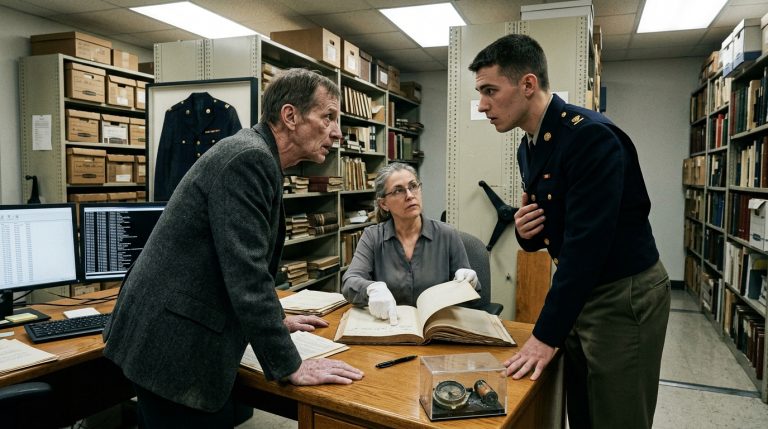
Reed did not flinch. He didn’t even look at the document the legal counsel began to pull from his briefcase. Instead, he drew a slim leather folder from beneath his left arm and flipped it open with a precise, metallic snap of its brass latch. Inside lay an official intelligence file stamped with deep red government seals, topped by a formal military photograph of Samuel Brooks—younger, his uniform crisp, but his eyes holding that same deep, calculated weariness Rachel had noticed in the treatment bay.
“This private facility,” Reed said, his voice dropping into a smooth, ironclad register that filled every square inch of the high-ceilinged lobby, “is currently holding Colonel Samuel Brooks. Five hours ago, an administrative decision was made by your office to flag his identification profile as a high-risk liability and order an unverified clinical transfer to an off-site clinic.”
“We followed the standard liability protocol for unidentified admissions,” Ellanar murmured, her hand faltering as her eyes scanned the top page of the leather folder. “He carried no insurance allocation, no valid state card—”
“He carried the active decryption markers for a deep-cover extraction network that has operated in the western sector for three decades,” Reed shot back, his gaze narrowing until it seemed to pin Ellanar against the wood grain of the desk behind her. “Had your staff executed that transfer order, his location would have been exposed to the municipal junction. He survived because one clinician inside this building chose to disregard your ledger.”
A collective gasp rippled through the nursing station. Linda slowly lowered her eyes, her fingers gripping the edge of a chart binder until her knuckles turned white. Jenna was standing by the water cooler, a single tear cutting a clean line through the powdery residue on her cheek.
Reed turned his head slightly, his eyes sweeping the perimeter of the room until they locked onto Rachel, who was standing near the eastern glass doors, her wet coat dripping gray water onto the clean tile floor. The two Marines at his flank stepped back instantly, opening a clear path through the center of the crowd.
“Nurse Carter,” Reed said, his voice softening by a fraction of a degree. “The Colonel is stable, but he has requested your presence before the transport detail clears the bay. The integrity of his treatment remains under your supervision.”
Rachel stepped forward, her chin lifting as she walked past Ellanar Green. The administrative notification form she had refused to sign remained on the desk down the hall, an insignificant scrap of paper text completely obliterated by the physical weight of the truth that had just entered the room.
CHAPTER 7: THE RECKONING LEDGER
The wet wool of Rachel’s coat dragged heavily against her frame as she moved past the white-gloved barrier of the Marine detail, her steps measured, unhurried, and anchoring the quiet of the room. Behind her, the automatic sliding doors closed with a soft, final sigh, sealing out the damp gray mist of the parking lot but trapping the pressurized hum of the idling diesel engines within the glass panes. Her boots left a trail of dark, broken-gravel imprints on the pristine white linoleum, leading directly to the center of the intake counter where Ellanar Green remained motionless.
Lieutenant Colonel Reed adjusted the slim leather folder under his arm, his fingers lingering on the embossed silver seal of the Department of Defense. He did not look back at the administrative line; his focus remained locked on Rachel as she approached, his head bowing a single, precise inch in recognition.
“The transport protocol is authorized under Section Four of the Emergency Civil Preservation Act,” Reed said, his voice carrying that smooth, ironclad weight that left no space for bureaucratic friction. “The localized quarantine placed on the patient’s telemetry has been overridden by the regional command. Ms. Green, your log files have already been mirrored to our central server.”
Ellanar’s hand, still clutching the small plastic clipboard, sank slowly to her side. The crisp edge of the suspension document she had pre-populated earlier crinkled under the sudden, involuntary pressure of her fingers. Her face had drained of its professional color, leaving only the dull, tired shadows under her eyes—the look of an accountant who had realized the ledger she spent twenty years balancing had been written in disappearing ink.
“We were mitigating institutional asset exposure,” the hospital’s legal counsel stammered, his briefcase still open on the counter, the neat white sheets of corporate bylaws looking thin and useless under the glare of the high-pressure sodium fixtures. “The clinical identity index was completely unresponsive. The municipal junction flagged the admission as an unverified legal liability.”
“The municipal junction flags what it is instructed to flag to preserve the separation of field assets,” Reed replied, his voice dropping into a quiet, cold register that caused the resident by the coffee machine to turn his eyes back to the floor. “The Colonel’s identity was quarantined to protect the seven active operational cells currently routed through the western transit hub. Your compliance protocol nearly severed that line.”
Rachel stopped beside the counter, placing the damp cardboard shoe box down on the laminate surface. The cardboard had softened from the rain, the corners starting to split, exposing the white rubber band binding her spare pens and the worn backing of the monochrome portrait underneath. She reached into her coat pocket, her fingers brushing past the quiet, unmoving gears of her father’s pocket watch to pull out the tarnished silver badge Sam Brooks had left in her palm.
She laid it flat on the counter between them. The dull light reflected off the faint, dark circular shadow where the original military engraving had been ground away to make room for the stamped letters: HOL CLASS 1968.
“The loading dose of ceftriaxone has twenty-two minutes left on the primary infusion,” Rachel said, her voice small but perfectly level in the wide silence of the lobby. “The systemic infection is anchored in the deep tissue of the left bicep, likely from an old fragment wound that went necrotic under exposure. If you move him before the fluid volume is restored, the peripheral vessels will collapse.”
Reed looked down at the silver tag, his features softening into a expression that looked remarkably like a faded, historical respect. He reached out with his white-gloved hand, his thumb tracing the stamped letters before turning the piece over to verify the linear pressure marks on the back. “The transport detail carries an advanced clinical suite, Nurse Carter. But the Colonel has stated he will not clear the holding bay unless your signature is recorded on the movement log.”
“She is currently under active administrative suspension,” Ellanar said, her voice faltering as she tried to re-establish the boundaries of her desk. “Her clinical credentials have been restricted from the central database.”
“Then you will reactivate them within the next ninety seconds,” Reed said, his gaze shifting back to the administrator with a sudden, sharp clarity that made the pen holder at the center of her desk vibrate with the low thrum of the vehicles outside. “The Department of Defense is extending a full federal service indemnity to St. Jude’s Facility under Case A status. Your ledger is clear, Ms. Green. But your jurisdiction over this practitioner is terminated.”
The silence that followed was broken only by the rapid, rhythmic clack of Nancy’s keyboard behind the counter. She wasn’t processing a discharge file this time; her fingers were moving across the system override panel, her face illuminated by the green glow of the terminal as she restored the access index for identification number forty-two. With a small, electronic chirp, the proximity reader mounted by the administrative door flashed green, its magnetic lock releasing with a heavy, internal click.
Linda stepped out from the treatment bay, her hands holding a clean white clipboard containing the original emergency intake sheet. She didn’t look at Ellanar; she walked straight to Rachel, her fingers trembling slightly as she offered the pen. “The laboratory telemetry just cleared the central queue, Rachel. The white cell count is down to fifteen thousand. You were right about the loading time.”
Rachel took the pen, its plastic barrel cold against her wet fingers. She signed her name at the bottom of the clinical override line, her handwriting small, neat, and precise—the same script she had used in her little notebook for fifteen years to record the names of grandchildren and favorite meals. She didn’t look back at the administrative office as she handed the clipboard back to Linda. She pulled her winter coat tighter around her sea-foam scrubs, her hand returning to the pocket where her father’s watch lay silent, and began the slow, unbroken walk toward the holding bay where Sam Brooks was waiting.
CHAPTER 8: THE REPAIRED CADENCE
The small plastic pen clicked as Rachel set it down on the counter, the raw tension of the administrative lobby settling into an absolute, grounded quiet. She turned from the desk, her coat still heavy with the scent of the outdoor rain, and walked down the treatment corridor one final time. In the holding bay, Sam Brooks sat on the edge of the gurney, his olive-drab jacket draped over his shoulders, his breath coming in a rhythmic, undisturbed cadence. The dark stain on his sleeve had been addressed with fresh sterile cotton, and the pale, yellowish tint of his skin had given way to a faint flush of returning warmth. He looked up as she crossed the threshold, his weathered hands resting quietly on the handle of a dark wood cane.
“The line is clear, Colonel,” Rachel said softly, her hand coming to rest on the chrome bar of the gurney rail.
“I know,” Sam murmured. His voice was a low, gravelly rasp, but the tremor in his fingers had subsided into a steady, intentional stillness. He reached into his pocket and lifted the tarnished silver badge, placing it into her hand once more. “The network remains locked, Nurse Carter. Because you didn’t look at the ledger. You looked at the man.”
There was no sudden counter-move from the administrative corridor. The system had not surrendered easily; the digital terminal behind the desk still flashed with the historical review protocols that would take months to rewrite, but the structural power of Ellanar Green’s corporate compliance had dissolved against the absolute reality of human preservation. The legal files were locked away in federal custody, leaving the hospital wing to breathe in a slow, unhurried peace that had been missing for years.
Months later, the early afternoon light filtered through the thin lace curtains of Rachel’s porch, casting warm, geometric patches of orange brightness across the small wooden table. The air was crisp, carrying the dry, sweet scent of falling leaves from the maple trees down the lane. On the table sat two heavy porcelain mugs, steam rising from the dark amber surface of freshly brewed black tea, its warmth radiating against the smooth, faded grain of the cedar planks.
Sam sat across from her, his heavy cane hooked over the back of the wicker chair. His frayed military jacket had been washed, the cuffs repaired with neat, dark green thread that reinforced the worn cotton fibers. Between them lay the small, disassembled components of her father’s mechanical pocket watch—the tiny brass cogs, the hairspring, and the polished iron balance wheel laid out precisely on a soft square of green felt.
“The internal escape wheel has a blunt tooth,” Sam said, his thumb holding a small metal file with a precision that belonged to someone who spent decades handling the delicate alignment of field machinery. He made two micro-adjustments to the brass gear, the scrape of the file remarkably soft in the quiet of the yard. “It catches every thirty seconds because the institutional impact was too violent. It doesn’t need to be replaced. It just needs the friction smoothed away.”
Rachel watched his fingers move, the fine, small acts of labor holding the same rhythmic focus she used when cleaning a wound or checking a baseline pulse. “Ellanar Green requested a formal policy review last Tuesday,” she said, her fingers curling around the warm porcelain of her mug. “The board is introducing an explicit medical mercy exception for the triage index. They’re naming it after the department’s veteran pool.”
Sam paused, his eyes lifting from the small brass wheel. The hard, stone-like calm that had defined his profile in the emergency lobby had softened into a deep, humanistic vulnerability. “A system can only be bent so far before it breaks, Rachel. But a person who understands the texture of the hurt can rebuild the foundation.”
He picked up the small tweezers, lifting the balance wheel and dropping it back into the heart of the brass casing. With a tiny, delicate twist of his thumb, he tightened the retaining screw.
The watch instantly came to life. The erratic, stammering skip that had plagued the mechanism for years died away, replaced by a clear, resonant tick-tick-tick that was perfectly level and unhurried. The small sound filled the space between them, a steady, unbroken cadence that seemed to measure the quiet growth of the world around them rather than the rigid parameters of an administrative clock.
Rachel reached out, her fingers touching the cool silver rim of the casing. The metal felt different now—not like a tool of survival or a marker of systemic defiance, but like a repaired fragment of her own history, restored to a functional grace. She looked out toward the lane where the streetlights were just beginning to flicker alive in the twilight, her spirit completely steady, knowing that the small human touches left within the storm were the only ledgers that truly mattered in the end.