The Cold Friction of Paper and Ice: A Tale of Bureaucratic Retribution
CHAPTER 1: THE INDECENCY OF SIGHT
“Turn that camera off right now.”
The scream sliced through the ambient hum of the living room, sharp enough to freeze the digital audio meters on the laptop display.
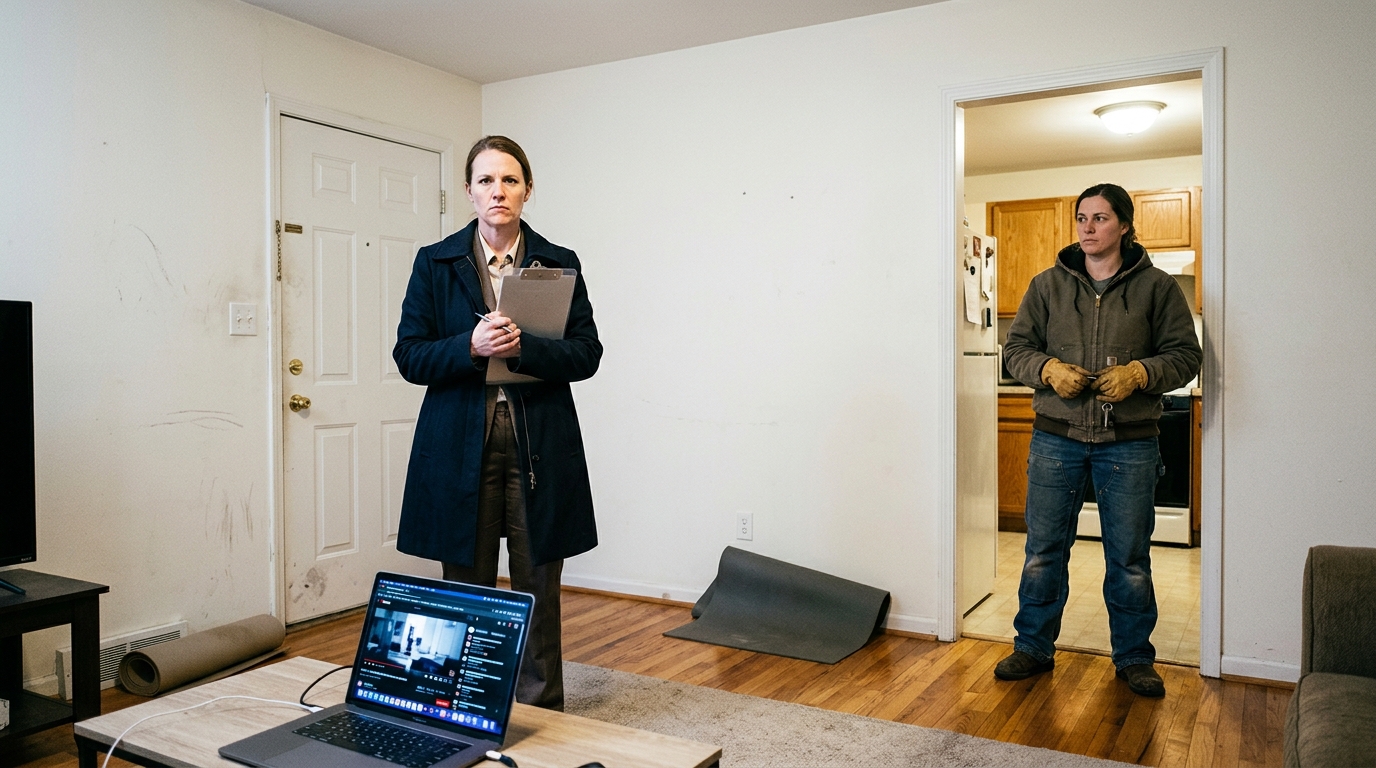
My wife stopped mid-pose on her mat. Three hundred live students hung in digital limbo, their chat boxes cascading with confusion. In the frame behind her, the front door didn’t just open—it slammed back against the drywall as Melissa Grant crossed the threshold without knocking.
“This stream is terminated,” Melissa said. She didn’t look at my wife’s face. She didn’t acknowledge the four years of quiet residency or the tax bills paid on time. Her eyes stayed locked on the black spandex leggings and the grey tank top. “This is an active broadcast of indecent attire on community-adjacent visuals. You are in direct breach of neighborhood standards.”
My wife stood up slowly. Her breathing remained steady, disciplined by years of athletic control, but the vein in her neck pulsed once. “This is my morning class, Melissa. It’s my livelihood.”
“Not on this property.” Melissa stepped closer, her heels clicking like sharp hammer taps on the hardwood. She thrust a plastic clipboard toward the camera lens, blocking the light. “Families live in this corridor. Children walk these sidewalks. We do not tolerate commercialized degradation in plain view of the common areas.”
“Which rule?” my wife asked. Her voice was flat, devoid of panic. “Cite the section in the covenants.”
Melissa leaned into the camera’s wide-angle lens, her mouth curving into a tight, bloodless line. “You don’t need to know the rule. You need to turn off the power.”
She turned her back before the sentence even finished landing, stepping out onto the porch and pulling the door shut behind her.
I didn’t move from the kitchen counter. My thumb rubbed the cold, notched steel of my tire-tread depth gauge, feeling the millimetric ridges bite into my skin. I didn’t raise my voice. I didn’t chase her down the driveway. I watched her through the frost-rimmed glass as she walked toward her sedan, her coat pressed perfectly against her ribs, her clipboard tucked under her arm like a weaponized ledger.
She thought she had just established control over a stubborn resident. She had no idea she had just entered the lens of the one house in this subdivision that understood exactly how systems grind people to dust.
Forty-eight hours later, the first envelope didn’t come by post. It was slapped directly onto the glass of our storm door with a strip of blue painter’s tape.
My wife pulled it off, her fingers leaving faint smudges on the paper. “It’s an administrative assessment.”
“Read the total,” I said, not looking up from my laptop.
“Twenty-five thousand dollars.” She let out a short, dry breath that was almost a laugh. “For ‘Unsanctioned Commercial Media Operations and Visual Degradation’.”
“No board signature?”
“Just her initials.”
I took the paper from her hand. The print was fresh, the toner still smelling faintly of warm plastic. No statutory references. No appeal hearing date. Just an invoice and a forty-eight-hour compliance deadline.
I set the paper down next to my depth gauge. I didn’t file an appeal. I didn’t write an angry email to the board listserv. I opened a empty spreadsheet, created a new directory labeled Grant_M_Compliance, and logged the exact timestamp of delivery.
The second notice arrived on Thursday at precisely 8:15 AM.
Same red header. Same cold, bureaucratic typography. But the total had been recalculated: $38,000. Attached to the bottom was a brief, single-line addendum: Failure to remit within 24 hours will trigger immediate escalation to property access restrictions and professional licensing notifications.
My wife stopped mid-reach for her coffee cup. Her thumb pressed hard against the ceramic, the nail turning white under the pressure. “She’s emailing my certification board.”
“She’s typing words into a template,” I corrected gently, stepping beside her. “She wants a reaction. She wants you to plead, or yell, or shut down the stream.”
“And if she actually sends it?”
“Then she creates a written record of intentional tortious interference,” I said, my voice dropping an octave into the flat, clinical register I used for municipal service evaluations. “Let her print the paper.”
By Saturday morning, the third packet sat on the mat. $52,000.
The strategy was obvious now. It wasn’t an attempt to collect money. Nobody expected a suburban household to write a check for fifty grand over a yoga mat. It was a structural chokehold—a rapid-fire accumulation of paper designed to induce panic, force a surrender, and make us vanish from the neighborhood narrative before anyone started asking questions about why she was so terrified of a camera pointed toward the street.
I walked to the front window and pulled back the blind by a quarter of an inch. Across the street, the sidewalk sat in deep morning shadow. A thin, translucent crust of black ice coated the concrete curb, completely unmarked by salt, completely invisible to anyone stepping out of a car.
I rolled the steel tread gauge across my knuckles.
“She’s not looking at your clothes,” I murmured to the empty room. “She’s looking at what’s behind you.”
CHAPTER 2: THE RECKONING OF PAPER
The $52,000 notice didn’t drop off the edge of the kitchen table, but it felt weightier than the wood underneath it.
I kept my thumb pressed against the notched steel of the depth gauge, feeling the cold transfer from the metal into my callus. Outside the window, the morning sun struck the street at a low, punishing angle. It didn’t melt the ice on the curb across from our driveway; it turned it into a mirror.
“Fifty-two,” my wife said quietly from the hallway. She had her hair pulled back, ready for her second session of the day—indoors this time, with the blinds drawn tight. “She’s doubling it every forty-eight hours.”
“Not doubling,” I said, stepping back from the glass. “Calculating.”
I picked up the third packet. The paper was heavy stock, eighty-pound bright white, identical to the previous two. But when I flipped to the back page, the staple wasn’t set at the standard forty-five-degree angle in the top left corner. It was punched twice, straight through the margin, binding a fold-out addendum that hadn’t been included in the initial digital emails.
My thumb ran along the bottom margin. There, printed in tiny six-point sans-serif type beneath the formal seal of the homeowners association, was a routing line: Ref: Vanguard Contract 4-B / Tier-1 Compliance Hold.
I didn’t point it out to her. Not yet.
“She isn’t trying to collect fifty-two thousand dollars,” I said, setting the packet down next to the first two. “If she wanted money, she’d have sent a demand letter from a collection firm. She’s building a ledger to justify a lien.”
“A lien on the house?” Her voice didn’t shake, but her eyes locked onto mine. “Over a live stream?”
“Over the address,” I corrected. “If she files an administrative lien against the title, we can’t refinance, we can’t sell, and we lose leverage in any dispute before the municipal board. She’s pinning us to the floor so we can’t move.”
She looked at her laptop sitting closed on the counter. “I cancelled the outdoor sessions for next week.”
“No,” I said. “You didn’t cancel them. You rescheduled them.”
I grabbed my heavy canvas coat off the peg by the door. The brass zipper was cold against my fingers. I pulled on my leather work gloves, feeling the stiff leather yield as I made a fist around the steel gauge.
“Where are you going?” she asked.
“To measure the street,” I said.
The air outside hit my throat like dry salt. The neighborhood was dead quiet—the kind of suburban silence that meant people were watching from behind double-paned glass. I didn’t head down our driveway toward the streetlamp where Melissa Grant usually parked her sedan. Instead, I walked thirty yards west, toward the cul-de-sac bend where the shade from the tall pines kept the pavement permanently frozen.
The concrete curb here wasn’t just cold; it was coated in a quarter-inch slab of clear, treacherous glaze.
I knelt on the cold asphalt, feeling the chill bite through the knees of my heavy denim work pants. I pressed the probe of the depth gauge into the seam where the sidewalk met the curb gutter. Three-sixteenths of an inch of solid ice.
I looked up at the light pole six feet away.
The galvanized steel post had two clean, unpainted drill holes four feet off the ground—the exact spacing for a standard municipal yellow caution placard: Caution: Ice Conditions May Exist.
The post was empty. The metal around the bolt holes was bright and raw, stripped of rust. The sign hadn’t fallen off during a storm. It had been unbolted within the last forty-eight hours with a socket wrench.
A car engine started down the block.
I didn’t turn around right away. I stayed on one knee, pressing the steel probe deeper into the frozen seam until it hit the concrete base. The engine hummed closer, smooth and low, before idling to a stop ten feet behind me.
I stood up slowly, wiping the ice dust off the tip of my gauge against my glove.
Melissa Grant’s silver SUV sat in the middle of the road, the driver’s side window already rolling down with a faint mechanical hiss. She didn’t have her clipboard this time. She had her hands resting at ten and two on her leather-wrapped steering wheel, her fingernails painted a sharp, matte burgundy.
“Mr. Vance,” she said. Her voice carried clearly over the rumble of the exhaust. “Inspecting community infrastructure isn’t a resident responsibility.”
“The sign’s gone, Melissa,” I said, keeping my hands at my sides.
“Signs are replaced on a scheduled maintenance cycle,” she replied, her face completely immobile, shielded behind polarized sunglasses despite the gray sky. “Unapproved surveys of common elements create liability for the board.”
“Liability for the board,” I repeated softly. I took two slow steps toward her vehicle, stopping just short of the driver’s side mirror. “Or liability for the vendor?”
Her hands tightened slightly on the wheel, the leather creaking under the pressure of her grip. It was a micro-action—brief, almost invisible—but the blood left her knuckles for a split second.
“Your outstanding assessment balance is now fifty-two thousand dollars,” she said, ignoring my question entirely. “The board meets on Tuesday. If the balance isn’t cleared or a formal cure agreement isn’t signed, the lien notice moves from administrative hold to public filing at the county clerk’s office.”
“Under what authority?”
“Section Four of the Master Covenants,” she said, her voice dropping into that rehearsed, clinical rhythm again. “Preservation of Community Integrity and Order.”
“Section Four requires a two-thirds board vote before any assessment exceeding five thousand dollars can be levied,” I said, leaning in slightly so she could see the steel gauge tucked in my palm. “Unless it’s designated an emergency safety mitigation.”
She didn’t answer. She didn’t look at the gauge. She simply touched the power-window button, and the glass began to slide back up between us.
“Tuesday, Mr. Vance,” she said as the window sealed shut.
The SUV pulled away, its tires crunching softly over the thin layer of sand scattered near the intersection—sand that ended abruptly ten feet before the icy curve where I was standing.
I watched her red taillights vanish around the corner. Then I pulled out my phone, unlocked the camera, and took four high-resolution photos: the raw bolt holes on the signpost, the three-sixteenths ice depth on the un-salted gutter, and the exact spot where the sand distribution stopped short.
When I got back inside, my wife was standing by the stove, holding two mugs of black coffee. She handed one to me without speaking.
“She’s filing the lien on Tuesday,” I said, setting the phone on the table.
“Can she do that?”
“She can file the paper,” I said, opening my laptop. “The clerk doesn’t check the validity of the debt at the counter; they just stamp the seal and charge a forty-dollar filing fee.”
I opened a web browser, bypassed the local HOA portal entirely, and navigated directly to the public procurement records for the county. In the search bar, I typed the string I’d found printed in six-point font on the back of the notice: Vanguard Contract 4-B.
The screen flickered, loading a dense index of municipal service agreements, municipal vendor logs, and winter maintenance schedules.
There it was. Vanguard Logistics LLC — Municipal Winter Mitigation & Hazard Maintenance.
I clicked the PDF link for the current fiscal year. The document opened to a table of approved subcontractors for residential subdivisions. Listed under Tier-1 Expedited Clearance was our development, complete with an annual allocation of forty-five thousand dollars for mandatory ice-removal, hazard signage, and continuous street salting.
At the bottom of the vendor approval form was the signature line for the client representative who certified that all winter services had been performed satisfactorily before the county released the funds.
The signature wasn’t a typed name. It was a loop of black ink, sharp and slanted.
Melissa Grant, Board President.
I stared at the screen while my coffee went cold in my hand.
“She isn’t using the HOA budget to fight us,” I said, the realization settling into my chest like a cold weight. “She’s using the municipal safety contract. She’s reporting our street as fully salted and cleared to collect the county reimbursement, while leaving the ice on the ground to avoid paying the salt crew.”
My wife leaned over my shoulder, reading the lines on the screen. “And the camera?”
“Your camera was pointed at the signpost,” I said. “Every morning at seven AM, your live stream recorded the street behind you. It recorded forty-five days of untreated ice on a road that the county paid forty-five thousand dollars to keep clean.”
The front doorbell rang—a loud, electronic chime that echoed down the hallway.
CHAPTER 3: THE FRICTION OF EXPOSURE
The doorbell chime hung in the air like a struck wire.
My wife’s hand froze on the edge of the kitchen island, her knuckles pale against the granite. I didn’t close the laptop lid. I turned the screen three inches to the left, angling the glowing PDF of Vanguard Contract 4-B away from the direct line of sight through the front entryway glass.
“Stay here,” I said softly, stepping around the counter.
My boots hit the hardwood with a flat, rhythmic thud. Through the frosted glass panel beside the deadbolt, the shadow was tall, lean, and holding a thick courier envelope rather than a clipboard.
I pulled the door back six inches. The cold air rushed into the foyer, smelling of ozone and diesel exhaust.
A man in a navy parka stood on the concrete porch, his collar pulled high against the wind. He didn’t have a badge, but he had a mechanical brass clicker in his left hand, turning it over and over between his fingers with a rhythmic metallic snick-snick.
“Mr. Vance?” he asked. His breath bloomed white in the gap between us.
“Yes.”
“Process delivery for the subdivision administrative board.” He didn’t offer a pen or ask for a signature. He slid a thick, manila packet through the gap in the doorway. It was stiff, double-sealed with reinforced fiber tape. “Official notification of immediate structural review.”
I caught the packet by its lower edge, feeling the grit of cheap adhesive. “Who sent this?”
“Counsel for the executive committee,” he said, already taking a step backward off the porch. His boots crunched on the thin, un-salted frost near the step. “The hearing is set for tomorrow, nine AM, at the annex. Absence constitutes default judgment.”
He turned and walked down the driveway without waiting for a reply. He didn’t take the sidewalk; he walked straight down the middle of the asphalt, steering clear of the shaded curb where the three-sixteenths-inch ice slab lay hidden under the dust.
I pulled the door shut, locking it with a sharp twist of the brass deadbolt.
“What is it?” my wife asked, coming down the hall. Her eyes were fixed on the reinforced tape.
I tore the top seam open with my thumb. The paper inside wasn’t standard eighty-pound bond. It was formal legal stock, stamped at the header with an official county seal: Notice of Emergency Injunction & Property Classification Restraint.
I read the first three lines under the bolded header.
“She’s accelerated the timeline,” I said. “She isn’t waiting until Tuesday.”
“What does it say?”
“She filed an emergency petition with the county clerk under Priority-Tier Expedited Clearance,” I said, pointing my index finger at the second paragraph. “She’s claiming our property poses an active public nuisance that threatens the subdivision’s municipal service status.”
“Our property?” Her voice dropped into a dangerous register. “We haven’t touched common ground.”
“It’s not about the ground,” I said, carrying the packet into the kitchen and spreading the pages beside the laptop. “Look at the filing justification. She attached six sworn affidavits from nameless ‘board representatives’ stating that unapproved commercial filming along the perimeter has compromised the safety reporting required for the municipal winter maintenance agreement.”
She leaned over the counter, scanning the pages. Her micro-action gave her away—her right thumb unconsciously dug into the palm of her left hand, a habit she only had when she was calculating a major risk. “She’s trying to blame us if the city revokes the snow removal contract.”
“No,” I said, my voice cold and absolute. “She’s building a pre-emptive defense. If the county inspects the street and sees the untreated ice, she wants a sworn legal record claiming we prevented the maintenance crew from working.”
“By standing on a yoga mat?”
“By recording the street,” I said. “The camera is the only weapon that doesn’t let her rewrite the log.”
I sat down in the wooden kitchen chair, pulling my phone from my pocket. I hooked it to the laptop with a braided cord, initiating an automated extraction of the live-stream archives from the last forty-five days. The progress bar began to crawl across the screen—two gigabytes, four gigabytes, eight.
Every file was timestamped down to the second, backed by cloud metadata.
“Where are you going with this?” she asked, watching the bar fill.
“I’m not going to the HOA board,” I said. “If you argue with a thief in her own living room, she controls the door. We’re taking the log to the people who pay the bill.”
I brought up the public directory for the Municipal Audit Division, locating the direct contact for the contract oversight officer assigned to Vanguard Contract 4-B.
I drafted a single, three-line email. No adjectives. No emotional appeals about harassment or fifty-two-thousand-dollar fines. Just cold, structural friction:
Attached are forty-five days of continuous, timestamped video logs documenting un-mitigated black ice conditions along Sector 4-B. Cross-reference against certified vendor completion logs filed under Account #883-M.
I attached four high-definition stills—the raw bolt holes on the empty warning post, the steel depth gauge reading three-sixteenths of an inch, the abrupt termination of the sand trail, and the signature line bearing Melissa Grant’s sharp, slanted loop.
“Sender?” my wife asked quietly, her hand resting on my shoulder.
“Resident of Sector 4-B,” I said, clicking send.
The screen flickered as the transmission completed. Outside, a sudden gust of winter wind rattled the loose pane in the kitchen window, sending a spray of dry, frozen snow swirling across the untreated driveway.
My phone screen lit up five seconds later. It wasn’t an automated auto-reply from the city.
It was a text message from an unknown local number: The board has called an emergency executive session for tonight at seven PM. You are advised to bring a cashier’s check for the full balance if you wish to suspend the public filing.
I picked up my steel depth gauge from the table, rolling its cold, heavy ridges across my knuckles.
“She thinks we’re going to negotiate,” I said.
CHAPTER 4: THE ANATOMY OF A AUDIT
The screen of my phone stayed lit for ten seconds before dimming into black.
I didn’t reply to the text. I rolled the steel gauge over my knuckles, feeling the sharp, cold ridges press into my index finger. Beside me, the laptop hummed as the last of the forty-five video archives finished uploading to the encrypted server.
“They want a cashier’s check by seven,” my wife said. She stood with her arms folded tight over her chest, staring down at the glowing text notification. Her jaw was set, but her fingers were twitching against her elbows—a micro-action that betrayed the sudden spike of adrenaline. “That gives us less than three hours.”
“It gives her less than three hours,” I said.
I leaned forward, tapping the trackpad. A new browser window opened, pulling up the public ledger for the county’s municipal service disbursements. I cross-referenced the line item for Vanguard Contract 4-B against the municipal budget allocations for Sector 4-B.
The numbers didn’t just misalign; they collided.
Every quarter for the last three years, forty-five thousand dollars had been disbursed from the county reserve directly to a holding account managed under the HOA’s executive seal. Each transfer was tied to a signed certification of completion. Every single document bore the same signature: Melissa Grant, Board President.
Yet, when I opened the HOA’s internal financial summary—published annually to residents in a sanitized, three-page PDF—the winter maintenance line item didn’t read forty-five thousand dollars.
It read twelve thousand.
Thirty-three thousand dollars a year was disappearing into the gap between what the county paid out under Priority-Tier Expedited Clearance and what was actually spent on salt and plows. Over three fiscal cycles, that wasn’t a minor clerical error. It was ninety-nine thousand dollars of cold, unaccounted equity.
“She isn’t covering for a lazy contractor,” I said, pointing the tip of my gauge at the screen. “She is the contractor. Vanguard Logistics isn’t an independent firm. It’s a shell entity registered to an off-site mailbox.”
My wife leaned closer, her eyes scanning the tiny PDF print. “And if an auditor steps onto Sector 4-B after an injury report—”
“—they request the logs,” I finished. “They look at the street, compare it to the paid invoices, and realize the maintenance was never performed. One slip-and-fall lawsuit triggers a forensic review by the Municipal Audit Division. Her insurance policy voids instantly for fraud. She loses the house, the title, and her freedom.”
A sharp crack echoed from the front porch.
We both turned toward the door. Outside, the temperature had plunged twelve degrees in ninety minutes, turning the melting frost on the eaves into heavy, clear icicles. The porch roof was settling under the sudden drop, the wood groaning against the iron brackets.
I stood up, pulling my canvas coat over my shoulders.
“Where are you going?” she asked, reaching for my forearm. Her grip was tight, her palm warm against the cold fabric of my sleeve. “The meeting is at seven.”
“The Municipal Audit Division doesn’t wait for board meetings,” I said, pulling my leather gloves on. “They have an emergency field investigator on call for municipal infrastructure discrepancies. If a site report shows active hazard concealment, they inspect before the salt trucks run.”
“And if she sees you out there?”
“Let her watch,” I said. “The camera isn’t on the porch anymore. It’s on the street.”
I stepped out onto the driveway. The wind hit my face like a wet towel, freezing the moisture in my nostrils. The street was an unbroken sheet of black glass now. Every streetlight cast a long, slick glare across the asphalt, illuminating the complete absence of sand or sodium chloride.
I walked toward the cul-de-sac bend, taking slow, deliberate steps. My boots had deep rubber treads, but even they slipped a fraction of an inch with every stride.
Across the street, a front door opened.
Melissa Grant stepped out onto her porch. She wasn’t wearing her coat. She had on a thick wool cardigan, her arms crossed tight against the bitter air. She stood under her porch light, her eyes tracking my movement as I reached the un-signposted curb.
She didn’t shout this time. She didn’t hold a clipboard. She walked down her front steps, her dress shoes clicking unnaturally hard on the frozen concrete until she reached the edge of her lawn.
“Mr. Vance,” she called out. Her voice was thin, clipped by the wind. “You’re making a catastrophic mistake.”
I stopped ten feet away, my hands plunged deep into my coat pockets. “The field officer from the county is twenty minutes away, Melissa.”
She didn’t flinch. Her face remained set in that smooth, unyielding mask of institutional authority, but her right hand reached out to grasp the cold iron of her mailbox post. Her knuckles turned white against the black metal.
“You think you understand how this community functions,” she said, her voice dropping into a low, venomous murmur. “You think you’re exposing a flaw. You’re destroying the property values of forty-eight families because your wife couldn’t move her camera indoors.”
“I’m measuring the ice,” I said calmly.
“There is no ice on the records!” she snapped, her composure cracking for a single, sharp second. “The records are certified! The county accepted the filing at four PM!”
“The county accepted the paper,” I said, taking a step closer until I could smell the sharp, metallic tang of the frozen air between us. “The auditor brings a thermometer.”
A pair of headlights swept around the corner of the subdivision entrance.
The vehicle wasn’t a plow. It wasn’t a police cruiser. It was a dark gray municipal sedan with high-visibility reflective decals along the passenger door: County Oversight & Contract Verification.
The sedan slowed down as it approached the cul-de-sac, its tires crunching faintly as they hit the thin layer of sand near the main road before sliding silently onto the untreated black ice of Sector 4-B.
Melissa’s hand slipped off the mailbox post.
The sedan came to a complete stop in the center of the road. The driver’s door swung open, and a man in an official high-visibility parka stepped out, carrying an electronic thermal scanner and a heavy digital clipboard.
He didn’t look at me. He didn’t look at Melissa. He walked straight to the gutter, pointed the infrared sensor at the concrete, and pressed the trigger.
The device let out a flat, electronic beep that cut through the frozen silence like a whistle.
“Sector 4-B,” the inspector said aloud, his voice recorded on his shoulder-mounted lapel mic. “Surface temperature twenty-two degrees. Chemical treatment zero percent. Physical hazard unmitigated.”
He turned slowly, looking directly at Melissa Grant as she stood frozen on the edge of her lawn.
“Mrs. Grant?” he asked. “Are you the certifying officer for Vanguard Contract 4-B?”
CHAPTER 5: THE WEIGHT OF THE RECORD
Melissa Grant did not move. Her hands remained rigidly clasped at her waist, her fingernails pressing so hard into her cardigan that the gray wool puckered around her knuckles.
“Mrs. Grant?” the inspector repeated. He stepped over the frozen gutter, his heavy tread-soled boots making a wet, crushing sound against the thin ice crust. “I’m Officer Miller, Field Inspector for the Municipal Audit Division. Are you the certifying signatory on Vanguard Contract 4-B?”
The street went deathly quiet. Across the cul-de-sac, three porch lights flickered on in sequence. Neighbors were peering through blinds, shadows shifting behind frost-patterned glass.
“This is an informal inquiry,” Melissa said. Her voice pitched higher than usual, cracking against the freezing air before she forced it back into a tight, practiced register. “The board was not given notice of an audit. Any site review requires a forty-eight-hour administrative window under our subdivision bylaws.”
“Subdivision bylaws don’t govern municipal procurement fraud, Mrs. Grant,” Officer Miller said. He raised the digital clipboard, his thumb clicking the side button. “We received a direct digital dispatch two hours ago containing forty-five days of continuous, timestamped visual telemetry for Sector 4-B. I’m comparing those logs against these.”
He reached into his parka flap and pulled out a stapled stack of blue-lined municipal ledger sheets.
“Account number 883-M,” Miller read aloud, his voice flat, devoid of theatrics. “Priority-Tier Expedited Clearance. Signed by Melissa Grant on December twelfth, January third, and February first. Each invoice certifies three full passes of chemical de-icing per week at twelve hundred dollars per run.”
He held up the thermal scanner. The digital screen glowed bright amber in the dark. “My sensor reads negative chemical residue across ninety-two percent of this road surface. The temperature of the asphalt is twenty-two degrees. There hasn’t been salt on this pavement since the first snowfall of November.”
Melissa took a half-step backward, her shoe heel catching on the edge of her lawn. “The contractor reported completion. If Vanguard Logistics failed to perform the work, that is a third-party vendor default. The HOA is a victim of breach of contract.”
I took three slow steps forward, stopping beside the inspector’s sedan. The engine idle was a steady, warm vibration against the cold air.
“Vanguard Logistics isn’t a third-party contractor, Melissa,” I said.
She snapped her head toward me, her eyes narrowing into sharp, dark slits. “Stay out of this, Vance.”
“I pulled the corporate registration from the secretary of state’s public database twenty minutes before Officer Miller arrived,” I said, pulling a folded sheet of paper from my coat pocket. I didn’t hand it to her. I handed it directly to Miller. “Vanguard Logistics LLC was incorporated three years ago. Registered agent: Melissa Grant. Principal business address: Suite 204, 110 Commercial Way—the same virtual mailbox address listed on your HOA reimbursement checks.”
Officer Miller took the sheet. He didn’t look surprised; he simply scanned the corporate ID number at the top and cross-referenced it on his tablet screen.
“Ninety-nine thousand dollars over three fiscal cycles,” I continued, keeping my voice level, stripped of anger. “You billed the county forty-five thousand a year under Priority-Tier Expedited Clearance, spent zero on salt crews, and reported twelve thousand in ‘routine maintenance’ to the homeowners. You didn’t just pocket the difference—you used the HOA account to launder the municipal checks.”
“That is a baseless slander!” Melissa’s voice broke entirely now, echoing down the dark street. “You’re fabricating documents because you couldn’t pay your assessment! You owe fifty-two thousand dollars in community violations!”
“The assessments were filed under emergency safety mitigation authority,” Miller interrupted, his eyes locked on his tablet. “According to county record, you used those violations to justify a legal hold on Mr. Vance’s property. But you can’t claim an emergency safety hazard on a street you certified as fully cleared under a municipal contract.”
He tapped the screen three times, the cold digital glass emitting a sharp, final chime.
“Effective immediately,” Miller said, looking up, “Account 883-M is frozen under Municipal Audit Division authority. All pending administrative liens filed by this executive committee under Vanguard Contract 4-B are stayed pending state review.”
“You can’t freeze the HOA accounts!” Melissa took two rapid steps toward the inspector, her composure entirely shattered. “We have operational expenses! We have street lighting, sanitation, insurance—”
“The state attorney general’s office handles the asset hold, Mrs. Grant,” Miller said, reaching into his pocket for a second, yellow carbon-copy form. “You are instructed not to alter, remove, or access any digital or physical ledgers associated with Vanguard Logistics or Sector 4-B. A formal summons for the emergency board hearing will be served at your residence at eight AM tomorrow.”
He handed her the yellow slip. She didn’t take it. The paper fluttered out of his gloved fingers, landing face-up on the slick, black ice at her feet.
Officer Miller turned back to his car, opened the door, and slid inside. The sedan backed out of the cul-de-sac slowly, its snow tires gripping the road as it vanished past the subdivision gates.
The street was dead silent again.
Melissa stood under her porch light, staring down at the yellow paper lying in the frozen gutter. Her breath came in short, jagged plumes of white steam. She looked at me once—not with anger, not with arrogance, but with the cold, hollow realization of a gambler who had played her last card and watched the dealer flip a losing hand.
She didn’t speak. She turned, walked up her front steps, and pulled her heavy oak front door shut. The deadbolt clicked into place with a dry, metallic snap.
I turned and walked back toward my house. My boots crunched steadily over the frozen ground.
When I opened the front door, my wife was standing in the warm light of the entryway. She didn’t ask what happened. She had watched through the front window, her hand resting against the glass where a small patch of frost had melted from her breath.
“It’s over?” she asked softly.
“The lien is dead,” I said, taking off my gloves and setting them on the bench. “The state takes the ledgers at eight AM.”
I reached into my pocket and pulled out my steel depth gauge, setting it down on the entryway table next to the laptop. The metal clicked against the wood—a clean, quiet sound that signaled the end of the long, bitter freeze.
CHAPTER 6: THE ARCHITECTURE OF CLEAR PAVEMENT
The steel depth gauge clattered against the oak tabletop, its notched edge leaving a tiny, barely visible dent in the grain.
My wife didn’t move away from the entryway bench. She unzipped her winter parka slowly, the teeth of the zipper giving off a harsh, metallic rasp in the quiet hall. Her hands were still stiff from the draft, her thumb unconsciously rubbing a pale pressure mark into her palm.
“They’re really freezing the accounts?” she asked, her voice dropping into the quiet space between us.
“The order went through before Miller drove out,” I said, unlacing my boots step by step. I kicked them off onto the rubber tray by the wall, the heavy soles caked with a crust of gray road grit and frozen slush. “Account 883-M is locked. Priority-Tier Expedited Clearance was revoked the moment his thermal scanner hit twenty-two degrees.”
She picked up the depth gauge, holding it by its cold stem. “What happens to the fifty-two thousand?”
“It never existed,” I said, walking past her into the kitchen. The refrigerator hummed low in the corner. I poured two glasses of tap water, the cold pipes vibrating inside the drywall. “The assessment was tied to the emergency safety clause under Vanguard Contract 4-B. When the Municipal Audit Division voided the contract for fraud, every administrative fine generated under that filing collapsed into evidence.”
The floorboards groaned above us as the house adjusted to the midnight drop in temperature. Outside, down at the end of the cul-de-sac, a heavy diesel engine turned onto Sector 4-B.
It wasn’t a patrol car or an investigator’s sedan.
The low, rhythmic thud of a six-cylinder engine echoed through our double-paned windows, accompanied by the loud, metallic scraping of a heavy steel plow blade riding an inch above the concrete. A blinding flash of yellow strobe light swept across our living room ceiling, painting the walls in sharp, alternating bands of amber and shade.
My wife walked to the front window, holding her glass in both hands. I stood half a step behind her shoulder.
A orange county service truck was backing into the curve. Two men in high-visibility vests stood on the rear platform, shoveling dense, pink-tinted rock salt out of the bed and casting it in wide, heavy arcs across the untreated gutter. The coarse granules hit the three-sixteenths-inch ice sheet with a sound like thrown gravel, immediately biting into the frozen glaze.
Across the street, the porch lights at Melissa Grant’s house remained dead black.
Her driveway was dark, her silver SUV parked rigid against the garage door. There were no paper packets on her porch, no clipboards tucked against her chest, no official notices pinned to our glass. The yellow carbon-copy slip Miller had dropped still lay face-up in the slush near her mailbox, partially buried under a fresh shower of municipal salt.
“She’s stepping down,” my wife said, watching the amber strobes recede down the block.
“She doesn’t have a choice,” I replied. “The emergency board session at eight AM isn’t a meeting. It’s a formal handoff to a court-appointed receiver. Every dollar from the Vanguard account has to be accounted for before the state attorney general signs off on the subdivision’s charter.”
She set her water glass on the sill, turning to face me. The tension that had held her shoulders tight for three weeks finally gave way, her breath coming out in a long, quiet exhale that didn’t fog the glass. “The class tomorrow?”
“Set the tripod up on the porch,” I said softly. “Use the wide lens.”
She offered a small, quiet nod—not a celebration, just the steady reset of someone who had held her ground until the floor stopped shaking.
I walked back to the kitchen table. The laptop screen was black, powered down for the first time in four days. The three thick paper packets—the twenty-five thousand, the thirty-eight thousand, and the fifty-two thousand—lay stacked neatly beside the keyboard.
I didn’t burn them. I didn’t tear them up. I pulled a plain manila folder from the side drawer, slid the entire stack inside, and wrote a single line across the tab in black ink: Sector 4-B Audit / Closed.
I picked up my steel tread depth gauge from the entryway table. The metal was no longer freezing; it had absorbed the ambient heat of the house, feeling solid and heavy in my palm. I opened my toolbox under the sink, set the gauge back into its molded foam slot beside the micrometer, and clicked the plastic latches shut.
The house was completely still now.
Outside, the salt was doing its work—a steady, microscopic cracking sound rising from the pavement as the chemical broke the bond between the ice and the road, restoring the raw, gritty friction of the concrete beneath.