A Rusted Vulture Rides Out the Desert Storm to Deliver Cold, Hard Justice to the Men Who Prey on the Helpless
CHAPTER 1: THE COLD THRESHOLD
The coffee in the styrofoam cup had already gone completely cold by the time Graves Mercer killed the engine outside the glass-fronted real estate office. He left the Harley idling in the morning grit for a single heartbeat, listening to the heavy valves settle before cutting the ignition.
No club patches. No backup parked at the curb. Just a heavy black leather jacket zipped to the throat against the Nevada desert wind that came off the flats smelling of creosote and dry dust.
He didn’t knock when he reached the glass door of Crow Properties. The brass latch gave way with a soft, expensive click under his palm.
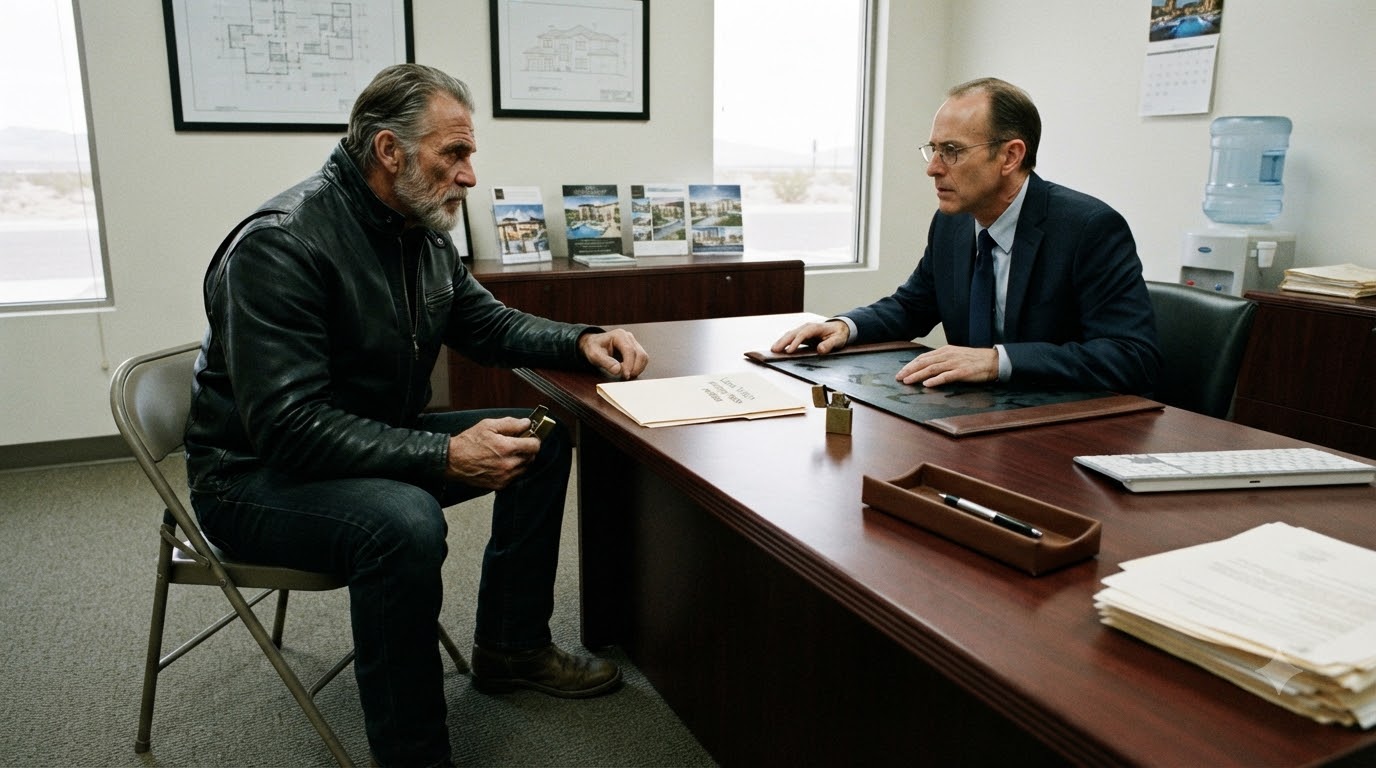
Inside, the carpet was the color of wet cement, and the air smelled of floor wax and printer toner. Vincent Crowe looked up from a mahogany desk the size of a billiard table, his fingers hovering over a wireless keyboard like spiders caught in a web.
“We’re closed to walk-ins,” Crowe said, not missing a beat. His silk tie was knotted tight enough to cut off his circulation, and his hairline looked like it had retreated another half-inch since yesterday.
Graves walked across the room in dead silence. His boots left no marks on the low-pile wool, but every step sounded like a gavel falling on a hardwood floor. He pulled out the single metal chair opposite the desk and sat down without being invited.
“You missed an appointment last night,” Graves said. His voice was lower than a whisper, scraped raw by two packs of unfiltered Camels and sixty-one years of hard breathing.
Crowe’s hand drifted toward a silver fountain pen resting in a leather trough. His eyes were small, wet stones behind thin wire-rimmed glasses. “I don’t schedule meetings at three in the morning in residential hallways, Mr. Mercer. And my property managers report property damage every time your associates linger near my buildings.”
Graves didn’t blink. He reached into his breast pocket, pulled out a scarred brass Zippo lighter, and flipped the lid open with a crisp, metallic snap. He didn’t light anything. He just held the cold metal between his thumb and forefinger, rolling the ridged wheel back and forth without generating a spark.
Clack. Click. Clack.
The rhythmic sound cut right through the hum of the overhead ventilation unit.
“You sent two men to apartment 3C,” Graves said.
“I send maintenance wherever it’s required,” Crowe replied, though his throat bobbed visibly as he swallowed. “Lease violations permit unilateral inspection under emergency clauses.”
“They weren’t carrying wrenches, Crowe. They were carrying flashlights and looking for a metal box that wasn’t there.” Graves stopped rolling the Zippo wheel. The silence that rushed in to fill the space was heavy, smelling of old paper and rising panic. “That makes it a crime. And in this county, a breaking-and-entering charge on a sick woman’s apartment ruins a man’s credit score permanently.”
Crowe stood up, smoothing his jacket with palms that left damp gray streaks on the navy wool. “You’re trespassing. If you don’t walk out that front door right now, I’ll pick up this phone, dial three digits, and have the state police pick you up before you reach the highway. You have no legal standing here. None.”
Graves closed the Zippo with a sharp metallic bite. He looked up at the developer, his cement-gray eyes entirely flat, empty of anger, empty of threat, carrying only the terrifying weight of inevitability.
“You can call whoever you want,” Graves said softly, standing up so slow his left knee gave an audible, sharp pop. “But before they get here, you’re going to call the county clerk and pull the eviction notice on Lena Vale.”
CHAPTER 2: THE PAPER TRAIL
The manila folder hit the mahogany grain with a dull thud.
Vincent Crowe didn’t reach for it. His hands stayed flat on the leather blotter, fingers splayed as if he were trying to keep the entire desk from sliding away from him.
“The county clerk’s office opens in twenty minutes,” Graves said. He kept his weight planted in the metal chair, the cold brass of the unlit Zippo heavy in his pocket. “That gives you nineteen minutes to sign the release and pull every active eviction filing tied to Milbrook Terrace.”
“You don’t understand how these entities operate, Mercer,” Crowe muttered, his voice dropping an octave as he tried to claw back a shred of his corporate authority. “I don’t just wake up and cancel leases. There are structures. Partnerships. LLCs nested inside other LLCs.”
“I know all about nests,” Graves said, leaning forward until the fluorescent light caught the silver streak in his beard. “Usually full of rats. Start signing.”
Crowe finally twitched, reaching for a Montblanc pen that looked expensive enough to pay a month of Lena’s medical bills. “You think a local clerk is going to override a multi-million-dollar development portfolio because some biker walked in with a grudge?”
“I don’t think. I know what happens when a forensic accountant opens up the public records on Ridgeline Capital,” Graves said, dropping the first real weight onto the table. “Tax ID numbers don’t lie, Crowe. Even when you route them through three different shell companies in Carson City.”
The developer’s hand froze an inch above the pen. The skin around his eyes went slack, the polished veneer cracking right down the middle to reveal a panicked, cornered animal underneath.
“Who told you that name?” Crowe whispered.
“Nobody had to,” Graves replied, standing up and letting the chair scrape loudly against the carpet. “The paper trail leads right back to your front door. You have until noon to clear Lena’s name at the county office, or the next papers filed won’t be evictions.”
CHAPTER 3: THE BROKEN WATCH
The vibration against his thigh felt like an electric pulse through denim.
Graves pulled the burner phone from his pocket, his thumb sliding across the screen to accept the connection without breaking stride toward the truck.
“You’re making a catastrophic mistake, Mercer,” March’s voice came through the speaker, smooth and devoid of any human warmth, like a recording played in an empty corridor.
“Depends entirely on whose books we’re auditing,” Graves said, tossing the heavy truck keys into the air and catching them before they hit the gravel.
“Those public records you think give you leverage are sandbox toys,” March continued, his tone hardening into an abrasive edge. “I’ve had twenty years to insulate every transaction. If you push the county clerk to cancel those filings, my legal team will file emergency injunctions alleging extortion and harassment against every associate tied to your name.”
Graves opened the driver’s side door, letting the stale heat vent out into the desert air.
“Try it,” Graves said.
“I won’t just try it,” March snapped back, the polished facade finally slipping to reveal raw, snarling desperation. “I’ll make sure the federal marshals review every gray-area title transfer your club touched back in ninety-four. Your friends on parole will be back behind razor wire before the weekend.”
The line went dead with a sharp click.
Graves climbed into the cab, slamming the heavy door shut against the howling desert wind. He pulled the scarred brass Zippo from his pocket, flipped the lid, and listened to the familiar, grounding clack of metal against metal.
March thought he held all the cards because he had lawyers and shell companies. But he didn’t account for a nine-year-old girl walking four miles through a freezing storm just to deliver her father’s final warning.
Graves dropped the phone onto the passenger seat, kicked the starter, and pointed the truck toward Milbrook Terrace.
CHAPTER 4: THE HIDDEN ARCHIVE
The linoleum under his boots was slick with tracked-in sleet.
Graves pushed open the unlocked door of unit 3C, his eyes immediately locking onto the kitchen counter where the contents of Phantom’s metal box lay spread across the laminate surface.
Ellie sat on a wooden stool nearby, her fingers tracing the edge of a faded photograph while the oxygen machine hummed a steady, mechanical rhythm from the corner.
“Is it all there?” Graves asked, his voice dropping to a gravelly purr as he stepped closer to the makeshift archive.
“Every single page,” Ellie replied without looking up, her voice carrying an eerie, quiet certainty. “Dad said the numbers on the left prove where the money came from, and the names on the right prove who signed off on it.”
Graves picked up a translucent onion-skin paper covered in neat, hurried ink entries.
It was a complete accounting ledger detailing twenty years of systemic cash routing, cross-referenced with routing numbers that linked directly to Ridgeline Capital’s shell accounts.
There were no official agency stamps, but the internal consistency of the data was undeniable.
It was a complete roadmap of financial fraud, laid out by a man who knew he was running out of time.
“Your dad didn’t just hide from them, Ellie,” Graves muttered, rolling the unlit brass Zippo between his thumb and finger with a sharp clack. “He built an anchor.”
A sharp knock rattled the front door frame, interrupting the quiet hum of the room.
Graves dropped the Zippo into his pocket, his hand curling into a hard fist as he stepped between the kitchen and the narrow hallway.
CHAPTER 5: THE CHECKMATE
The brass latch rattled as March stepped across the threshold, his tailored overcoat smelling faintly of cold rain and expensive leather.
He didn’t look like a corporate titan in this hallway; he looked like a man standing at the edge of an open grave, trying to calculate how fast he could fall.
“You’re a long way from Carson City, March,” Graves said, not moving an inch from the narrow corridor.
“I came to collect what belongs in my safe,” March replied, his voice dropping into a tight, rhythmic cadence that betrayed the trembling in his manicured fingers. “You’re holding documents that contain proprietary corporate architecture. The police will call it grand larceny.”
Graves reached into his pocket, his thumb catching the ridged edge of the brass Zippo. He flicked the lid open with a sharp, echoing clack, letting the metal bite into the silence.
“Call whoever you want,” Graves said, stepping forward until the developer had nowhere to retreat. “Before they reach the front steps, three separate federal prosecutors are going to receive certified digital packets containing every wire transfer, shell company, and kickback ledger you generated over the last twenty years.”
March’s face lost every trace of color, his skin turning the dull shade of wet cement. “You’re bluffing. You don’t have the routing infrastructure to bypass federal firewalls.”
“I don’t need to bypass anything,” Graves answered, tapping the breast pocket where a single flash drive rested alongside the Zippo. “A former state investigator already set up the secure drop. All I have to do is press send.”
March lunged forward with a desperate, animal snarl, his hands clawing toward the metal box on the laminate counter.
Graves moved with brutal, unyielding economy, planting his shoulder squarely into March’s chest and driving the developer hard against the peeling wallpaper with a heavy, breathless thud.
“Try it again,” Graves whispered against March’s ear, feeling the frantic, shallow pulse hammering beneath the expensive collar. “And watch your entire forty-seven-million-dollar empire turn into a prison cell by sundown.”
CHAPTER 6: THE DUSTY DAWN
The metal box sat closed and heavy on the laminate counter, its twenty-year war finally extinguished by a single flash drive and an immovable boundary.
March didn’t fight back when Graves released his jacket, letting the developer stagger backward toward the open door with his dignity completely dismantled.
“You have fourteen days to dissolve every entity attached to Ridgeline,” Graves said, his voice dropping into a flat, steady register. “And if you ever come within a hundred miles of this building again, the copies go out before you reach your car.”
March didn’t answer. He turned and shuffled out into the cold stairwell, his expensive shoes clicking against the concrete steps like a retreating clock.
Within two weeks, the county records updated permanently.
The eviction notices vanished from the refrigerator door at apartment 3C, replaced by a deed transfer assigning Milbrook Terrace to a local nonprofit housing trust.
Devlin March’s corporate shell companies dissolved quietly under federal audit pressure, leaving no trace of the $47 million redevelopment scheme behind.
The wind blew hard off the Nevada flats, rattling the corrugated roof of the diner where it all began, but inside the small house near the desert edge, the air was entirely still.
Lena sat comfortably by the window, breathing easily without the rattling hiss of emergency oxygen tanks while the morning sun painted the kitchen floor in warm gold.
Ellie stood by the front counter, her fingers brushing against the cold, familiar metal of an unlit brass Zippo resting beside her school books.
Graves watched them from the porch steps, his left knee clicking quietly as he stretched his legs out into the cool morning air.
He didn’t need to check the locks anymore.
The road out was clear, the debt was paid in full, and for the first time in fifteen years, the silence across the desert felt completely like home.