Forged in Winter Frost, a Single Mother and a Broken Heir Build a Legacy of Unyielding Human Grace
CHAPTER 1: THE BITTER FROST
The wind sliced through the early morning air, sharp and bitter flurries of snow sweeping across the frozen streets of Bridgeport. Sarah pulled her coat tighter around her thin frame, one hand gripping the frayed scarf at her neck, her fingers twisting the wool to anchor her nerves against the biting cold.
Her other hand held the small fingers of her six-year-old daughter, Emma, whose cheeks were flushed red from the brutal gale. The snow crunched beneath their worn boots as they trudged down the narrow sidewalk, their breath visible in short puffs.
“I’m cold, mama,” Emma whispered, her voice barely carrying over the wind.
Sarah squeezed her daughter’s hand gently, forcing a steady smile she didn’t feel. “I know, sweetheart, just a few more blocks to the community center. Miss Patricia will have the heater on.”
Her own fingers burned inside threadbare gloves as they rounded the corner onto Madison Avenue. That was when she saw him: an elderly man hunched on a bus stop bench, his body curled against the freezing air, wearing no coat and shaking uncontrollably.
CHAPTER 2: WARMTH IN THE DINER
The sharp smell of burnt toast and stale coffee cut through the biting chill clinging to Sarah’s coat. Across the worn vinyl booth, Walter’s hands shook violently around his own mug, spilling dark drops onto the Formica table.
“Careful, Mr. Harrison,” Sarah said softly, her fingers brushing the edge of the ceramic to steady his grip.
Emma pulled herself closer to the old man, her small fingers reaching out to wrap around a corner of the plaid blanket Joe had tossed over their shoulders. The diner hummed with the low murmur of morning regulars who studiously avoided looking at the shivering trio in the back.
Joe leaned against the service window, wiping a cloth in slow, rhythmic circles across the stainless steel surface. His eyes flicked to the register, then to the seventeen dollars resting in Sarah’s open wallet.
“Oatmeal and scrambled eggs,” Joe announced, his voice a gruff rumble that brooked no argument. “On the house for the first round, Sarah. Don’t look at me like that; cook’s prerogative.”
Walter stared blankly at the steaming plate set before him, the mechanical growl of his stomach breaking through his confusion. The smell of butter and hot grain finally pierced the fog in his mind, and he reached out with clumsy, trembling fingers.
“Eat,” Sarah urged gently, guiding the spoon toward his hand. “You’re safe here, Walter.”
The old man took a hesitant bite, his weathered eyes widening as the warmth hit him. He blinked rapidly, tears spilling over the deep lines of his face.
“You didn’t walk past,” Walter whispered, his voice cracking as he gripped the sleeve of Sarah’s threadbare coat. “Why did you stop?”
Sarah kept her gaze steady, though her throat tightened as she thought of her own empty pantry waiting at home. She looked down at her pocket, feeling the hard edges of her last few dollars pressed against the lining.
“Because you needed help,” Sarah said plainly, her voice dropping into a quiet, unshakeable register. “And because someone should always be willing to stop.”
Walter swallowed hard, his thumb rubbing the frayed fabric of her sleeve in a repetitive, anxious motion. “My son… Benjamin, he’s always working. Building things. He won’t know where I am.”
Sarah pulled her phone from her pocket, her thumb hovering over the keypad as she prepared to cycle through the disconnected numbers she had already tried twice. The diner door swung open behind them, letting in a sudden gust of icy wind that rattled the windowpanes.
CHAPTER 3: THE BROKEN FURNACE
She pocketed the phone. Walter was safe. Ben had arrived at the diner an hour ago—a whirlwind of expensive wool and frantic relief—and taken his confused father home. Now, Sarah had to face her own reality.
The rusted hinges of apartment 4B shrieked as Sarah forced the heavy door open.
She braced for the familiar biting draft, the indoor frost that required them to wear two layers of socks just to sleep. Instead, a wave of thick, dry air hit her face. The ancient baseboard radiators were clanking—a loud, rhythmic metal-on-metal heartbeat.
Heat.
A man in a grease-stained canvas jacket was securing the metal panel on the furnace unit in the corner of her tiny kitchen.
“Who are you?” Sarah demanded, immediately pulling Emma behind her legs.
The repairman wiped his hands on a dirty rag, unimpressed by her tone. “Emergency dispatch. Landlord’s follow-up request.”
“My landlord hasn’t answered the phone in four days,” Sarah said, her voice hard. “And he definitely doesn’t pay triple-time on a Saturday morning.”
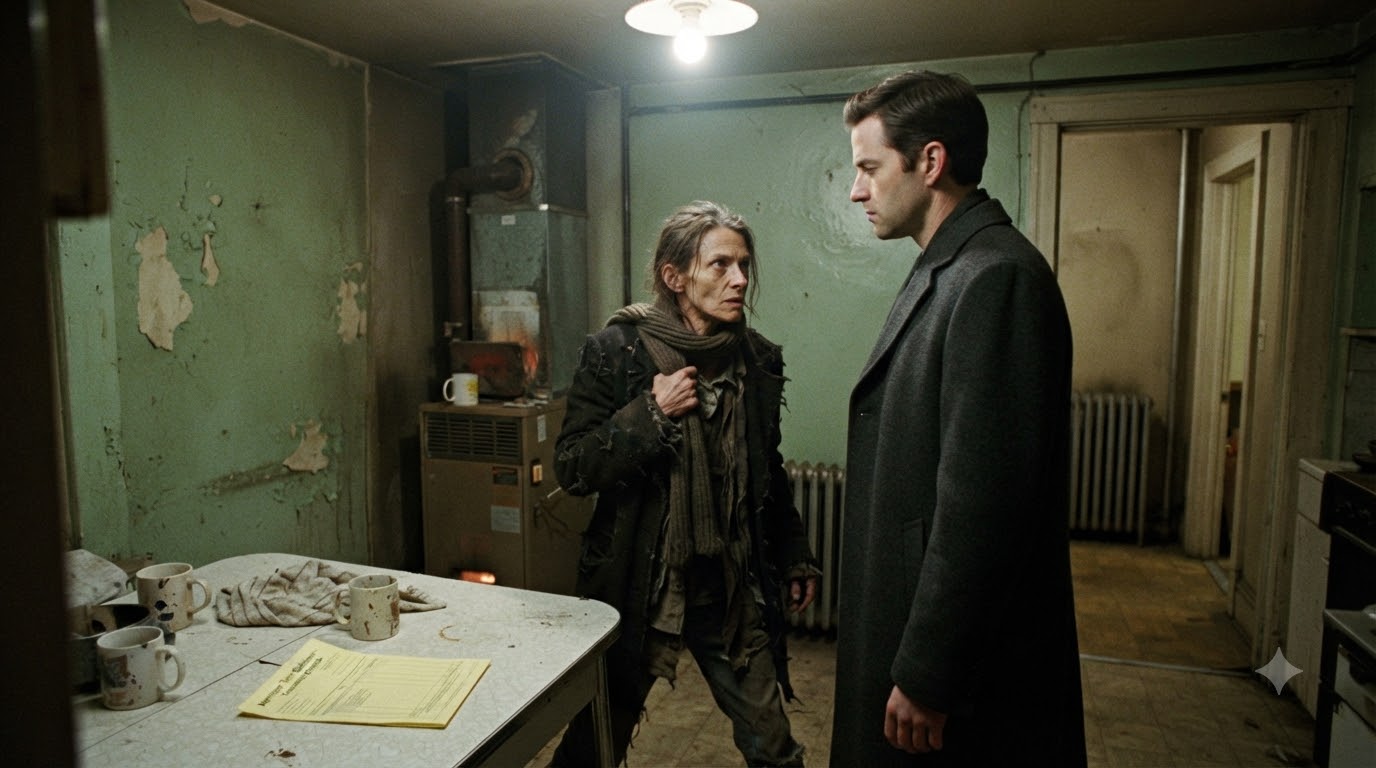
The repairman shrugged, tossing a yellow carbon-copy invoice onto her scarred kitchen table. “Invoice is zeroed out. Someone paid the premium. Have a good weekend.”
He brushed past her, leaving the apartment smelling of machine oil and a sudden, suspicious warmth. Sarah snatched the yellow paper. The billing name was blank, but the corporate account number printed at the top caught her eye. Harrison Corporate Services.
A heavy knock on the open door frame made her jump.
Ben stood in the dingy hallway. His tailored charcoal overcoat looked entirely alien against the peeling green paint of the corridor. He adjusted his pristine left cuff, his eyes darting to the clanking radiator before meeting her gaze.
“My father is resting,” Ben said, his voice quiet, lacking the frantic edge it had in the diner. “I wanted to make sure you got home safe. And…”
“And you bought my heat,” Sarah interrupted. She didn’t yell. She kept her voice dangerously level. She held up the yellow paper.
Ben’s posture stiffened. “Your daughter was shivering at the diner. My father told me about your broken windows. I couldn’t just go back to my condo knowing you were freezing.”
“So you threw money at it.” Sarah twisted the frayed ends of her scarf, anchoring her frustration to the rough wool. “You thought you could just parachute in, swipe a corporate card, and play savior.”
“I’m not playing anything. It was a practical solution to a physical problem.”
“It’s not your problem.” Sarah took a step forward, the dry heat of the room suddenly feeling suffocating. “I work two jobs. I stretch every dollar until it screams. I do not take charity, Mr. Harrison. If I let you pay for my life, I lose the only thing I actually own—my independence.”
Ben’s jaw tightened. He didn’t offer a dramatic apology or a patronizing smile. He looked at the peeling wallpaper, the worn boots lined up by the door, and finally at Emma, who was quietly soaking in the warmth from the radiator.
“Then consider it a loan,” Ben countered, his voice dropping. “Or bill me for the hours you spent keeping my father alive this morning.”
“I don’t charge for basic human decency.”
“Then let me show some.” Ben stepped fully into the apartment, the floorboards groaning under his weight. “Look at the invoice again, Sarah.”
Sarah glared at him, then glanced down at the yellow paper. Beneath the zeroed-out total, a small line of text was printed directly under the authorizing entity. Harrison Tech Solutions – Executive Override.
Her stomach plummeted. She had submitted her programming portfolio to that exact subsidiary three weeks ago. It was her only ticket out of this neighborhood.
“You’re not just a guy with a nice coat,” Sarah said, the realization turning the warm air to ash in her throat.
Ben adjusted his cuff again, the polished silver link catching the harsh glare of the bare overhead bulb.
“No,” Ben said softly. “I’m the CEO. And we need to talk about your job application.”
CHAPTER 4: THE BOARDROOM CLASH
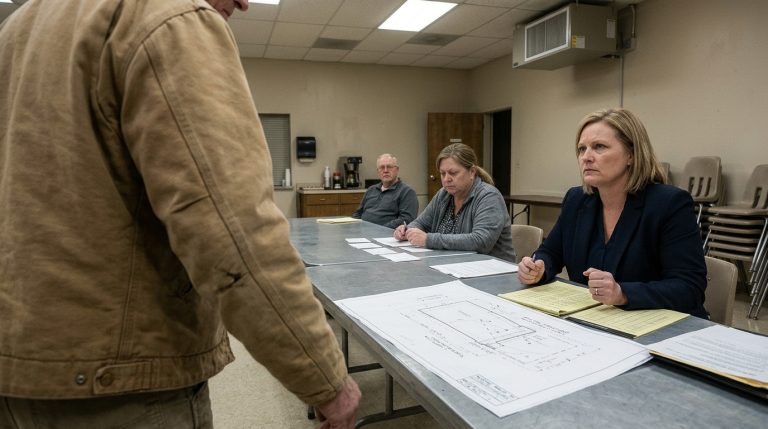
The loud slap of leather against wood echoed through the high-ceilinged conference room. Across the table, Richard adjusted his gold-rimmed glasses, his thin lips pressed into a harsh, bloodless line as he glared at the projection screen.
“This candidate has zero formal credentials,” Richard announced, his voice carrying the dry, unyielding authority of a man who measured human worth entirely by university seals. “No degree, no institutional pedigree, eight years of waiting tables. Hiring her at a senior junior developer bracket isn’t progressive, Ben. It’s an insult to every qualified professional who went through proper channels.”
Ben remained seated at the head of the table, his posture rigid. He did not raise his voice. He simply steepled his fingers, letting the cold silence of the room stretch until the corporate executives began shifting uncomfortably in their leather chairs.
“She built three functional applications from scratch while working two jobs,” Ben replied, his tone chillingly flat. “Her technical assessment scored higher than eighty percent of our incoming graduate pool.”
“Scores on a take-home test mean nothing without the discipline of a four-year university,” Richard snapped, leaning forward so his palms pressed hard against the polished wood. “Standards exist to filter out liability. You are letting personal sentiment dictate corporate policy. Everyone in this building knows you’ve been visiting her apartment.”
The accusation hung in the air, thick and suffocating.
Sarah, sitting quietly near the back doorway where she had been summoned under the pretense of an ordinary skills review, felt the blood drain from her face. Her fingers tightened instinctively around the frayed wool scarf tucked inside her coat pocket.
“Watch your phrasing, Richard,” Ben warned, his eyes narrowing into cold slits.
“I’ll watch the bottom line,” Richard retorted, turning his gaze directly toward Sarah to lock her in his crosshairs. “People from her background don’t survive corporate pressure. They fold, they make excuses, and they drag the entire department down with them. We are terminating her application effective immediately.”
Sarah stood up before Ben could speak. The sting of the insult was sharp, but the sudden surge of cold, practical anger washed it away completely.
“I didn’t ask for your pity, Mr. Blackwood,” Sarah said, her voice steady and clear, cutting through the heavy air of the boardroom. “And I certainly didn’t ask for your permission to be competent.”
Richard blinked, genuinely startled that a low-wage worker would dare talk back to him in a C-suite meeting.
“You’re out of your depth, young lady,” Richard sneered, sinking back into his chair with a dismissive wave of his hand. “Competence requires proof, not a sob story.”
CHAPTER 5: THE CRISIS OF BREATH
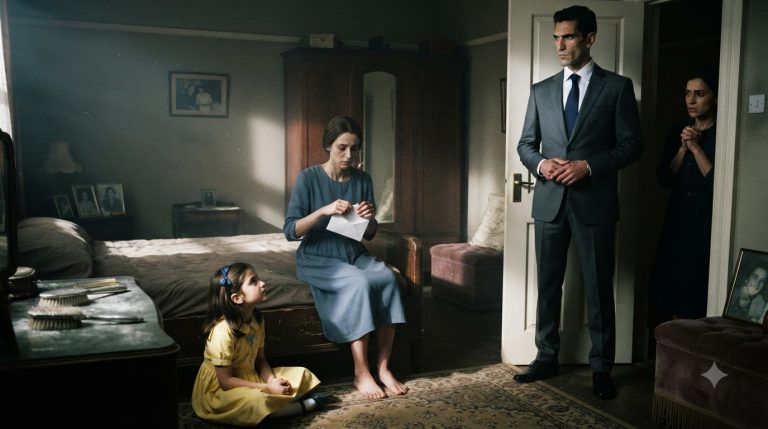
The hospital corridor smelled of antiseptic and cold linoleum. Sarah sat on the edge of the hard plastic visitor’s chair, her knees pressed together as she stared at the glowing digital monitors through the glass window of the pediatric ICU.
Inside, six-year-old Emma lay motionless beneath a clear oxygen tent, her chest heaving with a shallow, rattling rhythm.
“Pneumonia, severe and bilateral,” the attending physician had said two hours ago, his voice clipped and hurried. “We need to keep her on IV antibiotics and continuous oxygen monitoring.”
The monitor beside the bed emitted a steady, mechanical beep that echoed straight into Sarah’s temples. Her own pocket held exactly six hundred and thirty-two dollars—every penny she had saved for their apartment deposit, now entirely inadequate against the mounting wall of intensive care charges.
A sharp set of footsteps clicked against the polished floor. Ben appeared down the hall, his sleeves rolled up to his elbows, carrying a styrofoam cup of lukewarm coffee and a heavy administrative folder.
“How is she?” Ben asked, his voice low and raspy as he sat down on the hard chair beside her.
“She’s fighting,” Sarah whispered, her eyes never leaving her daughter’s pale face. “But the billing office just came by. Even with the diner’s basic insurance, the out-of-pocket room charges and lab work are over eight thousand dollars.”
Ben set the coffee down untouched. His jaw clenched, a muscle jumping tightly beneath his weathered skin.
“I’ll handle the account with the hospital administration,” Ben said immediately, reaching instinctively into his coat pocket. “Just sign the authorization form.”
Sarah turned her head slowly, her gaze locking onto his with a quiet, devastating intensity.
“No,” Sarah said, the word falling like a lead weight between them.
“Sarah, this isn’t about pride—”
“It is entirely about pride, because it’s the only thing I have left!” Sarah’s voice cracked, sharp enough to draw the quick glance of a passing nurse. She pulled her hands into her lap, twisting the frayed wool scarf until her knuckles turned white. “If you pay these bills for me, I am right back where I started. I become just another charity case kept afloat by your checkbook. I have to do this myself.”
“You’ve been working two jobs, cleaning offices until your hands bled, and now you’re learning code,” Ben argued, leaning forward, his voice rising with frustrated compassion. “You cannot out-work a medical emergency. There is a difference between being rescued and being supported.”
“I don’t know the difference anymore,” Sarah breathed, a single tear cutting a hot path through the dust on her cheek.
Before Ben could answer, the billing administrator rounded the corner, holding a crisp white tablet with an itemized payment schedule.
“Miss Mitchell,” the woman said smoothly, offering no room for emotional padding. “For this balance, we require a minimum commitment of four hundred dollars a month over twenty-four months to avoid collections.”
Sarah looked at the numbers on the screen. Four hundred dollars a month. On top of rent, food, and basic survival, it would strip away every cent of her new junior developer salary, plunging her right back into the exhausting loop of working herself to death just to stay in the same place.
Ben stood up, stepping directly between Sarah and the administrator. His silver cufflink caught the harsh overhead fluorescent light as he raised his hand, blocking the tablet from her view.
“Leave the paperwork,” Ben told the administrator, his voice dropping into an ice-cold executive register. “And tell your director that Harrison Enterprises is auditing every medical debt structure in this county starting tomorrow morning.”
CHAPTER 6: THE TRIUMPH OF PURPOSE
The heavy oak doors of the executive boardroom swung open with a slow, deliberate creak. Inside, the twelve board members sat in absolute silence around the mahogany table, their expressions carved from stone as Richard Blackwood stood at the far end, his breathing shallow and rapid.
Sarah walked in behind Ben, her posture straight, her fingers smoothing down the lapel of her secondhand blazer.
“The audit is complete, Richard,” Ben said, his voice cutting through the thick air without a trace of anger. “Every metric you weaponized against our workforce has been reviewed by independent counsel.”
Richard slammed his palm against the wood, his face purple with fury. “This is a coup! You are dismantling corporate standards to appease a low-wage outsider who doesn’t even belong in this building!”
“She belongs here more than you ever did,” Margaret Chen countered smoothly from her seat near the window, sliding a crisp folder across the polished surface. “Her community technology pilot has already placed twelve individuals into stable, tax-paying tech careers with full benefits. It operates under budget and yields higher retention than our traditional college recruiting pool.”
Richard snatched up the folder, his eyes darting frantically across the statistical breakdown before dropping it as if it burned his skin.
“The board hasn’t voted to strip my authority,” Richard snarled, his voice cracking with desperation as he grasped at his final administrative loophole. “You can’t override twenty-three years of financial governance on a whim!”
“We aren’t operating on a whim,” Margaret replied, looking around the table at the solemn faces of her peers. “We are operating on results. All in favor of approving the permanent expansion of the community technology initiative under Sarah Mitchell’s direct leadership?”
Eleven hands rose immediately, steady and unanimous.
Richard stared at the raised hands, his lower jaw trembling slightly as the full weight of his irrelevance finally crushed his institutional defenses. He snatched his leather portfolio off the table, spun on his heel, and stormed out of the boardroom without a single word, the heavy oak doors swinging shut behind him.
Silence settled over the room—not the cold, hostile silence of corporate intimidation, but a quiet, breathable space of absolute resolution.
Two weeks later, the morning sunlight streamed warm and golden through the clean windows of the new Bridgeport Community Technology Center. Outside, a line of thirty eager participants waited quietly on the sidewalk, holding notebooks and coffee cups.
Sarah stood near the front entrance, her hand resting comfortably on Emma’s shoulder as her daughter proudly tied a bright blue ribbon across the double doors.
Ben stood a few paces back, leaning against the freshly painted doorframe with his hands tucked casually into his pockets, watching the street outside where a city bus hissed to a stop at the corner.
“You did it,” Ben said softly, the exhaustion of the past year finally giving way to a genuine, unhurried smile.
“We did it,” Sarah corrected, turning to look at him with clear, untroubled eyes. “You built the space. I just brought the tools.”
Emma handed the leftover ribbon scraps to a grinning neighbor, then ran back to grab Sarah’s hand with an energetic squeeze.
“Mama, can we open it now?” Emma asked, her eyes shining with excitement.
Sarah looked down at her daughter, then across the room at the rows of modern computers humming quietly under the morning light. The old frayed scarf stayed buried deep inside her closet, no longer needed to anchor her against a freezing world.
“Yeah, baby,” Sarah smiled, stepping forward to untie the knot. “Let’s open the doors.”