Shadows on Mason Street: When the Only People Who Answered the Door Were the Ones Everyone Feared
CHAPTER 1: THE BOILING ASPHALT
The water stain on the bathroom ceiling looked vaguely like a boot, and Diane had called this place their starting over house.
Owen stared at the blue albuterol inhaler sitting on the kitchen counter while the San Joaquin Valley heat pressed its dry weight against the window screens.
His mother’s short, dry cough drifted from the back hallway, rhythmic and stubborn, cutting through the low murmur of Highway 58 traffic.
Owen kept his eyes on his library book about deep-sea fish, but his ears tracked every micro-movement down the hall—the shift of the mattress, the sudden heavy thump against the floorboards.
He didn’t hesitate or calculate; he pushed his chair back, the metal legs scraping against the linoleum with a sharp shriek, and crossed the small hallway in four fast strides.
Diane lay crumpled beside the bed, her left hand stretched blindly toward the nightstand where her rescue inhaler sat two feet out of reach.
Her face was tight and flushed, her lips edged in a dangerous gray shadow, each breath arriving as a thin, whistling pull that sounded completely hollow.
Owen dropped to his knees on the carpet, grabbed the plastic canister, and forced it into her trembling fingers, but her grip was too weak to depress the valve.
She looked at him with wide, frightened eyes, and the sheer terror on her face stripped away every ounce of childhood patience he possessed.
He spun around and ran for the phone, patting the kitchen counter and the couch cushions before realizing it wasn’t there.
His mind raced backward through the morning routine, remembering it left on the bathroom shelf since Tuesday, but panic crowded out the memory.
He bolted out the front door, leaving it wide open to the September glare, and ran straight across the asphalt toward Frank Holt’s porch.
CHAPTER 2: BEHIND CLOSED DOORS
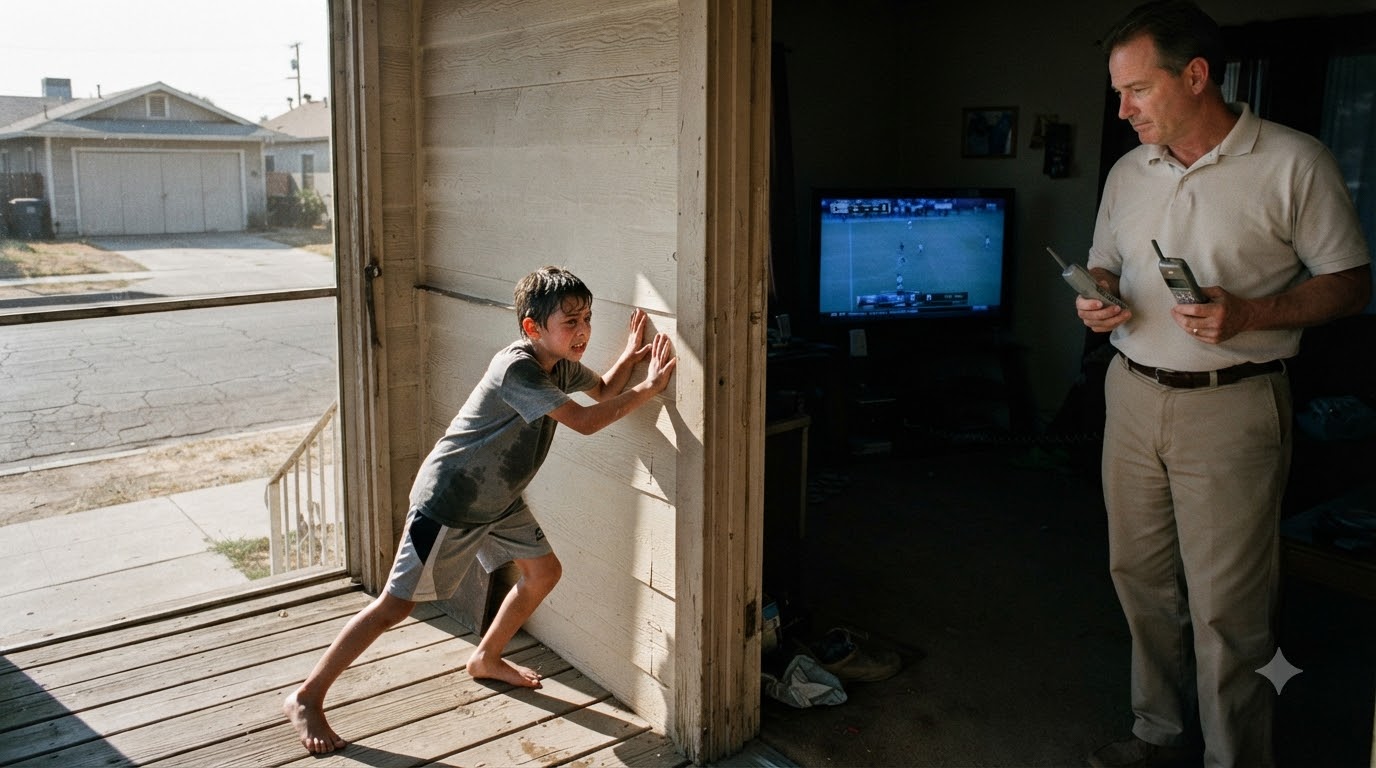
Frank Holt stood in the center of his carpeted living room, illuminated entirely by the muted blue glow of a sports channel broadcasting afternoon highlights.
He didn’t look up when Owen hammered his small palms against the wood.
Instead, he took his time shifting his weight from one foot to the other, his thumb lingering over the call button with the deliberate hesitation of a man who viewed an emergency as an administrative inconvenience.
“How bad is it?” Frank’s voice drifted through the narrow gap, clipped and dismissive. “Does she need an ambulance or does she just need her inhaler?”
Owen stared up at the screen of Frank’s phone, watching the numbers display in harsh orange digits before the call finally connected.
“She has her inhaler,” Owen said, his voice cracking from the dry September air and the raw panic tearing at his throat. “It’s not working. Please.”
Frank let out a slow, deliberate breath through his nose, adjusting his grip on the device as if he were placing a complaint with a utility company rather than reporting a medical crisis.
“Okay. Okay,” Frank muttered, his finger tapping the screen with agonizing slowness. “I’m calling. Go back to her.”
Owen didn’t wait to hear the dispatcher pick up; he turned and sprinted back across the blistering asphalt of Mason Street toward his own front door.
Inside the rental house, the air hung heavy and motionless, smelling faintly of old laundry and the stale metallic heat of the valley.
Diane lay crumpled motionless beside her bed, her fingers curled inward like dead leaves, her chest making a thin, whistling sound that carried almost no air at all.
Owen dropped to his knees beside her, grabbing her cold hand and squeezing it until his own knuckles turned white.
Thirty seconds ticked past in total silence, punctuated only by the distant, rhythmic hum of Highway 58 traffic outside.
He scrambled back to the front door and looked across the street through the dusty glass of the front window.
Frank Holt stood in his living room, the phone pressed lazily to his ear, one hand gesturing toward the television while he took his sweet time describing a situation he hadn’t even bothered to investigate.
Owen looked down the length of Mason Street at the tightly shut doors of the neighboring houses, every single one of them hiding behind locked screens and pulled blinds.
The silence of the neighborhood wasn’t peaceful; it was a heavy, calculated wall built by people who preferred not to see what was happening twenty feet from their own manicured lawns.
Owen let go of the door frame, his jaw tightening into a hard, unyielding line as he turned away from the street of closed doors and looked toward Oak Street.
The distant, low rumble of motorcycle engines vibrated through the dry pavement, rising faint and steady above the heat shimmer.
He didn’t wait for Frank Holt. He didn’t wait for an ambulance that was being debated across a living room table.
Owen turned on his heel, pushed the front door wide open, and broke into a dead sprint toward the gas station.
CHAPTER 3: THE THUNDER ON OAK STREET
The heavy scent of heated pavement and stale gasoline filled his lungs, burning with every ragged breath he forced down his throat.
Ray Callahan stood beside his parked motorcycle, one heavy boot resting on the foot peg while he talked quietly with Gus Merritt about a stretch of open highway.
Owen didn’t stop to catch his breath or look for an polite opening.
He planted his feet directly in front of the chrome-plated machine and threw both arms out wide to block the path.
“Don’t start your bikes,” Owen screamed, his voice cracking from raw desperation.
The words cut sharply through the heavy valley air, carrying a weight that forced every nearby head to snap around instantly.
Ray dropped his foot to the pavement, lowering his tall frame into a crouch in a single, fluid motion to meet the boy at eye level.
“I hear you,” Ray said, his voice level and steady despite the abrupt interruption. “Tell me where she is.”
“My house, Mason Street,” Owen gasped, his fingers clutching uselessly at his thighs as he fought the tremors in his legs. “She fell. Her inhaler isn’t working.”
Ray didn’t waste a second asking questions or checking the perimeter; he turned sharply toward his companion with a single nod.
“Gus,” Ray said, the command dropping like lead.
Gus Merritt moved instantly, his broad shoulders tensing as he stepped forward with the precise, practiced authority of a man who had spent years handling critical emergencies before changing paths.
“Which house?” Gus asked, his eyes locking onto the boy’s terrified stare.
“Four-twelve, the one with the purple tree out front,” Owen shouted, already turning back toward the street. “Go.”
Owen didn’t wait to see if they followed, spinning around and launching himself back toward the residential block with whatever energy he had left.
Ray and Gus were right behind him, their heavy boots thudding against the concrete sidewalk with a rhythmic, pounding urgency that matched the frantic beating of his own heart.
The two blocks of Bakersfield street blurred past under a sky that remained entirely indifferent to the crisis unfolding beneath it.
As they neared the rental house, Owen slammed his palms against the front door, realizing instantly that it had clicked shut behind him when he first ran out.
“It locked when I came out,” Owen sobbed, his voice breaking completely as panic threatened to swallow him whole.
Ray stepped up to the flimsy wooden barrier without a word of hesitation, assessing the cheap handle and the lack of any real security hardware.
He planted his boot beside the knob and delivered a single, calculated kick that snapped the latch clean out of the frame.
The door swung inward, releasing a wave of stale indoor air mixed with the sharp smell of distress as Owen pushed past and ran straight down the hallway.
CHAPTER 4: THE BROKEN DOOR
Diane lay crumpled on the carpet beside the bed, her fingers curled open and motionless against the gray floorboards.
Gus Merritt crossed the threshold in three long strides, dropping smoothly to his knees with the absolute stillness of a professional who had seen every shade of crisis.
He didn’t waste a breath on panic or confusion; his large hands moved with practiced precision, checking her rapid pulse and assessing the pale, pinched skin around her mouth.
“The inhaler,” Gus said, his tone low and flat as he snatched the empty blue plastic canister off the floor. “She’s empty.”
Owen stood frozen in the doorway, his chest heaving as the weight of the silence pressed down on the room like a physical hand.
“Bathroom cabinet,” Owen said, his voice pitching high before he forced the words down. “The orange one.”
He didn’t wait for a reply, spinning around and tearing down the hall to the medicine chest to retrieve the backup rescue canister.
When he skidded back into the bedroom, Ray Callahan was standing quietly in the doorway, his broad frame blocking the light from the broken frame outside while his eyes tracked every movement in the room.
Gus took the orange canister, shook it sharply twice, and pressed the mouthpiece to Diane’s lips with deliberate, measured counts.
“Breathe with me,” Gus murmured, his voice steady enough to anchor the entire room. “Easy now. Take it in.”
For three agonizing seconds, nothing changed, the whistling strain in her chest remaining thin and desperate.
Then, slowly, the tension in her shoulders began to loosen as the medicine found its way into her lungs.
Diane turned her head against the carpet, her hazel eyes fluttering open to fix directly on her son standing at the foot of the bed.
“I’m here, Mom,” Owen whispered, his fingers gripping the bedpost until his knuckles ached.
From the front of the house, a heavy, rhythmic thud echoed through the floorboards as boots crossed the threshold without permission.
Officer Brennan stepped into the hallway with his hand resting firmly on his holster, his eyes darting across the room with defensive caution.
“Nobody move,” Brennan commanded, his voice cutting through the quiet air with the authority of twelve years on the force. “Stay right where you are.”
CHAPTER 5: THE POLICE CAR LIGHTS
“Nobody move,” Brennan repeated, his voice sharp and tightly coiled against the tension in the hallway. “I need everyone to step back from this woman right now.”
Gus didn’t flinch or drop his hands from Diane’s shoulders; he simply tilted his head upward with the weary patience of a man who had survived far worse misunderstandings.
“She’s coming out of a severe asthma attack,” Gus said, his tone flat and unyielding. “If I let go of her now, her breathing drops again before the paramedics get here. I’m finishing the dose.”
Ray didn’t shift an inch from his blockade at the threshold, his heavy arms hanging loose at his sides while his eyes locked onto the badge on the officer’s chest.
“We called the bus four minutes ago,” Ray stated, his voice carrying the calm authority of someone accustomed to holding a perimeter. “They’re rolling down the street right now.”
Owen stepped out from the shadows of the bedroom, his small frame slipping past Ray’s shoulder to stand squarely in the center of the room.
“He’s helping her,” Owen said, his voice entirely steady as he looked up at Brennan. “Mr. Holt across the street called you because he wanted to make trouble about them, not because he cared about my mom.”
Brennan looked down at the boy, taking in the bare feet, the sweat-soaked shirt, and the fierce, unblinking glare that refused to back down.
The officer slowly lifted his hand away from his holster, the tension in his shoulders dropping a fraction as the front door filled with the flashing red-and-blue reflections of the arriving ambulance.
Outside through the shattered frame, the rotating lights painted the neighborhood walls in silent, frantic strokes.
Frank Holt stood rigidly on his front porch across the street, his arms crossed tightly over his chest, watching the emergency vehicles pull up with the self-satisfied posture of a man waiting for a reward.
Officer Webb pushed through the front door behind Brennan, holding a notepad and looking between the flashing lights outside and the quiet group inside the bedroom.
“What actually happened here?” Webb asked, flipping his notebook open to a fresh page.
Ray told him straight, leaving out nothing and adding no polish, while Owen stepped in to confirm every single detail of the timeline.
Through the open window, Frank Holt could be seen shifting his weight on his porch, his initial smugness visibly beginning to curdle as he realized the police were walking over to him instead of hauling the bikers away.
Webb jotted down the final notes, closed his book with a sharp snap, and looked at Frank through the window with a look of cold, professional realization.
“Looks like we have some follow-up questions to ask your neighbor across the street,” Webb said quietly, turning back toward the door.
CHAPTER 6: THE NEW NORMAL
“I reported what I saw,” Frank snapped, his hands flying up to gesticulate wildly as the officer stepped onto the wooden planks. “A group of known outlaws swarmed this property and took a child. You should be arresting them instead of questioning me.”
“Nobody took a child, Mr. Holt,” Webb said, his voice dropping an octave as he stopped two feet from the porch railing. “We spoke to the boy, we spoke to the neighbors who actually watched, and we saw the medical response inside. You called in an emergency report to target people you didn’t like while a woman was suffocating twenty feet away.”
“I was maintaining order,” Frank sputtered, his face flushing a deep, mottled crimson as his initial arrogance finally began to fracture under the weight of the facts. “This is a respectable street. We don’t need those kinds of people bringing down property values.”
“Respectable people don’t lock their doors while a seven-year-old child begs for help,” Webb replied coldly, snapping his pen back into his pocket. “Expect a citation for misuse of emergency services in your mailbox by Monday.”
Owen watched from the open doorway as Frank’s jaw dropped open, his mouth working wordlessly like a fish out of water before he turned on his heel and slammed his front door shut with a violent bang.
Inside the hospital room at Kern Medical Center hours later, the afternoon light faded into a warm amber glow across the San Joaquin Valley skyline.
Diane sat propped up against her pillows by the window, her color completely restored, watching her son tie his shoes by the edge of the bed.
Ray Callahan stood near the door with his leather cut resting over his broad shoulders, holding a plain white card out toward the bedside table.
“Anything you need,” Ray said quietly, his tone devoid of any theatrical pretense. “Ride to a follow-up appointment, fixing that broken front door properly, anything at all.”
Diane looked at the card, then up into the weathered face of the man who had shown up when the rest of the street turned away.
“That door was sticking for two years before you touched it,” she said softly, a genuine smile touching the corners of her eyes.
“I’ll fix it right this time,” Ray promised, giving a brief nod before turning toward the exit with Gus and Cole trailing close behind.
Owen walked them to the door, watching as the three large men stepped out into the hospital corridor and blended seamlessly into the quiet evening routine of the hallway.
He walked back to his mother’s bedside and climbed into the chair, his hands resting quietly in his lap as he looked out at the city lights blinking on across the valley.
The neighborhood on Mason Street was quiet now, its closed doors hiding a brand-new kind of memory that no amount of manicured lawn care could ever wash away.
Owen reached down and touched the laces of his sneakers, pulling them tight in clean, even loops without a single trace of hesitation.
He didn’t need to look back or wonder what came next because he already knew that when the real test arrived, the people who mattered were the ones who stayed.