A Quiet Nurse Stopped on a Desolate Highway to Save Five Strangers, Never Expecting What Would Roll Up Her Driveway a Year Later
CHAPTER 1: THE LEMONADE STAND
The coffee cup in Darren’s hand had gone completely cold, but she hadn’t noticed the shift in temperature until the low-frequency rumble of thirty heavy engines started vibrating straight up through the soles of her sneakers.
It wasn’t the kind of sharp, impatient noise you heard from commuter traffic rushing down the county line.
It was deep, rhythmic, and slow, rolling down the block like an approaching storm over flat Wisconsin farmland.
Brienne stopped stacking her paper cups, her small fingers freezing around the edge of a plastic pitcher.
She didn’t look scared.
An eight-year-old running a driveway business for a purple bicycle didn’t measure threats the way adults did; she measured momentum.
And right now, the momentum on Elm Street had entirely changed.
Across the asphalt, the first motorcycle rolled into view.
It was heavy, black, and polished to a dull chrome gleam that caught the blinding August sun.
Another followed immediately behind it, then a third, stacking up in a precise, practiced formation that occupied both lanes from curb to curb.
Thirty bikes.
Not a single rider yelled or revved an engine for effect.
They cut their motors one by one, the mechanical ticking of cooling steel replacing the roar with a dry, metallic echo.
Darren set her cold coffee on the bumper of her sedan, her thumb automatically reaching for the worn stainless-steel bandage shears tucked deep inside her pocket, a reflex as old as her shifts in the trauma ward.
She didn’t know these machines.
She didn’t know these men.
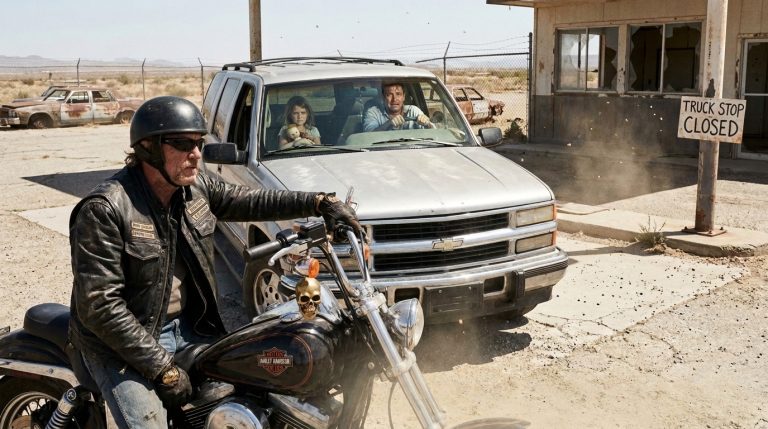
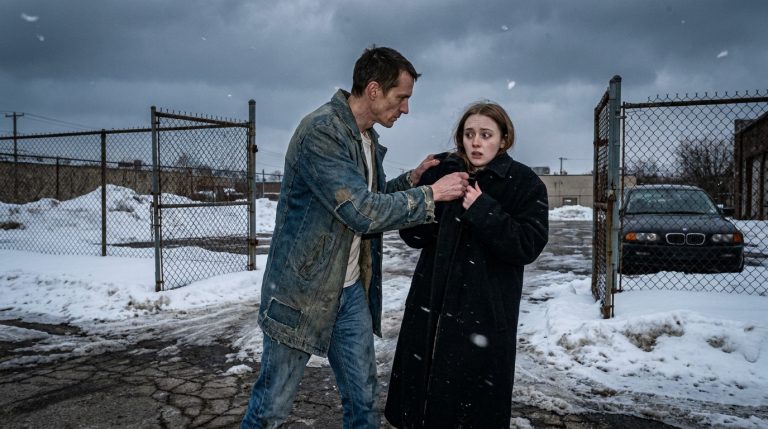
Yet beneath her ribs, a strange, heavy pressure began to tighten, dragging her memory back to a stretch of hot asphalt she had tried for three hundred and sixty-five days to stop replaying.
The front rider planted his boot firmly on the pavement.
He was broad-chested, his leather vest worn soft by weather, carrying a pale scar across his jawline and a long, faded line running down his left forearm.
He didn’t look at the houses.
He looked straight down the driveway.
Brienne blinked once, picked up her ladle, and cleared her throat with the immense, unshakeable dignity of a person whose business plan was currently facing an unexpected market expansion.
“Welcome,” Brienne said, her voice clear and steady in the morning heat. “Lemonade is fifty cents.”
The large man stepped forward, his heavy boots crunching softly on the driveway gravel.
He reached into his vest, pulled out a folded five-dollar bill, and laid it flat on the card table.
“Keep the change,” he said, his voice gravelly and low.
Darren watched the way he moved—the slight, careful compensation in his left knee, the deliberate balance of a man who had spent months learning how to inhabit a rebuilt body.
The air smelled of hot dust, exhaust, and cut grass.
The distance between that Tuesday on State Road 13 and this Saturday morning suddenly collapsed into zero.
CHAPTER 2: THE UNSEEN DEBT
Ray’s thumb hooked into the pocket of his worn leather vest, right beside a silver pin tarnished dark along the edges, his eyes fixed on Darren with the silent weight of a man who had waited twelve full months to deliver an answer.
“State Road 13,” Darren whispered, her voice barely carrying across the small patch of grass separating the driveway from the house.
Ray didn’t offer a dramatic speech or a polished set of words.
He simply nodded once—a heavy, deliberate lowering of his chin that carried the quiet certainty of thirty men standing in the Wisconsin sun.
“All five of us,” Ray said.
Darren’s hand went straight to her mouth, her fingers pressing hard against her lips to catch the sudden, violent tremor that surged up from her chest.
For three hundred and sixty-five days, she had buried the sound of tearing metal and the metallic smell of hot blood baking on rural asphalt.
She had gone back to her shifts on the ER floor, moving from bed to bed, never knowing if the man whose arterial bleed she had held closed with a ruined denim jacket had drawn another breath after the ambulance doors slammed shut.
She took three steps forward, her sneakers dragging through the dry grass, completely unaware of the thirty pairs of eyes tracking her every move.
Ray opened his arms, the thick leather of his vest creaking under the strain, and Darren stepped straight into the embrace.
The impact knocked the remaining air right out of her lungs.
It wasn’t a delicate hug; it was the rough, solid shelter of a man who had survived a catastrophe holding the person who had pulled him back from the edge.
Her forehead pressed into the rough collar of his vest, smelling of stale highway rain, engine oil, and cheap coffee, and the wall she had maintained for a year finally cracked down the center.
Her shoulders hitched once, twice, a silent weeping that didn’t use tears so much as it drained the exhaustion right out of her bones.
Ray’s broad hand rested flat between her shoulder blades, heavy and motionless as an anchor.
“We looked for you,” Ray said softly into her hair, his gravelly voice dropping so low only she could hear it. “Paramedics didn’t have a name. Hospital logs showed an off-duty civilian who cleared out before the police report was typed up. Took us eleven months to track down a face.”
“I was just… I was on my way home,” Darren managed to say, her voice muffled against the leather. “I didn’t have my kit. I didn’t have anything.”
“You had your hands,” Ray replied. “And you didn’t drive past.”
Behind them, Brienne set the plastic pitcher down on the card table with a solid clunk.
She didn’t ask questions or demand to know why a giant man covered in black ink was hugging her mother in the middle of a Saturday morning.
She walked over, wrapped both of her small arms around Darren’s waist, and pressed her cheek against her mother’s hip, anchoring her from below.
A younger rider near the front of the line—a guy with a freshly healed scar across his forehead and “Denny” stitched over his chest pocket—cleared his throat and looked up at the sky, blinking hard against the glare.
None of them moved back toward their bikes.
They stood in the driveway like a wall of chrome and leather, holding a silent guard over a suburban lawn while an eight-year-old girl held her mother’s waist.
Ray pulled back just far enough to look Darren in the eye, his rough hands resting on her shoulders.
“The club doesn’t leave things unsettled, Darren,” he said, using her name with a quiet, solemn cadence. “Not a debt like this.”
Darren wiped her cheek with the back of her hand, leaving a smear of dust near her cheekbone, but her fingers instinctively tightened around the chipped plastic grip of the bandage shears still buried in her pocket.
“You don’t owe me anything, Ray,” she said, her professional tone trying desperately to reassert itself. “It was just a shift on the road.”
“That’s where you’re wrong,” Ray said, his eyes narrowing slightly as he looked past her toward the quiet house. “Because what you did on that road didn’t end when the sirens pulled up. And we’re not the only ones who remember it.”
CHAPTER 3: THE QUIET REUNION
Ray’s heavy hand loosened from Darren’s shoulder as a dark sedan pulled up to the curb directly behind the wall of motorcycles, its engine idling with a sharp, metallic tick.
Darren didn’t look back at the car.
Her gaze stayed locked on the scarred forearm in front of her, where pale tissue marked the exact line where her fingers had dug into muscle to stop the bleeding twelve months ago.
“You stayed till the sirens came,” Ray said, his voice flat and steady. “Then you walked away before anyone asked for your driver’s license.”
“The paramedics had the scene,” Darren replied, her voice steadying as the ER mindset reasserted itself. “I didn’t need to be in the report.”
Denny stepped closer, setting a crumpled ten-dollar bill on the card table near Brienne’s cookie tin.
“We spent four months checking local fire departments,” Denny said, his eyes scanning the quiet suburban street. “Thought maybe you were off-duty EMS out of Racine. Nobody knew who stopped.”
Brienne carefully folded the ten-dollar bill and slid it through the slot in the tin lid.
“My mom works at the hospital,” Brienne announced to Denny, her chin tilted up. “She stays up late doing paperwork.”
Ray’s eyes flicked to Darren at the girl’s words, a subtle shift in his expression that lasted less than a second.
“Paperwork,” Ray repeated quietly.
He reached into his leather vest and pulled out a small, worn brass challenge coin, passing it between his knuckles with rhythmic, practiced ease.
“They’re giving you trouble about that afternoon, aren’t they?” Ray asked.
Darren’s hand tightened inside her pocket, her thumb pressing hard against the cold plastic grip of her bandage shears.
“It’s internal,” she said, keeping her tone strictly neutral. “Hospital policy on unsanctioned off-site care.”
“Policy,” Ray said, the word coming out dry and light. “You saved five men on a county highway without a kit, and management calls it a policy issue.”
“They call it liability,” Darren corrected, her voice dropping. “When an off-duty nurse performs roadside intervention without formal dispatch, risk management looks at potential exposure.”
Ray stopped rolling the brass coin across his knuckles, catching it flat against his palm.
“They don’t see five men standing in your driveway,” Ray said, turning his head slightly toward the dark sedan idling at the curb. “They just see a line item.”
Denny cleared his throat, leaning his shoulder against the handlebars of his bike. “The guy in that car’s been sitting there since we pulled up, Darren.”
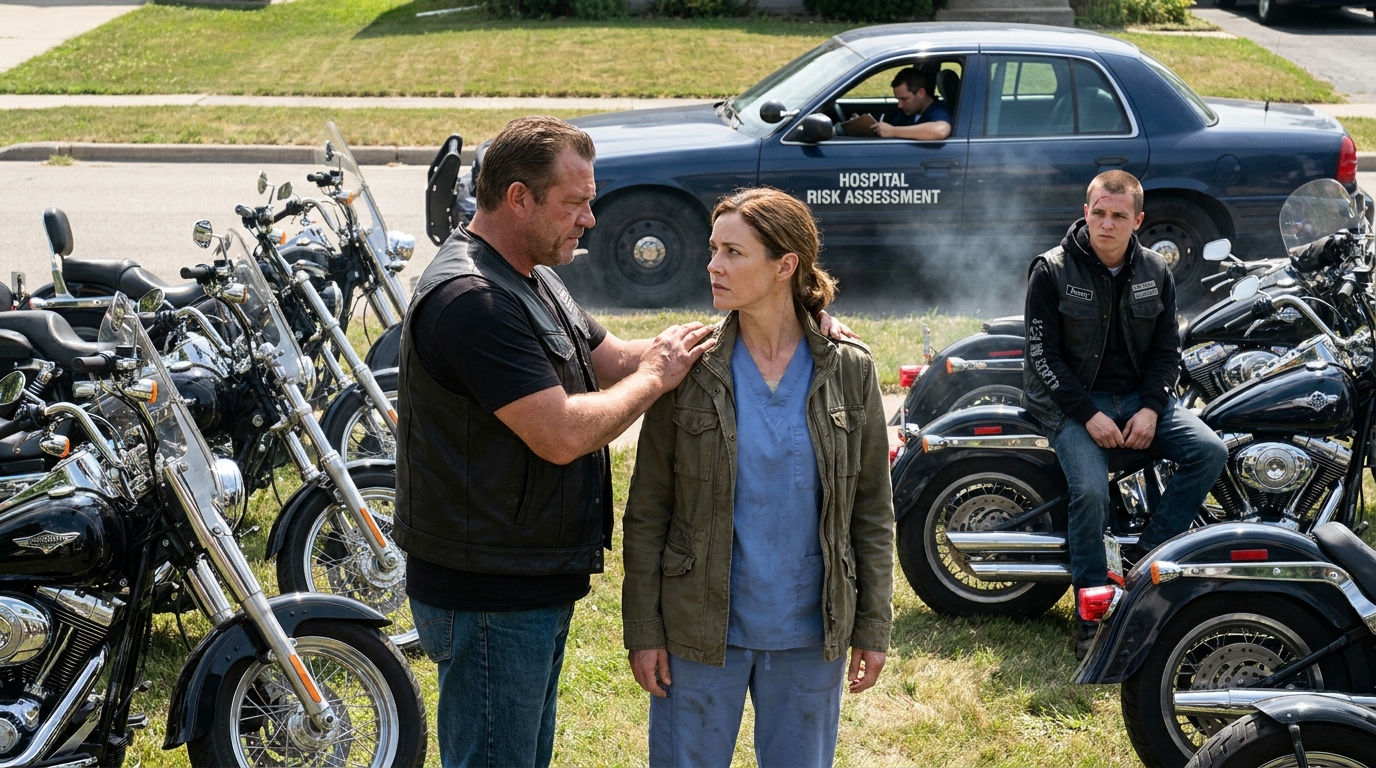
Darren glanced toward the street, recognizing the dark blue sedan from the hospital parking lot—the vehicle assigned to Risk Assessment.
The driver didn’t get out.
He sat behind the tinted glass, holding a clipboard against the steering wheel, taking notes in full view of thirty men in leather vests.
“Let him write,” Darren said quietly, stepping back toward her daughter’s table. “I have a shift at six tomorrow morning anyway.”
Ray looked at her for a long, silent moment, his face unreadable beneath the graying beard.
“We’ll be on the road by then,” Ray said. “But you aren’t fighting that board by yourself, Darren.”
CHAPTER 4: THE HOSPITAL NOTICE
Darren stood at the hospital breakroom counter, her hand extending toward the heavy Manila envelope left face-up on the scuffed laminate surface right beside a half-empty pot of stale morning coffee.
The fluorescent bulb overhead hummed with a thin, irritating vibration.
Across the room, the breakroom door swung open with a quiet pneumatic hiss, and Vance from Risk Management stepped inside, holding a manila folder tucked tightly beneath his arm like a shield.
“You took your time getting in, Stur,” Vance said, his voice flat, engineered to sound completely detached from human context.
Darren didn’t rush her movement.
She picked up the envelope, feeling the thick stock paper between her fingers before looking at him.
“My shift started seven minutes ago,” Darren said, setting her scrub jacket over the back of a vinyl chair. “I’m on the floor.”
“You’re scheduled for a preliminary administrative review at ten-thirty,” Vance replied, tapping his finger against his folder. “Risk Assessment needs a formal statement regarding the August fourteenth incident on State Road 13.”
Darren pulled her stainless-steel bandage shears from her scrub pocket and laid them quietly on the counter, the chipped plastic handle making a dull thud against the laminate.
“I gave my statement to the state trooper twelve months ago, Vance,” she said. “The scene was handed off to County EMS within twenty-one minutes.”
“State troopers handle traffic law, Stur,” Vance said, stepping closer, his shoes squeaking against the linoleum. “The board handles institutional exposure. You engaged in unsanctioned, off-site medical intervention without authorization, equipment, or dispatch log coverage.”
“Five men were bleeding on the highway,” Darren said plainly, her eyes locked on his. “One had an arterial bleed on his forearm. If I had waited for dispatch logs, he wouldn’t have made it to your trauma suite.”
“And if that rider had contracted an infection or suffered nerve damage under your bare hands, his insurance company wouldn’t be suing County EMS,” Vance shot back, his tone tightening with administrative arrogance. “They’d be suing this hospital for gross negligence by an off-duty employee.”
Darren looked down at the envelope in her hands.
The red stamp across the front read: FORMAL NOTICE OF DISCIPLINARY HEARING – LIABILITY COMPLIANCE.
“You’re framing a life-saving intervention as a policy breach to cover a settlement cushion,” Darren observed, her voice dropping into a dangerous, quiet calm.
Vance adjusted his collar, a faint red patch blooming along his neck—the only crack in his corporate composure.
“We’re protecting the facility’s operating license,” Vance said, turning toward the door. “Be in Conference Room B at ten-thirty. Don’t bother bringing union reps—this falls under civil liability review, not workplace grievance.”
The door hissed shut behind him, leaving Darren alone with the hum of the light fixture.
She picked up her bandage shears, slipped them back into her pocket, and opened the envelope.
CHAPTER 5: THE CORPORATE WALL
Darren’s hand rested on the smooth oak door handle of Conference Room B at 10:29 AM, feeling the cool metal give way under her palm as she pushed the heavy door inward.
Vance sat at the head of a long polished mahogany table, flanked by two regional hospital board representatives whose dark suits looked entirely untouched by an actual shift in a trauma ward.
A single paper folder lay open in front of Vance, its edges crisp and uncreased.
“Take a seat, Stur,” Vance said without looking up from his pen. “Let’s keep this administrative.”
Darren pulled back a heavy leather chair but stayed standing, her hands resting flat against the top of the seat back.
“I have three beds waiting in Triage,” Darren said, her tone level. “Say what you need to put in the file.”
Vance clicked his pen once—a sharp, aggressive sound in the silent room.
“The regional board is reviewing the August fourteenth incident under Section Four of your employment contract—unauthorized off-duty medical care resulting in institutional liability risk,” Vance stated, sliding a sheet of paper across the polished wood. “Sign the formal acknowledgment of breach, accept a thirty-day unpaid suspension, and we close the file.”
Darren didn’t reach for the paper.
She pulled her stainless-steel bandage shears from her scrub pocket and laid them squarely over the signature line, the chipped plastic handle anchoring the document to the table.
“I didn’t breach standard of care, Vance,” Darren said, looking straight past him at the two board members. “I stabilized five trauma patients with zero equipment before county units arrived. Every one of those men walked out of this facility alive.”
“And every one of those men represents an unhedged insurance liability!” Vance snapped, his composure slipping as he slammed his palm flat against the mahogany. “You acted outside protocol! If one of those riders had coded on that asphalt, his estate would be stripping this hospital’s endowment in civil court right now!”
“You aren’t protecting the facility, Vance,” Darren replied, her dry, common-sense tone cutting right through his rising volume. “You’re trying to force a suspension so Risk Assessment can point to a staff infraction if the county audit asks why your ER response times lagged that afternoon.”
Vance’s jaw clamped shut, a red patch blooming rapidly up his neck as he glared at her across the table.
“You don’t dictate policy here, Stur,” Vance spat, leaning forward until his knuckles turned white against the wood. “You sign that paper, or I hand this file to legal before five o’clock and revoke your clinical credentials permanently. You have no leverage, no union defense, and no standing.”
The quiet in the conference room stretched thin, broken only by the hum of the air conditioning unit overhead.
“I don’t need a union rep to know what common sense looks like, Vance,” Darren said softly. “And I’m not signing your cover-up.”
Vance laughed—a short, harsh bark devoid of humor. “Then you just ended your career in this county.”
CHAPTER 6: THE FINAL STAND
Vance stood frozen behind the conference room table, his hand hovering two inches above his desk phone as a deep, low-frequency rumble vibrated straight up through the floorboards from the glass atrium below.
The water inside the plastic cup beside his arm shivered in concentric circles.
“What is that?” one of the regional board members asked, his slick posture breaking as he looked toward the ceiling tile.
Darren didn’t answer.
She picked up her stainless-steel bandage shears from the top of the disciplinary notice, slipped them quietly back into her scrub pocket, and pulled open the heavy oak door.
The main administrative lobby was completely flooded with sunlight and leather.
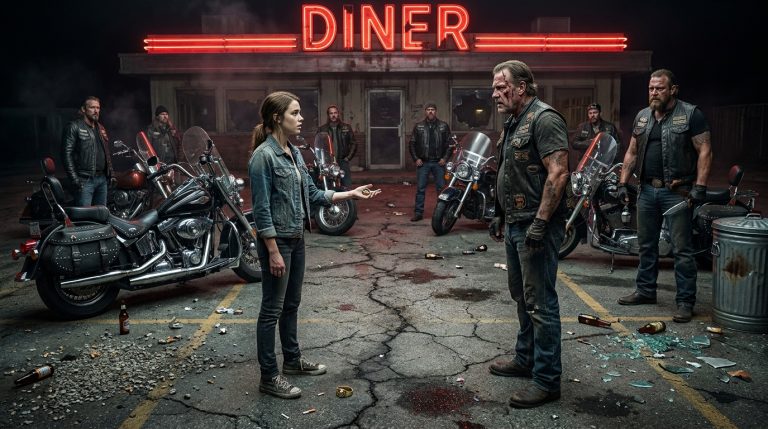
Thirty men in black vests stood shoulder-to-shoulder across the marble floor, their leather boots planted firmly against the polished tile, dead silent.
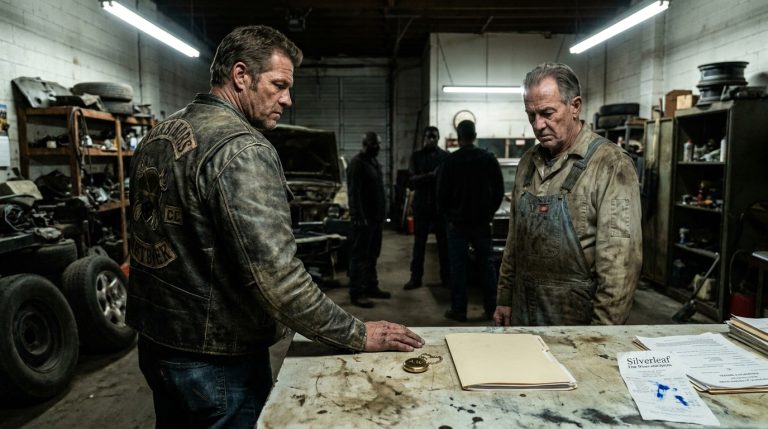
At the center of the line stood Ray, his broad chest rising and falling beneath his worn vest, his face unreadable as he held a thick, yellowed folder under his arm.
Security guards stood three feet away near the turnstiles, their hands resting nervously on their belts, but not a single officer made a move to step forward.
Vance burst through the conference room door right behind Darren, his face flushed dark red as he pointed a trembling finger at the crowd.
“This is private administrative property!” Vance shouted, his voice cracking against the high glass ceiling. “Security, clear these people out! Escort them off the premises immediately!”
Ray didn’t blink.
He took two slow, deliberate steps forward, his left leg carrying that familiar slight hitch, and laid the yellowed folder flat on the reception desk.
“That’s the state patrol incident report from August fourteenth,” Ray said, his gravelly voice carrying clearly to every corner of the atrium. “Along with sworn affidavits from five patients, two responding paramedics, and the county sheriff.”
Vance’s mouth opened, but no sound came out as he stared at the heavy stack of documents.
“You want to talk about institutional liability?” Ray continued, his tone dropping into a icy, calm register. “Every local news outlet in Milwaukee County is sitting outside in our parking lot right now. They’re waiting to hear why a regional hospital board is threatening the nurse who kept five voters breathing on a two-lane highway before your dispatch even picked up.”
The two board members behind Vance exchanged a swift, terrified glance.
The older board member cleared his throat, adjusting his silk tie with a hand that had suddenly begun to shake.
“Now, let’s not rush to extreme conclusions,” the board member stammered, stepping smoothly in front of Vance. “Mr. Vance was merely executing a standard protocol review. Risk Management is always required to conduct due diligence.”
“The file’s closed,” Darren said, her dry, common-sense voice cutting off his corporate retreat before he could build momentum. “Or every one of these men tells their story on the five o’clock news.”
Vance lunged forward, grabbing the disciplinary sheet off the desk. “You can’t threaten this board—”
“Shut up, Vance,” the board member snapped, snatching the paper directly out of Vance’s hand and tearing it down the center in one sharp motion.
He dropped the shredded paper into the nearest recycling bin, turned to Darren, and offered a tight, nervous nod.
“Your clinical standing is completely untarnished, Nurse Stur,” the board member said, his voice dripping with forced politeness. “Thank you for your exceptional service to this community.”
Darren didn’t offer a polite smile or a dramatic exit.
She looked at Vance’s pale, sweat-streaked face, turned her back on the suit, and walked straight down the center aisle of leather vests.
Ray met her near the automatic glass doors, nodding once with the quiet, unbroken respect of a brother.
Outside, the August heat hit her face like a warm blanket.
Sitting on the curb near the entrance was Brienne, her small legs swinging over the concrete edge as she held her cookie tin cashbox tight in her lap.
“Did you sell out of lemonade, sweetie?” Darren asked gently, dropping down to sit beside her on the warm pavement.
Brienne grinned, holding up a single paper cup drawn with a purple bicycle on the side.
“Saved the last cup for you, Mom,” Brienne said. “Fifty cents.”
Darren reached into her scrub pocket, pulled out two quarters, and dropped them clinking into the tin slot.
She took a sip of the cold, tart drink under the bright Wisconsin sun while thirty heavy engines started up behind them, filling the afternoon with thunder.