Red Rock Refuge: A Hard-Earned Reckoning in the Desert
CHAPTER 1: THE THRESHOLD AT FREIGHT ROAD
The screen door didn’t knock; it rattled against its frame under the weight of someone collapsing into the wood.
Cole set his bottle of black coffee onto the workbench, the glass clinking softly against the oil-stained pine. He didn’t rush. Out past the gravel yard, the desert air carried the low, greasy hum of a transformer on its last legs, but inside the kitchen, the silence was absolute.
He pulled the door back.
She hung from the casing by four white-knuckled fingers, her boots caked in red dust, her left wrist swollen where a thick gold band had bitten into the flesh. Her shirt was torn at the shoulder, revealing a dark, fresh bruise creeping up toward her collarbone.
“Please,” she rasped, her chest heaving against an eight-month belly. “He’s behind me.”
Cole didn’t look down the dark stretch of Freight Road. He looked at her jawline—the yellowish purple at the corner—and then at her wrist. He’d seen that precise pattern of red marks twenty years ago on a woman who never made it back to the porch.
“Your name,” Cole said. His voice was low, flat, and entirely devoid of the panic vibrating off her skin.
“Sarah,” she breathed, her knees buckling an inch before her hip hit the doorframe. “Sarah Callaway.”
Behind him, Danny Voss paused in the doorway, his iron key ring dropping into his palm with a dull, heavy clink. Neither of them needed a surname explained; in Red Rock County, Callaway meant Grant Harlow’s checkbook and three hundred head of cattle grazing on stolen water rights.
“Sit,” Cole said, stepping aside just enough to offer a clear path to the heavy oak table.
She looked at the chair like it was a trap, then slid into it, her hands immediately wrapping around her stomach like a shield. “He owns the sheriff,” she whispered, her voice tightening into a dry rattle. “He owns the judge downtown. I walked four miles from the highway after the deputy told me to go home and fix my marriage.”
Cole reached into his canvas jacket pocket. His fingers closed around a scarred, heavy brass key ring—three blank keys, no fob. He turned it once in his grip, feeling the notch scrape against his thumb.
“Sutter was on duty tonight?” Cole asked.
“He took my statement on a napkin,” she said, staring at the scarred surface of the table. “Then he called Grant.”
Danny set a thick ceramic mug of tap water in front of her. “Truck’s behind the barn,” he muttered toward Cole. “Gate’s latched, but if Harlow’s boys are tracking her, they aren’t using dogs. They’re using the headlights I saw turning off the state route five minutes back.”
Cole didn’t move toward the window. He stood between the table and the front threshold, his shadow long and motionless across the linoleum.
“He thinks his money travels faster than a man on foot,” Cole said, his voice level. “He hasn’t come through this yard yet.”
“You don’t understand,” Sarah said, her voice rising, cracked with exhaustion. “He doesn’t stop. He doesn’t lose things that belong to him.”
“Then he’s going to learn what happens when he tries to collect on a debt that isn’t owed,” Cole said. He turned the brass ring once more, the cold metal biting into his palm. “Danny, turn the porch light off. Leave the kitchen amber.”
CHAPTER 2: THE SHERIFFS DEMAND
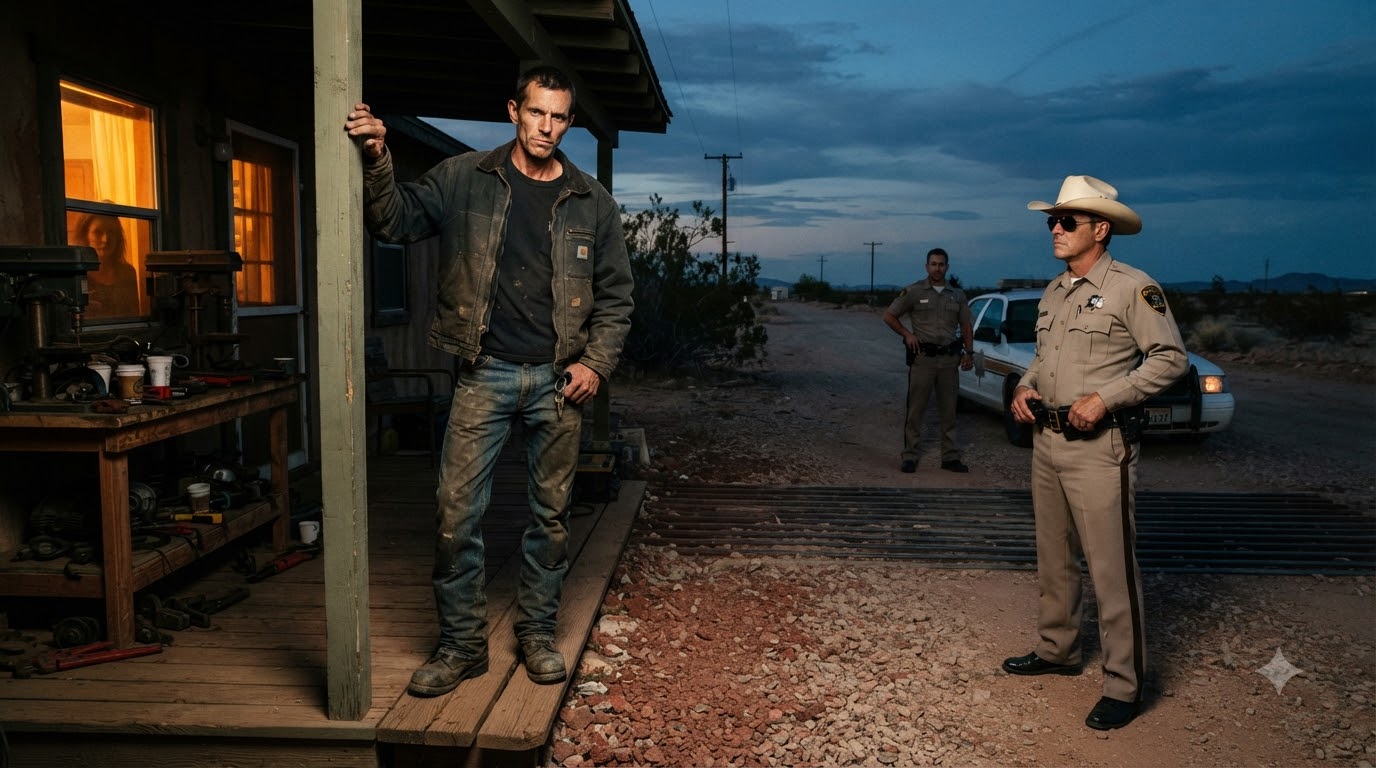
The twin shafts of light died, leaving the yard in a bruised twilight. A engine shut off with a wet, heavy shudder.
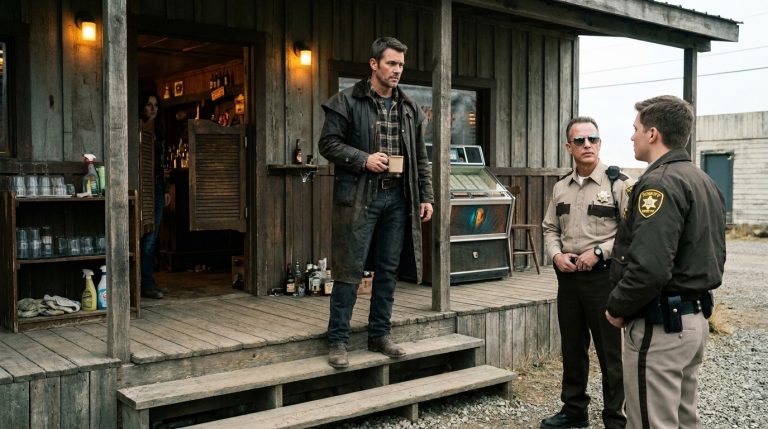
The door of the white patrol vehicle opened, the metal creaking in the desert cold. Earl Sutter took his time getting out. He adjusted his gun belt, his thumb hooking behind the leather, the brass buckle catching the amber glow from the kitchen window.
He didn’t walk like a man investigating a crime. He walked like a landlord checking on a tenant whose lease had expired three years ago.
“Cole,” Sutter said, stopping six feet short of the bottom step. He didn’t take off his sunglasses, even as the dark settled over the flats. “You got a light out.”
Cole stood on the top plank, his left hand resting flat against the square post. In his right pocket, his fingers didn’t move. The brass key ring stayed cold against his knuckle.
“I like the dark,” Cole said. “Means people have to think twice before they turn into the driveway.”
Sutter let out a short, dry sound from his nose. Behind him, the passenger door clicked open. A younger deputy—a kid with a cheap haircut and a holster that looked like it hadn’t seen oil since the factory—stepped into the gravel. His right hand drifted toward his waist, hovering two inches above the grip of his sidearm.
“We got a call,” Sutter said, pulling a clipboard from under his arm. He didn’t look at it. “Grant Harlow reported his wife missing about two hours ago. Said she left the house confused. Said she’s eight months along and not taking her medication.”
From inside the kitchen, the floorboard groaned softly. Sarah didn’t speak, but Cole could feel the air shifting behind the screen door—the tight, desperate hold of someone holding their breath until their lungs burned.
“She isn’t confused,” Cole said.
Sutter shifted his weight, his boots grinding a handful of red gravel into the dirt. “That’s not for you to decide, Cole. Or me. That’s a medical matter. Grant’s got an emergency order signed by the county clerk. I’m here to transport her to the regional hospital in Flagstaff for an evaluation.”
“Show me the judge’s signature,” Cole said.
Sutter smiled. It didn’t touch his cheeks. “It’s a civil protective custody order, Cole. Signed by the clerk on duty. That’s all the paper I need to step onto this porch and look around.”
“The clerk isn’t a judge,” Cole said, his voice dropping an octave, slipping into a flat, level register that made the younger deputy pause his movement. “And this isn’t county land past the cattle guard. The survey from sixty-eight puts my line three feet out into the road. You’re standing on private property, Earl.”
“Don’t do this,” Sutter said, his tone dropping the friendly tone. “Grant’s got three cars sitting at the crossroads. He’s being polite by letting me drive up here first. If I go back down that dirt road alone, he stops using the department to handle his domestic affairs.”
“Tell him to come himself,” Cole said. “He knows where the gate is.”
The younger deputy took a half-step forward, his leather boots crunching loud in the stillness. “Deputy, he’s obstructing—”
“Shut up, Miller,” Sutter snapped, without turning his head. He kept his eyes locked on Cole’s chest. “Cole. You’re running a repair shop out of a barn that isn’t zoned for commercial work. You’ve got six unregistered bikes sitting behind that fence. You want me to bring the county inspector out here tomorrow morning with a haul truck?”
Cole turned the brass ring once inside his pocket. The edge scraped his skin, hard and real.
“Bring him,” Cole said. “Tell him to bring a shovel. He’s going to need it if he wants to move those frames.”
Sutter stared up at the porch for three long seconds. The wind picked up from the east, carrying the smell of ozone and hot exhaust from the cruiser’s cooling manifold.
“She’s in the back, isn’t she?” Sutter asked softly.
“There’s nobody here but Danny and the grease,” Cole said.
Sutter pulled a yellow carbon copy from his clipboard and slapped it against the wooden post next to Cole’s shoulder. The paper fluttered in the draft. “That’s a notice of entry for a welfare check. I’ll be back at six in the morning with the circuit marshal. If that door doesn’t open, we cut the lock on the gate.”
He turned on his heel and walked back to the cruiser, his boots heavy and unhurried. The young deputy backed away slower, keeping his eyes on Cole until he reached the passenger side.
The patrol car reversed down the long dirt driveway, its red tail lights painting the dust clouds in thick, dark strokes before disappearing past the freight road.
The screen door squeaked open behind Cole. Sarah stood in the frame, her hand pressed hard against the center of her chest, her fingers hooked into the collar of her torn shirt.
“He’s coming back,” she whispered.
Cole didn’t turn around. He watched the faint red glow fade from the horizon. “I know,” he said. “Get your coat. We’re moving the truck into the barn before the rain hits.”
CHAPTER 3: THE BROKEN LINE
The latch dropped home with a dead, metallic thud just as the sky blew wide open.
Inside the barn, the air smelled of wet cedar, old gear oil, and the sharp, iron tang of raw dust being flattened by water. Danny stood by the workbench, a heavy flash lantern unlit in his left hand. Sarah sat on an overturned wooden crate in the corner, both arms crossed tight over her stomach, her boots pulled back into the shadows.
“Sutter won’t wait for six in the morning,” Danny said, his voice clipped over the drum of the rain. “He’s sitting at the crossroads right now, getting his story straight with Harlow.”
“Let them talk,” Cole said. He reached into his coat, pulled out the brass key ring, and set it on the workbench. It didn’t roll. It just sat in a ring of dark grease. “Sutter’s a cowardly man with a badge, but Harlow’s paying for a result. They won’t use the front road again.”
A sudden, sharp metallic crack echoed from the north side of the property—the sound of chain-link fence under tension, followed by the dull snap of a grade-four padlock giving way.
Danny didn’t reach for a weapon. He grabbed a six-foot length of rusted iron pipe leaning against the drill press and stepped toward the side door. “They’re coming through the equipment gate.”
“No lights,” Cole said, shifting his boots on the packed dirt floor. “They want a mess in the dark so Sutter can write it up as a trespasser incident.”
The side door rattled. Not a kick—a crowbar wedging between the frame and the cedar jamb, the dry wood groaning as lever action forced the deadbolt through the pine block.
Cole moved. He didn’t sprint. He used the weight of his shoulders, planting his lead boot into the dirt and slamming his full upper body against the thick oak crossbar of the door just as the iron bar bit deep. The wood shrieked. Through the three-inch gap, a man’s heavy, wet breathing pushed into the barn, accompanied by the smell of cheap tobacco and soaked denim.
“Harlow wants the woman, Riker!” a voice barked from the dark outside—not Sutter, but one of Harlow’s ranch hands, hired muscle with grease under his fingernails. “Step back and nobody takes a ride to the county lockup!”
Cole didn’t answer. He drove his hip into the door, forcing the crowbar back against the man’s wrist until metal hit bone with a dull crunch.
The man grunted, losing his grip. The iron bar dropped into the mud outside with a heavy splash.
“Danny! Clear the back window!” Cole called out, his lungs straining against the resistance of two more men shoving from the outside. The wooden door frame splintered near the top hinge, shower of dry sawdust spraying across Cole’s cheek.
Sarah stood up from the crate. Her face was pale in the dim grey light filtering through the high eaves, but her hands were steady as she grabbed a heavy brass wrench from the bench and set it on the table right next to Cole’s hand. She didn’t scream. She didn’t retreat.
“The county line is three miles east,” Sarah said, her voice cutting through the thrumming rain on the roof. “If they take me past the bridge, Harlow has a notary sitting in his parlor.”
Layer 1 was breaking right here in the mud. This wasn’t about a husband taking a runaway wife home. This was about a paper trail that needed her physical presence before the sun came up.
Cole planted his heels, his shoulder digging into the rough oak door until the wood bit through his denim coat. “He isn’t getting you to the bridge,” Cole said, his voice rough with strain. “Danny, drop the bar on the tractor gate!”
Outside, boots slipped violently in the fresh mud as the men lost their footing against the sheer, stubborn resistance of the frame.
Cole gave one final, bone-jarring shove, forcing the door flush against the jamb, and dropped the iron drop-rod into its floor socket. The latch held.
The rain hammered down harder, swallowing the sound of cursing men retreating back toward the broken perimeter fence.
Cole leaned his forehead against the damp wood, his chest rising and falling in slow, heavy cycles. He reached down, picked up the brass key ring from the bench, and slipped it back into his coat.
“They’ll go to the courthouse clerk now,” Sarah said, staring at the locked door. “They don’t need a judge if they have Sutter’s paper and my signature forced on a land transfer.”
“They don’t have your signature,” Cole said, turning to face her. “And they don’t have this barn.”
CHAPTER 4: THE DUSTY LEDGER
The paper was heavy bond, cream-colored, and entirely out of place among the grease-stained county maps spread across the pine table.
Sarah leaned over Cole’s shoulder, her hand resting on the back of his chair. Her thumb dug into the wood as her eyes tracked the typed lines across the top margin.
“That’s the parcel for the eastern water access,” she whispered. “Grant bought the easement six months ago from the county trust.”
“He didn’t buy it,” Cole said. He flipped the heavy ledger page back with a calloused finger, the yellowed paper crackling in the humid room. “He filed a conditional lien through his brother’s holding company. Look at the signature block at the bottom.”
The line reserved for the property owner was blank. Attached by a rusty paperclip to the back page was a blue carbon copy of a power-of-attorney filing.
The name typed on the primary line was Sarah’s. The signature beneath it was a shaky, forced scrawl—dated three days ago, a Tuesday afternoon when Sarah was sitting in the sheriff’s lobby waiting for Deputy Sutter to finish his lunch.
Danny set three cold mugs of tap water on the table, the glass bottom thudding against the ledger cover. “He’s using the county clerk to bypass the deed registry. If he files that carbon before the courthouse opens at eight, the water rights transfer to his estate automatically.”
“He doesn’t care about the water,” Sarah said, her jaw tightening until a muscle twitched near her ear. “The land grant includes the homestead clause. If he controls the title through a power-of-attorney, he can declare me legally incapacitated to protect the asset.”
Cole pulled his scarred brass key ring from his coat pocket and set it down directly over the forged signature. The heavy metal covered the fake name completely.
“This is what Sutter was waiting for,” Cole said, looking up at Danny. “The welfare check wasn’t to take her back to Harlow’s house. It was to get a deputy’s seal on a field verification form so the clerk could stamp the filing without Sarah standing at the window.”
Danny leaned both palms against the table, his elbows locked. “The circuit clerk is Earl Sutter’s brother-in-law. He’s got the keys to the side entrance on Third Street.”
“Then we don’t go to the police,” Cole said, his voice flat and practical. “And we don’t wait for six in the morning.”
Sarah reached down, her fingers brushing the cold brass of the key ring. “He’s going to be sitting at that side door himself, Cole. Grant doesn’t let other people handle the final stamp.”
“Good,” Cole said, closing the heavy ledger with a dull thump that puffed a tiny cloud of dust into the yellow light. “Means we won’t have to look for him.”
CHAPTER 5: THE CORNERED RAT AT THE COUNTY LINE
Grant didn’t drop his key ring. He turned around slowly, his leather coat slick with rain, his hair styled and unbothered despite the dawn sky breaking gray behind the tree line.
“Cole,” Grant said, his voice smooth, holding the effortless authority of a man who’d never had a check bounce or a demand questioned. “You’re trespassing on county property before public hours. Deputy Sutter is around the corner.”
“Sutter’s in his cruiser with a flat front tire,” Danny said, stepping out from the shadow of the brick pillar, his heavy wrench resting against his thigh. “He isn’t coming up these steps.”
Grant’s chin tilted up an inch. His eyes flicked to the heavy Manila folder tucked under his arm—the forged power-of-attorney documents waiting for the clerk’s morning stamp.
“This is embarrassing, Cole,” Grant said, stepping down one step, trying to use the height of the stone stairs to look down at them. “Sarah is unwell. She’s hysterically pregnant, wandering the flats in the dark. I am executing my legal duty as her husband to secure her estate and her medical care.”
Sarah stepped out from behind Cole. She wore Cole’s heavy canvas jacket, the sleeves rolled twice at her wrists. Her boots were stained dark with mud, but her jaw was set as tight as iron.
“I’m standing right here, Grant,” she said.
Grant’s smile twitched—just a fraction of an inch at the left corner of his mouth, the briefest slip in a mask forty years in the making.
“Sarah, get in the truck,” Grant said, his tone dropping the polite veneer, sharpening into a flat command. “You’re making a scene in front of grease-monkeys. We are going home, and you are going to rest.”
“Show him the ledger page, Sarah,” Cole said calmly.
Sarah pulled the yellow carbon copy from the inner pocket of Cole’s coat and held it flat against her chest. “The county clerk doesn’t take forged signatures when the principal owner is standing on the steps in front of two witnesses.”
Grant took a fast step down, his hand reaching out instinctively to grab the paper from her grip. “That is a private family document—”
Cole didn’t swing. He simply shifted his frame forward, stepping directly into Grant’s path. Grant’s shoulder slammed into Cole’s chest like a wave hitting a concrete pier.
The impact knocked the breath out of Grant, sending him stumbling back against the wet iron handrail. The leather folder slipped from under his arm, hitting the wet stone steps and spilling three signed carbon copies into the mud at Cole’s boots.
“You touch her again,” Cole said, his voice dropping into a quiet, terrible register that carried over the thrum of the rain, “and we find out how much that suit costs when it’s covered in ditch water.”
Grant straightened his tie with trembling, furious fingers, his eyes wild as he looked from Cole to the papers ruined in the mud.
“You think this changes anything?” Grant snarled, his face red, the entitlement boiling over into sheer, unadulterated venom. “I own half the water rights in this basin! I own the bank that holds your mortgage, Riker! You walk away now, or I will break every frame in your shop by noon!”
“Try it,” Cole said. He bent down, picked up the wet carbon copy, and handed it directly to Sarah. “The clerk opens in five minutes. And Sarah’s going to be first in line.”
CHAPTER 6: THE UNBURDENED HORIZON
Grant stood on the other side of the reinforced glass partition, his fingers pressed so hard against the counter ledge his knuckles turned white as bone.
“That filing is invalid without a verified deputy’s signature!” Grant’s voice cracked through the small circular speaker, stripped of every ounce of polish it had carried for twenty years. “You’re stamping a fraudulent claim!”
The elderly clerk didn’t look up. She slid the sealed carbon copy across the counter to Sarah, pulled her spectacles down to the tip of her nose, and pointed a thin finger toward the public lobby door.
“The lady is standing here in person, Mr. Harlow,” the clerk said, her voice flat, dry, and thoroughly unimpressed by three generations of family money. “In-person appearances override third-party filings. If you have a dispute, the circuit judge holds open calendar on Thursday mornings.”
Grant slammed his open palm against the glass, the sound cracking sharply through the empty hallway. “You think you can just walk out of here? You don’t have a dime, Sarah! You don’t have a house! Every asset in this county stays locked until my attorneys review that paper!”
Sarah took the stamped document. She didn’t wave it in his face. She didn’t yell back.
She turned her back to the glass, folded the heavy bond paper twice, and slid it into the inner pocket of Cole’s canvas coat.
“He’s going to spend six months calling lawyers,” Danny muttered as they pushed through the heavy bronze front doors into the cool morning air.
“Let him call,” Cole said, stepping onto the concrete apron. “Lawyers cost money every time they pick up the phone. He’ll get tired of paying for silence.”
Down at the curb, the rain had stopped. A thin streak of yellow sunlight cut through the gray clouds over Freight Road, washing the mud on the pavement in a pale, warm light.
Sarah stopped at the passenger side of Cole’s truck. She reached up with her right hand, her thumb catching the gold band on her left ring finger.
She twisted it once—not with hesitation, but with the steady, practical focus of someone undoing a rusted nut.
The ring slid off her skin, leaving a pale, deep depression in the flesh. She didn’t drop it into the gutter or throw it at the courthouse steps. She set it quietly on the flat top of the truck’s bed rail, the metal making a tiny, decisive click against the painted steel.
Cole opened the truck door for her, his boots planted firm on the wet asphalt. He pulled his brass key ring out, slipped the ignition key free, and handed the heavy ring to Danny.
“Get the shop open,” Cole said. “We’ve got a transmission to drop before noon.”
Sarah climbed into the bench seat, wrapping both hands around her stomach as the baby gave a slow, firm kick against her ribs. She looked out through the clean windshield toward the open desert road stretching east toward the county line.
Cole shut the passenger door, stepped around to the driver’s side, and turned the engine over. The old V8 roared to life, rough and steady, cutting through the silence of the morning.