Drawn Iron and Dry Dust: How One Rancher Defended His Water Against Corporate Suburbs
CHAPTER 1: THE EMPTY GAUGE
The dust on the ranch road did not settle for ten minutes after the truck engine died. I stepped down onto the baked earth, my boots hitting the caliche with a flat, dry thud.
The heat was already pressing down through the crown of my hat, heavy and thick enough to taste. I walked past the empty cattle troughs toward the low-slung pump house.
The north tank sat fifty yards off, a galvanized steel cylinder thirty feet across, meant to hold fifteen thousand gallons of well water against the dry season. Today, the metal skin of the tank was silent. There was no dull roar of pressure, no vibration in the ground beneath my heels.
I climbed the three wooden steps of the riser and tapped the side with my knuckles. It rang hollow—a high, tinny sound that told the whole story before I even glanced at the float gauge.
Dead empty. Every last drop pulled clean out of the ground I had spent ten years carving out of this stubborn dirt.
My fingers tightened around the cold ceramic handle of the coffee mug I had brought from the dash. I did not yell, and I did not throw the cup. Anger out here was a waste of sweat; it dried you out before you could figure out which way the wind was blowing.
Instead, I traced the base of the tank with my eyes, looking for the wet stain that would betray a split seam or a rusted-out valve. There was no puddle. The soil around the concrete footing was dusty, pale, and thoroughly disturbed.
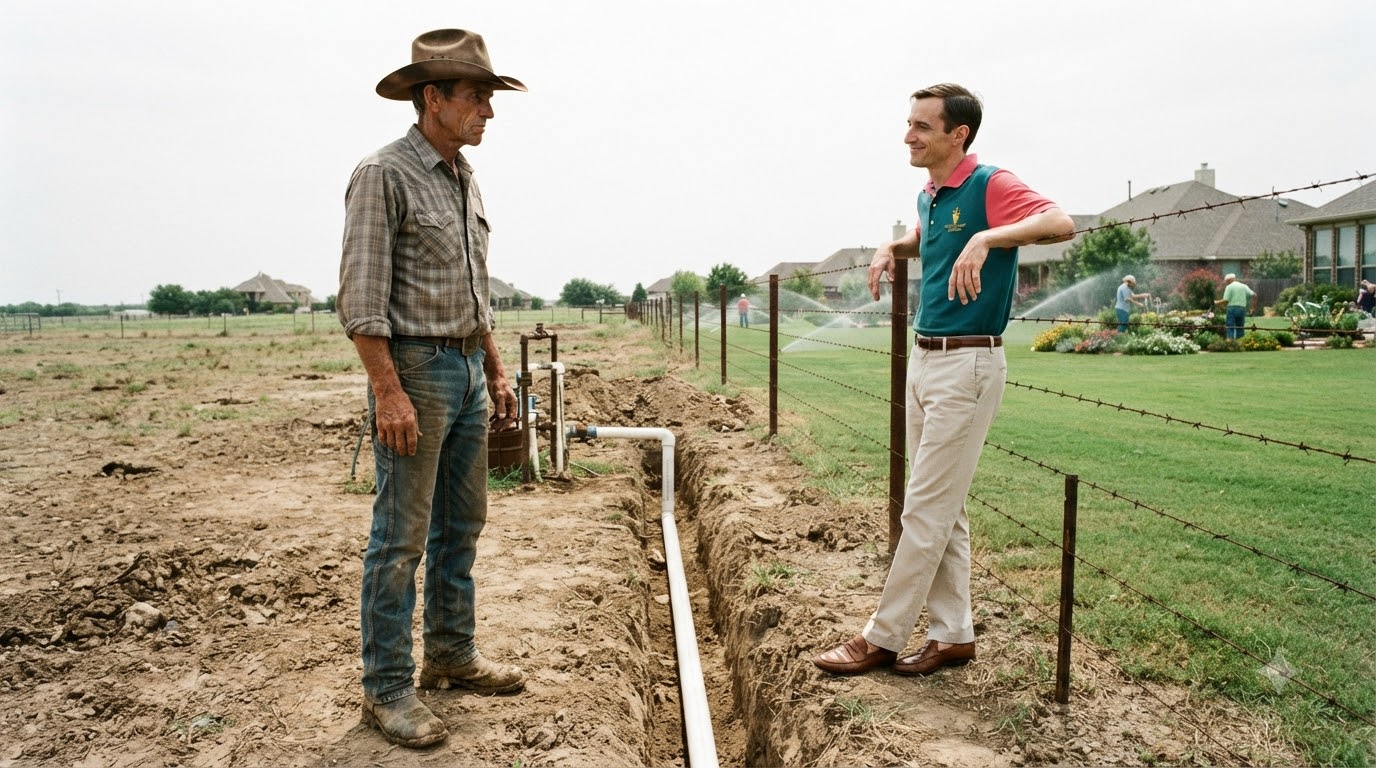
A fresh trench cut straight away from the tank base, heading east toward the wire fence line that separated my sixty-two acres from the Silver Meadow subdivision.
The earth had been turned over within the last week, dark gray soil thrown up over the lighter caliche. Someone had put a shovel to my land while I was two counties away at the Abalene cattle auction.
I walked the length of the fresh earth, my boots crunching over dry bunchgrass. The trench led straight to the fence, where the bottom wire had been neatly unclipped and pulled aside.
On the other side, gleaming under the harsh midday sun, stood a thick white PVC line running deep into the manicured lawns of Silver Meadow. Sprinkler heads were hissing quietly out in the green grass, spitting fine mist over flower beds that had no business blooming in this drought.
They had not just taken my water. They had automated the theft.
CHAPTER 2: THE POLISHED LOAFERS
A low hum drifted across the cut grass of Silver Meadow, rising over the regular ticking of the sprinkler heads.
A white SUV rolled up the subdivision’s paved access lane, stopping abruptly ten feet from my fence line.
The driver’s door swung open with a light, expensive click, and a pair of spotless leather loafers stepped out onto the caliche dust.
Grant wore a crisp polo shirt bearing a neat country club logo that looked entirely ridiculous against the dry backdrop of sixty-two acres of hard scrub.
He didn’t bother opening the gate; he just leaned his forearms against the top wire, smiling like a man who had never lost a calf to a late freeze.
“Mornin’,” Grant said, his voice smooth and carrying that practiced tone of a man used to running committees. “I see you found our auxiliary line. Thought we’d better get ahead of the dry spell before the landscaping took a hit.”
I let the cedar wire snap back into place, the rusted metal singing a sharp note in the thin air.
“You didn’t find an auxiliary line,” I said, my voice flat. “You found my well pump.”
Grant adjusted the collar of his shirt, his smile thinning out at the edges.
“Let’s not get technical about terminology,” he said, shifting his weight onto his loafers. “The previous board president had a verbal understanding with someone out here years ago. We invested significant infrastructure capital based on that precedent.”
The smell of industrial PVC glue drifted off the grass, sharp and chemical against the clean dust of the desert wind.
“There was a handshake for a fire emergency,” I said, stepping closer to the fence line until the rusted wire was between us. “Not for your Kentucky bluegrass.”
Grant’s smile vanished entirely, replaced by a tight, professional mask of corporate irritation.
“Maintaining property values benefits everyone in this valley,” he said, his chin lifting just a fraction. “If our entrance looks neglected, your land value drops right along with it. We had the contractor expedite the installation to avoid any seasonal brown-out.”
“Expedited trespassing,” I said. “That’s what you call it.”
Grant shook his head slowly, waving a hand toward the sprinkler heads hissing behind him.
“You can call it whatever helps you sleep at night,” he said, his tone hardening into an explicit warning. “We have legal counsel retained for community infrastructure. I’d advise you not do anything rash with our connection.”
CHAPTER 3: THE COLD COFFEE
The shrill ring cut through the stillness of the room, vibrating against the wooden counter where my coffee had gone stone cold.
I set the mug down without rushing, letting the ceramic tap against the laminate surface with a dull clack.
When I picked up the receiver, the line was already buzzing with a tight, hurried voice demanding to know why their water pressure had vanished.
“You cut the main feed to Silver Meadow,” the woman on the other end snapped, her words sharp enough to cut glass. “The association board authorized that connection months ago. If you don’t open that valve right now, we’ll pursue legal remedies by sundown.”
I leaned my hip against the edge of the counter, looking out the window toward the empty north tank shimmering in the dry heat.
“There was no authorization on file,” I said, my voice steady and low. “My well is private agricultural property, and your lines are off my land.”
The line crackled with a sharp intake of breath before the tone shifted from annoyance to outright intimidation.
“The board will not hesitate to file an emergency injunction,” she warned, every syllable measured to sound heavier than it was. “You’re interfering with community infrastructure and property compliance.”
“Then let the judge look at the survey markers,” I said, and hung the phone back on its cradle.
The silence rushed back in immediately, thick and dusty, broken only by the faint ticking of the wall clock.
I walked over to the heavy brass padlock resting on the utility hook by the back door, turning its cold metal weight over in my palm.
If they wanted water from my dirt, they were going to find out real quick that boundaries out here aren’t kept by polite suggestions.
CHAPTER 4: THE CLOSED DOOR
The conference room air smelled of industrial carpet and expensive coffee, a sharp contrast to the dust on my boots.
Cynthia sat at the head of the long table, shuffling papers with a sharp, nervous rhythm that made a dry scratching sound against the wood.
“You’ve created a severe liability for the entire subdivision,” she said, her mouth tightening into a thin line as she looked up. “The irrigation shutoff has already triggered yellowing on three prime homeowner lawns.”
I laid the brass key flat on the center of the table, letting the metal reflect the overhead lights.
“You didn’t have an easement,” I said. “You had a trespass with a garden hose.”
Grant shifted in his chair beside her, his loafers tapping a restless beat against the carpeted floor.
“We acted under standard community precedent,” Grant snapped, his voice rising past its usual corporate polish. “If you think you can lock out a planned community over a technicality, you’ve got another thing coming.”
“Try bringing that argument to a judge without a signed agreement,” I said, leaning my palms against the edge of the table.
Cynthia’s fingers froze over her paperwork, her eyes darting toward Grant as the sudden weight of the missing paperwork settled over the room.
The board had assumed they could bulldoze a rancher’s well, but the math on their unauthorized infrastructure was finally collapsing right back onto their desks.
CHAPTER 5: THE LEVEL TRENCH
The sun beat down directly between my shoulder blades as I leaned full weight onto the handle of the shovel.
The blade struck a buried section of white plastic pipe, sending a dull, vibrating shock up through my forearms.
Grant stood ten paces back on the subdivision side of the fence, his pristine loafers planted firmly in the manicured grass while he watched the dirt fly.
“You’re ripping out active association property,” Grant called out, his voice tight with an escalating sense of panic as he realized the bluff had failed. “We can hold you personally liable for the landscaping damage across our entire tract.”
I didn’t stop to look up; I just drove the steel edge deeper beneath the plastic line to leverage it free from the compacted earth.
“The only thing buried on this side of the fence is your unauthorized liability,” I said, heaving upward until the pipe groaned and snapped free from the soil.
Cynthia hovered behind him, her hands clenched tight against her sides as she watched the heavy plastic cord come sliding out of the dirt like a pulled tooth.
They had tried to manage a rancher’s property like a corporate ledger, but the physical reality of sixty-two acres of hard caliche had no room for their shortcuts.
I hauled the jagged end of the pipe toward the property line, dropping it right at their feet with a dry, hollow rattle.
“If you want water back on your lawns,” I said, wiping the sweat from my brow with the back of a calloused wrist, “it goes through a proper meter on my exact terms.”
Grant’s jaw worked silently for a second, his face flushing red under the dry desert glare as he stared down at the ruined infrastructure.
CHAPTER 6: THE DUSTY GRAY
I pulled the flap open and slid out the first monthly check, the paper crisp and smelling faintly of bank ink.
The figures written across the front matched the exact terms of the contract we had forced them to sign.
Outside, the north tank sat full and heavy, its pressure gauge resting steady against the upper mark where it belonged.
The trench along the eastern fence line had settled back into flat, dry caliche, packed down hard by the desert wind and my own boots.
Grant didn’t drive his white SUV down the ranch road anymore, and I didn’t spend my mornings staring out at green lawns that didn’t belong in this country.
Boundaries out here aren’t kept by pointing at old handshakes or waiting for someone else to fix the mess.
They’re kept by holding the line when the ground gets dry and making sure everybody understands the cost of taking what isn’t theirs.
I set the check down beside my coffee mug, picked up the remote for the pump monitor, and checked the water level one more time before getting back to work.