The Weight of a Mop Handle: How a Quiet Janitor Healed a Billion-Dollar Family’s Deepest Fracture
CHAPTER 1: THE LOCKED DOOR
The gray vinyl coveralls smelled faintly of bleach and damp cotton. Owen wrapped his fingers around the worn handle of his mop bucket, feeling the familiar, grounding friction of honest labor against his calloused palms.
Two security guards stood at awkward attention near the polished mahogany double doors. Diana Chun, the CEO’s sharp-tongued assistant, muttered into her phone with a tight, nervous jaw.
A few feet away stood Marcus Sterling. The man whose signature moved billions of dollars looked strangely diminished, his shoulders rigid beneath an expensive bespoke suit as he stared at the wood.
Owen did not wait for permission or announce his rank. He pushed past the perimeter of suits and corporate panic, his boots making a dull, heavy thud against the imported wool carpet.
He raised his hand and rapped his knuckles twice against the heavy oak panel. The sound was flat, unhurried, and distinct.
“Alexander,” Owen said, keeping his tone level, pitched just loud enough to carry through the dense wood. “This is Owen Carter. I clean this floor on Thursdays.”
A sharp intake of breath echoed from the other side. The security guard to Owen’s left opened his mouth to bark an order, but Owen ignored him entirely, keeping his eyes locked on the brass keyhole.
“You’ve got about four minutes before I need to get in there,” Owen continued, shifting his weight to his left boot. “So if you’re planning to stay, we should probably talk first.”
A metallic click cut through the hallway tension. The heavy latch turned inward, and the door drifted open an inch, revealing a sliver of darkness.
CHAPTER 2: THE GLASS WINDOW
Owen set his bucket down by the heavy oak door. The city lights bled through the floor-to-ceiling glass, casting long, pale shadows across the dark interior.
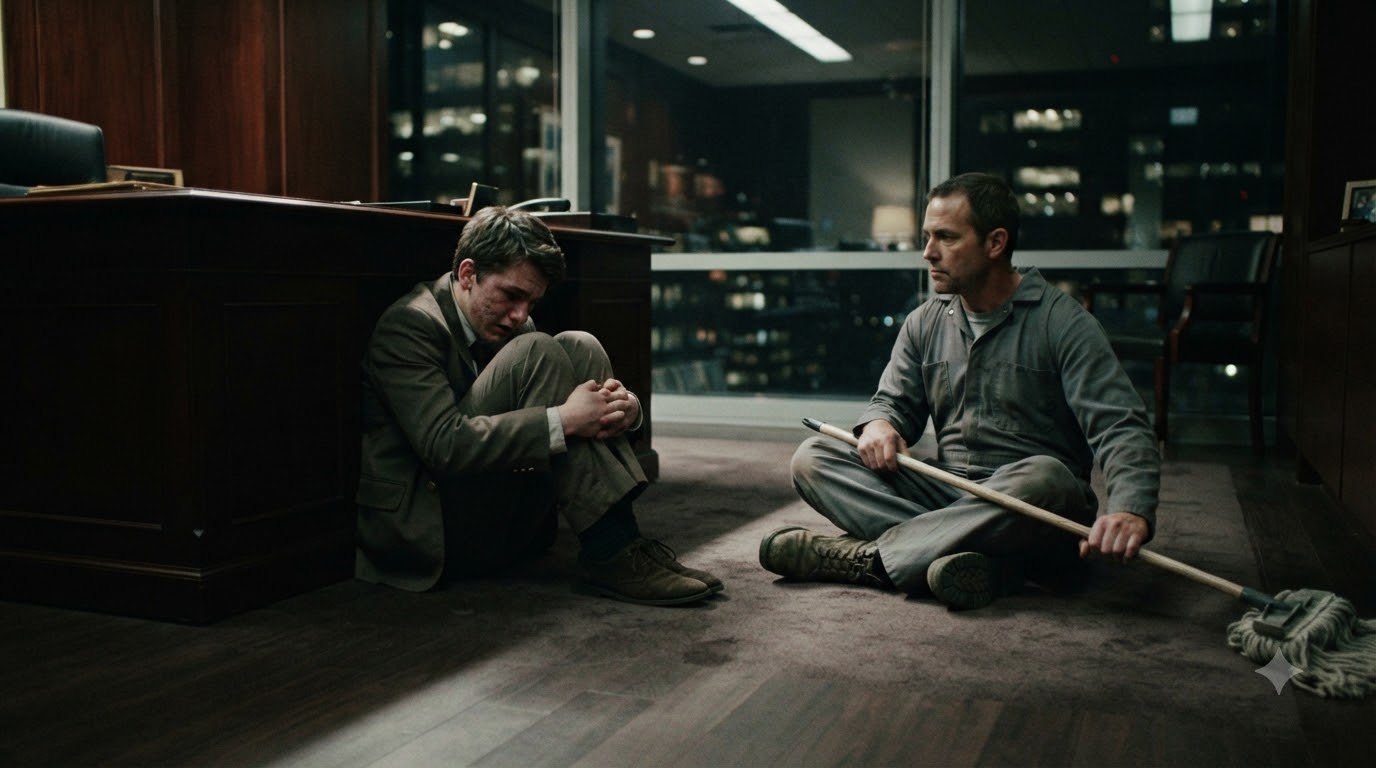
Alexander sat with his back pressed against his father’s massive mahogany desk. His knees were pulled tight to his chest, his private school uniform stiff and neglected.
“You know what I’ve noticed?” Owen said, keeping his voice flat and steady as he stared out into the night. “Your father works late every Thursday, as long as I’ve been here.”
The boy did not move or look up.
“And you sit in that conference room doing calculus homework until he’s ready to leave.”
“I’ve also noticed,” Owen continued, shifting his stance to ease the ache in his lower back, “that you never ask him when you’re going home. You just wait.”
A long silence filled the space, thick with the hum of the building’s climate control.
“My daughter does the same thing,” Owen said quietly, his hand brushing against the scuffed handle of his mop. “She’s twelve. Her mother died two years ago, and sometimes Maya will sit in the living room with her backpack still on, just waiting.”
Alexander’s breathing hitched slightly in the dark.
“Because if she asks me what’s for dinner or whether I checked her math homework, she’s afraid I’ll realize how much I can’t handle,” Owen murmured. “So she just waits for me to figure it out.”
Owen heard the fabric of Alexander’s trousers shift as the boy uncurled his legs an inch.
“He doesn’t want to be here,” Alexander muttered, his voice rough and low.
“With you?”
“With any of it.” Alexander gestured vaguely toward the empty room. “The company, the press, the everything. My mom left because he’s always working. And now he’s still always working.”
Owen turned away from the glass. He walked across the imported carpet and sat down on the floor, placing himself directly across from the boy.
“What happened today?”
“Nothing happened,” Alexander said, his hands trembling against his knees. “That’s the point.”
CHAPTER 3: THE UNSPOKEN LOSS
“I got early acceptance to MIT,” Alexander said, his voice dropping into a harsh, brittle whisper. “Full scholarship for their engineering program. I found out this morning.”
Owen remained entirely still, letting the heavy silence settle over the room like dust.
“I told him in the car on the way here,” the boy continued, his fingers digging white-knuckled into the fabric of his trousers. “He said, ‘That’s excellent,’ and then took a phone call that lasted until we pulled up to the building.”
The ghost of Sarah’s final months flickered uninvited through Owen’s mind—the hollow echo of medical updates delivered with the same clinical, detached tone.
“He hasn’t mentioned it since,” Alexander spat out, the bitter sting breaking through his composure.
“So you locked yourself in here,” Owen said quietly.
“I wanted to see how long it would take him to notice something was actually wrong.” Alexander let out a dry, humorless laugh. “Seven hours. He stood outside the door for seven hours before he figured out I wasn’t coming out on my own.”
“He’s out there right now,” Owen said, leaning his head back against the cool glass of the window, “because his assistant told him he had to be.”
“Maybe.”
“Or maybe because he’s terrified and doesn’t know what to do about it.”
Alexander lifted his chin, his dark eyes flashing with sudden, defensive resistance in the gloom.
CHAPTER 4: THE HALLWAY CONFRONTATION
Owen rose smoothly from the carpet, his boots absorbing the impact against the thick pile as the corridor light spilled into the dim room.
Marcus Sterling stood just across the threshold, his bespoke jacket rumpled from hours of standing guard against the polished wood.
“You can’t stay in here forever,” Marcus said, his voice dropping into a harsh, uneven register that lacked all boardroom polish.
“I didn’t plan on it,” Alexander snapped back, pushing himself up from the floor with an abrupt, defensive jerk.
“Your assistant’s gone,” Owen said, stepping quietly toward his mop bucket near the corner to give them space without vanishing entirely.
“I know she’s gone,” Marcus muttered, his gaze locked entirely on his son’s rigid shoulders. “The floor is clear. We can talk now.”
“Talk about what?” Alexander’s hands curled into tight knots at his sides. “The schedule? The next quarterly review?”
“About MIT.” Marcus took half a step forward, his jaw working as if the words were physically difficult to push past his teeth. “You told me this morning. I heard you.”
“You said ‘that’s excellent’ while your phone was ringing,” Alexander fired back, his voice cracking on the edge of raw fury. “That isn’t hearing someone. That’s just marking time until you can get back to your emails.”
CHAPTER 5: THE COLLAPSE OF ARMOR
Marcus raised a hand, his fingers twitching slightly before pressing flat against his temples.
“You’re right,” the older man whispered, the polished CEO persona entirely dissolving into exhaustion. “I didn’t ask. I should have.”
“Why didn’t you?” Alexander’s voice shook, the anger giving way to a dangerous, trembling hollow.
“Because I don’t know how to do this without your mother.” The admission dragged out of him, raw and unsparing. “I know how to run a company. I don’t know how to be enough for you on my own.”
Owen stayed back by the doorway, his hand resting lightly on the cold plastic rim of his bucket.
“So you just stop trying?” Alexander demanded, his eyes shining with unshed tears.
“No—I just kept working because it’s the only thing I’m good at,” Marcus choked out, pressing his palm harder against his forehead. “And I told myself you were fine because you never complained.”
“I stopped asking because you stopped hearing me.”
Owen watched the heavy silence drop between them, absolute and crushing.
CHAPTER 6: THE QUIET NEW NORMAL
Months later, the evening light cut cleanly across the polished tables of the corporate library.
Owen set a manila folder down on the wood grain, his fingers brushing against the familiar texture of paper.
Alexander looked up from his calculus notes, his expression steady and unburdened.
“You don’t have to check this floor anymore,” the boy said quietly.
“I know,” Owen replied, sliding his hands into the pockets of his coveralls. “I was looking for you.”
“Why?”
“Your dad asked me to look over your MIT essay before you turned it in.” Owen paused, watching the calm set in the boy’s posture. “I told him he should read it himself first, but he insisted.”
Alexander stared at the folder for a long moment.
“He read it last night,” Alexander said, a faint, genuine trace of ease touching his voice. “We talked about it for two hours.”
“Good.”
“He’s still trying,” Alexander murmured, glancing toward the glass wall looking out over the city. “It’s different now, but he’s trying.”
“That’s all anyone can ask,” Owen said, turning toward the exit with the quiet, measured tread of a man who finally had somewhere peaceful to walk back to.