The Rust on the Desert Highway: How One Man’s Quiet Code Shattered a County’s Corrupt Foundation
CHAPTER 1: THE DINER FLOOR
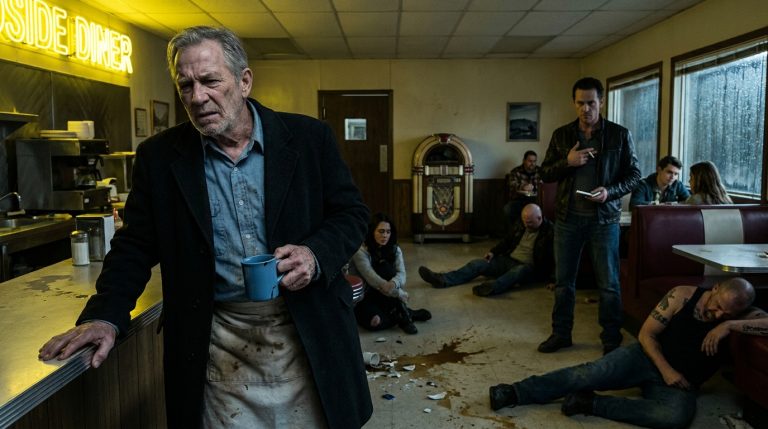
The air conditioning unit above the register rattled like loose gravel in a tin can, spitting lukewarm exhaust across the vinyl upholstery. Hank Cobb sat in the corner booth, his thumb calloused and steady against the edge of a chipped ceramic mug.
Across the room, the heavy glass door groaned on its hinges. A small shadow fell across the floorboards.
A five-year-old boy stood in the threshold, his oversized t-shirt stiff with dried mud and sweat. His left arm hung at a sharp, unnatural angle against his ribs, the wrist bent like a cracked twig.
Deputy Higgins didn’t stand up from his stool two seats down from the register. He just shifted his weight, his hand brushing the leather of his holster before dismissing the sight with a dull blink.
The boy’s wide, tear-tracked eyes scanned the room, bypassing the uniform entirely. They locked straight onto the worn leather cut across Hank’s shoulders.
The boy dragged his sneakers across the linoleum, each step trembling with raw, exhausted shock. He stopped inches from Hank’s heavy boots, the faint smell of copper and stale dust rising from his skin.
Hank lowered his heavy coffee mug to the table without a sound. He leaned forward, letting the worn leather of his vest creak in the quiet room.
“What’s your name, little man?” Hank’s voice was a low, gravelly rasp, stripped of any hollow comfort.
The boy swallowed hard, his lower lip splitting open. “Toby,” he whispered, his voice cracking from hours of unheeded crying.
Hank didn’t reach out to touch him yet; he kept his scarred hands resting flat on his knees to avoid spooking a cornered animal. “You’re hurt bad, Toby. Who did this to you?”
Toby pointed a trembling finger toward the floor, staring up with a look of absolute, desperate finality. “He broke it because I spilled the juice. I need a monster to stop him.”
CHAPTER 2: THE DESERT ROAD
Higgins sauntered over, his hand resting on his duty belt with an arrogance built on years of uncounted paychecks. “Hold on now, Cobb,” he said, adjusting his brim. “You’re stepping way out of your line. This is a sheriff’s matter and child welfare business. I’ll take the boy.”
Hank didn’t rise from the booth. He just turned his head, his eyes fixing on the deputy with a flat, icy stillness that made Higgins’s boot halt mid-step.
“You’ve been sitting on that stool for forty minutes, Higgins,” Hank said, his rasp carrying beneath the rattle of the air conditioner. “The kid walked in here dragging a snapped bone, and you didn’t even put your coffee down until you saw my vest.”
Higgins’s jaw tightened, his fingers twitching near his holster. “It’s the law, Hank. You take him out that door without authorization, and it’s kidnapping. Don’t make a stupid mistake.”
As Hank stood, his shadow swallowed the small space between the booth and the counter, forcing the deputy to take an instinctual half-step back. A strange, sharp odor caught in Hank’s nose—a chemical tang, harsh like precursor solvent, clinging faintly to the woven fabric of Higgins’s official badge ribbon.
Hank reached down with a slow, deliberate movement, sliding one massive arm under Toby’s knees and supporting the boy’s neck with his broad palm. Toby didn’t flinch; he leaned his face right into the cracked leather of Hank’s collar, clinging like a burr to wool.
“I’m taking him to Mercy General,” Hank said, passing Higgins as if the man were nothing more than a fence post. “If you want to cuff me for taking a crippled kid to a surgeon, unclip them right now. But you better be ready to use everything else on that belt, because I’m not stopping.”
Higgins swallowed, his eyes darting toward the open door, then down to his own boots. He didn’t unclip the handcuffs.
Outside, the afternoon heat hit like a physical weight, radiant heat shimmering off the hood of Hank’s custom black chase van parked at the curb. Hank slid the heavy side door open, settled Toby onto the bench seat with agonizing care, and climbed in behind the wheel alone—no motorcade, no armed escort, just the hum of a single engine cutting through the desert air.
In the rearview mirror, Higgins’s cruiser pulled out fifty yards behind them, trailing like a coyote waiting for a dead calf. Hank ignored the flashing grill lights, keeping his eyes on the road ahead and his left hand reaching back to steady the bench seat every time the tires hit a rut.
“Is the monster coming?” Toby whispered from the back, his small face pale against the dark vinyl.
“Not yet, little man,” Hank muttered, shifting into high gear as the hospital sign appeared through the haze. “First we get you mended. Then I go shopping.”
CHAPTER 3: THE TRAILER DOOR
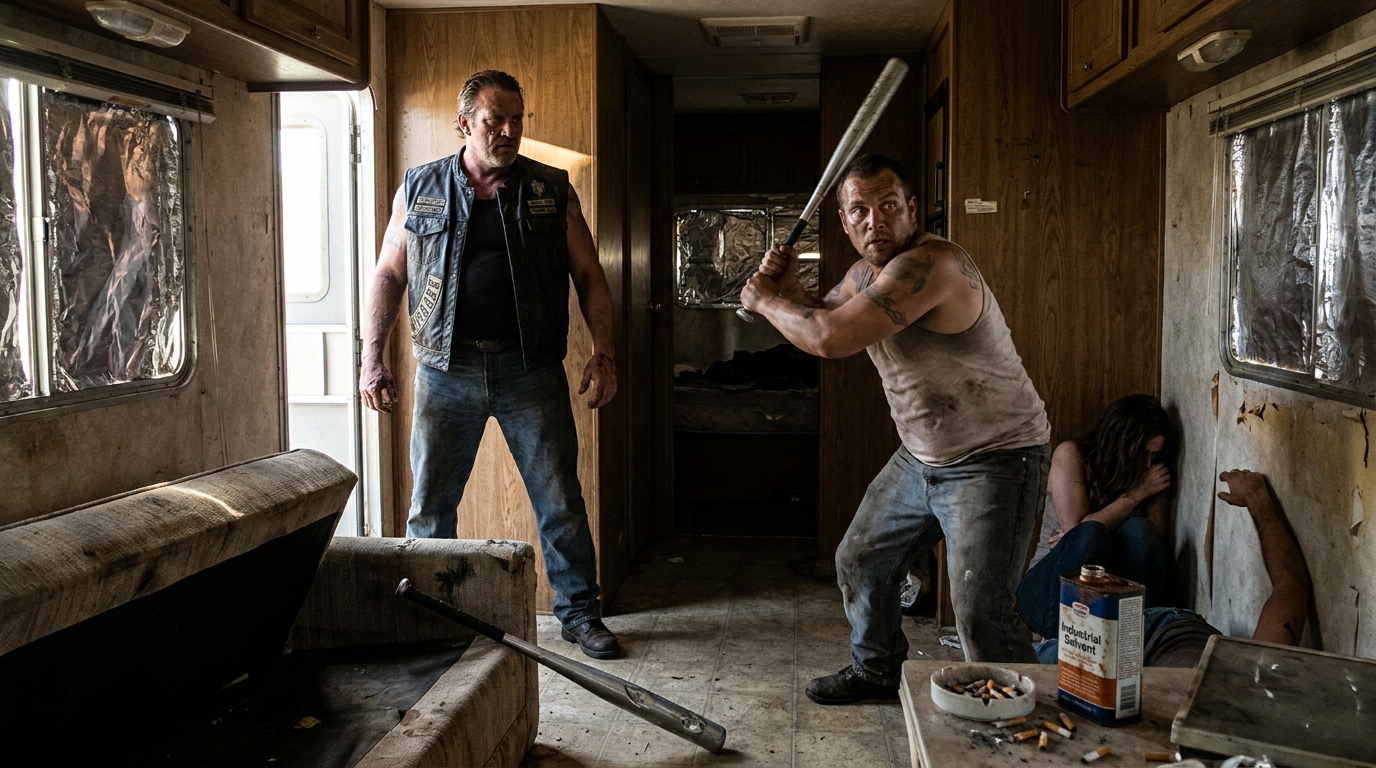
The air in the cul-de-sac smelled of stale trash and the unmistakable sharp tang of cooking chemicals. Trailer 44 sat at the dead end, a sun-bleached single-wide with aluminum foil taped over the narrow windows and an oil-stained Camaro rusting on cinder blocks in the dirt yard.
Hank didn’t hesitate or pause to look around for support. He stepped up the rotting wooden stairs, feeling the weak pine groan beneath his weight, and brought his steel-toed work boot down hard beside the cheap aluminum handle.
The latch tore through the thin metal jamb with a loud, metallic crack, swinging wide to slam against the inner wall.
A man jumped up from the stained sofa inside, clutching an aluminum baseball bat. He was broad-shouldered, wearing a filthy tank top, his arms covered in faded ink. “What the hell do you think you’re doing?” Greg Harmon bellowed, swinging the bat up in a defensive arc. “Get out of my house!”
In the corner, a woman huddled against the plywood paneling, her lip split and fresh purple bruising creeping around her left eye. She pulled her knees to her chest, her hands trembling so violently she couldn’t wipe the tears off her cheeks.
“Stay down,” Hank said to her without shifting his focus. His voice was a flat, heavy anvil.
Greg stepped forward, brandishing the bat, his chest heaving with frantic, aggressive energy. “You don’t know who you’re messing with, biker. I run product for people in Fresno, and I pay Harding and Higgins a grand every Tuesday to keep the road clear. You touch me, and the law will bury you.”
Hank took one step into the room, his massive frame blocking the sunlight from the open door. “The law isn’t on the road today, Greg.”
Greg lunged, swinging the bat in a blind, desperate arc aimed straight at Hank’s ribs.
Hank didn’t dodge; he closed the distance, stepping inside the swing. The hollow aluminum struck his heavy leather vest with a dull, thudding shock that jarred Hank’s shoulder.
Ignoring the deep ache radiating down his torso, Hank drove his open palm straight into Greg’s chest, pinning the larger man against the thin wall paneling. The trailer structure creaked violently, dust raining down from the ceiling seam.
Hank reached down with his right hand, his thick fingers wrapping around the aluminum bat and wrenching it out of Greg’s sweaty grip with a single, unyielding twist.
“You like breaking things that can’t fight back,” Hank growled, pressing his weight forward until Greg’s eyes bulged against the strain.
“Wait—wait!” Greg choked out, his hands clawing uselessly at Hank’s forearm. “I got cash in the back! Take it! Just leave!”
Hank dropped the bat onto the linoleum with a clatter. “I don’t want your cash. Pack her bags, Sarah. You’re leaving.”
CHAPTER 4: THE LEDGERS WEIGHT
Hank flipped the book open with one hand, his thumb catching on pages packed tightly with handwritten dates, numbers, and weights.
Greg lay groaning on the thin linoleum near the door, clutching his bruised collarbone, his breathing ragged. “Give that back,” Greg rasped, his voice trembling with a mix of fury and mounting panic. “That’s mine. You got no right to touch my things.”
Hank ignored him, his eyes scanning down the columns of figures. Two names appeared repeatedly alongside specific dollar amounts—Harding and Higgins.
Beneath the local kickbacks were larger payouts marked with a heavy, stylized C. The numbers didn’t add up to a low-level meth operation; thirty percent of every shipment was being routed around the primary distributor’s accounting, skimmed clean before it ever reached Fresno.
Layer 1 was broken wide open—it wasn’t just a dirty deputy protecting a small-time dealer; it was a systematic theft from a regional cartel, shielded by the local sheriff’s department.
“You’re stepping on your handler’s product, Greg,” Hank said softly, closing the cover with a dull snap that cut through Greg’s wheezing. “And you’re using the county badge to cover the shortfalls.”
Greg’s face drained of color, his defiant posture crumbling into sheer panic. “You don’t know what you’re talking about! If Chavez sees those books—”
“Chavez is going to see them,” Hank interrupted, slipping the notebook into the inner pocket of his heavy leather vest.
Sarah hurried past them, carrying a battered canvas duffel bag packed with clothes. Her hand hovered near Hank’s arm, her knuckles white with tension. “Is it enough? Can we actually leave?”
“Get in the van, Sarah,” Hank said, turning his back on Greg without another word. “We’re done here.”
As the van pulled away from the rusted gates of the Sunland trailer park, Hank glanced at the rearview mirror, watching the small green trailer shrink into the dust horizon. He pulled his heavy custom Zippo from his pocket, flicking the wheel once with a sharp click before letting the lid drop shut.
He didn’t need an army to handle what was coming next. He just needed to drop the truth where it would burn the brightest.
CHAPTER 5: THE RAILYARD SILENCE
The doors of the center SUV opened, and Hector Chavez stepped out into the dust, flanked by four men in dark jackets. Chavez adjusted the cuffs of his grey tailored suit, his eyes narrowing as he looked past Hank at the empty gravel lot.
“You came alone, Hank,” Chavez said, his voice quiet against the idle hum of the engines. “Or at least, without the noise you usually carry.”
“Don’t need noise to settle a bill,” Hank replied, his hand remaining flat over his chest pocket.
Chavez took two measured steps forward, stopping ten feet away. “Greg Harmon was moving two hundred thousand dollars of my inventory every quarter. Now his distributor line is dark, and two county cruisers are sitting outside my drop site. You owe me an explanation, or you owe me two hundred grand by Friday.”
Hank didn’t reach for a weapon. He unbuttoned his top vest clasp, pulled the small grease-stained notebook from his inner lining, and tossed it into the dirt between them.
“That’s Greg’s ledger,” Hank said. “Page twelve shows the weekly skim. He’s been diluting your product by twenty percent for two years and splitting the extra cut with Sheriff Harding and Deputy Higgins.”
Chavez stood motionless for three seconds before crouching to pick up the book. His thumb flicked through the columns of figures, his face remaining entirely still, though his jaw muscles clenched once as he hit the dated entries for Higgins.
“He told you I broke his line over a personal issue,” Hank continued, taking a step toward the cartel lieutenant. “Truth is, Greg was stealing from you under the protection of the badge, and he used a five-year-old kid to keep his house quiet.”
Chavez closed the notebook with a soft, dry slap. He slid it into his suit jacket and looked up, meeting Hank’s eyes.
“The boy?” Chavez asked softly.
“Out of the county,” Hank said. “And off limits.”
Chavez nodded once, a quick, sharp tilt of his chin. “Harmon is done. And the sheriff’s office will be handling their own internal crisis by morning.”
“Keep your business out of my town, Hector,” Hank said, turning back toward his driver’s side door.
“You have my word,” Chavez replied, already signaling his men back to the vehicles. “The debt is clear.”
CHAPTER 6: THE IRON VALLEY
Down on the grass, Toby pushed a rusted yellow dump truck through a mound of damp dirt, loading small pinecones into the bed with both arms working in smooth, steady rhythm. The heavy cast had been removed weeks ago, leaving only a faint, fading pink pressure mark along his left forearm.
Sarah walked out through the screen door, carrying two heavy mugs of black coffee. She handed one to Hank, the steam rising between them into the cool Pacific air.
“Harding and Higgins resigned on Tuesday,” Sarah said softly, resting her elbows against the railing beside him. “It was on the morning news. No charges filed, but they packed their lockers and left the county before noon.”
“Greg won’t be coming back either,” Hank replied, taking a slow sip from the mug. The coffee was bitter and hot, grounding him in the quiet quietness of the valley. “Chavez closed his books.”
“Is it really over?” she asked, her eyes searching his face for any lingering shadow of the desert heat.
“It’s over,” Hank said flatly. “The road back there doesn’t stretch up this far.”
Toby looked up from the grass, catching Hank’s eye. The boy stood, wiped his soil-stained palms against his jeans, and ran toward the porch, his small boots thudding rhythmically against the wooden steps.
He didn’t ask about monsters, or dark roads, or the men who ran the county. He just held up a shiny, smooth river pebble he had unearthed from the dirt.
“Look what I found, Hank,” Toby said, holding it out in his small palm.
Hank crouched down, his broad, scarred hand reaching out to gently touch the edge of the stone. “That’s a good one, little man,” he said, his voice low and steady. “Keep it safe.”
Toby nodded, pocketed the stone, and turned back toward his toy truck, his laughter carrying across the quiet orchard under an open blue sky.