The Line We Draw: A Cold Calculation of Suburban Warfare and Systemic Retribution
CHAPTER 1: THE BOUNDARY LINE
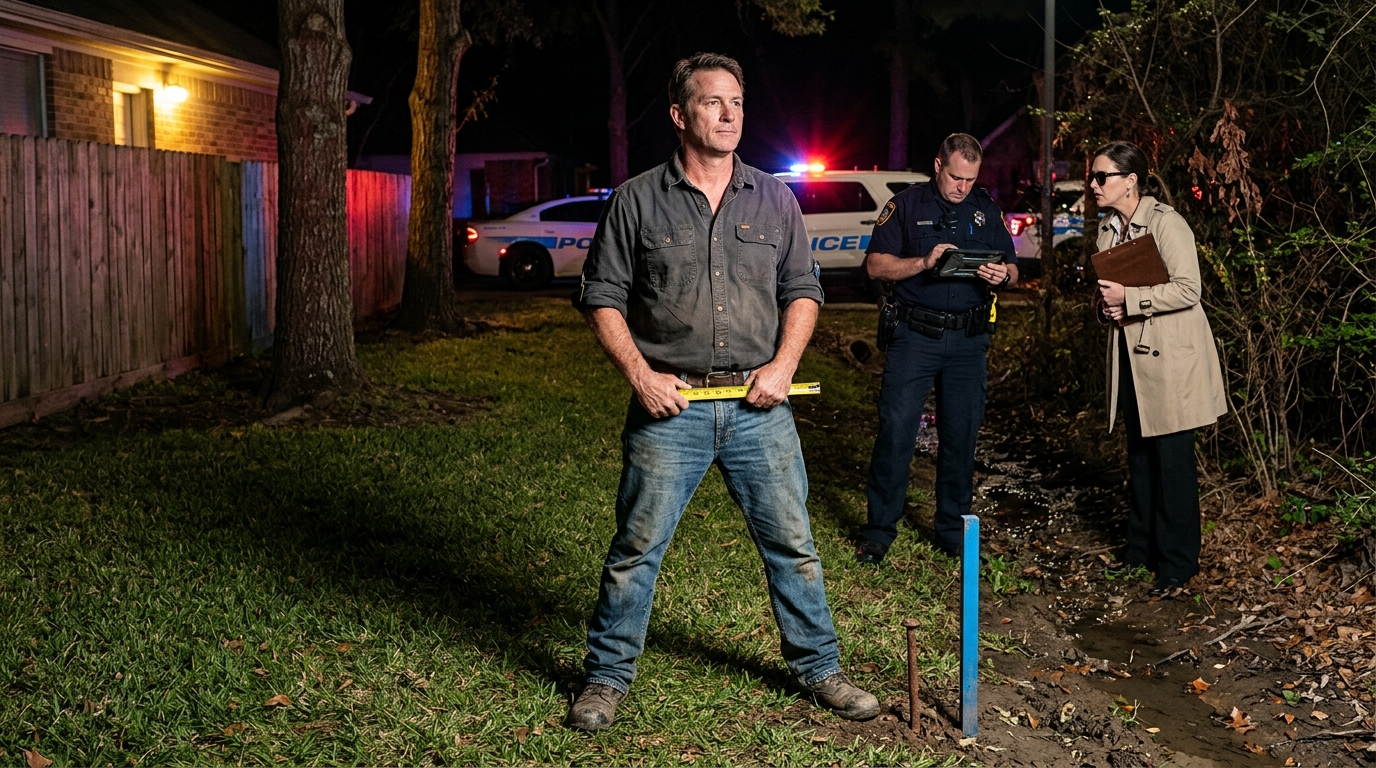
Red and blue strobes chopped through the dark, bouncing off the damp cedar of my back fence like blood on dry wood.
The deputy didn’t unholster his sidearm, but his hand stayed flat against the black polymer grip. He stood on my grass—my turf, four inches past the curb line—telling me to keep my palms visible.
Across the ditch, standing under the shadow of the property line gate, Celeste Harrow held her phone at chest height. The screen glowed white against her scrubbed, furious face. Behind her, deep in the thick brush of the unmapped drainage lot, four male voices were yelling. Glass shattered against pine bark.
“He’s harboring them!” Celeste’s voice hit a pitch that cut straight through the engine idle of two patrol cruisers. She pointed a manicured finger past my left shoulder. “He entices those boys back there! He sets out alcohol, he provokes them, and then he threatens them!”
I didn’t blink. I didn’t raise my hands past my waist either.
In my right palm, the steel casing of a heavy-duty Stanley tape measure felt cold and greasy from sweat. Snap. Click. I released the locking switch with my thumb, letting two inches of yellow steel bite into my palm, then retracted it. Snap.
“Officer,” I said, keeping my tone dead flat. “Her son broke my gate latch twenty minutes ago. He’s six feet past my property stake.”
“This entire corridor is HOA Common Area 3!” Celeste stepped forward, her leather flats crunching on the gravel shoulder. Her HOA badge—silver plastic, clipped to her lapel—flashed in the strobe light. “Sage Brook Ridge holds an administrative easement over the rear thirty feet of lot seventeen. You don’t own that dirt, mister.”
The deputy shifted his weight, pulling a ruggedized tablet from his belt clip. His thumb scraped the screen. He squinted at the county GIS overlay, then back at the red oak tree marking my corner pin.
“According to the county parcel map…” The deputy paused, frowning. He tilted the screen toward his partner. “This lot ends at the drainage ditch. The ditch is private property. It’s his.”
For half a second, Celeste’s face went hollow. The tight, practiced smile she used for board meetings vanished, leaving behind something raw and sharp.
Then the mask slammed back down.
“The county map hasn’t been updated with the revised master plat,” she said smoothly, angling her body to block the deputy’s line of sight toward the woods. Behind her, a shadow moved through the trees—a kid in a dark hoodie, slipping fast toward her driveway. “We filed an administrative adjustment last quarter. My son has every legal right to be in that corridor.”
“He’s trespassing,” I said. “And he’s selling something out of a gym bag.”
Celeste didn’t look back at the woods. She didn’t check on the kids vanishing into the dark. She took one step onto my grass, her phone camera aimed directly at my eyes.
“You’re hostile,” she whispered, loud enough for the officer’s body camera to pick it up. “You’ve been aggressive since the day you closed on this house. We have recorded concerns.”
“Clear the lot, ma’am,” the deputy told her, though he didn’t move to enforce it. He was tired. It was 1:40 AM, and administrative land disputes weren’t worth the paperwork. “Everyone go inside.”
Celeste didn’t move until the cruisers backed out of the cul-de-sac. The moment the tail lights faded down Juniper Bend, the laughter behind my fence started up again—low, muffled, and deliberate.
Celeste stayed at my property line. The red strobes were gone, replaced by the yellow glare of my porch light.
“Sage Brook Ridge has standards,” she said, her voice dropping into a razor-thin purr. “If you can’t afford to respect the community, you can sell.”
“Get off my dirt, Celeste.”
“Check your email at six AM,” she said, turning her back on me. “Let’s see what your deed is worth when the board finishes with you.”
The notification hit at 6:12 AM sharp.
I was sitting at the kitchen counter, a cold mug of black coffee sitting next to my property deed. The subject line was stamped in bold caps: NOTICE OF EMERGENCY FINES & VIOLATION ASSESSMENT.
Harassment of Residents: $250.
Interference with HOA Common Enjoyment: $250.
Unapproved Structural Security Modifications (Camera Array): $250.
Daily recurring enforcement fee: $750 per day, retroactive to date of notice.
Current Balance Due: $2,250.00.
At the bottom of the page, formatted in heavy crimson text: FAILURE TO REMEDY WITHIN 48 HOURS WILL TRIGGER IMMEDIATE LIEN PROCEEDINGS AGAINST LOT 17.
I stared at the screen. My thumb clicked the steel tape measure on the counter. Snap. Lock. Release.
She didn’t want the noise stopped. She didn’t care about a fence latch. She was trying to build a paper wall high enough to force a foreclosure before I looked too closely at the dirt behind my house.
Outside my front window, a dark navy pickup truck idled at the curb. On the driver’s door, a fresh magnetic decal read: Vanguard Security & Compliance.
The man inside raised a digital camera, pointed the lens straight at my front door, and clicked.
CHAPTER 2: TACTICAL MEASURINGS
The magnetic decal on the truck door didn’t even have a state license number stamped at the corner. Vanguard Security & Compliance. Just clean white block lettering slapped across cheap, matte-black vinyl.
Through the narrow pane of glass beside my front door, I watched the driver lower his digital camera. The glass lens reflected the morning sun in a sharp, blinding glint. He didn’t speed off. He didn’t duck his head. He simply set the SLR on the passenger seat, rested a tattooed forearm over the open window frame, and let the diesel engine rattle against the asphalt.
My thumb clicked the lock on the Stanley tape. Snap.
Twenty-two hundred and fifty dollars. In forty-eight hours, Celeste’s paper mill would convert that bogus fine into an administrative lien, file it under the HOA’s expedited collection clause, and slam a cloud over my deed. She wasn’t just trying to bully me out of the neighborhood; she was moving on a timer.
I didn’t open the front door. I turned, stepped back into the kitchen, and grabbed my laptop.
The Sage Brook Ridge resident portal was an outdated template hosted on a cheap third-party server. I logged in, bypassed the bright banner advertising the upcoming summer block party, and went straight to the public records archive. Under the tab marked Governance & Master Maps, a PDF file sat pinned at the top: SBR_Master_Plat_Revised.pdf.
I downloaded the file and pulled up my county-certified closing packet side by side on the screen.
On paper, they looked identical—the same winding cul-de-sacs, the same green-shaded common elements, the same drainage easements snaking along the western perimeter. But when I zoomed in to 400% on Lot 17, the line behind my fence didn’t match.
On the county document, my property boundary ran straight as a razor to a concrete monument pin set four feet past the drainage swale. On the HOA portal version, the line took a sudden, artificial jog inward, shaving off a thirty-foot strip of mature timber and tagging it as an “Administrative Maintenance Corridor.”
At the bottom corner of the HOA’s digital map, in microscopic gray text, sat the revision block: Approved via Plat 107-B.
I squinted at the screen. The signature field above the surveyor’s seal was flat black—not a scanned ink signature, but a vector shape inserted over the line. No surveyor registration number. No county filing stamp.
A vehicle door slammed outside.
I looked out the window. The Vanguard truck was still idling, but a bright orange Ford F-150 had just pulled into my driveway. On its door: Kramer & Associates Land Surveying.
Marcus Kramer didn’t look like a guy who cared about HOA politics. He was built like a vault, wearing a high-visibility vest faded to dirty peach by years in the sun, with a scuffed aluminum tripod slung over his shoulder.
I met him at the edge of the porch before he could hit the doorbell.
“You the owner?” Kramer asked, his voice sounding like two gravel bricks rubbing together. He set the tripod down on the grass and spat into the mulch. “Got your rush order from the county clerk’s office. They said you needed an official corner verification before noon.”
“I do,” I said. “Where do you want to start?”
“At the county monument,” Kramer said, pulling a heavy brass plumb bob and a handheld GPS collector from his canvas pouch. “If it’s in the dirt, we find it. If somebody moved it, we figure out who.”
Across the street, the Vanguard security driver put his truck in gear, rolled forward ten feet, and stopped again, keeping his camera aimed straight at Kramer’s orange vest.
Kramer didn’t even glance at him. He unhooked a two-foot steel prism rod from his belt and walked toward the side yard, his boots cutting deep tracks through the dew-soaked turf. I followed three paces behind, the yellow steel tape still clenched in my right hand.
We rounded the corner of the garage, stepping into the shade of the back lot.
The fence line was quiet now, but the ground told the real story. The tall fescue behind my cedar panels wasn’t just trampled—it was churned into dark, greasy mud. Empty aluminum cans, crushed cigarette packs, and several small, clear plastic zip-bags with the corners clipped off lay scattered around the base of an old red oak.
Kramer stopped at the tree, swung his GPS rod down, and pressed the tip into the mud.
“Here’s your first problem,” Kramer grunted, pointing with his boot.
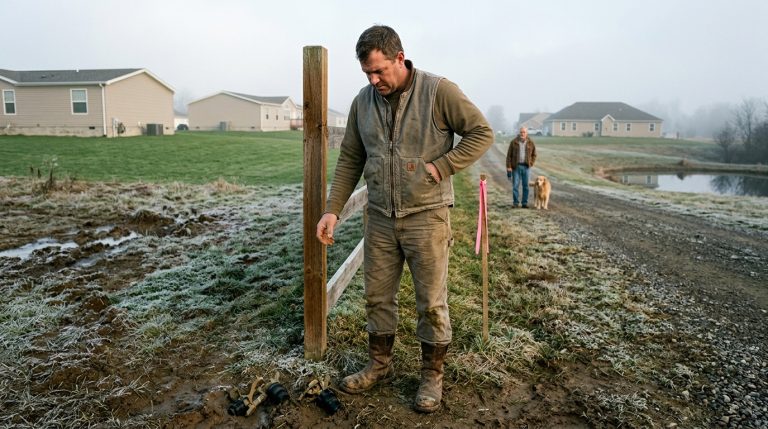
Half-buried under rotting oak leaves sat a rusted iron pin, capped with faded yellow plastic. But six inches to the left, freshly driven into the loam, was a brand-new aluminum rod topped with a blue cap.
“That blue cap,” I said, leaning down. “Whose is that?”
“Nobody’s,” Kramer said, kneeling in the dirt. He pulled a brass wire brush from his pocket and scraped the head of the blue cap. “No license number stamped on the metal. No surveyor identification. Somebody took a three-pound sledge, hammered a hardware-store rebar into the dirt, and called it a line.”
“Celeste,” I muttered.
“Don’t know who Celeste is,” Kramer replied, setting his prism rod over the original rusted pin and keying a command into his tablet. The device beeped three times in rapid succession. “But I know what the county GIS says. The rusted pin is your boundary. This blue piece of junk is a wild stake. It’s fake.”
“Can you certify that in writing?”
“Already doing it,” Kramer said. He stood up, his knee joints popping loudly in the quiet woods. “I’ll drop two wooden hubs with fluorescent ribbon right on the legal line. If anybody pulls ’em out, that’s destruction of survey markers. That’s a misdemeanor in this state.”
Before he could finish the sentence, the dry brush near the property line crackled.
Celeste Harrow stepped through the gap in the trees.
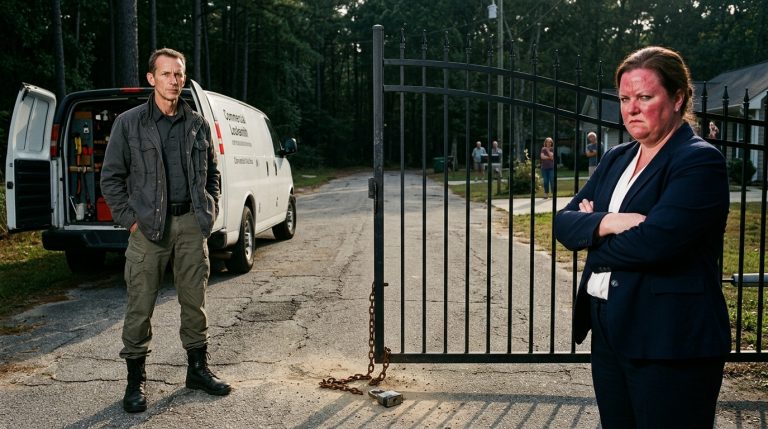
She wasn’t wearing her silver HOA badge today. She wore a tailored beige trench coat, a leather clipboard tucked under her arm, and a pair of dark sunglasses despite the morning overcast. Beside her stood the guy from the Navy-blue polo—the Vanguard contractor. Up close, he had the thick neck and flat eyes of a bouncer who’d been fired from better places.
“Stop what you are doing immediately,” Celeste said. Her voice was remarkably steady, smoothed over with the practiced authority of a bank manager turning down a loan. “This area is under active HOA compliance review. Unregistered contractors are not permitted on common corridor property.”
Kramer didn’t even look up from his tablet. “Ma’am, I’m a licensed state land surveyor performing a legal boundary verification under County Warrant 884.”
“The county does not govern Sage Brook Ridge’s internal easement agreements,” Celeste snapped, her fingers tightening on the edge of her clipboard until her knuckles turned ivory. She turned her attention directly to me. “I see you’re continuing your pattern of escalation. Hiring unvetted labor to disturb common grounds.”
“It’s my ground, Celeste,” I said, stepping between Kramer and her contractor. “The county monument is right there. Your blue stake is fraud.”
Celeste’s lips thinned into a pale line. She didn’t look at the rusted pin Kramer was measuring. She didn’t look at the clipped plastic bags in the mud either.
“Plat 107-B is the governing authority for Lot 17,” she said coldly. “If you attempt to obstruct Vanguard Security from maintaining this perimeter, your enforcement fine doubles at midnight. That’s fifteen hundred dollars a day.”
“Show me the signed surveyor verification for 107-B,” I said. “Show me the county recording stamp.”
The contractor took half a step forward, his hand resting casually over his belt where a heavy folding knife was clipped to his pocket. “Ma’am said clear the area.”
Kramer finally looked up. He didn’t flinch. He simply tapped the screen of his ruggedized tablet, locking in the spatial coordinates. “I’ve got your GPS fix, chief. And my truck camera is recording this entire boundary line in 4K. Keep talking.”
Celeste caught the contractor’s elbow with a sharp jerk of her hand.
“We’re done discussing this with you,” she told me, her eyes locking onto mine behind her dark lenses. “The board meets in executive session tomorrow night. You won’t just be paying fines; you’ll be answering for civil trespass.”
She turned and walked back into the brush, her contractor following half a pace behind, his eyes fixed on my face until the foliage swallowed them both.
I looked down at the tablet screen Kramer held out toward me.
The green lines of the official county map flashed over the real-time satellite imagery. The legal boundary didn’t just include the mud, the red oak, and the fence line—it extended another twelve feet past the ditch, cutting squarely through the path Celeste’s son had been using as his private access route.
“She’s lying,” I said low.
“Worse than that,” Kramer grunted, pulling a orange marker flag from his pouch and driving it deep into the dirt next to the real monument. “She’s building a paper trail on top of a lie. If you don’t break that paper trail before that executive session, the county won’t care who’s right—they’ll just see an unpaid lien and let her foreclose.”
My thumb hit the tape measure lock. Snap.
“I’m not letting her reach executive session,” I said.
CHAPTER 3: NIGHT TRAFFIC
I stood motionless beside Kramer’s orange stake long after the rumble of his F-150 died away down Juniper Bend. The neon ribbon fluttered against the rough bark of the red oak, a single gaudy mark of ownership driven six inches into the black earth.
The yellow tape measure was still locked in my palm. Click. Snap. I pressed the steel housing against my thigh until the corner dug through my jeans.
Forty-eight hours. The clock on Celeste’s lien wasn’t a threat anymore; it was a timer running on a battery she’d built herself.
By 9:00 PM, the cul-de-sac went dark. Suburban quiet settled over Juniper Bend—the kind of artificial silence maintained by three-hundred-dollar lawn services and quiet agreements between neighbors who never looked each other in the eye.
I didn’t turn on the kitchen light. Inside the dark house, I carried a heavy plastic tackle box up to the spare bedroom overlooking the rear yard.
Three days ago, I’d bought two self-powered infrared trail cameras for monitoring deer down at my brother’s lease. They were compact, housed in weather-sealed olive drab plastic, fitted with low-glow LED arrays that invisible light to the naked eye. I unboxed them on the carpet, checking the battery indicators by the faint amber wash of my phone screen.
I mounted the first camera four feet up the trunk of a young hickory tree inside my fence line, angling the glass lens down toward the mud path behind the oak. The second went high into the crotch of a cedar, aimed straight down the swale toward the culvert where Celeste’s blue stake still sat buried in the leaves.
At 10:14 PM, the brush crackled.
I sat on the dark floor of the spare room, my back pressed against the baseboards, watching the live feed stream over a private Wi-Fi bridge directly to my tablet screen.
The image flared in sharp, monochrome silver and shadow.
A black sedan rolled down the access alley behind the lot, its headlights killed fifty yards before the tree line. The engine idled with a wet, rhythmic thrum—no muffler damage, just heavy displacement. The driver’s door opened, cutting the dome light before the latch even clicked.
Two figures stepped into the frame.
The first was Celeste’s son, Julian. He wore a dark heavy hoodie, the hood pulled low over a pale, narrow face. His left hand kept twitching against the pocket of his jeans, a nervous, erratic rhythm. The second man was broader, taller, wearing a dark canvas jacket with a stitched nylon patch over the right breast—Vanguard Security.
Julian didn’t speak. He stepped up to the base of the red oak, right where Kramer’s orange survey flag stood pinned in the dirt. He reached down, grabbed the wood stake by the top, and yanked it out of the ground with a dull shluck.
On the screen, his lips moved. The low-frequency microphone on the trail cam picked up the muffled rasp of his voice through the glass pane.
“…told you he put ’em back.”
The man in the Vanguard jacket took the wooden stake from Julian’s hand. He didn’t break it. He tossed it casually over his shoulder into the deep brush of the swale, then turned his back to my fence line.
Another car pulled up—a silver hatchback, coasting to a stop on the unpaved shoulder past the culvert.
A guy in a gray sweatshirt got out from the passenger side. He didn’t walk into the woods; he stayed on the edge of the gravel. Julian walked out to meet him.
The camera caught the entire motion in brutal, high-contrast detail. Julian reached into his hoodie pocket, pulled out a flat, heavy vacuum-sealed brick wrapped in black electrical tape, and held it low against his thigh. The guy in the gray sweatshirt produced a thick roll of bills, held together by a thick red rubber band.
They exchanged items in less than three seconds. No handshakes. No words. The buyer turned and slipped back into the hatchback. The car rolled off without its lights on until it hit the main road.
Julian stood on the edge of my legal boundary, fanning the stack of bills with his thumb. The Vanguard guard stayed posted five feet behind him, his arms crossed over his chest, scanning the dark treeline like a paid sentry on a perimeter post.
My thumb dug into the side of the tablet case.
This wasn’t a handful of teenagers drinking beer behind a fence. This was a staged distribution point using an unmonitored land gap as a private drive-thru. Celeste hadn’t forged Plat 107-B to protect her son from a noise complaint. She’d manufactured a dead zone to protect a commercial pipeline—and she was using an HOA security contractor as the muscle to guard the register.
The tablet screen flickered once.
Julian turned his head toward the hickory tree where the first camera was hidden. For a second, his pale face filled the center of the frame, eyes wide, pupils dilated to black disks in the infrared glow.
He reached into his pocket and pulled out his phone.
Ten seconds later, my phone buzzed on the floor beside my knee.
No caller ID. Just an incoming text with a ten-second audio file attached.
I tapped the screen.
The audio played through the small speaker, crisp and cold against the silence of the dark bedroom:
“Tell your client to back off,” a man’s voice said—the flat, gravelly tone of the Vanguard contractor. “You’re making this bigger than it needs to be. The board owns the dirt. You keep digging, you’re gonna fall in.”
I didn’t reply. I didn’t save the text to a temporary folder; I backed the entire video file to two cloud servers and forwarded the raw MP4 directly to my attorney’s secure portal.
Through the window, I heard a car door slam in the dark woods. The engine thrummed once, then faded toward the highway.
I stood up from the carpet, picked up my heavy flashlight from the windowsill, and walked downstairs to the kitchen.
The house was cold. I stood at the sink, filled a glass with tap water, and looked out through the glass pane of the back door. Out in the dark, twelve feet past my cedar fence, the orange survey flag was gone, but the iron monument pin remained—buried three inches deep in the cold, wet soil where no draft of paper could ever move it.
My phone buzzed again on the counter.
A new email from the Sage Brook Ridge portal hit my inbox.
NOTICE OF EXECUTIVE SESSION HEARING AMENDMENT.
Location: Sage Brook Ridge Clubhouse.
Time: Tomorrow, 7:00 PM.
Agenda: Immediate Lien Confirmation & Revocation of Property Access.
I set the water glass down next to the steel tape measure. Snap. Click.
“Seven o’clock,” I said to the empty room. “See you there, Celeste.”
CHAPTER 4: THE PAPER TRAIL
The glass of water sat untouched on the laminate counter. Outside, the night went dead still, but the hum of the refrigerator felt like a drill against my ears.
My thumb clicked the steel tape measure twice. Click. Snap.
If Celeste wanted an executive session at 7:00 PM tomorrow, she wasn’t planning on giving me twenty-four hours to prepare a defense. She was setting a court date where she served as judge, jury, and clerk.
I opened my laptop, pulled up a fresh browser tab, and accessed the public domain portal for county business filings.
Vanguard Security & Compliance LLC.
The business entity had been registered eighteen months ago. The principal officer listed on the filing wasn’t the thick-necked contractor who’d been standing in my woods—it was a corporate shell firm registered out of a post office box three towns over. But under the registered agent line, there was an attorney’s name: Harrow & Associates.
Celeste’s late husband’s firm.
I leaned back, the leather of the kitchen chair creaking under my weight. My thumb rubbed the raw blister where the steel tape’s metal clip had been digging into my skin all morning.
She wasn’t just hiring a private security vendor to guard her son’s drop site. She owned the vendor. Every dollar the HOA paid Vanguard Security was flowing straight back into an account controlled by her family’s legal trust.
At 2:15 AM, my inbox chimed.
It wasn’t an official notice from the portal. It was an email thread forwarded from an anonymous external address—a blind copy sent to every homeowner on the Sage Brook Ridge mailing list, likely triggered by an internal board member using an automated auto-forward rule.
The subject header read: FWD: RE: Lot 17 Perimeter Control & Special Assessment Allocation.
I scrolled down through the chain, my eyes locking onto the message sent at 11:42 PM from Celeste’s personal email address:
“If we do not finalize the boundary classification at tomorrow’s hearing, the county will process the owner’s survey request. Once the county inspector enters the swale, police involvement becomes mandatory. Authorization is granted to draw from Contingency 4B to cover Vanguard’s night shift retainer through the end of the month. Ensure the owner receives no further extensions.”
Below her message was a short reply from the board treasurer:
“Contingency 4B is overdrawn by six thousand dollars. The quarterly audit is due next week.”
Celeste’s counter-reply was a single line:
“The audit will reflect a capital improvement expenditure for Plat 107-B. Finalize the lien.”
My mouth went completely dry.
Contingency 4B. It wasn’t a maintenance fund for damaged fences or storm drains. It was the HOA’s off-books emergency reserve—a pool of money fed directly by special assessment fees levied on homeowners. She was siphoning community funds into a ghost line item to pay her own private security firm to police a fake boundary line she’d forged herself.
I took a screenshot of the entire thread, verified the raw email headers to preserve the digital fingerprint, and saved three copies across two external hard drives.
I didn’t call the police department’s non-emergency line. A deputy responding to a trespass call at 2:00 AM wouldn’t read an email chain about line-item embezzlement. They’d see two neighbors fighting over a fence line and tell us to take it to civil court.
Instead, I dialed the direct office line for Detective Vance at the County Sheriff’s Financial Crimes Division—the number printed on the card he’d left in my mailbox two months ago during a neighborhood canvass regarding stolen mail.
The call went straight to voicemail.
“Detective Vance,” I said, my voice dead calm in the dark kitchen. “This is Lot 17 on Juniper Bend. I have documentary evidence of falsified public land filings, unauthorized draws from an HOA reserve account totaling over six thousand dollars, and audio recording of a private security contractor issuing verbal threats to protect an active distribution point on county land. I’m handing this over to the county prosecutor at eight AM unless you want to review the chain first.”
I hung up without leaving a callback number. He had my address.
Outside, the first pale blue light of dawn was breaking over the tree line. The moisture on the grass caught the cold light, turning the yard into a gray, frozen sheet.
I walked to the front window.
The navy Vanguard truck was gone from the curb, but parked two houses down under the street lamp sat Celeste’s white sedan. The driver’s side window was cracked an inch. Inside, the silhouette of her head was motionless, her face lit by the pale blue glare of a tablet screen.
She was waiting for the clock to run out. She thought forty-eight hours of pressure would break my resolve, force a settlement, or drive me to sell before the quarterly audit hit the board table.
I picked up my phone, opened the email draft addressed to the County Clerk, the Sheriff’s Financial Crimes Division, and the state Licensing Board for Land Surveyors, and attached three files: Kramer’s certified survey, the raw infrared video from the trail camera, and the unedited PDF of the Contingency 4B email thread.
I didn’t hit send.
I set the draft to auto-trigger at 7:15 PM—fifteen minutes after Celeste’s executive session was scheduled to begin.
I locked my front door, put the steel tape measure in my coat pocket, and walked out to my car. My tires crunched over the frost on the driveway, leaving dark, sharp tracks in the white grass.
CHAPTER 5: CHECKMATE AT THE PODIUM
The tires crunched over the crushed stone parking lot of the Sage Brook Ridge Clubhouse at 6:48 PM.
Inside, forty folding chairs scraped against the beige linoleum floor. The air smelled of stale coffee, damp wool coats, and commercial carpet cleaner. Neighborhood residents sat shoulder-to-shoulder, speaking in low, clipped whispers, their eyes darting toward the front table where three board members sat behind nameplates.
In the center sat Celeste Harrow.
Her posture was rigid, her hair pinned back into a seamless, severe bun. A thick black binder lay flat before her, flanked by a stack of pre-printed lien notices. Beside her, the Vanguard Security contractor leaned against the wall, his arms folded over his chest, his eyes tracking every person who crossed the threshold.
I didn’t take a seat in the back. I walked down the center aisle, my boots leaving damp tracks on the carpet, and stopped four feet from the podium.
The clock on the wall read 6:58 PM.
Celeste tapped her pen once against the wooden tabletop. The sharp click brought the room to immediate silence.
“This executive enforcement session is now called to order,” Celeste said, her voice dropping into that smooth, practiced register that carried effortlessly across the room. “We are here to address severe, ongoing compliance violations regarding Lot 17, including unauthorized interference with maintenance corridors and harassment of community security personnel.”
She didn’t look at me. She opened the black binder and turned a page.
“Pursuant to the covenants of Sage Brook Ridge, the board will now vote to confirm the special assessment of two thousand two hundred and fifty dollars, and authorize the immediate recording of an administrative lien against Lot 17 to preserve common assets.”
“The easement isn’t common asset,” I said.
Celeste’s hand froze over the page. She raised her head slowly, her expression blank, unreadable.
“You will have your allocated three minutes during the public comment portion,” she said coldly. “Sit down.”
“You don’t have an easement,” I repeated. My hand went into my coat pocket. My thumb unlatched the heavy brass clip of the Stanley tape measure, resting flat against my fingers. “And you don’t have a valid survey.”
A murmur rippled through the second and third rows. An older homeowner near the aisle leaned forward, squinting.
“This board is acting under the authority of Plat 107-B,” Celeste said, her tone sharpening by a fraction of a degree. “The filing is registered with the management portal. If you continue to disrupt this proceeding, security will escort you from the premises.”
The Vanguard contractor took a step forward off the wall, his heavy boots thudding against the floorboards.
I reached into my inner jacket pocket, pulled out a manila folder, and dropped it flat onto the table directly in front of her nameplate.
“Plat 107-B is a vector graphic overlay slapped over a county map,” I said, loud enough for the back row to hear every syllable. “The surveyor signature is a digital asset copied from an expired municipal permit. The state licensing board verified this morning that no surveyor by that registration number has operated in this county for nine years.”
Celeste didn’t touch the folder. Her jaw muscles tightened, a single pale muscle twitching near her ear.
“This is an internal administrative matter—”
“It stopped being administrative when you drew six thousand dollars out of Contingency 4B,” I cut in.
The board treasurer, sitting two seats down from Celeste, flinched. His head snapped toward me, his hands instantly gripping the edge of the table until his knuckles turned gray.
“What did you just say?” the treasurer asked, his voice cracking.
“Contingency 4B,” I said, looking straight at him. “Check your ledger. Three transfers made over the last sixty days, categorized as capital improvements for Plat 107-B. Every dollar went directly into an account owned by Vanguard Security & Compliance LLC—an entity registered to Harrow & Associates.”
The room erupted. Chairs scraped backward. Voices rose from the middle rows as neighbors turned to look at each other.
“That’s a lie!” Celeste stood up so fast her chair rattled against the drywall behind her. “This man is fabricating accusations to evade his legal debt! Security, clear the room!”
The Vanguard contractor stepped between me and the table, reaching out with a heavy forearm to force me back toward the aisle.
Before his hand made contact, the double doors at the back of the clubhouse swung open.
Two men stepped inside. The first wore the gray suit and silver badge of the County Sheriff’s Financial Crimes Division. Behind him stood Detective Vance, a thick tablet locked in a rubberized case held in his left hand.
Silence crashed down over the clubhouse like a dropped curtain.
“Nobody is clearing the room, Mrs. Harrow,” Detective Vance said, his voice level and dry as bone. He walked down the aisle, his eyes fixed on Celeste. “County Clerk’s office flagged the digital signature on Plat 107-B two hours ago. We’ve been reviewing your reserve account transfers since four PM.”
Celeste’s face drained of color, the composure she’d maintained for weeks dissolving into raw, exposed panic. She looked down at the treasurer, then back at the detective.
“This is a private HOA meeting,” she stammered, her hand grasping for the edge of her binder. “You have no standing—”
“We have a warrant for the server logs of Vanguard Security,” Vance interrupted, stopping beside the podium. He raised his tablet and tapped the screen once. “And we have thirty minutes of infrared video showing your son operating a narcotics drop point twelve feet inside Lot 17’s legal boundary, backed by private security guards paid out of community funds.”
The treasurer pulled his hands off the table as if the wood had caught fire. He pushed his chair back and stood up, stepping three feet away from Celeste.
“I didn’t sign off on those transfers,” the treasurer said quickly, his hands raised in front of his chest. “She routed them through the emergency clause. I had no idea about Vanguard.”
Celeste turned on him, her eyes wide. “Shut your mouth!”
“Mrs. Harrow,” Detective Vance said, stepping around the contractor, who had quietly frozen in place, his hands dropping flat to his sides. “Step out from behind the table.”
Celeste didn’t move for three seconds. She stood behind her nameplate, surrounded by her printed notices, her binder, and her plastic badge, looking out over forty neighbors who were staring at her in absolute, unbroken silence.
Then her shoulders sank.
She didn’t speak as the detective escorted her down the center aisle. The double doors clicked shut behind them, leaving the clubhouse completely silent except for the low hum of the fluorescent lights overhead.
I picked up my manila folder from the table, pulled the steel tape measure from my pocket, and walked out into the cold night air.
CHAPTER 6: COLD SOIL
The heavy oak door of the clubhouse clicked shut behind me, sealing off the low hum of forty neighbors trying to make sense of what they had just seen.
Night mist hung thick over the gravel parking lot. The red lights of Detective Vance’s cruiser were already turning the corner onto the main avenue, pulling away into the dark with Celeste Harrow in the back seat.
I stood on the wet asphalt, the manila folder tucked firmly under my arm. Inside my coat pocket, my right hand rested on the square steel body of the tape measure. Click. Snap. The metal locking lever felt cool and solid under my thumb.
The Vanguard Security contractor didn’t wait around for the meeting to formally adjourn. He slipped out through the side emergency exit, his boots hitting the gravel once before he vanished past the tree line on foot, leaving his navy truck idling under the street lamp.
Two days later, the interim board sent an official notice to every home on Juniper Bend.
The paper was plain, printed on standard white bond without the gold embossed HOA emblem Celeste had used for years. The text was short and dry:
Special assessment notices issued under Plat 107-B are declared null and void. All fine enforcement actions associated with Lot 17 are formally rescinded. An independent audit firm has been retained to reconcile the Contingency 4B account.
By Saturday morning, the county clerk’s office had purged the forged digital filing from the public record. On the official GIS portal, Lot 17 resumed its true shape—a crisp, rectangular parcel extending thirty feet past the drainage ditch, bounded by iron pins set deeply into the clay.
I spent Saturday afternoon in the back yard.
The sun sat low behind the pine trees, casting long, cool shadows across the grass. The churned mud along the fence line was beginning to dry, stiffening into pale gray ruts where the foot traffic had been heaviest.
I carried a four-pound sledge, a hand trowel, and a fresh eight-foot section of treated cedar 2×4 down to the rear boundary.
Kramer’s orange survey flag was still pinned in the soil where he’d driven it, bright fluorescent plastic standing out against the damp oak leaves. Beside it sat the original rusted iron pin—the true county monument, undisturbed.
I set the 2×4 along the ground, aligning the edge precisely with the iron pin and the corner oak. I pulled the tape measure from my pocket, extended eight feet of yellow steel, and clicked the lock home. The black tick marks lined up to the millimeter.
I dug out the shattered remnants of the old fence latch—the plastic bracket Julian had kicked through two weeks ago—and scraped away the rotten splinters. Using a cordless driver, I set three stainless steel screws through a heavy galvanized steel hinge, securing the gate firmly back into the frame.
When I lifted the gate latch, the metal tongue dropped cleanly into the strike plate with a heavy, satisfying clack.
Across the drainage swale, Celeste’s house sat completely dark. The drapes were drawn tight over the back windows. Her son’s car was gone from the driveway, and the navy Vanguard truck had been towed from the cul-de-sac on Thursday morning under a county impound order.
I knelt in the damp grass by the red oak tree.
I pulled out the blue-capped hardware store rebar—the fake stake Celeste’s contractor had hammered into my yard—and dropped it onto the dirt path. It clattered weakly against the roots before rolling into the ditch.
I picked up a handful of dark, cool earth from around the base of the county pin, pressing it firm around the iron shaft until the metal was flush with the surface of the lawn.
The woods behind the fence were quiet. No mufflers idling on the shoulder, no footfalls in the brush, no low voices negotiating exchanges across a fake line. Just the wind moving through the red oak leaves and the steady, quiet drip of water through the swale.
I wiped my hands on my jeans, stood up, and looked down the length of the fence line.
The dirt hadn’t changed. The trees hadn’t moved. The line had been there the entire time, written in surveyor’s ink and anchored in solid steel, waiting only for someone to measure it.
I clicked the tape measure release. The yellow blade snapped back into the steel casing with a sharp, final report, and I walked back to the house.