The Weight of a Gift: How a Quiet Uncle Fought for a Little Girl’s Right to Just Be a Child
CHAPTER 1: The First Bell
The yellow school bus idling in the driveway smelled of diesel exhaust and damp rubber. Frank wiped grease from his knuckles onto a shop rag, watching seven-year-old Mary adjust the strap of her oversized backpack.
Her one-eyed cat, Fred, sat firmly on the porch railing, staring down the driveway with a single unblinking gaze. Mary reached out, scratching behind Fred’s ear before turning toward the bus doors.
“You don’t have to talk to anyone if you don’t want to,” Frank said, his voice low and gravelly. “Just sit by the window. Look at the trees.”
Mary gave a sharp, dissatisfied nod. She climbed the steps without a backward glance. Roberta, leaning against the fence line with a cup of coffee, shook her head as the doors hissed shut.
Inside the third-grade classroom, the air was thick with the scent of pine cleaner and wet woolen coats. Mary slid into a desk near the back, pulling a blank composition book from her bag. She didn’t look at the other children whispering in clusters around the room.
When the bell rang, Mrs. Bonnie stepped up to the chalkboard and tapped a piece of chalk against the slate.
“Alright, class, let’s start with something simple,” Bonnie said, turning to write a row of numbers. “What is two plus two?”
A chorus of small voices murmured the obvious answer. Mary didn’t move her pencil. She stared at the corner of the desk, tracing a splinter in the wood with her thumbnail.
Bonnie noticed the quiet girl in the back drawing intricate geometric shapes instead of looking at the board. She walked down the aisle, her shoes clicking against the linoleum.
“You finished with the worksheet, Mary?” Bonnie asked, pausing by the desk.
“It’s not a worksheet,” Mary said flatly, not looking up. “It’s an exercise in wasting time.”
Bonnie raised an eyebrow, picking up Mary’s notebook to inspect the margin notes. The arithmetic scrawled across the page wasn’t third-grade work. It was algebraic shorthand.
“Let’s see about that,” Bonnie said, testing her. “What is fifty-seven multiplied by one hundred thirty-five?”
The classroom grew instantly quiet, save for the hum of the overhead fluorescent lights. Mary blinked twice, staring at the empty space between her inkwell and the desk edge.
“Seven thousand six hundred ninety-five,” Mary said without pausing for breath. “And the square root is approximately eighty-seven point seven two.”
Bonnie froze, her hand hovering over the desk. She reached into her cardigan pocket, pulled out a small plastic calculator, and furiously punched in the digits. The screen blinked back the exact numbers Mary had just recited from memory.
Before Bonnie could form a response, Mary stood up, grabbed her backpack, and walked straight out the side door toward the principal’s office.
CHAPTER 2: The Barroom Secret
Frank stared at the amber fluid inside the glass, his fingers tightening around the condensation until his knuckles turned white. Ferg’s bar smelled stale, a heavy mix of floor wax, spilled draft beer, and old cigarette smoke that clung to the vinyl booths.
The door creaked open, letting in a sharp draft of humid Florida air. Bonnie walked across the scuffed linoleum, her coat collar turned up against the night chill, and slid into the opposite side of the booth without asking.
“I didn’t have anything to do with Evelyn showing up,” Bonnie said, her voice dropping beneath the murmur of the television mounted above the register. “You have to believe that.”
Frank didn’t look up. He rotated the beer bottle an inch to the left, watching the label peel at the corner where the moisture had soaked through.
“Evelyn doesn’t care about what Mary wants,” Frank said, his voice flat and gravelly. “She cares about a lineage. She looks at that little girl and sees a project that got away.”
Bonnie leaned forward, her elbows resting on the sticky tabletop. The fluorescent lights overhead buzzed, casting a pale, sickly hue across her face.
“She’s seven years old, Frank. The school principal is already talking about legal intervention if you keep pulling her out of classes,” Bonnie said, her tone sharp with a mix of frustration and genuine concern. “You can’t just homeschool her out of the world forever. The system doesn’t work that way.”
“The system didn’t raise her when Diane died,” Frank muttered.
The memory hit him without warning—the silence of that house six years ago, the cold couch where Mary sat waiting while her mother lay silent in the bathroom. He swallowed hard, the muscles in his jaw clenching so tight his teeth ached.
“Tell me the truth about Diane,” Bonnie asked, her voice softening just enough to cut through the noise of the room. “Why did she… why did it end like that?”
Frank set the bottle down with a sharp thud that made the glassware rattle.
“She called me,” Frank said, staring straight ahead at the scarred wood of the bar. “She wanted to talk. I was out. By the time I got to the house, it was already over.”
He reached into his jacket pocket, his thumb brushing against a worn, wooden token he kept there for friction. He didn’t mention the notebooks locked away in the back of his truck. He didn’t mention the pages of advanced calculations Diane had left behind—proofs that Evelyn would weaponize the moment she got a judge to listen.
“She left me with Mary,” Frank said, his voice dropping to a harsh whisper. “And I promised myself I wouldn’t let anyone turn that little girl into a machine.”
Bonnie watched him for a long, quiet moment, reading the exhaustion carved into the lines around his eyes. She reached out, her fingertips hovering just above the table before pulling back.
“Evelyn already filed the paperwork, Frank,” Bonnie said quietly. “She’s not going away.”
CHAPTER 3: The Courthouse Shadows
Frank stepped past the iron-framed doors, the chill of the air-conditioned hallway hitting the sweat on the back of his neck.
The corridor smelled of floor wax and old paper. Evelyn’s lawyer, Aubrey, stood by the mahogany bench, smoothing down his tie with slow, deliberate arrogance.
Beside him sat a stranger with slicked-back hair and a blank expression that screamed complete detachment.
“Mr. Adler,” Aubrey said, his voice carrying too well down the narrow hall. “I trust you brought your financial statements. The court likes tidy paperwork.”
Frank didn’t answer. He jammed his hands deep into his jacket pockets, his fingers wrapping around the smooth wooden token as he forced his breathing to stay level.
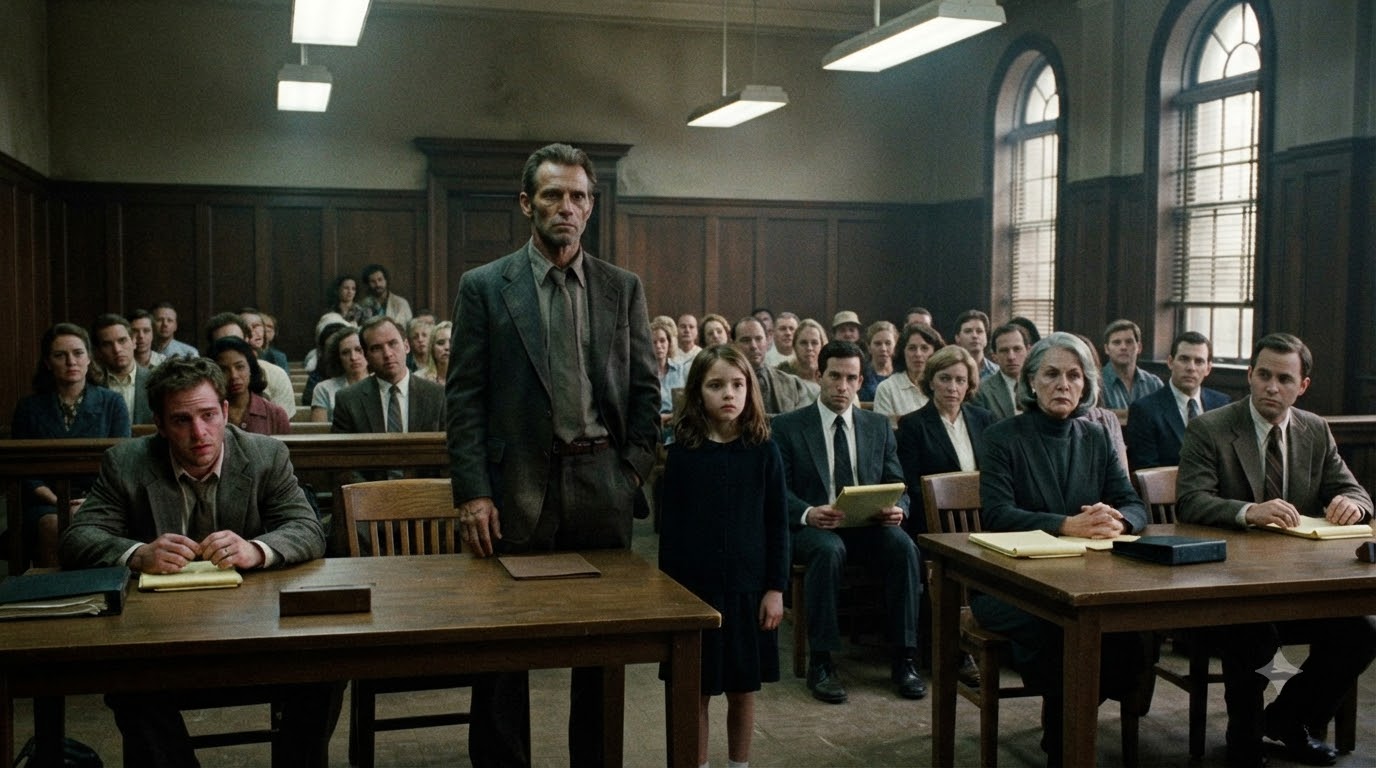
Inside courtroom three, the judge adjusted her glasses and glanced down at the stack of briefs cluttering her desk.
“We are here to review the guardianship petition for the minor child, Mary Adler,” the judge said, her tone flat and exhausted. “Counsel for the petitioner may proceed.”
Aubrey stepped forward, his posture upright and theatrical. He pointed a polished leather shoe toward the stranger sitting at the plaintiff table.
“We present a material fact previously obscured by the respondent’s isolationist lifestyle,” Aubrey said smoothly. “The biological father, Bradley Pollard, has stepped forward to claim his legal rights and has formally assigned guardianship to Mrs. Evelyn Adler.”
The gallery behind them shifted. Roberta let out a sharp, audible huff from the wooden bench, her arms crossed tight over her chest.
Bradley stood when his name was called, looking around the room like a man waiting for a bus that wasn’t coming. He couldn’t even meet Frank’s eyes.
Glenn, Frank’s court-appointed attorney, didn’t flinch. He adjusted his wire-rimmed glasses and stood up slowly, holding a single yellow legal pad.
“Mr. Pollard,” Glenn began, his voice dry and conversational. “When was the last time you saw your daughter?”
Bradley blinked, shifting his weight from one foot to the other. He glanced sideways at Evelyn’s icy stare before mumbling his answer.
“I… well, things were complicated after Diane passed,” Bradley said, his voice dropping. “I tried to find her.”
“Did you?” Glenn asked, stepping closer. “Tell the court what Mary’s middle name is.”
The courtroom went dead silent. Bradley stared at the defense table, his lips parting, but no sound came out. He swallowed hard, sweat beading along his hairline as the seconds stretched into an unbearable eternity.
“I don’t recall,” Bradley muttered, his face flushing dark red.
Glenn turned away from him with total disdain, looking straight up at the bench.
“He hasn’t spent a single day, a single hour, or a single dime on that child,” Glenn said clearly. “This is not a father claiming his daughter. This is an orchestrated legal maneuver designed to strip a grieving uncle of a home he built with his own hands.”
Evelyn’s expression hardened into stone, her fingers gripping the edge of her folder so tight her knuckles turned white.
CHAPTER 4: The Parting Promise
The gravel crunched beneath the heavy tires of the pickup truck. Frank stared at the white wooden fence of the state-approved temporary home, his hands locked tightly around the steering wheel until his fingertips lost color.
The court order sat on the passenger seat, a stark white document dictating terms he never agreed to.
Mary sat beside him in the cab, her small fingers clutching the fabric of her jacket. She hadn’t said a word since they left the courthouse parking lot.
“You don’t have to stay here long,” Frank said, his voice cracking slightly against the dry air in the cabin. “It’s just until the paperwork gets sorted out. I’m coming back for you.”
Mary turned her face toward the side window, refusing to look at him. A single tear tracked down her cheek, but her jaw was set with a stubborn, silent fury that mirrored his own.
“You promised we wouldn’t be separated,” Mary whispered, her voice barely audible over the hum of the engine.
The words struck him like a physical blow. Frank reached out to touch her shoulder, but the front door of the foster house swung open.
A woman in a neat cardigan stepped out onto the porch, offering a practiced, sympathetic smile that didn’t reach her eyes.
“Mr. Adler,” the foster mother called out, her voice carrying across the yard. “We’re ready for her whenever you are.”
Frank swallowed hard, the weight of the court mandate pressing down on his chest like an iron plate. He killed the ignition, the sudden silence inside the truck ringing in his ears.
“Come on, kiddo,” Frank murmured, pushing the door open.
Mary didn’t move. She clutched her backpack to her chest, her knuckles whitening as she stared straight ahead at the dashboard.
“I’m not going in there,” Mary said, her voice dropping into a flat, dangerous calm. “You’re leaving me.”
“I’m right down the road,” Frank said, his voice thick with a suffocating mix of guilt and exhaustion. “I am not walking away for good.”
He climbed out of the truck, walked around to the passenger side, and pulled the door open. The cold autumn air rushed in, swirling around them as he reached down to unbuckle her seatbelt.
Mary flinched away from his touch, scrambling across the seat to press herself against the far door.
“Don’t,” she choked out, her breath catching in her throat. “Just… don’t.”
The foster mother walked down the gravel path, her footsteps crunching a steady, relentless rhythm that filled the space between them. Frank stood frozen on the pavement, realizing with crushing clarity that the legal machinery had finally torn his life apart.
CHAPTER 5: The Sheltered Cat
Frank slammed the truck door shut, his boots splashing into a stagnant puddle as he sprinted toward the metal entrance doors.
The heavy iron latch rattled under his grip. Inside, the air smelled aggressively of bleach, wet fur, and the sharp chemical sting of disinfectant.
A receptionist behind a scratched plastic partition looked up from her desk, her expression tightening at the frantic look on his face.
“Visiting hours ended twenty minutes ago,” she said, her voice flat.
“I’m not here to visit,” Frank panted, slamming a hand down on the counter. “I’m looking for a cat. A one-eyed cat. Brought in today.”
The worker blinked, sliding her glasses down her nose to study him with sudden suspicion.
“We get strays all the time,” she muttered, tapping away at an old keyboard. “Description?”
“Grey tabby. Missing his left eye. Answers to Fred,” Frank said, his jaw locked so tight his teeth ached. “He belongs to a little girl. He wasn’t a stray.”
The monitor clicked, and the woman scrolled down a digital ledger. Her fingers paused over the keys.
“Ah. Drop-off register from this afternoon,” she said slowly. “Brought in by an elderly woman. Stated the household had a severe allergy issue.”
Frank felt the blood rush to his ears. Evelyn. She hadn’t just targeted Mary; she had targeted everything the child loved to break her spirit completely.
“Where is he?” Frank demanded, leaning over the counter.
“Intake holding bay. Row three,” the worker replied, stepping back. “Though you’re cutting it close. The evening processing list just went out for final clearance.”
Frank didn’t wait to hear the rest. He pushed through the swinging double doors marked Authorized Personnel Only, his boots hammering against the concrete floor.
The hallway was lined with wire cages, a chorus of high-pitched yowls echoing off the cinderblock walls. He searched the tags frantically, his breath coming in short, harsh gasps.
At the end of row three, tucked into the bottom tier, a single green eye stared back at him from behind cold steel mesh.
Fred let out a raspy, indignant meow, pressing his paw against the wire as Frank dropped to his knees on the gritty floor.
Frank reached inside, his fingers trembling as he gathered the cat against his chest, feeling the frantic, rapid heartbeat beneath the gray fur.
The intake card clipped to the cage door bore a neat, printed signature at the bottom: Evelyn Adler.
Frank stood up slowly, tucking the cat securely beneath his arm, his mind racing with cold, absolute clarity.
CHAPTER 6: The Final Equation
Evelyn didn’t look up from her paperwork as Frank stepped across the threshold. The room smelled of old paper, lavender air freshener, and the bitter restraint of wealth.
“You’re violating the temporary placement order, Frank,” Evelyn said, her voice clipped and devoid of warmth. “The court made it clear that visits must be scheduled through legal counsel.”
Frank dropped the box onto the dark wood. The cardboard flaps parted, revealing loose folders, scribbled margins, and inked calculations that had sat gathering dust in the back of his truck bed for six long years.
“I’m not here to talk about visitation,” Frank said, his voice flat, low, and entirely uncompromising.
Evelyn frowned, resting her fountain pen beside her ledger. She glanced down at the open box, her eyes catching the handwriting scrawled across the topmost page.
Her breath caught. The color drained from her face in a single, sharp heartbeat.
“That’s…” Evelyn whispered, her fingers trembling as she reached out to touch the margin notes. “That’s Diane’s work. The final sequence.”
“She finished it,” Frank said, stepping closer until the heavy oak table separated them like a battle line. “Before she died, she solved it. Every single line of it.”
Evelyn stared at the paper, her composure cracking under the weight of decades of academic obsession and bitter pride. She had spent her life chasing a ghost, believing her daughter had failed, believing greatness had slipped through their fingers.
“Why didn’t she publish?” Evelyn demanded, her voice shaking with sudden, desperate grief. “Why would she hide this?”
“Because she didn’t want her child treated like a formula,” Frank answered, his eyes locked onto hers. “She wanted a daughter, not a prize to hang on your wall.”
Evelyn opened her mouth to argue, to fall back on her lawyers, her court orders, her unyielding demand for control. But the words died in her throat as she looked at the papers—and then at Frank, standing immovable in the center of the room.
She realized then that no amount of legal pressure could break him. He had already survived the worst life could throw at him.
“Take her home, Frank,” Evelyn whispered, her shoulders finally collapsing under the weight of the truth.
Outside on the lawn, Mary stood waiting by Roberta’s car, watching the front door with wide, anxious eyes. When Frank walked out into the afternoon sunlight with Fred purring securely in his arms, the little girl started running.
She didn’t stop until she hit his side, burying her face against his jacket as the tears finally came.
Frank knelt down in the grass, wrapping his arms around her tightly, letting the quiet warmth of the afternoon wash away the months of fear.
The yellow school bus would come again tomorrow. There would be math classes, playground arguments, and ordinary days filled with noise and messy paintbrushes.
And for the first time in six years, that was more than enough.