The Weight of a Single Song: How an Unlikely Friendship Restored a Broken City’s Heart
CHAPTER 1: THE BIRTHDAY SERENADE
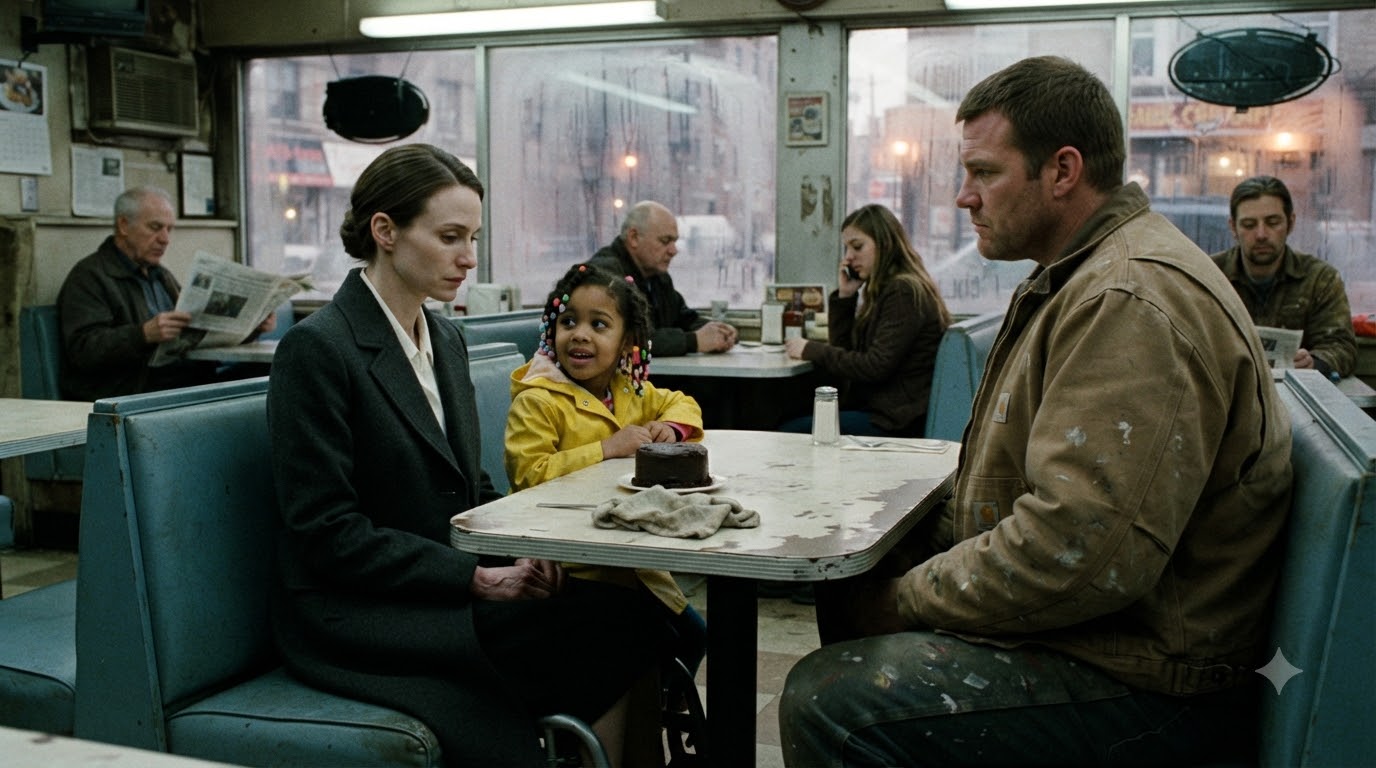
The windows of the Daily Grind Cafe on Pine Street wept with condensation.
Inside, the air smelled of dark roast and damp wool. Eleanor Hart traced a scarred finger along the rim of a small, solitary chocolate cake.
She was thirty-two today. Her driver was sick, her father was flying over the Pacific for a merger, and her legs remained a silent, numb burden beneath the leather booth.
The cafe door chimed. A rush of cold wind swept across the floorboards.
A little girl in a bright yellow raincoat skipped inside, her dark curls bouncing with colorful beads that clicked softly. Behind her stepped a tall man with broad shoulders and tired, watchful eyes.
They ordered hot chocolate at the counter. The little girl chattered about an art project, her voice cutting sharply through the lonely drone of the room.
Then, her gaze landed on Eleanor.
Before the man could react, the child skipped straight across the room. She held out a slightly damp crayon drawing of a cat wearing a party hat.
“Excuse me, miss,” the girl said, her voice entirely serious. “Is today your birthday?”
Eleanor blinked, caught completely off guard. “Yes. It is.”
The child’s face lit up with absolute sunshine. “I knew it. I could tell. Can we sing for you, please? Nobody should be alone on their birthday.”
The man appeared beside his daughter, his expression instantly apologetic. “Lily, sweetheart, we don’t bother strangers.”
“Please,” Eleanor whispered, the word tearing past her throat before she could stop it. “Please. I’d like that.”
Marcus met her eyes across the small table. In that quiet fraction of a second, she saw the heavy, shared weight of profound isolation mirrored in his gaze.
He nodded once, pulling out a chair for his daughter. Together, right there in the middle of the indifferent city, they sang Happy Birthday off-key.
Lily’s enthusiasm carried the melody, while Marcus’s steady bass anchored the room. Eleanor closed her eyes, feeling the cold armor around her chest crack open for the first time in two agonizing years.
CHAPTER 2: SHADOWS IN THE RAIN
The rain did not let up. It came down in heavy, gray sheets that turned the Seattle gutters into rushing streams.
Eleanor gripped the metal handrims, her knuckles white, feeling the familiar, stubborn urge to push forward alone.
Marcus kept his hands steady on the back of the chair, his movements unhurried, offering neither pity nor false cheer.
“Watch the lip of this curb,” Marcus said, his voice a low anchor against the storm. “Tree roots pushed the concrete up about two inches.”
Eleanor felt the front castors lift smoothly, the weight shifting with calibrated precision as Marcus tilted the chair just enough to clear the obstruction without jarring her spine.
She did not thank him aloud. The silence between them was heavy, weighted by the kind of mutual understanding that required no preamble.
They navigated the uneven six blocks toward her apartment building, the water drumming a rhythmic, deafening tattoo against the fabric of Lily’s bright yellow raincoat.
Lily skipped half a step ahead, holding a damp paper folder tightly against her chest like a shield.
“Almost home,” Lily called back over her shoulder, her voice cutting through the hiss of passing traffic. “We got big umbrellas protecting the art!”
Eleanor looked down at her own damp gloves, feeling the damp chill biting through her wool coat.
Every crack in the pavement was a reminder of what her legs could no longer navigate on their own. Every block covered was a small, bruising negotiation with gravity.
Marcus stayed right there behind her, his breathing even, matching her pace without a single trace of condescension or impatience.
They reached the covered overhang of Eleanor’s apartment complex on Elliot Bay, the wind howling off the dark water.
Marcus wheeled her under the dry portico, stepped back, and shook the gray water from his jacket shoulders with a sharp shrug.
“Safe delivery,” Marcus said simply, checking the sky.
Eleanor reached into her coat pocket, her fingers brushing against her keys, her eyes catching a strange, out-of-place smudge of blue ink on the brass ring that hadn’t been there when she left the community center.
CHAPTER 3: UNCOVERING THE LEDGER
The digital glow of her laptop screen cut through the dark living room like a knife.
Eleanor sat at her mahogany desk, the cursor blinking rhythmically against the search field of the state business registry.
She did not call an executive assistant or rely on corporate investigators. She used her own tired, persistent fingers on the keyboard, digging through public contractor records, archived restoration proposals, and local permit filings.
The screen flickered, pulling up a digital record from six years prior.
Wright Building and Restoration.
The address listed was a weathered workshop in the Georgetown district. The photos attached to the closed permits showed breathtaking craftsmanship—painstakingly restored Victorian crown moldings, structural masonry work that honored Seattle’s earliest industrial history, and client reviews that praised absolute integrity.
Then, the digital timeline stopped dead.
No new projects. No permit renewals. Just a sudden, silent void following the probate records of Jasmine Marie Wright.
Eleanor scrolled further, crossing reference databases with industry application logs that her personal network could access.
Her breath caught sharply in her throat.
Marcus had applied for seventeen distinct restoration contracts across King County over the past six years. He had interviewed twelve times.
Three formal job offers had been issued. Every single one had been mysteriously rescinded within forty-eight hours under vague, bloodless corporate pretexts about “shifting budgetary priorities” and “cultural alignment.”
Corporate double-speak. The exact shield used to mask institutional gatekeeping.
She stared at the monitor, the harsh blue light reflecting in her tired eyes.
This was not bad luck. It was an engineered wall designed to keep working-class excellence out of elite spaces.
She felt a cold, sharp anger rise in her chest—not a flash of temper, but a quiet, calculating resolve.
Her phone chimed beside the keyboard, breaking the silence with a soft vibration.
A text message flashed across the screen from an unknown local number, displaying a single, chilling phrase: Some doors are locked for a reason, Eleanor. Leave the past in the dirt.
CHAPTER 4: THE COLLABORATIVE MURAL
The community center activity room buzzed with the chaotic, joyful energy of thirty children splashing paint across a massive brick wall.
Eleanor parked her wheelchair near the supply table, her mind still anchored to the anonymous warning sitting on her phone.
Marcus wiped a streak of yellow paint from his cheek, stepping carefully around a bucket of brushes to reach her side.
“You’re miles away today,” Marcus said, his voice carrying a quiet, steady gravity that cut through the noise of the room.
“Just thinking about invisible walls,” Eleanor replied, her eyes tracking Lily as the little girl eagerly blended blues and greens into a corner of the mural.
“Walls are meant to be taken apart,” Marcus said, resting his hand briefly on the back of her wheelchair frame. “Brick by brick. Same as a restoration project.”
Before Eleanor could answer, the heavy double doors of the center swung open with a sharp clatter.
Diane, the senior project manager from Hart Technologies, stepped inside out of the gray Seattle downpour, holding a damp clipboard tightly against her tailored wool coat.
Her gaze swept across the room, bypassing the children entirely until it locked onto Marcus.
“Mr. Wright,” Diane called out, her voice cutting across the room with professional coldness. “We have an unexpected inspection issue at the Paramount site. The historical preservation board just flagged your foundation permits.”
Marcus straightened up immediately, his expression hardening into quiet vigilance.
“Which permits?” Marcus asked, stepping away from Eleanor’s chair to face her squarely. “Every filing was cleared three weeks ago.”
“Not according to the new compliance desk,” Diane said, tapping her clipboard sharply with a manicured fingernail. “They claim your prior company’s lapsed registration invalidates your current standing. They’re demanding an immediate work stoppage.”
Eleanor gripped the armrests of her chair, her heart hammering against her ribs as she realized the anonymous text was no empty threat.
The institutional gatekeepers were striking back.
CHAPTER 5: CONFRONTING THE BOARDROOM
The executive boardroom on the twentieth floor smelled of expensive leather and cold coffee.
Eleanor positioned her wheelchair at the foot of the long mahogany table, her forearm crutches leaning against her chair like silent witnesses.
Across from her sat the board of directors, flanked by Harrison and Diane, their expressions carved from polished stone.
“The compliance audit is definitive, Mr. Wright,” Harrison stated, leaning back and lacing his fingers over his stomach with a thin, unyielding smile. “Your past corporate registrations contained unresolved discrepancies. The foundation permits for the Paramount are officially void.”
Marcus stood upright behind Eleanor’s right shoulder, his jaw tight, his hands resting flat against the edge of the polished wood.
“The filings were submitted correctly according to state restoration code,” Marcus replied, his voice level and dangerously low. “The discrepancy was manufactured after the fact by a compliance desk that never wanted local contractors touching this project.”
“Watch your tone, Mr. Wright,” Diane interjected, tapping a thick stack of printed emails against the tabletop. “You are addressing the governing board of Heart Technologies. We protect the company’s legal integrity, regardless of your personal grievances.”
The trap was complete. They had cornered him with red tape, weaponized his past against him, and demanded an immediate, humiliating surrender.
Marcus did not blink. He reached into his weathered leather portfolio, pulled out a single, dog-eared carbon copy of a certified receipt dated six years prior, and slid it across the mahogany table.
“You can hide behind paperwork all afternoon,” Marcus said, his voice cutting through the heavy air with absolute finality—refusing to yield, refusing to break. “But the city archives stamped this receipt the day my registration was cleared. Try revoking a public seal.”
Harrison’s smile vanished instantly, the color draining from his face as his eyes scanned the official stamp.
CHAPTER 6: RECLAIMING THE FUTURE
The air in the boardroom remained dead and heavy.
Harrison snatched the receipt back, his fingers trembling slightly as he squinted at the faded municipal seal.
“This—this proves nothing about current compliance,” Harrison stammered, his face flushing a mottled, furious red as he tried to claw back his footing. “Registration lapses happen every single year.”
“Not when the filing fee was paid in full and archived by the county clerk,” Eleanor said, her voice cutting through the room with calm, unshakeable authority.
She wheeled forward an inch, planting her hands firmly on the table.
“You engineered a bureaucratic roadblock to protect your own comfort, Harrison,” Eleanor continued, her eyes locked onto his. “You weaponized compliance against a man who has built more integrity with a single trowel than you have in twenty years behind a desk.”
Diane stared down at her clipboard, her pen slipping from her fingers to clatter against the polished wood.
The defense crumbled entirely. There were no more loopholes, no more corporate double-speak, and no more hiding behind institutional bias.
Marcus stood quietly beside Eleanor, his hand resting once more on the back of her wheelchair—not as a symbol of dependence, but as a shared anchor.
Three weeks later, the grand reopening of the Paramount Theater filled downtown Seattle with music, laughter, and light.
Five hundred people packed the restored auditorium, their voices washing over the polished art deco balconies.
Eleanor walked down the central aisle under her own power, leaning lightly on her cane, her steps measured and steady.
Marcus and Lily stood near the stage, the little girl holding a brand-new box of watercolors while her father smiled with a quiet, hard-earned peace.
The heavy shadows of isolation and regret finally lifted, replaced by the simple, enduring warmth of a chosen family.
Eleanor stopped beside the front row, looking up at the restored plaster moldings glowing under the warm chandeliers.
She didn’t need wishes anymore. She had a future built on truth, resilience, and the quiet triumph of common sense over entitlement.