The Quiet Men of Route Nine and the Broken Girl Who Stopped Waiting
CHAPTER 1: THE SHATTERED PORCELAIN
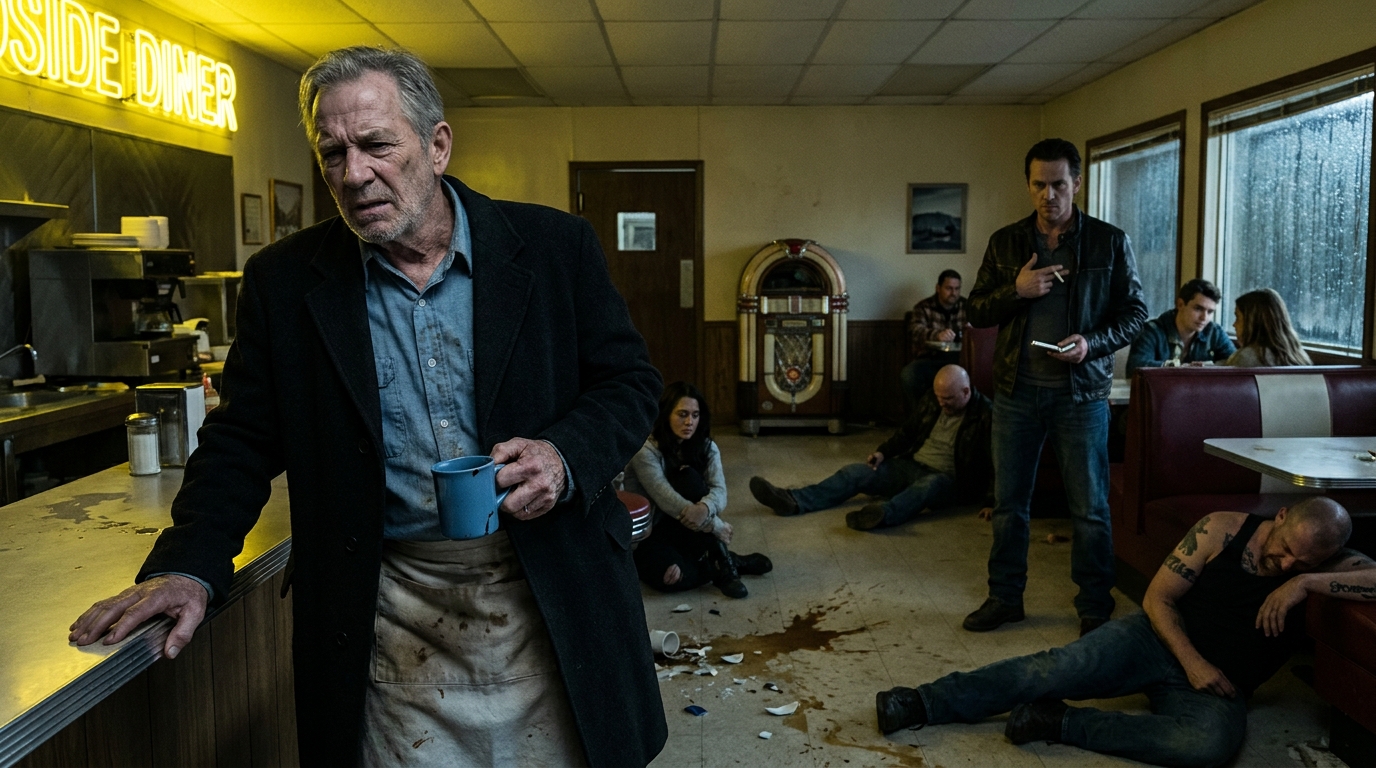
Rain beat a steady, deafening rhythm against the diner windows, but the crack of ceramic exploding against floor tile hit louder than the storm.
Walt Greer stopped polishing the chipped blue mug in his hand. His fingers tightened around the worn porcelain, feeling the rough edge where the glaze had worn thin over eleven years behind this counter. Across the floor, grease and hot coffee spread across the vinyl tiles around Lily’s work shoes.
“Smile for us, sweetheart,” the big one said. Tattoos crawled up his throat like thick ivy, disappearing under the collar of a damp leather vest. His hand remained clamped around Lily’s forearm, the skin turning white under the pressure.
Lily didn’t scream. She didn’t pull back with a panic that might give him satisfaction. Her shoulders went square, green eyes locking onto the man’s flat nose. “Let go of my arm.”
“Or what?” The dark-haired one sitting beside him leaned forward, resting his elbows on the laminate table. He picked up a butter knife, tapping the flat edge against the salt shaker with a dull, rhythmic clack-clack-clack. “You gonna write us up, Lily?”
Walt set the blue mug down on the stainless steel counter. The porcelain made a quiet, definitive thud. He didn’t rush. At sixty-seven, rushing only made your knees give out early, and thirty-one years on the force taught him that speed was less useful than position. He stepped out through the swinging wooden gate at the end of the counter.
“That’s enough,” Walt said. His voice didn’t rise above the hum of the overhead neon sign. “Food’s on the house. Walk out the door.”
The third man—bald, wide through the chest, standing near the jukebox—turned slowly. He stepped straight into the aisle between the booths, cutting off Walt’s line to Lily. Six feet two, two hundred and forty pounds of deliberate obstruction.
“Stay behind your counter, old man,” the bald one said.
Behind him, the dark-haired man reached out. Fingers caught the collar of Lily’s uniform shirt. A hard, single jerk.
The sound of cotton tearing cut clean through the rain.
Lily stumbled backward into the edge of Table Six. Her hands flew to her chest, gathering the ripped blue fabric together, holding it tight. The tray she’d been holding rattled across the floor, spinning until it hit the leg of the bald man’s boot.
Nobody in the diner moved. The trucker in the back booth lowered his fork, staring straight at his plate. The young couple near the window froze, the boy’s arm locking rigid around the girl’s shoulder.
“Look at that,” the dark-haired one laughed, stepping closer to Lily, reaching out to cuff her chin with two fingers. “Nobody coming to help. Let’s see who can save you now.”
Walt took a step forward, his shoulder hitting the bald man’s chest. The larger man didn’t move an inch. Instead, he brought a heavy, palm-flat hand up and shoved Walt straight backward.
Walt’s spine slammed into the sharp edge of the counter. The impact drove the air clean out of his lungs, a sharp, white-hot flare of ache shooting through his lower back. His knees buckled slightly before he forced them straight, gripping the lip of the counter behind him until his knuckles turned gray.
He looked at Lily. She wasn’t looking at the men. She was looking at the floor, her teeth pressed into her bottom lip until it bled, her breath coming in short, silent hitches. It was the look of someone who had calculated the math of this moment long before tonight.
The dark-haired man raised his hand again.
A chair scraped back from the corner booth.
It wasn’t a sudden movement, but the heavy iron leg dragging across linoleum made a sharp, screeching sound that pulled every eye in the room toward the dark wall.
The man sitting there stood up. Silver hair pushed back, a frost-white beard tight against his jawline. He wore a damp black vest over a gray thermal, ink crawling down both arms in dark, faded coils.
He didn’t look at Walt. He didn’t look at Conrad Hail, who sat three tables away in a tailored coat, quietly sipping cold black coffee.
He just looked at the big man holding Lily’s chin.
“Let go of her,” the man in the corner said.
CHAPTER 2: SHADOW IN THE CORNER
The big man’s fingers didn’t release Lily’s chin immediately. He blinked, turning his head slowly, as if his mind couldn’t quite process the sound of someone speaking to him in that tone.
“You got a problem, old man?” the dark-haired one asked, stepping away from Lily. He left the butter knife on the table, letting his right hand slide casually into the pocket of his damp jacket.
Marcus didn’t answer. He took two slow, measured steps out of the shadows. Every movement was methodical, the heavy thud of his boots on the wet linoleum striking like a hammer against a wooden plank.
On the shoulder of his leather vest, frayed threads caught the buzzing yellow light of the neon sign. It was an old, faded task force patch—a shield with a lightning bolt through the center, stripped of its gold thread until only the ghostly outline remained.
Walt saw it. Thirty-one years in uniform meant his eyes caught the specific weave of federal cloth before his mind even asked why a biker in a roadside diner was wearing it.
The bald man stepped back from Walt, turning his full two-hundred-and-forty-pound frame toward Marcus. “This ain’t your table, gray-hair. Walk back to your coffee before you get hurt.”
“He’s not walking anywhere,” a smooth, flat voice called from three tables back.
Conrad Hail set his coffee cup down on the saucer. The porcelain clink was soft, almost delicate, but it brought an absolute silence to the room. He stood up slowly, smoothing the front of his tailored wool coat.
“Conrad,” Walt said, his voice raw from the impact against the counter. He took a heavy breath, pushing himself upright despite the sharp bite in his lumbar spine. “This is my place. You want something from me, you take it up with me.”
Conrad didn’t look at Walt. His dark eyes remained fixed on Marcus’s face, a cold, calculating flicker passing behind them.
“Marcus Reed,” Conrad said softly. “Viper. The Steel Wolves.”
Marcus didn’t flinch at the name. His hands remained at his sides, open, relaxed, fingers slightly curved—the posture of a man who had spent half his life expecting a physical threat and knew better than to tense up before the strike.
“You’re a long way from your county line, Marcus,” Conrad continued, taking a step closer, his leather-shod shoes silent on the tile. “Last I heard, your boys didn’t ride down Route Nine.”
“I ride wherever the road goes,” Marcus said. His voice was gravel dragged over slate. “And I drink coffee where I choose. But I don’t watch three grown men tear a working girl’s shirt in front of an old man who can barely stand.”
The big enforcer with the throat tattoos sneered, his chest puffing out. “She’s a diner waitress. She gets paid to be polite.”
“She gets paid to bring food,” Marcus replied, his eyes dropping to the hand still hovering inches from Lily’s face. “Don’t touch her again.”
The dark-haired one lunged. It wasn’t a clean punch—it was a sloppy, arrogant reach intended to grab Marcus by the throat and push him back into the booth.
Marcus didn’t duck. He pivoted his left hip three inches to the inside, letting the man’s arm brush past his gray thermal sleeve. His right hand came up, palm open, striking the underside of the dark-haired man’s wrist with the hard, heel edge of his palm.
Bone hit bone with a dry thwack.
The dark-haired man yelped, his shoulder jerking violently as his hand bounced off thin air. Before he could recover his balance, Marcus grabbed him by the collar of his damp coat, redirected his momentum, and drove him face-first into the laminate table.
Plates shattered. A half-eaten hamburger slid across the wood.
The bald man roared, charging forward with his arms spread wide to tackle Marcus into the counter.
Marcus didn’t step back. He grabbed the heavy edge of a steel-framed dining chair, slammed it legs-first into the bald man’s knees, and locked his foot behind the man’s heel.
Gravity and momentum did the rest. The giant hit the floor with a bone-jarring crash that shook the napkin dispensers on the counter.
Through it all, Conrad Hail didn’t move a muscle. He simply stood there, watching Marcus dismantle two of his men in three seconds without breathing heavy.
“You’re good,” Conrad said, his voice dropping an octave, losing its polite veneer. “Decorated military. Tactical unit. I read the files on your club.”
Conrad reached into his coat pocket, pulling out a slim silver cigarette case. He tapped it against his thumb, his gaze shifting over Marcus’s shoulder straight to Walt.
“But you don’t know who you’re protecting, Reed,” Conrad said, clicking the silver case open. “You think you’re standing up for an old cop running a quiet diner. You don’t know what this bastard did nine years ago.”
Walt gripped the edge of the counter, his thumb pressing into a fresh scratch on the wood. “Tell him, Conrad. Tell him whatever lies keep you awake at night.”
“Not lies,” Conrad said, pointing the unlit cigarette at Walt’s chest. “My brother, Arthur. Seven years in federal custody because this ‘honest detective’ lied on the witness stand to cover his own badge.”
Marcus didn’t turn around. He kept his eyes locked on Conrad, but his left ear twitched slightly at the mention of the court case.
“Arthur died in the yard three years in,” Conrad hissed, his composure finally snapping, revealing the jagged, raw hatred underneath. “A heart attack at sixty-one years old while this hypocrite was wiping down coffee mugs in peace.”
CHAPTER 3: THE GHOST OF THE WITNESS BOX
“Arthur didn’t belong in a federal penitentiary,” Conrad said, his voice dropping to a gravelly rasp. “He was fifty-eight years old, running auto parts across state lines. You turned a shipping infraction into an interstate conspiracy.”
Walt didn’t look away. His hand slid along the lip of the counter until his palm rested flat against the chipped blue coffee mug he had set down minutes earlier. The porcelain was cold now.
“Your brother was moving stolen assault frames with scrubbed serial numbers, Conrad,” Walt said smoothly, each word falling heavy and deliberate. “I didn’t invent the crates we found in his warehouse. I just logged the manifest.”
“You lied about the warrants!” Conrad stepped closer, the sharp tip of his dress shoe crunching over a shard of broken glass. “You swore under oath that you had probable cause before you kicked his side door open. You took thirty years of wearing a badge and weaponized it to build your own reputation.”
The bald enforcer groaned on the floor, pushing his heavy frame onto one elbow, but Marcus didn’t even shift his gaze toward the noise. His eyes remained locked on Conrad’s face, taking in the twitching muscle along the man’s jawline.
“I didn’t lie,” Walt said. He picked up the blue mug, turning it slowly in his right hand. “Your brother sold two carbines to an undercover deputy in the parking lot behind this exact building. I had the tape. I had the serial numbers. I didn’t need to fake a single syllable.”
“He died on a Tuesday morning,” Conrad spat, the refined composure completely dissolving into raw, ugly grief. “Collapsed on the asphalt during recreation hour. Three years in. They called me forty minutes after his heart stopped.”
Lily stirred near the counter’s end. She stayed low, clutching the torn collar of her shirt with both hands, but her eyes moved from Conrad’s trembling fingers to the steady, unmoving silhouette of Marcus Reed.
“I know when he died,” Walt said quietly.
Conrad went rigid. “Don’t you act like you cared.”
“I read the warden’s report,” Walt said, his tone devoid of defensive heat, carrying only the weary weight of an old man who had lived with the consequences of his choices every morning at four o’clock. “I read it twice. And I sat right here at this counter, drinking cold coffee, knowing a man I put away wasn’t coming home.”
“You think that makes us even?” Conrad took another step forward, ignoring the way Marcus subtly shifted his weight onto his lead foot to bar the aisle. “You think sitting in a rural diner feeling sorry for yourself pays for nine years of an empty chair at my Sunday table?”
“No,” Walt said directly. “It doesn’t pay for anything. It just means I carry it. The law doesn’t guarantee anybody a clean conscience, Conrad. It just demands the truth.”
Marcus spoke then, his gravelly voice cutting clean through the thick air. “You didn’t drive out here in a storm just to yell at an old cop about a dead brother.”
Conrad slowly lowered his hand, his eyes sliding from Walt over to Marcus’s silver hair.
“I came to collect what’s owed,” Conrad said softly. “Walt Greer ruined my family’s name and left my brother to rot in the dirt. He doesn’t get to live out his golden years playing saint to waitresses and truckers.”
“You brought three thugs to beat up a girl and smash glass,” Marcus said, his arm raising just enough to gesture toward the shattered plates on the floor. “That’s not justice. That’s just a weak man throwing a tantrum because he can’t fix the past.”
Conrad’s face went pale, the vein in his temple throbbing against his skin. He reached into his inner breast pocket, his fingers wrapping around a heavy black shape.
“You picked the wrong night to step in, Reed,” Conrad whispered.
CHAPTER 4: THE SOUND OF IRON ENGINES
A sharp, high-pitched double-chirp echoed through the rain outside. Conrad pulled a short black key fob from his coat, his thumb driving down on the button once, twice.
Before the sound died, headlights swept across the wet glass in three blinding beams. Three dark SUVs cut their engines in a jagged semi-circle across the lot, blocking every inch of the diner’s front entrance.
Four men spilled out of the lead vehicle, their boots splashing through deep puddles before kicking the front doors open with a violent, metallic crash.
“Out!” the lead driver shouted, a thick-necked man in a oil-stained canvas coat, waving a heavy tire iron toward the couple by the window. “Get out!”
The young couple scrambled toward the kitchen exit, knocking over two vinyl chairs in their panic. The trucker in the back booth didn’t look up, sliding flat beneath the table as the room descended into complete, chaotic noise.
The bald enforcer on the floor hauled himself up, grabbing the leg of an overturned table to hurl it straight at Marcus’s chest.
Marcus caught the edge of the flying laminate table mid-air, the heavy steel legs digging into his palms. He didn’t drop it—he swung the entire hundred-pound table around in a low, brutal arc, slamming the edge straight into the bald man’s ribs with a muffled, hollow crack.
The dark-haired one charged from the left, lunging low to wrap both arms around Marcus’s waist.
Marcus took the impact, his heavy work boots dragging three inches back across the wet floor tiles. He brought his right elbow down in a sharp, vertical drive into the man’s shoulder blade, using the sheer weight of his frame to anchor them both against the counter.
Walt lunged forward, grabbing the dark-haired man by his collar and pulling him backward with every ounce of sixty-seven-year-old muscle he had left. “Get off him!”
The man kicked back, his heel catching Walt square in the shin. Walt grunted, his grip slipping, but it bought Marcus two seconds to twist free and drive a short, heavy knee straight into the man’s midsection.
Conrad stepped back toward the door, his face twisted in cold satisfaction as his four fresh men flooded the narrow aisles, tearing down napkin dispensers and shattering the remaining window panes with lead pipes.
“You brought a knife to a war, Reed!” Conrad shouted over the grinding crunch of boots on glass. “You think your military record protects you in a room full of men who don’t care about your medals?”
Then the floor began to vibrate.
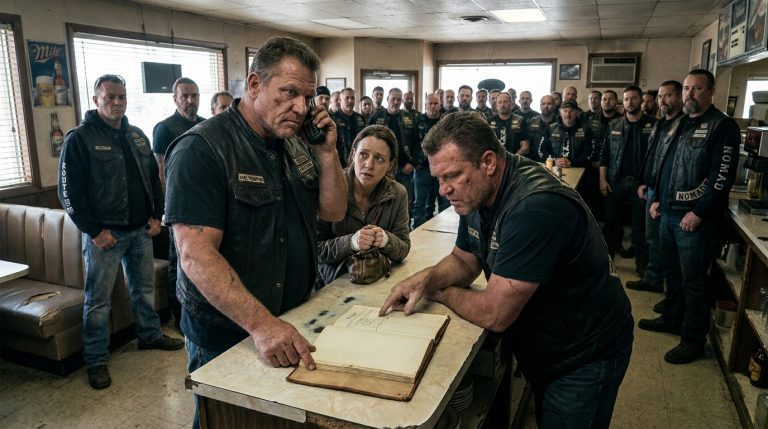
It wasn’t a sudden sound—it was a low, sub-audible thrum that started in the soles of their boots and rattled the salt shakers on the counter. The rain outside seemed to freeze against the glass as the deep, guttural roar of thirty v-twin engines crested the hill on Route Nine.
Headlights cut through the downpour in a solid wall of yellow light, sweeping across the lot like searchlights on a runway. The thunder of iron exhaust pipes drowned out the rain, the sound vibrating straight through the diner’s wooden frame.
The four men in canvas coats froze, their lead pipes hovering in mid-air as the rumble shook the dust from the ceiling tiles.
Marcus didn’t turn around. He wiped a streak of grease from his cheek with the back of his hand, his eyes fixing on Conrad’s pale face.
“Those aren’t my medals, Hail,” Marcus said, his voice dropping into a terrifyingly quiet register. “Those are my brothers.”
Outside, the Steel Wolves rolled into the lot, thirty bikes forming a tight, steel wall behind Conrad’s three SUVs, shutting off the exit completely.
CHAPTER 5: THE WEAPON IN THE POCKET
The glass in the front door rattled as Conrad slowly pulled his hand from his inner breast pocket. The black steel of a compact semi-automatic pistol caught the flickering overhead neon light.
“Nobody moves,” Conrad said, his voice tight, stripped of every trace of polish. He leveled the barrel straight at Marcus’s chest. “I didn’t drive out here to be intimidated by a parade of leather jackets.”
The four men in canvas coats backed up against the shattered jukebox, their eyes darting nervously toward the headlights blinding them through the doorway, but Conrad didn’t glance back once.
Marcus didn’t raise his hands. He took a single step forward, bringing his chest closer to the iron sights. “You pull that trigger, Hail, and thirty men tear those SUVs down to the frame before you can rack another round.”
“I don’t care about the frame,” Conrad hissed, his finger tightening against the curve of the trigger. “I care about the man standing behind you.”
Walt stepped out from behind the counter. His boots crunched over heavy glass shards, his knees stiff, but his posture straight. He put himself directly between Conrad’s gun and Marcus.
“You want the man who testified?” Walt said, his hands held low, open, empty. “Here I am, Conrad. Put the steel on me and leave everyone else out of it.”
Conrad’s eye twitched, a single bead of sweat cutting a clean trail through the grime on his temple. “You think you get to be a martyr now, Greer? You think dying in a diner pays for Arthur?”
Behind the counter, Lily moved.
She didn’t run, and she didn’t scream. She reached up under the edge of the shelf where Walt kept his spare apron, her fingers finding the cold, heavy steel of the snub-nosed revolver Walt had tucked away years ago and never touched.
She slid her hand around the wooden grip, pulling it free. The metal made a soft, scraped sound against the wood.
Lily walked out from behind the counter gate. She held the small revolver with both hands, arms extended, pointing it not at Conrad, but straight at the big man with the throat tattoos who had torn her shirt.
“Put your hands on your head,” Lily said. Her voice didn’t shake. It was quiet, steady, carrying a flat, terrifying clarity.
The big enforcer froze, his mouth dropping open as he looked from the small steel frame in her hands to the cold green of her eyes.
“Lily, stay down,” Walt warned without breaking eye contact with Conrad.
“No,” Lily said, stepping into the middle of the aisle, her boots firmly planted. “I’m done staying under the counter, Walt. I’m done waiting for somebody else to fix what’s broken in front of me.”
Conrad looked at her, his vision wavering between Walt’s chest and the young woman holding six rounds of iron with unblinking resolve. The absolute certainty he had carried into Route Nine for nine long years was cracking right down the middle.
“Put it down, Hail,” Marcus said softly, taking one final step to close the distance. “It’s over.”
Conrad looked at the gun in his hand, his thumb shaking against the safety notch, the weight of the steel suddenly heavier than his pride could bear.
CHAPTER 6: THE LONG COLD MORNING
Conrad Hail didn’t drop the gun. He slid it back into his coat pocket with a slow, mechanical numbness, his fingers trembling as he buttoned the wool front. He backed through the diner door into the gray downpour, his four men trailing behind him like beaten dogs.
The roar of thirty motorcycle engines slowly faded down Route Nine, leaving only the steady drip-drip-drip of water leaking through the shattered window frames.
Lily set the small revolver down on the laminate counter. Her hands weren’t shaking anymore. She reached up, pulling Walt’s oversized flannel jacket tighter around her torn shirt, and sat on the nearest upright stool.
Walt walked around the counter, stepping over broken glass and crumpled napkin holders. He picked up his chipped blue porcelain mug from the counter. The coffee inside was stone cold.
“You knew before you walked through that door tonight,” Walt said softly, staring into the dark liquid. He didn’t look up at Marcus. “You didn’t just stumble into Route Nine.”
Marcus stood six feet away, his leather vest damp from the rain, his hands buried deep in his pockets. On his shoulder, the faded threads of the task force patch seemed to catch the gray morning light filtering through the plastic sheeting.
“I’ve known for twelve years,” Marcus said. His voice was rough, like gravel shifting under water. “William Reed was my father.”
Walt went completely still. The porcelain mug stayed frozen inches from his lips.
“The gunrunner,” Walt murmured, his eyes closing briefly as the memory hit him—a raid twelve years ago, two officers down, and a federal courtroom where he took the stand. “He died in custody fourteen months into a five-year stretch.”
“A heart attack in a cell in Ohio,” Marcus said. He stepped up to the counter, pulling out a stool and sitting down. “The guard said the last thing he did was call my name. I was forty minutes late getting to the hospital room.”
The silence in the diner stretched wide and heavy, filling every broken corner of the room.
“I didn’t fake the evidence, Marcus,” Walt said, opening his eyes to look the younger man square in the face. “Your father shot two deputies. One of them had a four-year-old daughter. I swore an oath to state what I saw.”
“I know,” Marcus replied. He reached out, his thick, calloused fingers tracing a scratch on the wooden counter. “He was a bitter, dangerous man, and I couldn’t save him from what he built. I didn’t come here tonight to avenge him.”
“Then why did you stand up?” Lily asked quietly from her stool.
Marcus turned his head, his cold river-gray eyes softening as he looked at her. “Because what a man did twelve years ago in a courtroom, and what three cowards do to a woman in a diner at eleven at night, are two different things. I learned a long time ago not to let one answer for the other.”
Walt set the blue mug down with a firm, quiet click. He reached for the fresh glass coffee pot behind the burner, flipping the switch on.
“I’ve thought about your father every morning at four o’clock for twelve years,” Walt said, his voice steady, carrying no defense, only the unvarnished truth. “I don’t regret telling what I saw. But I carry the weight of what it cost every single day.”
“We all carry something, old man,” Marcus said, taking a thick white ceramic mug from the rack behind the counter. He slid it across the wood toward Walt. “Pour the coffee.”
By six-forty-seven, the rain had stopped completely. Pale blue sunlight cut through the plastic sheeting over the windows, illuminating the dust floating over the freshly swept floor tiles.
Walt stood near the front door, a heavy broom in his hand, sweeping the last pile of glass shards into a dustpan held open by Lily. Her dark hair was down, resting softly over her sweater, her posture upright and unburdened.
Marcus pushed open the front door, carrying a small cardboard box under his arm. He set it down on the counter. Inside were two fresh halogen bulb tubes.
“For the sign outside,” Marcus said, zipping up his vest. “The left side’s been flickering for three weeks.”
Walt looked at the box, then looked up at Marcus. “I can fix my own sign.”
“Next Tuesday,” Marcus said, stepping back out toward his motorcycle parked in the dry gravel. “If the coffee’s hot.”
“Coffee’s always hot,” Lily called out from the doorway, a faint, genuine smile touching her lips.
Walt stood beside her, watching the lone motorcycle kick to life, its low, steady rumble echoing off the damp asphalt of Route Nine before shrinking into the bright, clear morning.
Lily let her hand fall away from her wrist, her fingers leaving the old scar completely as she breathed in the sharp, clean air of a storm that had finally passed.
Walt turned back inside, grabbing his broom to finish the floor. The diner was broken, but it was still standing, and tomorrow they would fix the sign.