The Weight of Iron and Tears: How a Weary Outlaw Honored a Ghost on a Weathered Bench
CHAPTER 1: THE SMALL HAND
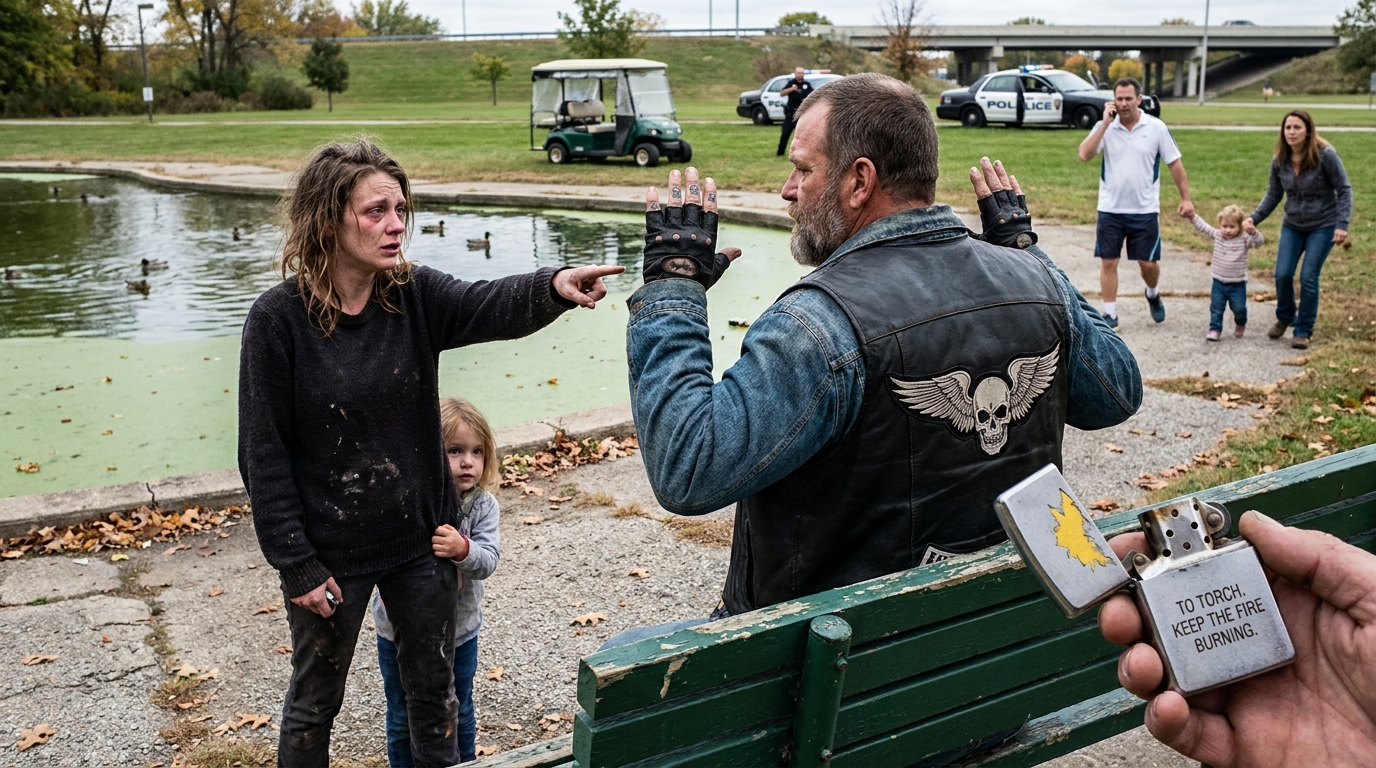
The green paint on the slatted bench was peeling in stiff, sharp curls that bit into the denim of my jeans if I shifted too fast. I kept my boots planted flat against the cracked concrete, the weight of the old Panhead’s three-hundred-mile run still vibrating deep in the marrow of my shins. Across the pond, a man in a crisp white tennis shirt threw a neon-orange ball for a golden retriever, his chest puffed out like a rooster guarding a manicured lawn. The dog barked twice, the sound thin and hollow against the ambient hum of the cross-town expressway.
I didn’t look at the dog. I turned the silver Zippo over in my right palm, the metal cold against the calluses on my thumb. Five years since the mountain highway went slick with oil and black grease. Five years since Bobby’s eyes went flat under the high-beams of an unidentified Peterbilt. My thumb caught the tiny, jagged streak of yellow paint on the lighter’s hinge—a mark from the tool cabinet we’d shared when we were still pulling grease rags through our belts.
A shadow fell across my boots, blocking out the glare off the stagnant green water.
“Are you lost, too, mister?”
The voice was tiny, a brittle rasp that barely carried over the rustle of the dry autumn oak leaves scraping along the path. I didn’t jump. Decades on the blacktop teach you to move like old molasses when things get tight. I slowly rolled my neck, my beard brushing the heavy brass snap of my leather cut.
She wasn’t taller than the armrest of the bench. A pink knit sweater, three sizes too big, hung off her narrow shoulders, the cuffs dragged down over her knuckles. One pigtail had lost its rubber band, leaving a clump of bright blonde hair falling straight into wide, watery blue eyes. Her left knee was raw—a fresh, jagged scrape with a single bead of dark crimson welling up and tracking through the dust on her shin. In her arm, she squeezed a gray stuffed elephant that was missing its left eye, leaving only a white knot of frayed thread.
“I think maybe I am, little one,” I said. My throat felt like it was full of dry river gravel, the words coming out thick and heavy. I rested my forearms on my knees, letting the skulls tattooed across my knuckles drop into plain sight. “But it looks to me like you’re a lot more lost than I am. Where’s your mama?”
Her lower lip gave a hard, rhythmic quiver. She didn’t flinch from the leather or the faded ink. She just leaned closer, the faint smell of strawberry bubblegum and damp dirt coming off her sweater. “I was looking at the ducks. Then mommy wasn’t by the tree.”
I took a slow breath, letting the cool October air settle the heat rising in my chest. Beyond her shoulder, the tennis-shirt dad had stopped his dog. He was staring right at us, his hand hovering over the pocket of his shorts where his phone lived. A woman three benches down pulled her toddler by the wrist, her eyes locked on the winged death’s head stitched across my back. They saw the patch, and they saw a predator. The sour taste of their judgment stayed right beneath my tongue, but I kept my eyes on the kid.
“Grizz,” I rumbled, giving her a short, dry nod. “My friends call me Grizz. What do they call you, squirt?”
“Chloe,” she whispered. She reached out, her small, sticky fingers extending toward the edge of my vest.
I didn’t move. My hand stayed frozen on the Zippo. Over twenty years since my own girl had been small enough to fit against my ribs, and the sheer physical proximity of a child felt like an iron bar pressing into my throat. Slowly, with the deliberate care of a man handling live blasting caps, I let her tiny fingers wrap around the rough edge of my denim cuff.
“Well, Chloe,” I said, my voice dropping an octave to keep the gravel from shaking. “You’re in luck. I happen to be exceptionally good at finding things. Let’s go look by the ice cream truck.”
As I stood up, my six-foot-four frame casting a long shadow across the gravel, the tennis-shirt dad took three quick steps backward, his phone already up against his ear. I ground my back teeth together until my jaw clicked. Let him dial. The local black-and-whites would just make the search area smaller.
“My daddy has a jacket like yours,” Chloe said as we hit the asphalt path, her light-up sneakers clicking in a erratic rhythm beside my heavy engineer boots.
My stride cut short. A piece of gravel rolled under my sole. “Is that so?”
“Uh-huh. A loud motorcycle too,” she said, squeezing the one-eyed elephant against her ribs. “It has the white skull on the back. With the wings. Mommy keeps it in the big brown box in the closet. She cries when the door stays open.”
The air in my lungs went solid. The hum of the highway, the barking dog, the rustle of the wind through the pines—it all dropped into a dead, ringing silence. My grip on her sticky fingers tightened just enough to anchor her. I dropped to one knee right there on the blacktop, the sharp edge of a stone cutting straight through my denim into the skin.
“Chloe,” I said, my face inches from hers. I could see the tiny flecks of dark gold in her blue eyes—the exact, unmistakable pattern I’d seen in a rearview mirror for fifteen years on the road. “What was your daddy’s name?”
She looked down at her flashing shoes, her voice dropping to a tiny, frightened click. “Mommy calls him Robert. But the men with the loud bikes called him Torch.”
The silver Zippo slipped out of my fingers, hitting the asphalt with a dull, metallic clink.
CHAPTER 2: THE RED LINE
The sound of small tires grinding into gravel cut through the noise of the approaching engines. Two park security golf carts split the low shrubbery by the pond, their plastic roofs rattling violently. Right behind them, two local police cruisers tore over the pedestrian walkway, their tires spitting gray stones into the manicured grass. The doors flung open before the cruisers had even fully stopped rocking on their suspension.
“Hey! You! Step away from the little girl!”
The voice belonged to a young officer with a tight buzz cut and a name tag that read Harrison. His face was flushed, his boots skidding slightly on the slick grass as he drew his taser, the twin laser dots dancing erratically across the winged death’s head on my chest. Behind him, two more officers moved into a flanking position, their hands unstrapping the retention clips on their duty holsters.
Chloe whimpered, her small fingers bunching the thick denim of my jeans into a tight knot as she shrank entirely behind my right leg. The sharp corner of her one-eyed stuffed elephant dug into my calf. I looked at the taser prongs pointed at my ribs, then at the distant gazebo where a woman in a visor was pointing a trembling finger in our direction. They had the numbers, they had the badges, and they had the absolute certainty that I was the monster the afternoon news had warned them about.
I didn’t reach for the lighter. I didn’t reach for the pocket where my folding knife sat.
Slowly, letting the stiff leather of my sleeves creak in the quiet air, I raised both hands, palms flat and open, level with my ears. Every muscle in my upper back screamed to lock up, to give them the hard, ugly stare that usually cleared a path through any roadside bar from here to the state line. Instead, I let my shoulders drop, breathing out the stale scent of three hundred miles of exhaust.
“Take it easy, officers,” I shouted, keeping the gravel in my chest level and steady. “The girl’s lost. We’re looking for her mother. Her name is Clara Henderson. Just help me find her mother.”
Harrison’s finger hovered over the taser trigger, his chest heaving under his heavy nylon vest as he took in my open palms. The sheer asymmetry of the standoff hung in the air—an aging outlaw in outlaw clothes, offering total compliance to three boys who looked like they hadn’t even bought their first house yet.
“Chloe! Oh my god, Chloe!”
The scream ripped through the line of parked cruisers before Harrison could bark another order. A woman came tearing through the gap between the bumpers, her hair loose and messy, her sneakers catching on the edge of the paved path. She didn’t see the badges or the tasers. Her eyes were locked onto the pink sweater hiding behind my boot.
I lowered my right hand slowly, pointing a single, scarred finger toward the gravel. “I think someone is looking for you, squirt.”
Clara hit the walkway with a dull, bone-jarring thud, her knees taking the full force of the stones as she gathered the little girl into her arms. The air left Chloe in a small puff as her mother buried her face in the messy blonde pigtails, her shoulders shaking so violently the pink knit sweater began to shift. The three officers stayed frozen in their half-crouched stance, their weapons still halfway out of their holsters, caught in the awkward space between a dynamic felony stop and a family reunion.
Harrison lowered the taser an inch, his eyes darting from Clara’s weeping form to the ink on my knuckles. “Ma’am? Do you know this man? Did he try to take your daughter?”
Clara slowly lifted her head. Her face was ashen, the skin around her eyes tight and red-rimmed from five years of living in a shadow I hadn’t even known was cast. She looked at my boots, then up the front of my cut, her gaze lingering on the death’s head patch that she had fled across three state lines to escape. I didn’t offer a word. I didn’t give her a plea. I just stood there, a six-foot-four reminder of the graveyard she’d left behind, waiting for her to speak the words that would put me in a county cage.
“No,” Clara choked out, her hand smoothing down Chloe’s hair with a fierce, trembling pressure. She pulled herself up, her voice hardening as she faced the badge. “No, officer. He didn’t take her. He’s… he’s an old friend of my late husband. He was keeping her safe.”
CHAPTER 3: THE COLD FUEL
The young officer Harrison gave me one last hard stare before slamming his door, the tires of his cruiser chewing up the edge of the lawn as they cleared out. The silence that came back down over the pond was heavy, thick with the smell of unburnt premium fuel and the sharp scent of crushed pine needles.
“Chloe. Honey,” Clara said, her voice dropping into a tight, vibrating whisper that didn’t match the forced calm on her face. “Go sit right on the middle of that big wooden bench for two minutes. Mommy needs to talk to her old friend.”
The little girl gave a small, jerky nod, her light-up shoes clicking softly against the concrete as she shuffled away, dragging the one-eyed elephant by its single arm. Once the kid was fifteen feet away, out of earshot but still in the clear sightline of the pond, Clara turned on me. The exhaustion on her face seemed to age her ten years in the span of a single breath, the skin around her jaw tightening until the tendons in her neck stood out like wires.
“How did you find us, Arthur?” she hissed, stepping so close I could smell the stale diner coffee on her breath. “Did you put a tail on my car? Did the club track the utility bills? Tell me the truth.”
I reached slowly into my side pocket, my fingers brushing past the folding blade to pull out the silver Zippo, my thumb instantly finding the rough, industrial yellow scrape on the hinge. I didn’t flick the wheel. I just rolled the cold metal over my knuckles, letting the weight of it anchor the rise in my chest.
“I haven’t looked for you in four years, Clara,” I said, keeping my rumble low, below the noise of the wind in the branches. “Not since you sent that letter to the garage threatening to call the federal marshals if a patched bike ever crossed your county line. I backed off. The club backed off.”
“Then why are you sitting on my bench?” She jabbed a sharp index finger straight into the middle of my leather cut, right against the heavy denim beneath the patch. “In my town? In the one park where I take my daughter? You expect me to believe the universe just dropped you here?”
I held the lighter up between us, the engraved block letters—To Torch. Keep the fire burning.—facing her nose.
“Look at a calendar,” I said softly. “It’s October seventh.”
The finger against my chest went loose. The heat in her face drained out all at once, leaving her skin the color of skim milk. She took a half-step back, her balance slipping slightly on the loose gravel before she caught herself.
“Five years today,” I continued, my gaze shifting past her shoulder to the gray water where the ducks were still paddling in slow circles. “Bobby and I used to haul freight through this valley when we were still prospects scrubbing the grease pits. We’d pull over at this exact turn to stretch our legs and clear the dust out of our throats. I rode three hundred miles this morning just to sit on this wood and have one quiet thought for my brother. I didn’t find you, Clara. Your girl walked right up and touched my leg.”
Clara covered her mouth with both hands, a tiny, fractured sound slipping past her teeth. She turned her back to me, her arms crossing over her ribs as if she were trying to physically prevent herself from breaking into pieces right there on the path.
“She has his eyes,” I said, moving just enough to let my shadow block the glare off the water from hitting her face. “His exact blue. Clara… why didn’t you come to the garage? Why did you run? The club would have put a roof over your head before the dirt even settled on his box. Bobby was our blood.”
She spun around so fast a stray strand of blonde hair whipped across her cheek, her eyes flashing with a sudden, desperate sharpness that made me lock my knees.
“Because your blood is exactly what killed him, Grizz!” The words came out in a ragged whisper that cut right through the quiet of the lawn. “You think I ran because I didn’t like the noise? You think I hid my daughter in a rent-controlled apartment three states away because I hated the leather?”
My eyebrows pulled down, my thumb stopping dead on the yellow paint streak on the lighter. “You told the state troopers it was a midnight semi on a blind curve. You said the truck driver was blind drunk.”
“I lied,” Clara said, her voice dropping into a dead, flat registry that chilled the skin under my collar. “I lied to the cops, I lied to the insurance company, and I lied to myself every morning for eighteen hundred days because I wanted my baby to draw breath.”
She took a shaky breath, her eyes darting toward the bench where Chloe was spinning the small silver guardian bell between her fingers, entirely oblivious to the ground shifting beneath our boots.
“Bobby didn’t just drift over the yellow line, Arthur. It wasn’t an accident.” She stepped back into my shadow, her face inches from mine. “About a month before the crash, he found a second set of shipping manifests stuffed behind the insulation in the auto shop’s back office. Someone inside your circle was taking money from the Croft Syndicate to move heavy crates across the state line under your freight permits. Bobby had the ledgers in his duffel bag the night he went over the ridge. He was riding to your house to hand you the name of the rat.”
The Zippo felt like a block of dry ice in my palm. The five years of guilt—the sleepless nights spent staring at the ceiling wondering if I should have told him to stay off the mountain road—evaporated, replaced by a cold, greasy weight that settled deep in my stomach.
“Silas Croft,” I rumbled, the name tasting like old zinc.
“A man in a gray suit met me at the grocery store three days after the funeral,” Clara whispered, her fingers twisting the fabric of her sweater into tight knots. “He told me Bobby was a business expense. He said if I ever breathed the name Croft to you or the state police, they’d come back for the baby. I had to choose, Grizz. I could let you start a war that would burn half the city down, or I could keep Bobby’s daughter alive. So I took the plates off the car and I vanished.”
I stood perfectly still, the wind rustling the heavy steerhide of my cut. The brotherhood I had dedicated thirty years of my life to hadn’t just lost a member on that hill; it had been used as a shield by the very man who broke his neck. I looked down at the small yellow scrape on the lighter’s hinge—the exact shade of the commercial loaders used at the Croft shipping docks.
“You did the right thing,” I said, my voice steady enough to crack a stone. I reached out, my heavy leather-gloved hands resting gently on her trembling shoulders. “You kept the blood safe. Bobby would have been prouder of you than the patch. I’m proud of you.”
Clara let out a short, broken sob, her forehead dropping against the cold brass snaps of my vest for three seconds before she pulled herself back together, wiping her face with the back of her wrist. “But Croft… he’s still running the docks, Arthur. If his people see you near my neighborhood—”
“Silas Croft is a dead man walking,” I said, my thumb clicking the Zippo lid open with a sharp, definitive snap. “He put his hands on my garage. He put his hands on my brother. You don’t look over your shoulder anymore, Clara. I’m going to take his air away.”
CHAPTER 4: THE BITTER BREAD
The air inside the terminal was thick with the smell of old diesel exhaust, wet cardboard, and the metallic tang of wet rust. I kept my palms open, out of my pockets, letting my heavy engineer boots clip the stained concrete in a slow, unhurried rhythm. A lone forklift zipped past three bays down, its yellow warning light spinning a lazy circle against the soot-stained corrugated iron ceiling.
“The front office is closed to civilians, boss,” a voice called out from the shadow of a double-stacked pallet of commercial brake drums.
Manny—the night shift dispatcher who had spent twenty years letting the club park its overflow trailers in the lower gravel lot—stepped into the low light of a hanging halogen bulb. He wore a grease-smeared canvas vest over a flannel shirt, his left shoulder hanging a little low from an old rotator cuff tear he couldn’t afford to get fixed. His fingers were shoved deep into the front pouch of his apron, but the tight line of his jaw told me he wasn’t looking at an old friend. He was looking at a liability.
“Office might be closed, Manny, but the freight keeps moving,” I said, stopping five feet short of his line. I pulled the silver Zippo from my pocket, not flicking the wheel, just using the cold metal casing to smooth down the rough edge of my thumb callus. “I’m looking for a routing sheet. The one from the fifth anniversary of Bobby’s run over the ridge. Three-axle commercial box, regional manifest.”
Manny didn’t take his hands out of his apron. A heavy bead of sweat broke from his hairline, tracking a clean line through the black grit on his temple before dripping onto his collar. “That file’s shredded, Grizz. Five years is ancient history in a logistics terminal. The computers don’t even carry the data anymore.”
“The hard drives don’t, but the paper ledger in the back cage does,” I said, letting my voice stay level, flat as a piece of strap iron. I stepped right into the space between us, the smell of his sour adrenaline hitting my nose. “The one with the yellow carbon copies. The ones Silas Croft likes to verify by hand before his drivers hit the state line.”
Manny’s head gave a quick, involuntary jerk toward the chain-link enclosure at the back of the bay—the cage where the high-value freight manifests were locked behind a heavy brass padlock.
“You don’t want to dig that box up, Grizz,” Manny muttered, his left boot shifting an inch back, his weight priming to move if I reached for my vest. “The local precinct handles the security compliance for this yard. Every third manifest gets stamped by the desk sergeant over at the second district before the trucks even pull up to the scale. If you touch that gate, the light on the wall goes red.”
The pieces clicked together with a dull, heavy thud. It wasn’t just a rogue patch inside the club garage looking the other way for a few thousand bucks; the local law enforcement structure was actively signing off on the weight distribution sheets to keep the federal DOT inspectors away from Croft’s crates. Bobby hadn’t just discovered a rat in the garage—he had stumbled onto the system that paid for the very cruisers that had surrounded me at the park.
I didn’t answer him. I walked right past his left shoulder, the heavy leather of my vest brushing his canvas sleeve as I headed for the chain-link cage.
CHAPTER 5: THE CLOSING TRAP
The lock didn’t need a key. The rust had eaten through the core years ago, leaving the latch brittle enough to snap when I applied a steady downward lever with the heel of my palm. Inside lay three bundles of yellowed trip tickets, all carrying the second district precinct stamp right next to the initials S.C. I didn’t take the whole box. I slid the October 7th sheet under the denim of my vest, the stiff paper pressing sharp against my ribs as I stepped backward out of the cage.
“You’re about five years too late to play traffic cop, old man.”
The voice didn’t belong to Manny. It came from the open bay doors behind me, accompanied by the dry click of polished leather soles stepping onto the grease-slicked concrete. A middle-aged man in a tailored gray suit stood under the shadow of the overhead crane, his fingers casually hooking the pockets of his waistcoat. His jaw was cleanly shaven, the skin smelling faintly of expensive bay rum, a stark contrast to the diesel stench of the terminal. Behind him stood two yard guards wearing high-visibility vests, their thumbs hooked into the utility belts where their heavy steel flashlights hung.
Silas Croft didn’t look like a highway killer; he looked like a man who spent his mornings auditing small businesses. His eyes locked on the Zippo I was still rolling over my knuckles, his mouth twisting into a tight, entitled sneer that didn’t reach his cold blue eyes.
“Manny told me someone was digging in the graveyard,” Croft said, taking two slow steps closer, his shoes making a distinct, mocking tap against the floor. “You’ve spent thirty years riding in a pack, Grizz. You really think you can walk into my logistics office alone and dictate the weight of my trucks? This entire yard operates under my authority. The police cruisers you passed on the boulevard are paid to ensure my manifests stay clear of inspectors.”
“The town doesn’t belong to your books, Croft,” I said, keeping my hands level, my thumb pressing hard against the yellow scuff on the lighter’s hinge. “The law might look the other way for a corporate stamp, but the asphalt has a long memory. I have the sheet from Bobby’s last haul. The one with your initials right next to the over-weight permit.”
Croft let out a short, dry laugh, his chest rising as he took a slow step backward toward the exit, his hand subtly waving the two guards forward. “A piece of old paper doesn’t make a case in this county, outlaw. You don’t have a club behind you today. You don’t even have a badge. You’re just a trespasser standing on private property at midnight.”
The two guards moved in from the flanks, their heavy boots squeaking against the slick floor as they unhooked the long steel cylinders from their hips. They weren’t moving fast; they were relying on the sheer weight of their position, the unearned confidence of men who thought an old biker would break before a corporate uniform. I didn’t drop the lighter. I didn’t take a stance. I just shifted my weight to my back heel, letting the cold air from the bay doors hit the sweat on my neck as the space between us narrowed to six feet.
CHAPTER 6: THE RUSTED PEACE
The silk pajamas Silas Croft wore wrinkled into tight, white lines as he scrambled backward against his mahogany headboard, his manicured fingers scratching frantically at the wallpaper where his panic button had been cleanly snipped. I didn’t point a barrel at his ribs. I simply kept the silver Zippo between my knuckles, the metal completely warm now from the friction of my palm, while the smoke from my lone cigar curled lazily toward the high ceiling.
“The federal investigators received the overnight package exactly sixty minutes ago,” I said, my voice coming out as a slow, gravelly rumble that filled the tight spaces of the room. “The yellow trip tickets from five years ago, the bank routing paths, the precinct sign-offs—every line Bobby dug up before you pushed him off the mountain, plus everything I pulled out of the cage tonight. They’re breaching your perimeter right now.”
“You think a few old papers will stick to me, outlaw?” Croft hissed, his chest heaving as a heavy sheet of sweat ruined the expensive cream contour of his face, his voice cracking into a high, desperate tantrum. “This is my township! I built the infrastructure! I’ll buy the judges before the ink on the indictment even dries, and I’ll have your life for stepping onto my floor!”
“The infrastructure’s gone, Silas,” I said, standing up to my full height, the steerhide of my cut catching the moonlight as I dropped the cigar onto his wool rug and ground it out under the thick heel of my engineer boot. “Your precinct captains are already being unbuckled from their desks. You enjoy the state concrete.”
I didn’t wait for him to scream again. I bypassed the main staircase, cutting through the side terrace just as the front iron gates splintered under the heavy ram of the federal cruisers.
Six months later, the morning sun was clean and sharp against the freshly painted white picket fence of the small house on the state line. The customized Panhead sat idling by the curb, its low, rhythmic V-twin rumble the only sound cutting through the quiet suburban street. I wasn’t wearing the leather cut today; the patch was folded flat at the bottom of the saddlebag, replaced by a simple black flannel shirt with the sleeves rolled to the elbows.
“Uncle Arthur!”
The front screen door banged shut with a sharp wooden clap as Chloe flew down the porch steps, her light-up sneakers flashing bright red and blue against the manicured grass. I braced my shins against the lawn, catching her fifty-pound frame in one fluid lift and hoisting her up onto my broad shoulder with a deep, creaking laugh that didn’t feel heavy anymore. In her left hand, she clutched the gray stuffed elephant, its missing eye now replaced by a shiny, mismatched silver button I’d clumsily stitched on with a piece of heavy utility thread.
Clara walked out onto the porch, wiping her hands on a dry dish towel, the hollow, haunted look completely erased from the corners of her eyes. She looked out at the yard, her face breaking into a wide, quiet smile as the morning sun hit the porch rails.
“You’re right on time, Grizz,” she called out, her voice steady and light. “The kitchen’s warm. Apple pie’s already on the counter.”
“Wouldn’t miss a slice, Clara,” I said, setting Chloe down gently until her light-up shoes hit the gravel driveway.
I knelt down one last time, my bad knee popping in the quiet air, and reached into my pocket to pull out the silver guardian bell, its small surface catching the gold glare of the morning. Chloe took it in her palm, giving it one quick, clear shake that chimed softly against the hum of the engine.
“I keep it right in my pocket,” she said, her gold-flecked blue eyes looking straight into mine without a single trace of the park tears. “It keeps the bad road things away.”
“That it does, squirt,” I whispered, wrapping my huge, calloused hand completely over hers. “But you remember the real rule?”
She gave a firm nod, her small fingers holding tight to my thumb. “I don’t just need a bell. I have my uncle.”
I stood up, the gravel shifting under my soles as I took her hand and walked toward the porch. The ghosts on the mountain road were finally below the dirt, the silver Zippo stayed quiet in my pocket, and the air in my lungs tasted completely clean.