The Cold Between Us: How a Freezing Winter and an HOA Tyrant Sparked an Unflinching Defense of Home
CHAPTER 1: ICE IN THE VENTS
The air coming out of the baseboard vent didn’t move.
I held my hand two inches above the slotted metal grill. Nothing. No faint hum of the furnace, no dry rush of heated air. Just cold air sinking into the floorboards like poured water. Outside, the blizzard rattled the triple-pane glass, pushing white drifts against the lower frame.
Along the bottom edge of the window, a thin, jagged line of frost was growing indoors.
My phone buzzed in my right palm. The screen was smudged with a streak of moisture where my thumb had wiped away condensation. 07:12 AM. The indoor digital thermometer on the wall read forty-three degrees. Dropping one degree every twenty minutes since the utility technician shut off the main propane line at the curb.
Outside, the crunch of boots on frozen snow was sharp, brittle.
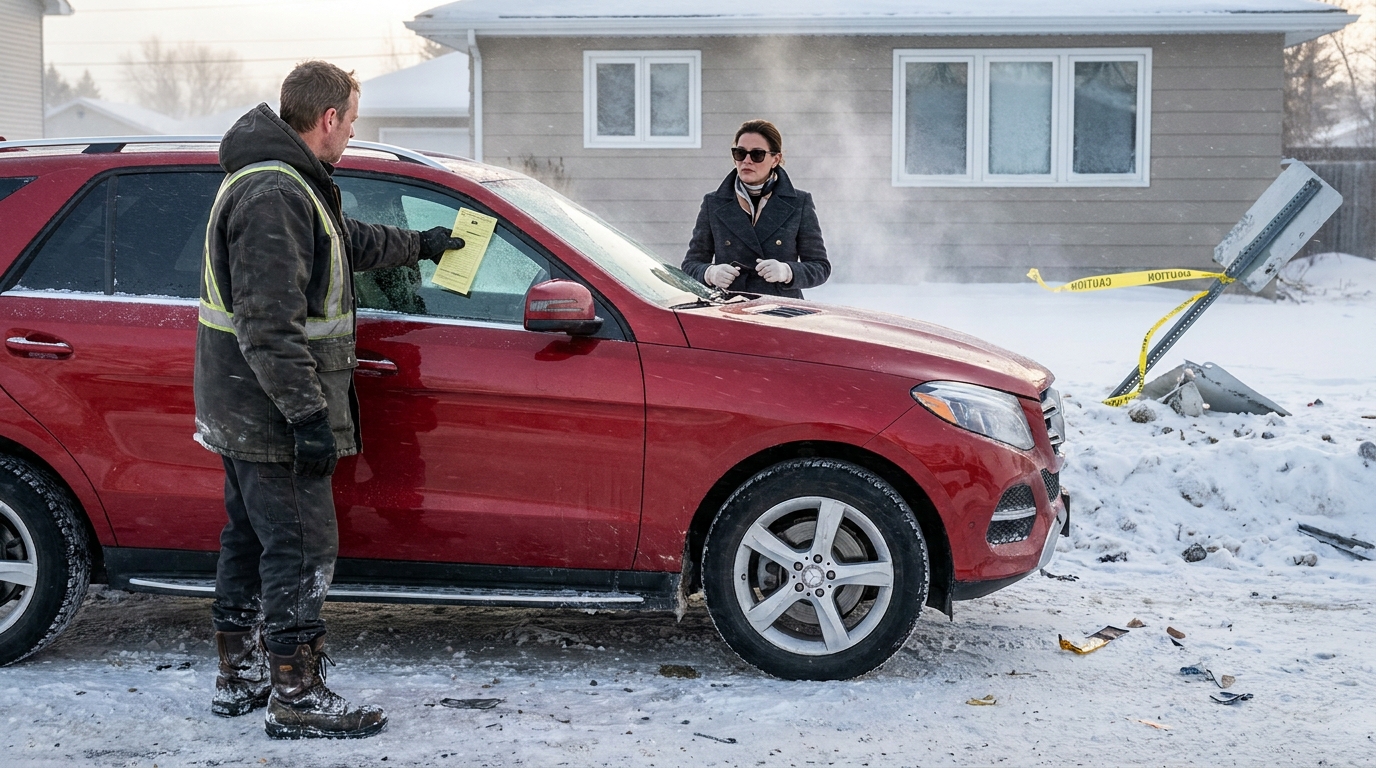
I stepped to the glass. Through the swirl of whiteout, Lena Caldwell stood near the access lane. Her bright red Mercedes GLE sat idling fifty feet back, its exhaust plume thick and white in the freezing air. She wore a tailored wool coat, her leather-gloved hands gripping the thick yellow caution tape the fire department had stretched across the driveway two hours ago.
Snap.
She didn’t unknot it. She didn’t unscrew the plastic mounting brackets. She pulled until the warning tape sheared across the plastic barricade, the sound carrying straight through the insulated glass of my living room.
I opened the front door. The cold hit my lungs like fine glass.
“Lena,” I said. My voice stayed low, flat, pushed out through a heavy fleece collar. “Fire captain posted those. The line under that drift is cracked.”
She didn’t turn around right away. She smoothed the front of her coat, flicking a scrap of yellow tape off her glove before facing me. Her expression was clean, polished, completely devoid of rush.
“Enough with the theatrics,” she said. Her breath barely fogged—she spoke too fast, too tight for deep breaths. “This lane stays open. Emergency operations for the HOA take precedence over unverified resident claims.”
“It’s not a claim.” I tapped the screen of my phone. “Utility shut the main valve at six this morning. The fire department put up the barricades.”
She stepped forward, her boots sinking two inches into the fresh powder. She looked at the phone in my hand, then up at my face. A small, thin smile touched the corners of her mouth—not amusement, just ownership.
“You really expect me to believe there’s a gas leak?” She waved a hand toward the snow-covered lane. “This looks like an excuse to block parking because you don’t like where the plow dumps snow. I’ve seen residents make up plenty of stories to dodge winter regulations.”
“My heat is off, Lena.”
“Then call a private contractor,” she said, her voice dropping into that smooth, practiced pitch she used for board meetings. “The HOA has emergency authority during severe weather. We are not shutting down access for an entire block based on a panic call. If this were real, someone official would be standing here stopping me.”
She turned her back before I could answer. Her gloves caught the edge of the heavy orange warning sign—DANGER: GAS LEAK – NO VEHICLE ACCESS—and jerked it free from the metal stake. Metal scraped against frozen soil with a dull clink.
She tossed the sign into the snowbank.
I didn’t yell. I didn’t reach for the sign. My thumb clicked the side button on my phone, locking the screen as the video file saved to local storage.
“Forty-two degrees,” I murmured to the empty doorway as she walked back toward her idling SUV.
Inside, the silence of the house felt heavier. I walked to the kitchen, grabbed a roll of heavy blue painter’s tape, and began sealing the interior doors to lock the remaining warmth into the smallest bedroom. My fingers were stiff, the tape refusing to stick to the cold wooden trim.
When the phone buzzed again, it wasn’t a weather alert. It was an automated notification from the HOA portal.
Notice of Violation: Unit 104. Unauthorized obstruction of common property. Fine assessed: $250. Payment required within 48 hours.
I stared at the black text on the glowing screen. Outside, the engine of the red Mercedes revved once, high and sharp, as Lena backed it closer to the cleared lane.
CHAPTER 2: THE PAPER ARMOR
The floorboards beneath my boots shuddered as the Mercedes engine revved higher.
The vibration traveled up through the soles of my work boots, rattling the loose roll of blue painter’s tape still in my left hand. I stood frozen over the kitchen island, staring down at the glowing phone screen. $250. Unauthorized obstruction of common property.
My breath bloomed in a small, tight cloud that vanished against the laminate countertop.
The low rumble outside wasn’t just horsepower—it was an anchor dragging across the frozen subsoil. Memory spiked sharp and cold: three winters ago, when the city replaced the main water headers, the contractor warned us about the fragile depth of Conduit-B, the underground PVC chase housing our secondary utility runs. Lena had been on the board then, too. She’d signed off on the backfill without an independent inspector.
I set the roll of tape down. The cardboard core made a hollow thunk on the counter.
My thumb swiped across the screen, closing the HOA portal and opening the voice-memo app. I tapped record, held the mic to my mouth, and spoke with deliberate, unhurried precision.
“07:18 AM. Interior temperature forty-one degrees. HOA board has issued a non-negotiable fine following the utility shut-off. Red Mercedes GLE is currently operating over the restricted zone.”
I locked the screen, slid the phone into my heavy coat pocket, and walked out to the front porch.
The storm had shifted. The wind didn’t howl now; it hissed, driving needle-fine ice horizontally across the asphalt. Lena’s red Mercedes had pulled clear onto the cleared access patch, its rear tires resting less than three feet from where the yellow tape had been torn away. The driver’s side window rolled down two inches. A plume of scented warm air—vanilla and ozone—poured out into the sub-zero gale.
“You’re wasting your time standing out there in the cold,” she called out. Her voice was muffled by the glass, but the sharp, administrative edge cut right through the storm. “The board is convening an emergency executive session online at noon. If you want to appeal the fine, submit a written statement. Otherwise, keep the lane clear for the plow.”
“The fire department isn’t an applicant, Lena,” I said. My gloves were stiff as I shoved them into my pockets. “They issued an order. The utility technician said the ground pressure from a heavy frame—”
“A gas leak notice requires a certified municipal seal on-site,” she interrupted, her words snapping like dry twigs. “A hand-written tag from a junior firefighter doesn’t override community access rights. We have residents who need groceries. We have elderly owners on lower levels who need emergency service access.”
She wasn’t defending the parking spot anymore. She was wrapping herself in the board’s fiduciary mantle, turning a blatant safety violation into an act of civic mercy.
“I emailed the official notice to the entire board five minutes ago,” I replied. “Including the utility incident ticket number.”
Her eyes narrowed slightly behind her dark designer sunglasses. Her left hand remained on the leather-wrapped steering wheel, her knuckles tightening until the black leather stretched white.
“The board email filter screens unverified external attachments during severe weather,” she said softly. “To prevent phishing. I wouldn’t rely on that inbox if I were you.”
A heavy, yellow utility truck rumbled around the corner, its snow tires chaining a rhythmic clack-clack-clack against the packed ice. It slowed down near my driveway, the orange roof beacon casting a hypnotic amber pulse across the snowbanks.
The driver’s side window of the utility truck rolled down. A technician in a dark blue canvas parka looked out, his face lined with cold-fatigue. He glanced at the torn caution tape lying in the snow, then at the red Mercedes parked directly over the snow-covered ground marker.
“Who took down the perimeter?” the technician asked. His voice was raspy from breathing freezing air all morning.
“The HOA president,” I said, stepping toward the truck. “She claims the shut-off notice is unverified.”
The technician didn’t argue. He didn’t raise his voice. He reached over to his passenger seat, pulled out a thick, metal-clip binder, and flipped open a laminated multi-copy form. He scribbled three lines with a heavy-duty permanent marker, ripped off the top yellow carbon copy, and held it out the window.
“Section 12-B of the Public Safety Code,” he said, handing the paper to me. The paper was stiff, freezing fast in the air. “Secondary notice. Non-compliance carries an immediate civil injunction and mandatory reimbursement for all emergency dispatching. Give her that.”
I took the yellow sheet. The ink was still fresh, smelling faintly of solvent.
“And tell her,” the technician added, looking past me straight into the side mirror of the red SUV, “if she turns that key again while parked over a pressurized pocket, she won’t just be paying a fine. She’ll be paying for a crane.”
He rolled his window up and drove off, his tires churning up a fresh cloud of gray slush.
I walked toward the driver’s door of the Mercedes. Lena’s window rolled up another inch, leaving only a tiny crack. I pressed the yellow carbon copy against the cold glass, right at her eye level.
OFFICIAL CITATION: UNLAWFULLY ENTERING RESTRICTED UTILITY ZONE.
Through the glass, I saw her thumb rub a raw, red blister on her inner wrist—an involuntary, frantic motion that completely betrayed the calm smirk on her face. She didn’t take the paper. She didn’t look down at it.
“This is harassment,” she whispered through the crack. “And it’s going on your file.”
She pulled the shift lever into reverse, the transmission clunking hard under the heavy vehicle, and backed the Mercedes another ten feet into the restricted driveway.
CHAPTER 3: THRESHOLD OF FROST
The clunk of the Mercedes transmission vibrated through the glass panel directly into my fingertips.
Lena didn’t look back at me. She kept her eyes fixed straight ahead, her manicured hand resting with rigid discipline on the gear selector as the heavy SUV surged backward another ten feet. The tires crunched down hard into the packed snow, compressing the drift right over the main utility conduit.
I pulled my hand back from the window. The yellow carbon paper in my grip was stiff, its edges curling inward from the biting cold.
“Ten feet,” I whispered into the wind. My breath didn’t float—it dropped, heavy with moisture, freezing instantly into micro-crystals against my coat collar.
She parked the Mercedes square across the access lane, dead center over the buried utility run, and killed the ignition. The engine gave one last, deep metallic sigh before going silent. Through the tinted side glass, I watched her unbuckle her seatbelt with calm, rhythmic motions. She gathered her leather handbag, smoothed her lapels, and pushed the heavy driver’s door open into the snowbank.
“You’re making a record you can’t erase, Lena,” I said, my voice barely carrying over the whistle of the wind through the eaves.
She stepped out, her designer boots sinking four inches into the unplowed drift. She didn’t stumble. She braced her weight against the door frame, turned, and looked at me with a face completely devoid of strain.
“The board’s legal counsel is already reviewing your file,” she said, her tone as dry as bone. “By nightfall, this area will be designated an official HOA staging zone for storm management. If your personal heat line happens to lie beneath a designated community access path, that is an architectural oversight between you and the original developer.”
She slammed the door. The sound was flat, swallowed whole by the falling snow.
She didn’t walk toward her front door. She marched toward the green metal utility junction box sitting at the corner of my lot, her coat trailing behind her like a shroud. I followed three paces back, my boots breaking through the icy crust with heavy, rhythmic thuds.
When she reached the box, she reached into her pocket, pulled out a small set of brass keys, and unlocked the secondary maintenance latch on the side casing.
My chest tightened. “That’s municipal infrastructure. You don’t have a key for that.”
“The HOA owns the casing enclosure,” she replied smoothly, pulling the hinged panel open. “Maintained under Vanguard-Escrow operational funds since 2019. We have full access rights for structural inspections.”
She reached inside. I stepped closer, my phone already up, the lens tracking her gloved hand.
On the inner rim of the green steel box, partly obscured by a layer of road salt and dried grease, a faded white sticker caught the grey daylight. It bore a faded red stamp: Audit-77 — FAILED INSPECTION. Below it, handwritten in black grease pencil, was a date from four years ago and a crossed-out authorization code.
Lena’s glove swept across the box, intentionally brushing snow over the white sticker until the text disappeared beneath a white smear.
“What was that sticker?” I asked, my voice dropping an octave.
“Routine maintenance log,” she said without looking at me. She clicked the panel shut, snapped the brass padlock back into place, and wiped her gloves clean on her coat sleeve. “Everything in this junction is operating within normal parameters. There is no emergency. There is no leak. There is only an uncooperative owner trying to force the community to pay for private line upgrades.”
She turned on her heel and walked toward her unit, her stride deliberate, her heels cutting neat, deep square holes into the pristine white driveway.
I stood alone by the junction box. The cold was a physical weight now, pressing against my temples, numbing the tips of my ears despite my wool cap. I knelt in the snow, my knee joints popping in the sub-zero air, and brushed the fresh powder off the lower edge of the green metal casing.
Beneath the box, where the thick grey conduit entered the frozen earth, a tiny, steady stream of bubbles was pushing up through a pocket of slush.
Hiss.
It wasn’t louder than a whisper. But in the dead quiet of the storm, it sounded like a fuse burning down.
I stood up, my body shaking with a deep, bone-rattling chill that had nothing to do with fear and everything to do with forty minutes in thirty-degree indoor temperatures. I turned back toward my house. The front windows were completely opaque now, covered in a thick, feathered coat of interior frost.
Inside, the kitchen was thirty-eight degrees.
My hand was shaking so hard I could barely punch in the five-digit passcode to unlock my phone. I didn’t open the HOA app. I opened my email draft folder, attached the photo of the Audit-77 sticker, the video of Lena clearing the snow over the junction box, and the signed citation from the utility driver.
I addressed it to the Municipal Code Enforcement Bureau, the County Fire Marshal’s Direct Desk, and every single email address listed in the public HOA directory.
My thumb hovered over the send button. My joint oil felt stiff, my knuckles red and raw. Sending this meant nuclear escalation. It meant fines that could cloud my property title. It meant an open war with a woman who held the legal bank accounts of forty families in her palm.
Outside, the starter on Lena’s Mercedes clicked twice as she activated the remote cabin warmer from inside her living room.
The heavy V8 engine roared to life with a deep, guttural vibration that shook the frost loose from my kitchen window.
I pressed Send.
CHAPTER 4: THE SPARK AND THE SNOW
The digital chime on my phone signaled the email had cleared the outbox, exactly as the kitchen window frame rattled in its track.
The rumble wasn’t just noise—it was a low, heavy pulse that traveled straight through the icy floorboards, into my boots, and up my spine. Outside, Lena’s red Mercedes sat buried to its side-skirts in the snowbank directly over the compromised line, its exhaust pipes spitting thick, grey clouds that flattened against the frozen ground.
My thumb, numb and raw from the thirty-six-degree air inside the house, slipped across the glass as I tried to open the camera app again.
Click-click-click-whir.
The Mercedes’ remote starter cycling through its ignition sequence. Through the frost-etched glass of my front door, I saw Lena step out onto her porch fifty feet away. She held a steaming ceramic travel mug in one gloved hand, her dark coat wrapped tight against her chest. She looked toward my unit, her chin tilted up, watching me stand in the unheated doorway like a statue.
She took a slow, deliberate sip from her mug. She wasn’t getting into the car yet. She was letting the engine run, warming the leather interior while idling over the exact square yard of earth the fire department had cordoned off.
I took three steps out onto the porch. “Lena!” My voice cracked against the freezing air. “Turn it off! The exhaust heat—”
“Go back inside,” she shouted back. Her tone was dismissive, smooth, delivered with the practiced ease of someone addressing a minor disturbance at an annual meeting. “The executive board meeting is in four hours. You can present your grievances then.”
She clicked the remote key fob in her pocket. The engine revved higher, the automatic choke compensating for the sub-zero intake air.
Beneath the rear bumper, where the snow was packed tight over the cracked PVC casing of Conduit-B, a thin, blue haze didn’t drift away with the wind. It trapped itself under the chassis, hugging the wheel wells, curling into the hollow frame of the SUV.
I didn’t argue. I didn’t take another step forward.
My phone screen was already recording. My hands were shaking violently—not from fear, but from the brutal, lingering chill settling into my muscle tissue. I kept the lens locked on the rear tire, where the rubber pressed directly against the snow-covered utility mark.
Lena lowered her mug. For a fraction of a second, her expression shifted. Her left eyebrow twitched downward as she noticed the thick, shimmering heat distortion rising not from the tailpipe, but from the snowbank beneath her driver’s side door.
She made a fast, sharp movement—stepping off her porch, her boots crunching hard into the snow as she marched toward the driver’s door. “What did you do to the line?” she demanded, her voice losing its polished composure, dropping into a sharp, defensive snap. “If you loosened that valve—”
“Don’t open the door!” I shouted, backing away toward my doorframe. “Lena, stay back!”
She reached for the handle. Her gloved fingers wrapped around the chrome pull.
She didn’t just unlock it; she yanked the heavy door open. A rush of fresh oxygen pulled beneath the chassis, mixing instantly with the trapped, pressurized pocket beneath the floorpan.
Inside the engine bay, the secondary starter relay clicked a second time.
The world didn’t scream—it compressed.
The air between my porch and her vehicle didn’t move forward; it punched outward. A concussive, heavy wall of pressure slammed into my chest, knocking my shoulders back against my front doorframe with a dull, heavy thud. The phone nearly twisted out of my stiff grip as a flash of violent orange tore through the whiteout.
BOOM.
It wasn’t a fireball from a movie. It was a brutal, contained rupture—a violent pulse of expanding gas that tore through the fiberglass underbody of the Mercedes.
The rear axle lifted three inches off the ground before slamming back down into the ice. Glazing shattered outward from the driver’s side window, spraying tiny, frosted cubes of tempered glass across the snowbank like hail. A cloud of black, chemical smoke erupted from under the hood, instantly turning the pristine white drifts into filthy, grey ash.
Heat—searing, dry, immediate heat—rolled across my face, melting the frost on my eyebrows in a single second.
Lena was on her back in the snow five feet from the vehicle.
Her travel mug had shattered against the pavement, hot coffee steaming against the ice near her outstretched arm. She wasn’t bleeding, but her coat was covered in black soot, her designer sunglasses lying crushed six inches from her ear. She was staring up at the grey sky, her mouth open, her chest heaving in rapid, shallow gasps.
The Mercedes didn’t burn with towering flames. It hissed. Thick, acrid black smoke poured from the ruptured floorpans as the undercoating melted against the hot exhaust manifold. Car alarms across the entire court began wailing in discord—three, four, five horns blaring through the storm.
I didn’t hesitate. I didn’t run to her car.
I stepped down from my porch, my phone still held high, the lens locked on the smoking wreck, the shattered glass, and the clear, undeniable space where the warning barricades had been torn away. My boots crunched through the warm ash falling like dirty rain onto the snow.
“Lena,” I said, standing ten feet away, my voice flat, grounded, and cold. “Don’t move. Fire department is already on the way.”
She pushed herself up on one elbow, her gloves covered in black grease and melted slush. She looked at the ruined, smoking shell of her seventy-thousand-dollar vehicle, then up at me, her eyes wide, unblinking, and stripped completely of authority.
“You…” she choked out, her breath ragged, trembling. “You… set me up…”
“Physics set you up,” I replied, holding the recording phone steady as the distant, screaming pitch of approaching sirens began to cut through the blizzard.
CHAPTER 5: PAPER TRAPS
The sirens didn’t fade—they crested over the snowbank with a high-pitched, metallic whine that vibrated through the frame of my front porch.
Lena remained on her elbow in the slush, her fingers clawing uselessly at the snow for leverage. Her soot-stained coat dragged behind her like a dead weight as she tried to pull herself backward, away from the ruined, smoking undercarriage of her Mercedes.
“You’re on video, Lena,” I said, my phone screen glowing bright against the grey storm light. “The camera recorded every second from the moment you unlocked the driver’s door.”
Two fire engines roared into the court, their giant studded tires chewing through the icy drifts before coming to a heavy stop ten yards away. Emergency strobe lights washed the scene in erratic pulses of red and blue. Four firefighters stepped down before the vehicles had fully settled, heavy rubber boots slamming onto the packed road.
A fire captain with a frost-dusted visor marched straight past the smoldering SUV, his eyes sweeping the scene with practiced speed.
“Stand back!” he barked, waving a gloved hand at the small cluster of neighbors who had begun peeking out from behind their curtains. “Driver! Are you injured?”
Lena pushed herself up to her knees, her voice high and erratic as she pointed a trembling, soot-darkened glove straight at my chest. “He tampered with the shut-off! I came out to inspect a reported obstruction, and he triggered an ignition!”
The captain didn’t even look at me first. He knelt by the melted fiberglass floorpan of the vehicle, sniffed the air once, and looked back at her. “Ma’am, this is an active gas pocket explosion. The entire lane was marked off six hours ago.”
“I am the HOA president!” Lena shouted, her composure cracking completely into a harsh, shrill rasp. “The board holds emergency easement authority under Vanguard-Escrow contracts! We authorized vehicle clearing!”
“Your HOA contracts don’t override municipal utility isolation,” a voice called out from behind the second engine.
The utility supervisor stepped into the red strobe light. In his hand was a heavy black digital tablet displaying a series of red-flagged line schematics. Beside him walked a city police officer, notebook already drawn, his pen clicking open with a sharp, cold snap.
I walked down my front steps, my boots leaving deep, steady tracks in the snow. I tapped my phone screen twice, bringing up the master file package I had compiled over the last three hours, and held it out toward the officer.
“Everything is timestamped,” I said quietly. “The original shut-off notice at six this morning. The video of her tearing down the tape. The citation copy handed to her by your field technician at seven-fifteen. And the municipal junction box she unlocked thirty minutes ago.”
The police officer took the phone. His eyes moved rapidly across the screen, his thumb scrolling through the high-resolution photos and video clips.
“She unlocked the casing?” the officer asked, looking up at Lena.
“The board maintains access for structural audits,” Lena interjected rapidly, her hands fluttering against her coat pockets as she searched for her phone. “We have a municipal variance! Check the filing under Audit-77! It grants Vanguard-Escrow secondary clearance!”
The utility supervisor gave a short, bitter laugh. He tapped his tablet screen and turned it toward the police officer.
“Audit-77 wasn’t a variance,” the supervisor said, his voice dropping into a cold, flat register that cut right through the idling diesel engines. “It was a failed structural audit from four years ago. The city flagged Conduit-B because someone performed an illegal, unpermitted bypass to dodge commercial utility rates for the HOA clubhouse. That junction was condemned.”
The silence that followed was absolute. Even the blizzard seemed to drop its volume, the wind subsiding into a quiet, icy hiss against the scorched metal of the Mercedes.
Lena’s face went completely grey. The sharp, arrogant edge in her eyes vanished, replaced by a wide, unblinking terror. Her hands stopped fluttering.
“That… that was the previous board’s contractor,” she whispered, her voice barely audible over the hum of the fire pumpers. “We were… we were amortizing the repair costs through the escrow account…”
“You were using Vanguard-Escrow to collect repair fees from residents while leaving a high-pressure line compromised under an active access path,” the officer said, stepping closer to her with his handcuffs hanging from his belt loop. “You cleared safety barricades to conceal a failed audit during a severe weather emergency.”
“I was protecting community property values!” she screamed, her voice breaking as the officer reached for her arm. “If the city red-tagged the lane, property values would drop thirty percent!”
“You put a seventy-thousand-dollar SUV over a leaking line to hide a paper trail,” I said, stepping between the fire captain and the edge of my lot. “My house has been thirty degrees for six hours because you didn’t want the owners to see the audit.”
The officer turned her around. The sharp, metallic click of the cuffs locking around her wrists carried across the frozen lot like a breaking branch.
Lena didn’t fight back physically, but her eyes locked onto mine as she was led toward the rear door of the cruiser. “You ruined this community,” she hissed, her teeth chattering uncontrollably from the shock and the cold. “You ruined everything.”
“The truth just caught up to the paper you signed, Lena,” I replied flatly.
She was ushered into the back of the police car, the heavy door slamming shut behind her with a final, heavy seal.
The fire captain turned to his crew, issuing quick, sharp commands to deploy a secondary foam line over the hot undercarriage of the Mercedes. The utility supervisor walked up to my porch, holding a steel clipboard and a fresh, heavy-duty brass lock.
“We’re setting a permanent steel cage over the junction box,” the supervisor said, his breath fogging as he spoke. “Work crew is already on their way with a heated repair tent. Your main line will be replaced and pressure-tested before nightfall.”
I looked at the yellow carbon copy of the citation still sticking out of my coat pocket, then down at my hands. My knuckles were red, the skin dry and cracked from the weather, but the deep, bone-rattling shake in my frame had finally stopped.
“Thank you,” I said.
I turned and walked back into my house, closing the front door firmly against the storm.
CHAPTER 6: WARMTH RESTORED
The heavy oak front door clicked shut against its frame, sealing out the raw bite of the wind.
Inside, the living room felt suspended in a strange, thick stillness. The air was cold—thirty-six degrees—and every breath still produced a faint grey vapor. But the deafening roar of the diesel pumpers, the flashing red strobes, and the shrill panic of Lena’s voice had vanished behind three inches of insulated wood.
I stood in the entryway for a long minute, my boots dripping grey slush onto the doormat.
Through the frosted side pane, I watched the yellow flashing lights of the municipal repair van pull into the clearing. Two workers in orange high-visibility coveralls stepped out into the blizzard, unloading heavy steel frames, a diesel heater duct, and a pressurized arc-welding kit. They worked without rush, their movements methodical and calm as they erected a heated nylon dome over the exposed ground where Conduit-B lay.
My phone chimed in my coat pocket. A single notification illuminated the glass.
It was an automated administrative bulletin from the city code enforcement division, broadcast to all owners in the parcel block. The non-negotiable fines levied against Unit 104 had been officially expunged. Attached was a formal municipal directive overriding the HOA board’s authority, placing the property under emergency utility conservatorship, and freezing the association’s operational accounts at Vanguard-Escrow pending a forensic audit of the Audit-77 filings.
I tucked the phone into my pocket. My thumb was raw, the skin split near the nail from hours of handling freezing metal and glass, but the dull ache felt distant now.
I walked through the dark, cold hallway into the kitchen.
On the countertop, the blue roll of painter’s tape sat exactly where I had left it three hours ago beside the cold sink. I picked up the roll, tossed it into the drawer under the counter, and grabbed a small adjustable wrench from my tool bag.
Down in the basement, the air smelled of damp concrete and old dust. The iron water main, which I had shut down to prevent the pipes from bursting as the temperature plummeted, sat rigid and dark in the corner. I knelt on the cold cement floor, my knees aching slightly against the stone, and fitted the wrench over the valve stem.
I turned it slowly.
The brass valve groaned once, then opened with a clean, smooth hiss. Water rushed through the copper lines above my head, filling the empty pipes with a steady, rhythmic thrum. No leaks. No fractures. The copper had held.
When I climbed the stairs back into the living room, a soft, low hum was already vibrating through the floorboards.
I stepped over to the baseboard vent near the front window. A faint, rising current of air touched the palm of my hand—not hot yet, but no longer freezing. It carried the dry, sharp scent of heating coils warming up for the first time in ten hours.
Outside, the storm continued to fall. The heavy nylon dome over the utility junction glowed with a warm, amber interior light as the technicians finished securing the heavy steel cage over the main line. Beyond them, the parking lot sat empty and orderly. The scorched patches of snow where the red Mercedes had idling were already being covered by a fresh, clean layer of white.
I pulled a wooden chair over to the window, sat down, and rested my arms on the smooth, cool wood.
The furnace fired up with a deep, reassuring pulse beneath the floor. Warmth moved through the house in steady, invisible waves, pushing the lingering chill from the corners, thawing the frost along the windowpanes until the feathers of ice dissolved into clear, bright beads of water sliding down the glass.
I leaned my head back against the chair. There was no victory speech, no celebration, only the quiet, unbreakable weight of a boundary that had finally held.