The Weight of Stone and Water: How One Retired Veteran Out-Engineered a Neighborhood Tyrant’s Impending Flood
CHAPTER 1: THE LINE IN THE MUD
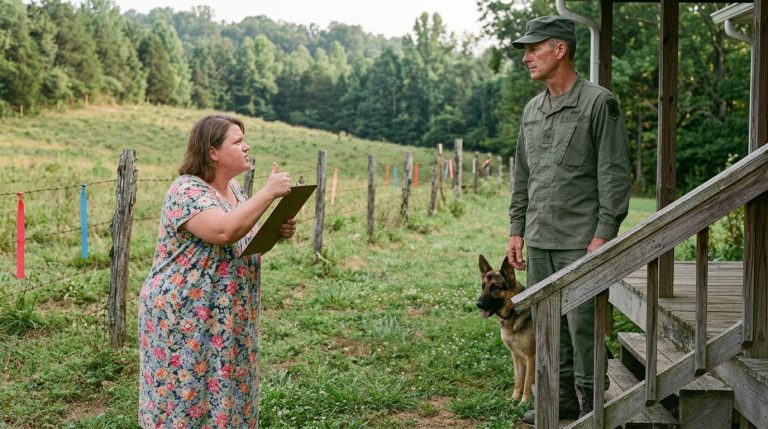
The blue floral-print muu-muu strained against the humid morning heat, a violent splash of color against the rusted iron and dry earth of my ridge.
Karen stood four inches deep on my side of the ancient stone property line, her clipboard clutched like a shield and a scepter. Her blonde hair had been lacquered into a shell that defied the breeze rolling down from the hills, perfectly rigid, perfectly insulated from the reality of the soil beneath her heels.
“Mr. Miller,” she said, her voice dropping into that practiced, patronizing cadence reserved for recalcitrant children and code violators. “As per the vote last night, the association is taking eminent domain over this section of your property for the good of the community. We’ll have engineers here next week to begin the drainage process for the new driving range.”
I stood on the crown of the earth-and-stone dam my grandfather had built with his own two hands sixty years ago. My boots were caked in the gray-brown silt of the seasonal creek, heavy and real. Below us, Miller’s Pond stretched out, dark and still, cradling the reflection of the morning sky like a secret it had no intention of sharing.
The audacity of her claim didn’t make me shout. It settled into my bones with the dull, metallic weight of a rusted anchor.
For twenty years in the infantry, I learned that the most dangerous enemy isn’t the one screaming threats across a trench; it’s the one who genuinely believes their own logistics will save them from physics. Karen had a clipboard, a three-ring binder of bylaws, and a board of sycophants who nodded at every syllable. She saw a muddy, mosquito-infested retention pond that dragged down the property values of her cookie-cutter stucco kingdom.
She couldn’t see the core. She couldn’t see the packed clay core my grandfather tamped down by hand in 1952, or the wide, deep spillway designed to catch the northern runoff before it could turn the lower valley into a swamp.
“Eminent domain, Karen?” I kept my voice flat, stripped of friction. “You’re an homeowners association. Not a municipality. The county plat map is six feet behind you in my kitchen desk, and it hasn’t moved since the Eisenhower administration.”
Her smile didn’t break; it only tightened, stretching the skin across her jaw until it looked porcelain-white. “Times change, Jack. The community needs space to grow. We all have to do our part for property values.”
She turned on her heel, her clipboard tucked firmly under her arm, confident that a printed declaration was enough to rewrite geography. She walked back toward the manicured lawns of Lakeside Meadows, leaving me alone on the dam with the cicadas and the hum of the morning heat.
I looked down at the dark water, then out toward the beige rooftops gleaming in the sun below. I didn’t reach for my phone to argue. I reached down, scraped a dry pinch of dirt from the crest of the dam between my fingers, and felt the iron-rich grit crumble against my palm. She thought she was starting a paperwork battle. She had no idea she had just handed me the coordinates to her own funeral.
CHAPTER 2: THE WEIGHT OF THE PAST AND THE FIRST PAPER TRAIL
The screen door of the farmhouse didn’t slam; it groaned on its brass hinges, a long, dry complaint that settled into the quiet afternoon. I let it close behind me, the latch clicking home with the finality of a bolt sliding into place.
On the kitchen table, the official notice sat where I had tossed it an hour ago. It wasn’t folded neatly. Karen’s certified mail envelope had been ripped open with a thumb, its crisp, cream-colored paper catching the slanted amber light of the midday sun. The logo—a stylized swan floating on a chemical-blue pond—smiled up at me with corporate sterility.
Article 9, Section 4. The words danced across the page in a clean, sans-serif font designed to intimidate anyone who didn’t know the difference between a municipal ordinance and a private delusion. They claimed structural unsoundness. They claimed a hazard. They claimed a unanimous board vote to absorb the offending parcel for community improvement, complete with daily fines of five hundred dollars if access was denied.
I pulled out my grandfather’s original deed from 1948. The paper was heavy, thick rag stock yellowed at the edges like old bone, inscribed in a flowing, iron-gall ink that had eaten slightly into the fibers over the decades. Metes and bounds. Iron pins driven into bedrock. Oak trees that had rotted and fallen away half a century ago, replaced by their progeny, but whose legal ghosts still marked the corners of my ten acres.
In the army, when a supply line was cut or an FOB was boxed in by hostile terrain, you didn’t panic and shout at the horizon. You broke down the logistics. You looked at the supply manifests, checked the weight limits of the bridges, and traced the map back to the primary source. Karen was treating my property like a tactical nuisance, a patch of weeds blocking the view from her kitchen window. She thought a three-ring binder gave her the high ground.
My boots left gray prints of dried silt across the linoleum as I walked over to the landline. I didn’t call a lawyer yet. Lawyers were artillery—you only bring them up when you have the exact coordinates dialed in. Right now, I needed the terrain data.
I dialed the county records office, listening to the hollow, rhythmic click of the analog line before a bored clerk answered. It took forty minutes of waiting, listening to a canned loop of synthesized jazz, and feeding credit card numbers for digital document retrieval before the files began pinging into my battered laptop.
The first file was the master plan from 1997, back when Lakeside Meadows was nothing more than a developer’s pipe dream of asphalt and stucco. I scrolled past the marketing brochures—pictures of smiling families playing tennis next to artificially green turf—and dug straight into the engineering appendices.
There it was, buried on page 114 of the environmental impact report: Appendix C – Watershed Runoff and Hydrological Mitigation.
The original developers weren’t fools. They had hired competent hydrologists who understood what happens when you pave over a hundred acres of rolling hills and oak groves. When you replace absorbent soil and root systems with roofs, driveways, and parking lots, rainwater doesn’t soak in anymore; it accelerates. It turns into a grey, rushing sheet of kinetic energy looking for the path of least resistance.
According to their own documents, the natural drainage sloped southward, straight down toward the low-lying basin where Tulip Court and Primrose Lane now sat in immaculate, beige rows. The developers hadn’t built a massive retention basin of their own. Instead, they had calculated the cost of earthworks and quietly designated my grandfather’s pre-existing earthen dam and pond as their primary storm-water retention buffer.
They had baked my family’s private infrastructure into their zoning approval. For thirty years, the subdivision had grown fat and secure in the shadow of a dam they didn’t maintain, didn’t own, and legally pretended didn’t exist except when it conveniently kept their basements dry during spring thaw.
A sharp, intrusive memory flickered behind my eyes—a briefing tent in the Korengal Valley, staring at a topographical map where a friendly village sat directly in the flood path of a narrow gorge, relying entirely on an aging retaining wall to hold back the spring melt. We had reinforced that wall with sandbags and prayer because we knew what happened when the masonry failed under pressure.
Karen wanted to tear down the wall to build a driving range. She wanted to bulldoze the core of packed clay to give her neighbors a place to practice their short game, completely blind to the fact that she was standing on the cork of a bottle holding back an ocean.
I saved the PDF to a secure folder, renamed it with a stark, military precision, and closed the laptop. The screen flickered black, reflecting my own tired face in the glass. The first line of defense was mapped out, but paper and ink weren’t enough to stop a woman who lived inside a laminated bubble. I needed a modern simulation. I needed hard, undeniable physics.
I picked up the phone again, dialed a number I hadn’t used in two years, and waited for the line to connect on the other end.
“Sapper,” I said when a gruff, familiar voice answered. “I need you to look at some water.”
There was a brief pause on the line, the sound of heavy machinery rumbling in the background before Sapper let out a low, gravelly chuckle. “Jack. You always find the most interesting ways to spend a Tuesday. Send me the coordinates. Let’s see what the water wants to do.”
CHAPTER 3: ENLISTING THE ENGINEER AND THE RUNOFF SIMULATION
The receiver settled back onto its cradle with a dry, mechanical thud that clipped the tail end of the dial tone. I didn’t move my hand away immediately. I kept my fingers wrapped around the cream-colored plastic, feeling the faint residual warmth of the electronics while the dust motes danced in the shaft of amber light cutting across the floorboards.
Two days later, the secure file arrived in my inbox.
It wasn’t a standard document. When I clicked the attachment, my battered laptop screen filled with a heavy, multi-layered digital workspace rendered in desaturated blues and charcoal grays. Sapper hadn’t just crunched numbers; he had built a complete, high-resolution topographical model of the entire valley, stitching together old county survey data, modern LiDAR elevation scans, and localized rainfall absorption rates.
I sat at the wooden kitchen table, my eyes tracking the contour lines that mapped out the slope of the northern hills. My ten acres sat at the throat of a natural funnel, and the earth-and-stone dam my grandfather built was the narrowest, strongest point of resistance.
The simulation ran in real-time cycles. First came the baseline test—a standard 100-year storm event mapped against the valley’s current configuration. On screen, simulated sheets of blue rain swept down from the ridges. The water pooled behind the dam, the wide stone spillway engaged with mathematical precision, and the runoff channeled cleanly into the concrete culverts feeding the Lakeside Meadows stormwater network. The houses on Primrose Lane and Tulip Court stayed bone-dry, their manicured lawns barely glistening under the virtual downpour.
Then Sapper’s script toggled to the secondary scenario.
Scenario B: Structural Removal.
On the screen, the dam graphic dissolved into a dotted gray outline, replaced by a flat, graded expanse representing Karen’s proposed driving range. The rain simulation started again. The water hit the upper slopes, but this time, without the clay-core barrier to hold back the initial kinetic surge, there was nothing to break the fall.
A jagged wall of blue water, mixed with virtual debris and loosened topsoil, tore down the ravine with terrifying velocity. It hit the undersized culverts beneath the main subdivision road within four minutes, choking the concrete pipes instantly. The water backed up with nowhere to go, spilling over curbs and turning the symmetrical streets of Lakeside Meadows into rushing canals.
The software color-coded the depth in grim shades of yellow and deep crimson. Within sixty minutes of the simulated storm’s peak, forty-seven houses—the sprawling, expensive corner lots with the carefully marketed water views—were submerged from two feet in the lower garages up to catastrophic first-floor inundation.
A text block flashed at the bottom of the screen, written in Sapper’s blunt, unvarnished engineering shorthand: Catastrophic hydraulic failure. Downstream property damage estimated at 32.4 million dollars. Removal of the retention structure without a multi-million-dollar engineered diversion constitutes gross criminal negligence.
I leaned back, the wooden chair legs groaning against the floorboards. The screen cast a cold, pale light across my face. Karen wanted to pave over my history to give her neighbors a place to practice their short game, completely blind to the fact that she was holding a match inches from a powder keg of her own making. She thought she was running a tight ship with her laminated notices and floral moo-muus, but her entire administrative authority rested on a foundation of sheer, willful ignorance.
The data was there, clean and undeniable. But numbers on a laptop screen wouldn’t stop an HOA president who lived behind a wall of self-importance. To make her see the wall she was about to crash into, I had to take that data out of the digital ether and plant it firmly in the real world.
I reached for my jacket draped over the back of the chair, the heavy canvas smelling faintly of machine oil and dry earth. The sun was dipping lower behind the western treeline, casting long, bruised shadows across the ridge. It was time to stop looking at maps and start walking the perimeter, because the first cracks in Karen’s kingdom weren’t going to start in a courtroom—they were going to start at a neighbor’s mailbox.
CHAPTER 4: WALKING THE PERIMETER: PLANTING THE SEEDS OF RESISTANCE
The sun had sunk below the crest of the western hills, leaving behind a bruised smear of orange and slate-gray across the sky. The gravel of the access road crunched sharply beneath my boots, each step measured and heavy. I didn’t head toward the gate that led to the paved, uniform streets of Lakeside Meadows; instead, I walked the perimeter fence line where my ten acres met their manicured boundary.
The contrast was absolute. On my side, the land smelled of dry pine needles, iron-rich mud, and wild scrub oak. On their side, the earth was tamed, choked by chemical fertilizers and trimmed with surgical precision. Between the two worlds ran the ancient stone wall my great-grandfather had laid with fieldstone hauled up from the creek bed.
In the army, you never secured a perimeter by waiting inside the wire. You went out, found the seams where the local population interacted with the opposing force, and laid down lines of communication before the shooting started. Karen thought she commanded a loyal garrison of homeowners who would march wherever her clipboard pointed. But tyranny relies on silence, and silence breaks the moment people realize they’re standing in the path of the flood.
I rounded the bend near Tulip Court, where the manicured lawns bled into the common easement. A man was out by his pristine, white-painted mailbox, bent double as he wrestled a stubborn garden hose into a green plastic reel. His movements were stiff, mechanical, the careful posture of someone who spent forty years at a desk and was now trying to buy his way into a quiet retirement.
I slowed my pace, letting my boots grind purposefully against the asphalt edge of their street.
The man straightened up, wiping a forearm across his forehead, and caught sight of me standing near the stone wall. His hands froze on the plastic reel. I recognized him from the county plat maps and the neighborhood directories I’d skimmed during my research: George, a retired history teacher whose house sat squarely on the blue-shaded flood zone of Sapper’s simulation.
For three seconds, neither of us spoke. The tension between us was an invisible wire stretched tight across the property line. I could see the memory of Karen’s propaganda flickering in his eyes—the warnings about the grumpy, uncooperative veteran hoarding a blighted nuisance.
“Evening,” I said, keeping my voice level, stripped of any edge.
George hesitated, his fingers twitching against the green plastic of the hose reel. He looked left, then right, as if checking to see if the neighborhood surveillance queen was watching from a bay window. When he saw the street was empty, a cautious, guarded curiosity replaced the apprehension on his face.
“Evening, Mr. Miller,” he replied, his voice dry. “Working late on the property?”
“Just checking the drainage line,” I said, walking slowly toward the low stone wall and resting one hand on the cool, gray granite. “The seasonal creek from the north has been acting up with the recent humidity. My grandfather built the stone spillway down there to handle the surge before it reaches the lower elevations.”
George straightened fully, letting go of the hose. The mention of drainage wasn’t accidental; it was the frequency he needed to catch. He walked a few paces closer, stopping two feet short of the property line as if an invisible boundary marker still held force.
“Karen’s been sending out flyers,” George said, lowering his voice into a gravelly half-whisper. “Says the association is moving forward with the seizure next month. She claims your pond is an unmaintained hazard dragging down property values across the entire subdivision.”
I didn’t smile, and I didn’t reach for the paperwork in my jacket pocket. I let the silence stretch for a beat, letting the weight of his words settle into the damp evening air.
“Hazard,” I repeated softly. “That’s an interesting word for a structure that has kept this valley from turning into a swamp since the late fifties.”
George frowned, his brow furrowing as he leaned slightly over the grass. “What do you mean?”
“Ask yourself a simple question, George,” I said, keeping my gaze steady on his. “When the developers cut down the oak groves and paved over a hundred acres of absorbent soil back in ninety-seven, where did they calculate all that extra rainwater was going to go? They didn’t build a massive retention basin down here on the flatlands. They didn’t have the space.”
George’s eyes drifted away from mine for a fraction of a second, tracking down the gentle downward slope of Tulip Court toward the center of the development. His mind, trained by decades of reading primary sources and cross-referencing archives, began to connect the invisible dots.
“They used your property,” he murmured, more to himself than to me. “They tied our stormwater management into your grandfather’s dam.”
“They didn’t just tie it in,” I said quietly. “They depended on it. If you pull the cork out of a bottle, you don’t control where the wine goes. You just clean up the mess.”
I didn’t hand him a document. I didn’t overwhelm him with Sapper’s thirty-page hydrological report or show him the terrifying crimson hues of the flood simulation. In intelligence work, you don’t dump the whole intelligence dossier on a potential asset all at once; you plant the seed of doubt and let their own curiosity do the heavy lifting.
George stared at the ground for a long, silent moment, the wind rustling the manicured hedges around his immaculate yard. When he looked back up, the corporate compliance in his expression had vanished, replaced by a cold, sober realization.
“She didn’t check the original master plan, did she?” George asked, his voice hardening.
“Karen doesn’t read history, George,” I said, pushing away from the stone wall and turning back toward the dim shadow of my ridge. “She only reads bylaws. And right now, she’s marching her board straight into a crossfire they don’t even know exists.”
I didn’t wait for him to answer. I turned on my heel and walked back into the gathering dusk, listening to the rhythmic crunch of gravel beneath my boots. The seed was planted in fertile ground. All I had to do now was give it room to grow.
CHAPTER 5: THE COUNTY ARCHIVES AND THE FINALIZED METRIC
The heavy steel door of the county records room clicked shut behind me, sealing out the hum of the parking lot and trapping the dense, stagnant scent of aging wood pulp and decades-old printer toner.
The basement was quiet, save for the low, rhythmic whir of a single microfilm reader humming away in the far corner like a mechanical heartbeat. I didn’t head for the front desk or wait for a clerk to offer assistance. In operations, you don’t ask permission to check intelligence you already know exists; you simply verify the coordinates.
My boots clicked sharply against the scuffed linoleum floor as I walked past rows of steel filing cabinets until I reached aisle four, section twelve—the municipal repository for the 1997 Lakeside Meadows development permits.
The box I needed was heavy, cardboard reinforced with metal grommets that had begun to bloom with a thin layer of orange rust. I hauled it down onto a scarred wooden table, the dry cardboard scraping against the surface with a rasping sound. Inside lay a dense, unorganized brick of municipal documents, zoning approvals, and engineering submittals.
Karen had spent two years weaponizing three-ring binders and laminated notices, operating under the assumption that an HOA board’s internal bylaws possessed the weight of statutory law. But law isn’t dictated by what an association votes on in a clubhouse; it is anchored in the physical registry of deeds, zoning maps, and stormwater management covenants filed under oath with the county.
I sat down on the hard wooden chair, pulling the first oversized blue-line blueprint toward me. The paper was stiff, creased along ancient fold lines that cracked softly under my fingers.
The blueprint mapped out the initial civil engineering projection for Lakeside Meadows before a single square foot of asphalt was poured. My eyes tracked the topographical lines north toward my ridge. There, marked in faded red ink by a surveyor’s hand, was the definitive proof: Primary Detention Outflow Control Structure – Miller’s Dam.
It wasn’t a suggestion. It was a mandatory engineering dependency. The developers had saved millions in grading and retention construction costs by tying their entire subdivision’s subterranean drainage network directly into my grandfather’s earthen barrier. If the dam were ever breached or removed without a complex, multi-million-dollar engineered alternative, the lower basin of Lakeside Meadows would transform into a natural sinkhole for the northern runoff.
I pulled out a small black pen and a legal pad, noting the specific permit numbers, the names of the original contracting firms, and the water management district sign-offs. Each data point was a bolt of heavy iron, threaded together into a legal trap that Karen’s administrative bluster couldn’t punch through.
A shadow fell across the table. I looked up to see an elderly clerk peering over wire-rimmed glasses, holding a ceramic mug of weak coffee that smelled of chicory and stale heat.
“Find what you’re looking for, Mr. Miller?” the clerk asked, his voice raspy from years of breathing basement air.
“Just checking the plumbing, Frank,” I said, offering a faint, measured nod. “Some people down the hill seem to have forgotten where the water goes when it rains.”
Frank chuckled, a dry, rattling sound, and tapped a yellowed finger against the edge of the blueprint. “Water always remembers, Jack. People forget. Water never does.”
He shuffled back toward his desk, leaving me alone with the rustling paper and the hum of the fluorescent lights. I spent another hour photocopying the critical pages, the rhythmic slap and flash of the copier throwing stark white light across my face. By the time I stacked the documents into my canvas bag and zipped it shut, the paperwork felt heavy—not with the weight of ink, but with the inevitable momentum of physics.
Karen was preparing to rally her board for a public takeover, convinced that a printed notice and a show of corporate authority could rewrite the geography of the valley. She was marching straight toward an ambush, blind to the fact that the very structure she wanted to pave over was the only thing keeping her neighbors’ basements dry.
I tucked the bag under my arm, stepped back out through the heavy steel door, and headed out into the night. The trap was fully documented. All that remained was to let her trigger it.
CHAPTER 6: THE TOWN HALL AMBUSH AND THE MAP THAT SPOKE
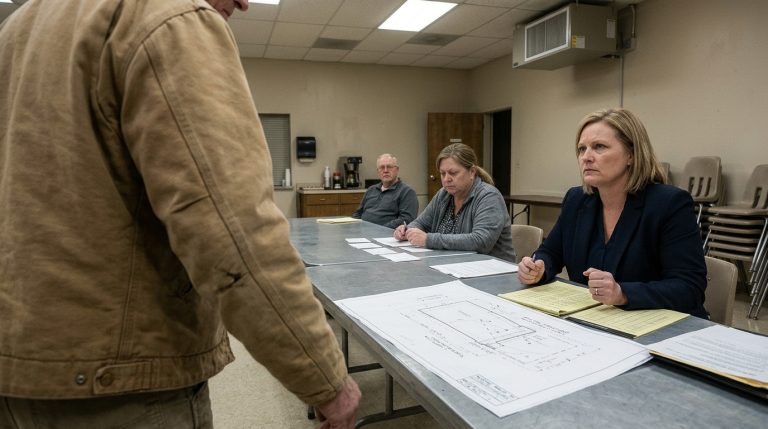
The air inside the Lakeside Meadows clubhouse smelled of synthetic lemon cleaner and stale anxiety. A cavernous, soulless room built with beige cinderblock walls and rows of folding chairs, it was packed to capacity with anxious homeowners murmuring among themselves.
At the front of the room sat Karen and her four-person board behind a long folding table draped in a cheap blue vinyl cloth. Karen wore a vibrant pink pantsuit that cut a sharp, flamingo-bright silhouette against the dreary backdrop. Her hair was lacquered into its familiar, unyielding helmet, and she tapped a small wooden gavel against the table with a crisp, performative rhythm.
“Welcome, everyone,” Karen announced, her voice pitched high and bright, dripping with artificial cheer. “I’m delighted to see such a wonderful turnout in support of our new community enhancement project.”
I stood near the back, my boots planted firmly on the commercial tile. In my left hand, I carried a heavy foam-core board wrapped in brown paper. Beside me, George and Ellaner sat in the third row, giving me a short, steady nod of acknowledgment. They had spent the last forty-eight hours circulating copies of my notes among the neighborhood mailboxes, turning isolated whispers into a quiet, unified front.
Karen launched into her presentation with a slide projector humming overhead, casting a washed-out image of an idealized putting green onto a pull-down screen. She spoke of property values, aesthetic harmony, and the urgent necessity of removing an unmaintained, hazardous mud puddle that dragged down the prestige of the neighborhood. She breezed through the acquisition process as if it were a routine administrative housekeeping measure, deliberately omitting any mention of legal notices, state statutes, or property bounds.
When she opened the floor for questions, she expected softballs from her hand-picked supporters.
Instead, George stood up immediately.
“Karen,” George said, his voice carrying clearly across the silent room. “I have a copy of the original 1997 development master plan. It designates Miller’s Pond as the primary stormwater retention basin for this entire subdivision. Were you aware of that when the board voted to drain it?”
Karen’s smile froze, the corners of her mouth twitching as her painted-on confidence cracked for a fraction of a second. “That’s an outdated document, George. Our engineers have assured us—”
“What engineers?” Ellaner called out from the third row, her tone sharp as broken glass. “Can we see their certified report?”
A collective murmur rippled through the rows of folding chairs. The tension spiked, thick and combustible. Karen’s face flushed a deep, mottled red, her cheerful veneer instantly stripping away to reveal a cornered bureaucrat.
“This is all a scare tactic!” Karen shouted, pointing a trembling finger straight toward the back of the room where I stood. “Orchestrated by him! He prefers living next to a swamp and wants to drag our property values down with him!”
The spotlight swung to me. Every head in the room whipped around, eyes locking onto my canvas jacket and worn boots.
This was the exact moment the tactical engagement shifted. I didn’t shout back, and I didn’t raise my voice. In tactical operations, shouting is a sign of lost initiative; true control belongs to the man who brings the physics.
I stepped out from the shadow of the back wall, walked down the center aisle, and pulled the brown paper wrap off the foam-core board. It was Sapper’s high-resolution hydrological flood map, enlarged to poster size, showing the vivid blue-and-crimson modeling of the valley during a 100-year storm event.
I set the easel up right beside Karen’s projector screen, letting the stark, undeniable imagery flood the room with cold light.
“My name is Jack Miller,” I said, my voice low, steady, and stripped of all friction. “I’m not here to argue politics or aesthetics. I’m here to show you what happens to your homes when the water has nowhere else to go.”
I tapped the surface of the map with the back of my knuckles, pointing directly to the crimson-shaded blocks covering Tulip Court and Primrose Lane.
“This isn’t an opinion,” I said, looking across the sea of pale, stunned faces in the audience. “This is a computer simulation based on county topographical data. When the northern runoff hits this valley without the dam to break its momentum, forty-seven of your homes will take two feet of water in the garage within four minutes. Within an hour, your living rooms will be underwater.”
A collective gasp echoed through the room. Several homeowners near the front lurched forward, reading the street names labeled clearly on the map.
I laid the county water management district’s official warning letter flat on the edge of Karen’s table, right beside her pristine microphone. “The board didn’t check the engineering specs. They didn’t pull the county files. They signed a death warrant for your basements because they wanted a view of a putting green.”
Karen slammed her gavel down, the sharp crack splintering the air as her face twisted in absolute fury. “It’s a lie! He’s faking these documents! This meeting is adjourned—”
She didn’t finish the sentence. The room erupted. Homeowners were on their feet, shouting over one another, turning their anger away from the quiet ridge and directly toward the vinyl-covered table at the front of the room. The trap had sprung, and the iron jaws were locked tight.
CHAPTER 7: SERVING THE PAPER CAGE: BONDS AND LIABILITIES
The friction in the room shifted from a chaotic roar to a tense, biting silence the moment the latch of the leather briefcase clicked open.
Ben Carter didn’t rush. He walked down the center aisle with the deliberate, measured stride of a man who had navigated a hundred corporate battlefields and knew the exact breaking point of institutional arrogance. His charcoal-grey suit was free of dust, a sharp contrast to the frayed nerves and flushed faces surrounding him. He stepped past the screaming knot of homeowners, his gaze locked entirely on the vinyl-covered table at the front where Karen stood frozen like a broken marionette.
“Karen Thompson?” Ben’s voice wasn’t loud, but it cut through the lingering echoes of shouting with terrifying clarity. “I am Benjamin Carter. I represent Mr. Jack Miller.”
Karen’s hand remained rigidly pointed toward me, her finger trembling as her breath hitched in her throat. The pink pantsuit that had projected such unearned authority moments ago now looked like a costume she had outgrown in real time.
“You have no standing,” Karen croaked, her voice cracking as she tried to claw back control of a room that had completely slipped away from her grip. “This is an illegal assembly. We are pursuing legal action for harassment, for defamation, and—”
“And you are hereby served with a notice of intent to sue,” Ben interrupted smoothly, his movements unhurried as he extracted a thick stack of heavy bond paper from his briefcase.
He didn’t throw the papers; he placed them squarely on the blue vinyl cloth in front of her, anchoring them with a heavy brass paperweight he pulled from his pocket. Then, moving methodically down the line, he laid identical packets before each of the four board members sitting beside her.
The silence in the clubhouse grew heavy, suffocating.
“For conspiracy, gross negligence, and reckless endangerment,” Ben continued, his tone conversational yet heavy with consequence. “My client possesses irrefutable engineering data proving that this board has knowingly pursued a course of action designed to dismantle critical municipal stormwater infrastructure. A course of action that, according to certified hydrological simulations, would result in catastrophic property damage to at least forty-seven homes in this development.”
Arthur, a timid board member seated on Karen’s far left, stared down at the cream-colored document as if it were crawling with venomous insects. His hands began to shake visibly against the edge of the folding table.
“I just voted how Karen told me to vote,” Arthur muttered, his voice cracking into a high-pitched squeak that carried across the silent room. “I didn’t see any simulations. Nobody showed us any county maps.”
“Ignorance of municipal zoning law is not an affirmative defense in a civil liability suit, Mr. Arthur,” Ben replied calmly, turning his focus toward the assembled crowd of homeowners. “And for the rest of you, my client has instructed me to state that should this board persist in its reckless course, Mr. Miller will have no choice but to comply with their demands to decommission his dam. However, he will simultaneously be forced to file third-party joinder suits against every single member of this association to recover the catastrophic structural losses to his own property, alongside the multi-million-dollar damages resulting from the subsequent flooding.”
The words dropped into the room like heavy iron weights.
The realization hit the crowd not with the fury of a shouting match, but with the cold, hollow punch of a physical blow. The homeowners who had spent the last twenty minutes baying for Karen’s blood suddenly realized the crosshairs had widened. They weren’t just spectators cheering an underdog; they were co-signers to a financial disaster engineered by the very people they had elected to represent them.
“You’re saying we’re liable?” a man in the fifth row stammered, his face draining of color.
“If the dam comes down without a federally approved, multi-million-dollar engineered diversion plan, yes,” Ben said without hesitation. “Your association assets, your reserve funds, and your individual property titles are legally tied to the stormwater management covenants established in 1997. The liability is collective.”
A collective, terrified gasp swept through the folding chairs. The anger directed at Karen transmuted instantly into a raw, feral panic directed at the entire leadership structure.
Karen grabbed the edges of the table, her knuckles whitening until the skin was translucent. “He’s bluffing! You can’t—you have no right—”
“The $20 million surety bond requirement outlined in our formal response to your cease-and-desist is entirely real, Karen,” Ben said, zipping his briefcase shut with a crisp, final snap. “You wanted the property. Now you get to pay the price of admission.”
He turned away from the table, stepping back up the aisle without looking back, leaving the board stranded in a sea of hostile, trembling eyes. The paper cage was locked. All that remained was for the inhabitants to realize they couldn’t claw their way out.
CHAPTER 8: THE BOARDS COLLAPSE AND THE UNRAVELING OF THE QUEEN
The silence that followed Ben Carter’s departure wasn’t the quiet of a peaceful room; it was the heavy, suffocating stillness before a structural collapse.
Karen stood behind the blue vinyl-covered table, her fingers locked onto the edge of the cheap fabric so hard her knuckles looked like polished ivory under the harsh fluorescent glare. The cream-colored packets of legal notices lay scattered before her like unexploded ordnance, each one bearing the seal of a firm specializing in land-use liability and real estate recovery. The pink pantsuit that had radiated such an air of untouchable command now looked stiff and brittle, a pathetic costume for a queen whose fortress had just been breached from within.
“She knew,” a woman in the second row hissed, her voice cutting through the quiet like a rusted blade. “She knew about the county warnings. She knew about the flood simulations, and she kept pushing us toward this.”
The murmurs rippled outward, growing sharper, coalescing into an ugly, focused hum. The homeowners who had spent years nodding blindly at Karen’s monthly newsletters, her endless citations regarding mailbox paint shades and lawn ornament violations, suddenly saw the naked arithmetic of her ambition. They weren’t looking at a community leader anymore; they were looking at the single point of failure between their life savings and a multi-million-dollar flood lawsuit.
Arthur, the timid board member seated on the far left, was the first to physically break. He shoved his folding chair back with a harsh, metallic screech against the tile floor.
“I resign,” Arthur stammered, his eyes darting wildly toward the exit as if expecting the basement walls to cave in. “I didn’t vote for this. I wasn’t briefed on the engineering data. I wash my hands of it.”
“Sit down, Arthur!” Karen snapped, her voice cracking, losing its rehearsed corporate cadence and devolving into a raw, desperate shriek. “We are a unified board! We stick together—”
“Stick together?” Another board member slammed his binder shut, the leather cover slapping against the table with a sharp crack. “She didn’t give us the data, Karen. You hid the county notices in the bottom of your filing cabinet. You told us it was just an easy administrative seizure for a golf amenity.”
The betrayal was instantaneous, absolute, and entirely transactional. Tyrants who rule by proxy find their armies evaporating the moment the cost of loyalty exceeds the price of surrender. The remaining board members scrambled away from Karen as if her very presence carried an electrical charge, gathering their personal belongings and backing away toward the sides of the room.
Elellanar stood up from the third row, her small frame radiating an unyielding, aged authority. She didn’t shout; she simply projected her voice with the calm certainty of someone who had seen empires fall for less.
“I call for an immediate vote of no confidence in President Thompson and the entire executive board,” Elellanar announced, her words ringing clear across the cinderblock walls.
“Second!” George shouted instantly from the aisle, his hand raised high.
A forest of hands shot up across the folding chairs. It wasn’t a close vote. It was a landslide of pure, unadulterated self-preservation. Every single hand in the room—save for Karen’s, which remained frozen in mid-air—slapped upward or pointed directly toward the front table.
Karen stood entirely alone. The blue vinyl table in front of her felt less like a seat of power and more like a witness stand.
“You can’t do this,” she whispered, her voice finally dropping into a hollow, defeated register as she looked across the sea of averted eyes. “I built this community. I protected our property values…”
“You almost drowned us in our own driveways,” George replied coldly, stepping forward to take his place at the front of the room.
Karen didn’t wait for a formal escort. She snatched her leather portfolio off the table, the zipper snagging halfway before she yanked it free with a sharp rip of fabric. Without another word, she turned on her heel and shuffled toward the double doors, the crowd parting before her in absolute silence, as if giving wide berth to a toxic spill. The heavy metal doors swung open, letting in a brief gust of cool night air before clicking shut behind her.
The queen of Lakeside Meadows had been erased from her kingdom, not by an army or a municipal decree, but by the weight of a single topographical map and the unforgiving laws of physics.
George turned to face the room, adjusting his collar with a steady hand. “Meeting adjourned,” he said quietly. “Tomorrow morning, the new interim board will contact Mr. Miller’s legal counsel to settle this matter permanently.”
I watched from the back of the room, my hands tucked deep into the canvas pockets of my jacket. The air felt lighter, cleared of the static electricity of bluster and ego. The first phase of the war was over, but the ground still needed to be leveled and rebuilt.
CHAPTER 9: THE TERMS OF SURRENDER AND THE IRONCLAD DEED
The morning sun broke over the eastern ridge, cutting long, sharp shadows across the dew-soaked grass of my ten acres. The air carried the clean, sharp scent of damp earth and iron-rich silt, completely free of the synthetic lemon cleaner and stale tension that had choked the clubhouse days before.
I sat on the front porch of the farmhouse, a ceramic mug of black coffee cooling between my palms, watching a pair of blue jays dart across the crown of the earthen dam.
A low-slung sedan turned onto the gravel access road, tires crunching rhythmically against the stone. It wasn’t an aggressive municipal cruiser or an unmarked HOA maintenance truck; it was George’s modest blue station wagon. He parked near the base of the ridge, stepped out slowly, and walked up the wooden steps carrying a thick manila folder tucked beneath his arm. He looked tired, the deep lines around his eyes etched by a week of sleepless board meetings and emergency neighborhood assemblies.
“Morning, Jack,” George said, stopping a respectful two paces from the porch edge.
“Morning, George,” I replied, taking a measured sip of coffee. “Pull up a chair. Or keep walking if you brought more paperwork from the association.”
George offered a dry, self-deprecating smile, leaning against the wooden porch railing. He didn’t carry the defensive posture of the previous board; his shoulders were slack, burdened by the realization of what it took to clean up a mess left by an unchecked tyrant.
“The interim board met late last night,” George began, sliding the manila folder across the weathered wood of the porch table. “We voted unanimously to adopt every term of Ben Carter’s settlement proposal. No modifications, no pushback.”
I didn’t open the folder immediately. I let the silence hang between us, feeling the solid, unyielding grain of the wood beneath my fingers. “And Karen?”
“Gone,” George said flatly, shaking his head. “She put her house on the market yesterday morning, priced below value for a quick exit. Several of the homeowners down on Primrose Lane filed personal civil suits against her for willful negligence regarding the flood exposure. Her financial backing evaporated overnight. She sold off at a loss and moved two counties away by midnight.”
It was a clean, clinical erasure. A woman who had weaponized rules and regulations found herself destroyed by the exact mechanics of legal and physical reality she had refused to understand.
I opened the manila folder. Inside lay the legal instruments Ben had hammered out over the past week.
First was the formal public apology, printed on heavy stock, acknowledging the association’s gross overreach and mischaracterization of the dam. Second was a certified cashier’s check covering the entirety of my legal and engineering consultation fees—over thirty thousand dollars drawn straight from the HOA’s reserve accounts, a permanent, expensive reminder of what happens when a community surrenders its judgment to a bully.
Third, and most importantly, was the newly drafted deed covenant. It was a binding legal instrument to be filed directly with the county clerk, permanently carving out my property rights, shielding the pond from any future association interference, and legally designating the earthen dam as critical municipal infrastructure under my exclusive private control.
“We’re also pushing through a special assessment for the engineering study,” George added quietly, looking out toward the dark water of the pond. “Sapper’s firm is cleared to come in next week. We want the dam reinforced, the spillway updated, and the whole system brought up to modern standards. The association is footing the entire bill.”
I looked up from the papers, meeting his gaze. “You’re taxing your own neighbors nearly a hundred grand to fix something they tried to destroy a week ago.”
“We’re paying for our own apathy, Jack,” George said, his voice steady. “We let her run roughshod over everyone because it was easier than fighting. If we don’t pay to fix it right, the next storm would have washed us out anyway. You didn’t just save your property; you saved our homes.”
I picked up a pen from the table, unscrewed the cap, and signed my name at the bottom of the deed covenant. The ink flowed dark and clean against the paper, anchoring the agreement with the finality of a bolt sliding home.
“Tell Sapper to bring his heavy equipment on Monday,” I said, handing the signed copy back to him. “We have a dam to secure.”
George accepted the folder, a profound sense of relief washing over his tired features. He turned and walked back down the porch steps, his boots crunching against the gravel as he headed toward his car. I sat back down, listening to the wind move through the oak trees, knowing the foundation was finally secure.
CHAPTER 10: THE RESTORED HORIZON AND THE QUIET SURFACE OF THE POND
The cool November air carried the faint, sharp smell of wet iron and dry earth across the ridge. I stood alone on the crown of the newly reinforced dam, holding a ceramic mug of black coffee that had long since stopped steaming.
The professional work crews had packed up their heavy machinery three days ago, leaving behind a landscape meticulously restored to its original, rugged balance. Sapper’s engineering team had done more than just patch up an old barrier; they had armored the downstream face with heavy, stacked rip-rap stone, poured a fresh, durable concrete cap over the widened spillway, and installed a precise, modern control valve system buried deep within the earthen core. The dam my grandfather built in the fifties was no longer just a relic of family history—it was a hardened, state-compliant engineering asset designed to endure for another half-century.
Down in Lakeside Meadows, the frantic panic of the summer had settled into a sober, respectful quiet. The old stone property wall, which Karen had once treated as a hostile trench line, had quietly transformed into a neighborhood meeting point. Just yesterday, Bill—the resident who had once been harassed over his unapproved garden hose—had walked over with his ten-year-old grandson, asking permission to drop a fishing line into the deep water near the southern bank. We had stood there in the crisp afternoon sun, talking about tackle and old times while the boy watched the ripples spread across the dark surface.
I took a slow sip of the cold coffee, letting the bitterness ground me.
The struggle had never truly been about a piece of paper or a powertripping HOA president. People like Karen built their lives on the illusion that administrative control could overwrite the laws of the physical world, that a three-ring binder and a laminated notice could bend geography to their will. But geography always wins. Water always remembers where it has to go.
I walked down the slope of the earthen embankment, my boots crunching firmly against the gravel and dry soil. At the water’s edge, a great blue heron stood motionless in the shallow reeds, its silhouette stark against the amber reflections of the autumn oaks. It didn’t rush, and it didn’t panic; it simply waited, perfectly attuned to the rhythm of the ecosystem around it.
I reached down and picked up a rusted iron latch that had fallen from the old wooden sluice gate during the construction work weeks ago. It was a heavy, weathered piece of hardware, caked in orange oxidation and dried mud. In the garage workbench, I had a wire brush and a tin of machine oil waiting.
I turned back toward the weathered gray timber of the old toolshed, my steps slow and deliberate. The sanctuary was safe. The boundary was marked not just by stone and mortar, but by a quiet, unbreakable understanding anchored in the soil. I had come home looking for silence after twenty years of noise, and now, under the grey November sky, the world had finally settled into its rightful weight.