The Weight of the Lever: A Symphony of Faded Steel, Hidden Scars, and the Unwritten Touch
CHAPTER 1: THE JAMMED SPROCKET
The 60-ton beast sat dead in the center of Bay 4, its left track thrown completely off the drive sprocket like a shed skin of blackened iron. Air didn’t move in the motorpool; it simply rested on the skin, a wet, ninety-degree wool blanket thick with the sharp tang of hydraulic fluid and the sour musk of sixteen sweating mechanics.
Sergeant Miller let the heavy five-pound wrench slip from his fingers. It struck the grease-slicked concrete with a dull, concussive clang that rattled the diagnostic tablets resting on the tool carts. He didn’t look at his men. He looked at the digital display of the primary diagnostic unit, where a glowing red line indicated that the hydraulic tensioner was operating at ninety-eight percent capacity. The machine was screaming through its sensors, yet the steel teeth of the sprocket remained exactly three-quarters of an inch out of alignment with the end connectors.
“Specs say it’s straight,” Corporate Harris muttered, his knuckles raw and bleeding where they had grazed the side skirts ten minutes prior. He didn’t wipe the blood; it just mixed with the gray grit on his forearm. “The computer is reading zero variance along the longitudinal axis, Sarge. It should slide right on.”
“It isn’t sliding,” Miller said. His voice was too quiet, the dangerous pitch that came right before a formal reprimand. He reached up, using the back of his hand to smear a mixture of soot and sweat across his forehead, his uniform already dark with salt rings down the spine. “The manual says a three-man team can reset the skirt and alignment guides using the onboard auxiliary pump. We’ve been burning the seals on that pump for three hours. The manual is wrong.”
In the deep shadow of the back corner, near the racks where the flammable solvents were chained to the wall, a rhythmic, dry scrape continued unabated. Scritch. Scritch. Scritch.
It was a soft sound, almost rhythmic enough to be soothing if it weren’t for the desperate ticking of the clock on the bay wall. 11:30. In exactly two and a half hours, General Sterling’s command staff car would cross the yellow line at the main gate. The General did not look at reports; he looked at grease fittings. He did not read excuses; he touched the armor to feel if the maintenance rotation had been completed by hand.
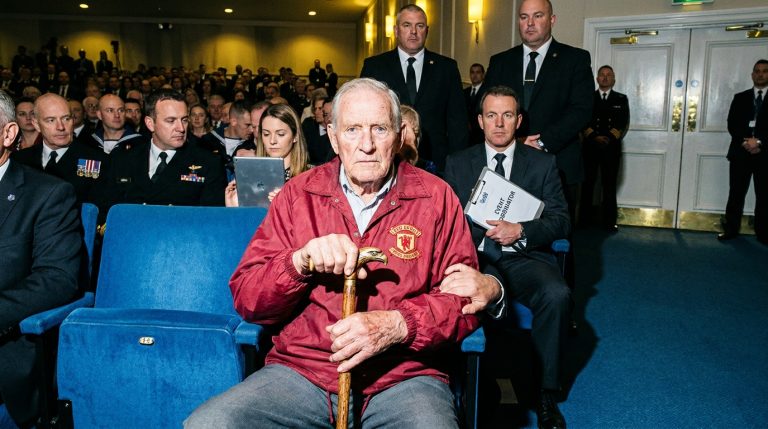
Miller turned his eyes toward the sound. Bill was there, leaning his hip against the rough wooden handle of a forty-eight-inch industrial push broom. The old man’s gray jumpsuit was frayed at the cuffs, the cotton washed so thin it looked like cheesecloth around his bony shoulders. His right leg was hitched slightly higher than the left, his boot worn down at the outer heel from a lifetime of favoring a knee that didn’t bend past forty degrees.
“You’re fighting the steel, Sergeant,” Bill said. His voice sounded like two dry bricks being rubbed together in a basement. He didn’t take his eyes off the small pile of metal shavings and dry dirt he had gathered near the threshold. “The digital box doesn’t know the concrete under that front road wheel is sloped four millimeters to the drainage ditch. You’ve got a twist in the third link.”
Miller’s jaw tightened until the muscle below his ear twitched. He stepped away from the tank, his boots sticking slightly to the floor. “Go back to the broom, Bill. We aren’t working on old diesel trucks here. This is an M1A2 SEPv3. The tolerances are handled by digital valves, not guessing games.”
Bill didn’t argue. He just shifted his gnarled hands along the smooth ash wood of the broom handle, his thumb brushing against a small, non-regulation weld spot—a crude, circular patch of rough steel down near the tank’s underbelly that didn’t exist on any blueprint Miller had ever studied.
CHAPTER 2: THE SHADOW WITH THE BROOM
The silence that followed Miller’s sharp dismissal did not clear the air; it compressed it. The heavy ash wood of the broom handle remained perfectly still in Bill’s hands, his thumb resting over that odd, unmapped weld spot near the chassis. To Miller, the small circle of rough metal looked like a scar on an old soldier’s skin—unseemly, unauthorized, and entirely outside the diagnostic parameters displayed on the glowing screen of his tablet.
“Three millimeters,” Bill said again, not moving an inch. His voice lacked the defensive heat of a man trying to win an argument; it had the flat, heavy certainty of ballast. “The drainage slope runs toward the bay door. Look at the left front road wheel housing, Sergeant. The housing isn’t level with the concrete block. It’s tilting the weight forward. Your digital sensor thinks the hull is flat because it’s measuring from the internal gyros, but the ground beneath the track is throwing the geometry off by a fraction. Every time you push that pump to max pressure, you’re just jamming the tooth against the guide horn.”
Miller felt a sudden, familiar tightness in the small of his back, the exact same phantom ache he’d felt five years ago at Fort Benning when a chief warrant officer had torn his first diagnostic report to pieces in front of the entire platoon. That same feeling of exposed vulnerability turned his skin cold despite the stifling heat of the motorpool. He looked from Bill’s faded blue eyes down to the gnarled fingers resting against the wood.
“Harris,” Miller barked, his voice cutting through the low hum of the ventilation fans. “Get the manual level out of the storage locker. The bubble level. Not the laser.”
Corporal Harris blinked, his grease-stained face tightening in confusion. “Sarge? The digital calibration unit is accurate to a hundredth of a degree. The manual says—”
“I know what the manual says,” Miller snapped, his fingers tightening around the edge of the tablet until the plastic casing groaned. “Get the level. Now.”
The corporal scrambled away, his boots slapping against the oily floor. The remaining mechanics stood in a loose, awkward semicircle around the massive flank of the Abrams, their hands stuck into their pockets or hooked into their belts. None of them looked at Bill directly, yet every eye was aware of the gray jumpsuit standing by the solvent racks. The old man hadn’t returned to sweeping. He simply stood there, his presence occupying the room with the quiet weight of a structural pillar that everyone had forgotten was holding up the roof.
Miller walked slowly to the front left road wheel, kneeling down until his knee touched the slick concrete. The smell of spent lithium grease was stronger down here, mixed with the damp, earthy scent of dust blown in from the canvas staging areas outside. He reached out with his tactical glove, running his fingers along the edge of the track shoe. Bill was right about the incline; he could feel the slight, almost imperceptible slide of his hand toward the drainage grate. But his eyes kept drifting back to that non-regulation weld spot near the idler arm housing.
It was crude. Modern military maintenance was an exercise in pristine replacement—modular blocks swapped out according to barcoded schedules. This patch was different. It was a piece of heavy plate steel, hand-cut and torched into place, the bead of the weld thick and overlapping like a heavy zipper. It belonged to an era of field expediency that the modern logistics network had systematically spent billions to eliminate.
“That patch,” Miller said without looking up, his voice dropped low enough that the other mechanics couldn’t hear over the distant whine of a generator in Bay 5. “That’s not in the technical manual. If the inspectors from battalion see an unauthorized modification on a tier-one asset, they’ll red-tag the whole vehicle before the General even steps out of his staff car.”
Bill took a slow step forward, his limp more pronounced now that he was moving out of the deep shadow. The rubber soles of his old boots made no sound against the concrete. “That patch was put there during the second week of February, 1991,” the old man murmured, looking down at the top of Miller’s helmet. “In the middle of a dust storm forty kilometers north of the Kuwaiti border. The digital bypass valves on the early block models used to clog with fine silica until the computer locked the suspension solid. We torched a relief port into the housing so we could clear the mud out with a cleaning rod without having to drop the entire side skirt.”
Miller stayed on his knee, his eyes fixed on the rough metal zipper. “You can’t just torch holes in an Abrams hull, Bill. It compromises the structural integrity of the armor array.”
“It kept the gun stable while the Republican Guard was trying to bracket our position,” Bill replied softly. The lack of anger in his tone made the statement feel heavier than an order. “The manual didn’t have a chapter for what happens when the sand turns into wet cement inside your drive sprocket. Sometimes you have to let the machine breathe, Sergeant.”
Harris came jogging back, holding a battered eighteen-inch aluminum level he’ve pulled from the bottom of an unmonitored tool chest. He knelt beside Miller, placing the metal bar across the lower edge of the track guide.
The small green vial sat between them. The dark bubble didn’t center. It sat pushed entirely against the right black line, skewed, uneven, and completely contradicting the green “READY” light still pulsing on the digital diagnostic screen attached to the hull.
Miller stared at the bubble. The realization didn’t come with a flash of light; it came with the cold, heavy settle of an anchor dropping into the mud of his stomach. The sophisticated system wasn’t broken; it was simply blind to the ground it stood on. He looked up at Bill, his pride tasting like copper in the back of his throat.
“The third link,” Miller said, his voice flat. “Where exactly is the bind?”
Bill didn’t answer with words. He walked over to the tool rack, bypassed the laser guidance rigs entirely, and laid his gnarled hand on the cold surface of the six-foot iron crowbar.
CHAPTER 3: THE CALCULUS OF DESPERATION
The six-foot bar of hardened iron left the wall rack with a dry, metallic rattle that sounded thin against the heavy breathing of the motorpool. Bill did not rush. His bad knee clicked—a sharp, internal catch of bone against cartilage—as he dragged the weight of the steel bar toward the tank’s underbelly. Miller remained balanced on one knee, his eyes tracked to the old man’s deliberate movements. The countdown to 1400 hours felt like a physical pressure building behind Miller’s temples, a sharp throb that aligned perfectly with the rapid blinking of the diagnostic tablet’s red indicator.
“If that hydraulic line goes, the whole assembly drops,” Miller warned, his voice low, his tactical gloves staying pressed against the lower skirt of the track. He could feel the high-frequency vibration of the auxiliary pump running through the metal plates, a tremor that signaled the system was straining against its own safety valves. “The pressure is maxed out. If the line shears while you’re under the skirt, the fluid will cut clean through that jumpsuit before you can blink.”
“Then don’t let it shear,” Bill said flatly. He didn’t look at the tablet. He dropped down beside Miller, the rough fabric of his gray overalls brushing against the grease-stained concrete. The sour, stale scent of sweat and aged cotton clung to him, a sharp contrast to the chemical heat radiating from the machine’s undercarriage. “Corporal, step back from that relief valve. You’re standing directly in the spray path if the O-ring fails.”
Harris looked at Miller, his face pale beneath the smears of soot. Miller gave a sharp, downward jerk of his chin. “Do what he says. Back off five paces. Keep your eyes on the manifold.”
The corporal retreated, his boots scraping quickly over the slick floor until he was clear of the hydraulic block. The remaining mechanics drew back into the deeper shadows of the adjacent bays, leaving Miller and Bill alone in the tight, hot corridor between the flank of the Abrams and the concrete wall. The heat down here was oppressive, rising from the floor like steam from a broken boiler.
Miller watched Bill’s gnarled hands guide the hooked end of the iron lever toward the gap beneath the drive sprocket. The old man wasn’t guessing; his fingers moved by a muscle memory so deep it looked like instinct. He ran his bare palm over the rubber track pads, feeling for the hidden twist that the computer’s digital sensors had failed to record.
Suddenly, a loud, wet hiss cut through the bay. A fine mist of hydraulic fluid sprayed from the coupling above the idler arm, hitting the side armor with a sharp, sizzling sound as it evaporated against the hot metal.
“Sarge! Pressure’s spiking past eleven thousand!” Harris shouted from the darkness, his voice cracking with panic. “The bypass valve isn’t dumping! It’s going to rupture the main line!”
“Cut the power!” Miller yelled, half-rising from his knee to reach the diagnostic terminal.
“Leave it,” Bill commanded. The authority in his voice was absolute, a heavy bark that stopped Miller’s hand inches from the kill switch. “If you cut the pressure now, the track drops back into the guide groove crooked, and you’ll strip the teeth off the main sprocket when you try to move her. We need the tension exactly where it is for five more seconds.”
“It’s a safety violation, Bill,” Miller hissed, his heart slamming against his ribs. The copper taste of dry panic was sharp under his tongue. He could see the braided steel lines of the hydraulic hose bulging near the coupling, the outer rubber casing fraying under a load it was never designed to sustain. “The manual states any pressure spike over ten thousand requires immediate system shutdown. I won’t risk my crew for a vehicle status report.”
“You aren’t risking your crew, Sergeant. You’re risking your career because you don’t trust what your hands are telling you,” Bill said softly, his watery blue eyes locking onto Miller’s face through his thick lenses. There was no arrogance in his gaze, only a profound, exhausted patience. “The system isn’t blowing because the pump is failing. It’s blowing because you’re forcing a square peg into a round hole. Hold the lever’s anchor point right here. Don’t let it slip.”
Miller looked at the bulging hose, then at the old man’s steady hands. The choice was a razor’s edge—trust the unyielding parameters of his training or risk a catastrophic equipment failure on the word of a man who swept the floors. The clock on the wall read 11:34. The General’s shadow was already lengthening across the tarmac outside.
With a muttered oath, Miller leaned his shoulder against the top of the iron bar, his tactical gloves gripping the cold, chipped metal right above Bill’s fingers. The weight of the machine felt immense, a crushing force transmitted through the lever straight into his collarbone. He could feel the heat of Bill’s breath against his neck as they wedged themselves into the narrow space beneath the hull, their combined weight the only thing preventing the iron tool from snapping out of the bind.
“Hold it steady,” Bill murmured, his body tensing as he prepared to find the leverage point. “When she pops, she’s going to throw everything to the left. Don’t let go of the bar, or the recoil will break both your wrists.”
CHAPTER 4: THE IRON LEVER
The air in the narrow gap between the Abrams’ hull and the cold concrete of the maintenance bay felt vacuum-sealed. Miller braced his boots against the slick floor, his thigh muscles screaming as he leaned into the six-foot crowbar. Beside him, Bill didn’t grunt or falter; he simply became a part of the steel, his weight distributed with an uncanny, rhythmic precision that made Miller feel clumsy and over-engineered.
“Now,” Bill whispered, his voice cutting through the hiss of the straining hydraulic coupling.
Miller threw his weight forward, his heart slamming against his ribs. For a terrifying, suspended heartbeat, the world stopped moving. The iron bar vibrated against his palms, the metal singing with the sheer amount of tension channeled through it. Then, with a sound like a rifle shot echoing in a cavern, the track shifted. It didn’t just slide; it leaped. The heavy rubber-and-steel links snapped into their proper seating with a violent, final thud that vibrated up through Miller’s arms and into his jaw.
The hydraulic system let out one last, prolonged groan—a mechanical death rattle—and then the pressure dropped instantly. The hiss ceased. The bay descended into a sudden, jarring quiet that felt heavier than the noise had.
Miller collapsed back, his breath coming in ragged, shallow gasps. His hands were shaking so violently he had to hook his thumbs into his belt to steady them. He looked down at the idler arm. The track was perfect. The tension was calibrated, the teeth aligned in the sprocket with a clean, surgical accuracy that the automated diagnostic system had claimed was impossible.
Bill didn’t cheer. He didn’t offer a nod of triumph. He simply pulled the hooked end of the crowbar from the gap, wiped a smear of grime from the steel with a ragged cloth from his back pocket, and began to stand. His bad knee popped audibly in the silence.
Miller scrambled to his feet, his mind racing to find an explanation for what he’d just witnessed. He walked around to the front of the drive sprocket, staring at the non-regulation weld spot he had been obsessing over moments before. Up close, in the dim, amber glow of the bay’s overhead lights, he noticed something he had missed from his kneeling position. Embedded near the base of the crude weld was a tiny, etched set of initials: J.W., followed by a faint, scratched date: MAR ’91.
“You were there,” Miller said, his voice sounding thin and small in the cavernous space. He looked up at Bill, who was already turning away to retrieve his broom. “You said you served in ’91. You didn’t just ‘work on the tanks,’ did you? You built this patch.”
Bill stopped, the broom handle resting against his calloused palm. He didn’t turn around immediately. He looked at the vast, silent silhouette of the M1 Abrams, his gaze lingering on the turret as if he were seeing the ghosts of a crew that had long since moved on. “I didn’t build it, Sergeant. I just made sure it could survive long enough to bring the boys back home. That patch… it’s not just metal. It’s a reminder that sometimes, the only thing standing between a machine and a graveyard is the person willing to look at it, not the display screen.”
“Why didn’t you say anything earlier?” Miller asked, his frustration resurfacing, though it was now tempered by a confusing, burgeoning sense of awe. “You let me waste three hours of labor. You let the Captain breathe down my neck. You let us think the equipment was beyond recovery.”
Bill finally turned, and for a fleeting second, the exhaustion in his face vanished, replaced by a sharp, piercing clarity that made Miller feel like he was being measured for a uniform he hadn’t yet earned. “If I’d told you, you would have written it off as an old man’s ramblings. You needed to see the machine fail before you were willing to see the truth. You spent all morning treating this tank like a computer, Miller. Until you treated it like a living, breathing partner, you weren’t going to fix anything.”
Miller wanted to argue—he wanted to cite the manual, the chain of command, the standardized procedures that kept the entire battalion functioning—but the words died in his throat. He looked at the level, still resting on the track, and the bubble was perfectly centered. The tank was ready. The inspection would go forward.
“The General arrives in ninety minutes,” Bill said, his voice returning to the low, flat tone of the janitor. He gestured with his chin toward the diagnostic tablet, which was now flashing a calm, steady green. “You should probably clear the hydraulic fluid off the floor before the Colonel steps in here and slips on your incompetence.”
He walked toward his corner, the scraping of the broom beginning again, a rhythmic, steady sound that seemed to mock the frantic, high-tech desperation that had defined the last three hours. Miller stood frozen, his hand still resting on the cold, hard steel of the idler housing, his fingers tracing the J.W. initials. He felt the weight of his own ignorance, a heavy, sinking sensation that was somehow, paradoxically, the most grounded he had felt in months. He turned back to the rest of his crew, who were staring at him, waiting for orders, waiting for an explanation that he didn’t yet have the words to give.
CHAPTER 5: THE WILLIAMS WEDGE
The rhythmic scrape of Bill’s broom returned to the far corner of Bay 4, a steady, scraping cadence that beat out the remaining seconds like a pendulum. Miller did not pull his hand away from the track housing immediately. His fingers remained pressed against the rough, hand-welded zipper of steel, the cold iron imprint pushing through the synthetic weave of his tactical glove. J.W. MAR ’91. The initials felt less like data and more like a physical weight left behind in the metal, a permanent scar on a machine built to outlive the men who fought inside it.
“Harris,” Miller said, his voice dropping an octave as he finally stood upright. His spine made a dull popping sound, a testament to the minutes spent pinned under sixty tons of unyielding armor. “Go down to the log cabinet by the technical library. Pull the historical master file for this hull. Not the digital log on the server—the old paper binders from the long-term depot transfer.”
Harris looked up from his grease rag, his brow furrowed. “Sarge, those records are uncatalogued archives. Most of them are just carbon copies from the old motorpools before the digital transition. It’ll take twenty minutes just to find the box.”
“Then you’ve got nineteen minutes to get back here with it,” Miller said. He didn’t raise his voice, but the flat, unblinking glare he directed at the corporal left no room for hesitation. “Look for the field modifications log from the 24th Mechanized during Desert Storm. Move.”
As Harris hurried out of the bay, his boots echoing down the long, concrete utility corridor, the other mechanics began picking up the abandoned tools scattered across the floor. The heavy iron crowbar lay across the corner of the primary tool cart, its chipped tip still smeared with a dark line of lithium grease. Miller walked over to it, his boots sticking slightly to the thin sheen of hydraulic fluid that had sprayed during the pressure spike. He picked up the heavy iron bar, feeling its crude balance. It didn’t have an ergonomic grip or an electronic strain gauge. It was simply mass and leverage, an analog solution that had broken through a digital gridlock.
He looked over at Bill. The old man was still working the broom, his slight limp hitching his right hip with every forward stride. He didn’t look up to check if Miller was watching. He didn’t need to. He moved with the quiet invisibility of an object that had occupied the same space for so long it had become part of the architecture.
Miller walked over to the supervisor’s metal desk near the parts cage. On the lower shelf, half-buried under a stack of unread safety bulletins, sat an old aluminum clipboard with a fraying canvas strap. He pulled it out, shaking loose a fine layer of gray emery dust. The top sheet was a modern dispatch manifest, but as he flipped the pages back, the paper changed texture—turning from crisp, white laser print to thin, yellowed carbon sheets with faded purple ink from three decades prior.
His eyes scanned the columns of standard maintenance codes until they stopped at a handwritten note in the margin of a document dated March 14, 1991. The handwriting was identical to the precise, blocked lettering of the initials on the tank’s hull. The note read: Bypass valves compromised by sand expansion. Hull relief modification fabricated in field. Operational integrity maintained. Signed: Williams, J., Cpl.
Miller felt the skin on the back of his neck tighten. J. Williams. Not Bill. Bill’s name on the current civilian payroll sheet was William Williams Senior.
Before he could process the discrepancy, a low, concussive vibration rattled the corrugated steel panels of the bay ceiling. It wasn’t the internal hum of the ventilation system or the distant whine of a generator. It was the synchronized, heavy rumble of commercial diesel engines approaching from the main perimeter road—the distinct, aggressive growl of a staff car escort convoy.
The heavy rolling doors at the front of the maintenance bay began to hum, their automatic tracks engaging as the security detail triggered the approach sensors from outside. The blinding glare of the noon-day sun cut across the concrete floor in a widening wedge of white light, illuminating the dust motes dancing in the heavy air. Miller dropped the old clipboard back onto the desk, his heart skipping a beat against his ribs. The clock above the tool rack read exactly 13:45.
General Sterling’s convoy was fifteen minutes early.
The mechanics immediately went rigid, dropping their cleaning rags and straightening their uniform jackets as the first blacked-out utility vehicle rolled to a stop just outside the threshold. Miller stepped forward to meet the light, his boots clicking sharply against the floor, his mind still trapped between the faded ink of the old log and the immediate, high-tension reality of the inspection party now descending upon his motorpool.
CHAPTER 6: THE ARRIVAL OF GRANITE
The widening wedge of sunlight cut across the concrete like a blade, exposing every swirl of dust and drop of dried solvent in the motorpool. Miller stood his ground at the edge of the shadow, his boots snapping together as the blacked-out staff car slid to a smooth, silent halt just past the threshold. The vehicle’s twin exhaust pipes exhaled a soft plume of premium diesel heat that warped the air behind it. From the back seat, the door swung open before the driver could even clear the front bumper.
General Sterling stepped out into the stifling heat of Bay 4. He was a mountain of a man, his frame packed tightly into desert camouflage that bore three polished silver stars on each stiff collar point. His face looked as though it had been roughly hewn from river stone, weathered by decades of sun and unyielding standard procedures. Behind him, a full colonel and the battalion command sergeant major fell into a synchronized flank, their clipboards held like shields.
“Attention to orders,” Miller called out, his voice snapping the remaining mechanics into rigid, breathless postures along the tool walls.
Sterling didn’t offer a traditional greeting. He simply marched past Miller, his dark leather combat boots striking the concrete with a heavy, rhythmic thump that seemed to measure the structural discipline of the entire room. His eyes, a pale, piercing gray under the shadow of his patrol cap, swept the pristine alignment of the diagnostic carts before stopping dead on the flank of the M1 Abrams.
“At ease,” Sterling rumbled. The voice was low, vibrating through the corrugated steel paneling like distant artillery. He walked straight to the left drive sprocket, his large, gloved hand reaching out to touch the heavy iron skirt. He didn’t check the screen of the diagnostic terminal; he simply ran his palm down toward the lower housing, his fingers navigating the metal entirely by feel.
Miller felt a drop of sweat trace a cold line down his ribs. He stepped up to the flank of the tank, keeping exactly two paces behind the General’s right shoulder. “Sir, the vehicle has been fully serviced. The left track assembly is seated and calibrated according to field operational parameters.”
Sterling didn’t answer immediately. He knelt, ignoring the thin sheen of dust on the floor, his massive frame shifting lower until he could peer directly into the dark recess of the idler arm. His hand paused. His thick fingers ran across the rubber track pads, tracing the exact curvature of the third link before drifting back toward the circular patch of hand-welded steel. The zipper of rough metal was unmistakable under his touch.
“Good tension,” Sterling noted, his voice dropping into a flat, contemplative drawl. He stood up slowly, the joints in his massive frame popping with a muffled click. He looked down at Miller, his thick eyebrows knitting together until they formed a solid line across his granite forehead. “I was informed by the brigade logistics office that this specific unit had thrown its track three hours ago, Sergeant. They said you were dead in the water waiting on a heavy-lift crane from the depot.”
“We had a technical issue, sir,” Miller said, his jaw tightening as he chose his words with absolute precision. The old yellowed carbon paper log from 1991 was still sitting fresh in his mind, the hidden history of the machine humming beneath its freshly cleaned exterior. “The automated sensors were fighting the slope of the bay floor. We bypassed the software constraint and reset the geometry manually.”
Sterling’s eyes narrowed, a sharp gleam passing through the gray iris. “Manually? You don’t manual-steer a sixty-ton modern platform without a tensioning rig, Sergeant. The technical manual explicitly states that an unanchored alignment attempt under field conditions will sheer the guide horns.”
“We didn’t use a rig, sir,” Miller whispered, his voice steadying despite the heavy silence that had fallen over the mechanics along the wall. He looked toward the tool rack where the rusty six-foot iron crowbar sat, then back to the General’s stony face. “The alignment was guided by a lever point on the lower chassis. We used a physical fulcrum to clear the twist in the third link.”
The Colonel behind Sterling made a sharp, scratching sound with his pen against his clipboard. “Sergeant, that’s an unauthorized field procedure. If you’ve damaged the internal teeth of that drive sprocket—”
“Quiet, George,” Sterling interrupted. He didn’t look back at the Colonel. His eyes remained fixed on Miller, but his gaze was drifting past the sergeant’s shoulder, focusing on the dim, oil-scented corner near the solvent racks where the dry, rhythmic sound of a push broom had suddenly ceased.
The General’s face didn’t soften, but the rigid lines around his mouth cracked open, a look of genuine, staggering recognition sweeping across his features as he stared into the shadows of the motorpool.
CHAPTER 7: THE RECOGNITION AT FORT HOOD
The absolute stillness in the bay was deafening. General Sterling’s heavy gray eyes did not wander back to the polished technical tablets or the starched uniforms of the inspection team. He stepped away from the massive flank of the Abrams, entirely bypassing Miller, his leather boots crossing the oily concrete toward the dark, unlit corner where the parts cage met the solvent racks.
“Bill,” the General called out, his voice dropping its formal edge, replacing it with a deep, resonant rumble that shook the tense quiet of the room. “Bill Williams.”
The old man stopped moving. The dry, rhythmic scraping of the broom bristles died instantly against the concrete. Bill turned around slowly, the worn denim of his jumpsuit bunching at his thin shoulders, his right hip hitching high as he adjusted his stance against his bad knee. He reached up with one thick, gnarled hand, shifting his thick-lensed glasses slightly up the bridge of his nose. He squinted through the ambient glare of the noon sun slicing into the hanger.
“Hello, Mike,” Bill said simply.
A collective, sharp inhalation rattled through the line of mechanics along the wall. Miller felt his own breath hitch in his throat; the entire structural hierarchy of the base seemed to warp in an instant. A civilian groundskeeper, an old man who emptied the trash bins and cleared the metal lathe shavings, had just addressed a three-star general by his first name. And Iron Mike Sterling did not flinch. He did not call for the guard detail.
Instead, the General marched straight into the oil slicks and gray dirt, ignoring the meticulous path his colonel had mapped on the clipboard. He closed the distance between himself and the old janitor, his massive, camouflaged arms reaching out to pull Bill into a heavy, brief bear hug that rattled the wooden broom handle between them.
“I haven’t seen you since Fort Hood, top,” Sterling said, stepping back just enough to grip Bill’s frayed collar with both hands, his granite face cracking into an expression of raw, unpolished warmth. “What in God’s name are you doing pushing a broom in a maintenance bay?”
Bill shrugged, his thin shoulders rising in a slow, indifferent gesture that carried the weight of someone who had long since ceased caring about titles. “Keeps the joints moving, Mike. If I sit on the porch too long, the rust sets into the hip permanent.”
Sterling turned back to face the frozen group of mechanics, his features instantly freezing back into their stone-carved baseline. The gray eyes locked onto Miller, burning with a low, dangerous heat that made the sergeant’s spine stiffen into iron. “Do any of you men actually know who is sweeping your floor?” Sterling demanded, his voice dropping into a low, terrifying register that echoed off the corrugated ceiling panels.
Silence was the only response. Miller looked from the General to Bill, the yellowed paper log from 1991 flashing through his mind like an unread indictment.
“This is Master Sergeant William Williams,” Sterling said, gesturing with a thick, gloved finger toward the old man in the cheesecloth jumpsuit. “He was my tank commander in Desert Storm. At the Battle of 73 Easting, our entire lead section was cut off in a thermal blackout. We had three vehicles tracking blind, fine silica cementing the main bearings, and the Iraqi Republican Guard closing in from the reverse slope. This man single-handedly kept those platforms operational under a sustained mortar bracket. He fixed a breached high-pressure fuel line using a foil MRE wrapper and two strips of standard canvas tape while the turret ring was throwing sparks.”
Sterling stepped back toward the flank of the modern M1A2, his palm slapping the cold metal of the armor plate with a concussive thud. “He is the only reason half of this battalion’s history isn’t written on a memorial wall. And let me guess, Sergeant Miller—he fixed your thrown track using an iron bar and a pivot point?”
Miller swallowed hard, the copper taste of his own exposed pride sharp against his teeth. He couldn’t look the General in the eye. He looked down at the floor, where the green bubble of the manual level was still perfectly centered on the track shoe. “Yes, sir. He called it a pivot wedge.”
“The Williams Wedge,” Sterling chuckled, a grim, private smile passing over his lips as he shook his head in absolute disbelief. “He tried to get the logistics board to standardize the lever clearance into the block manuals back in ’92. The brass in Washington said it wasn’t a repeatable procedure for untrained personnel. Too dangerous for kids who only know how to read a diagnostic screen.”
The General turned back to Bill, his hand resting affectionately on the old man’s sloped shoulder. “You’re done with the broom, Bill. I’m taking you to the officer’s mess, and then we’re talking to the civilian contractor about moving you into a senior advisory role. I have a thousand kids in this brigade who can diagnose an electronic bus line but don’t know how to listen to the vibration of a failing turbine through the soles of their boots. I need you to teach them how to touch the steel.”
Bill looked down at the neat pile of dirt he had gathered at the base of the solvent rack, his thumb still tracing the smooth, oiled grain of the wood handle. He didn’t look excited; he looked incredibly tired, his eyes drifting back to the small J.W. initials etched into the tank’s underbelly. “I don’t know, Mike. I kind of like the quiet down here.”
“That’s an order, Master Sergeant,” Sterling said softly, the command carrying a weight that bypassed the civilian contract entirely, striking straight at forty years of shared service.
Bill straightened his spine, the slight hitch in his hip remaining, but the slouch vanished from his shoulders. He brought his right hand up to his brow in a single, crisp salute that was sharper, cleaner, and more technically perfect than anything Miller had seen since his time at the academy. “Yes, sir.”
As the General turned to lead Bill out toward the waiting staff car, the convoy engines outside rising into an impatient whine, Miller stood entirely frozen in the center of Bay 4. His hand drifted back to his pocket, where the old yellowed carbon log sheet rested against his palm. He looked at the empty corner where the broom now lay propped against the parts cage, the silence of the room rushing back in to fill the space the old man had left behind.
CHAPTER 8: THE HAND ON THE WOOD
The exhaust notes of the General’s departing staff car faded down the long tarmac, leaving the motorpool to sink back into a heavy, vacuum-sealed quiet. The remaining mechanics stood perfectly motionless along the tool wall, their forms cast in long, stark shadows by the slanting afternoon light. Miller did not pull his eyes away from the open bay door immediately. His fingers were still buried deep in his pocket, resting against the coarse edge of the old yellowed carbon log sheet he had pulled from the cabinet.
When he finally turned back into the dimness of the hanger, his boots felt twice as heavy against the concrete. His gaze moved slowly across the massive, silent hull of the M1 Abrams, tracking past the perfectly tensioned left track to the empty back corner. The forty-eight-inch industrial push broom lay propped unceremoniously against the parts cage, its ash-wood handle splintered slightly near the top where Bill’s gnarled hands had held it for years.
Miller walked over to the supervisor’s desk, the coldness in his center solidifying as he looked down at the paper records. He pulled the carbon log completely free from the clipboard, his fingers smoothing out the fraying edge of the yellow sheet. He knew the truth now—not because the General had spoken it bluntly, but because the physical evidence in his hands forced the pieces to slip into alignment like the teeth of the drive sprocket.
J.W. Corporal. Jonathan Williams.
“Harris,” Miller said, his voice a flat, quiet murmur that barely carried across the open space of the bay. He didn’t look up from the page. “The personnel transfer file for the long-term depot. When Bill Williams Senior signed his original civilian groundskeeping contract here five years ago… what was the date?”
Corporal Harris stepped out from the shadows of the tool rack, wiping his hands slowly on a grease rag. The confusion on his face had hardened into something softer, a quiet, tired comprehension. “October 2021, Sarge. It was exactly three months after the battalion returned from that deployment in Paktika Province.”
“The deployment where Third Platoon lost their lead asset to a secondary hull rupture,” Miller stated, his eyes fixed on the block lettering of the signature.
“Yes, sir,” Harris whispered. “The vehicle commander on that asset was Sergeant Jonathan Williams Junior. Bill’s son.”
The revelation sat in the room like an unexploded shell. There was no sudden outburst, no dramatic confirmation from an outside source. The absolute reality of Layer 2 was written in the very dust of the floor Bill had swept every single morning. The old man hadn’t stayed at this specific, low-paying motorpool out of a simple desire to keep his joints moving or because he liked the quiet. He had stayed because this vehicle—this precise, sixty-ton beast with the field-fabricated relief patch from 1991—was the final tangible legacy his son had commanded before the sand took him. The father had spent five years keeping an anonymous, silent vigil over the steel that had carried his boy, protecting the unwritten touch of a generation from being entirely erased by digital checklists and administrative indifference.
Miller let out a slow, steady exhalation, the tight knot of professional pride that had driven him all morning dissolving completely into the heavy air. He walked back to the tool cart where the six-foot iron crowbar lay, its chipped tip reflecting the dim amber glow of the overhead lights. He reached out, his tactical glove sliding off his hand as he touched the bare metal with his naked palm. The iron was freezing to the touch, heavy and uncompromising, but it no longer felt like a threat to his authority. It felt like an inheritance.
He picked up the bar, its weight anchoring his posture as he carried it across the floor toward the parts cage. With deliberate, quiet care, he set the tool against the wooden wall behind the desk.
“Sarge?” Harris asked, his voice hesitant as he watched Miller step over to the corner and wrap his hand around the smooth, worn wood of the abandoned push broom. “What are we doing with the inspection report for the captain?”
“The report stays exactly as it is,” Miller said, his voice firming as he looked down at the neat pile of metal shavings and dust Bill had left near the threshold. He felt the texture of the wood grain against his palms—rough, frayed, and entirely real. “Write it down clearly. The digital diagnostics missed the twist in the chassis. The vehicle was returned to operational status through manual intervention. The hard way. The right way.”
He shifted his weight, his boots finding a steady, balanced purchase on the concrete as he pushed the broom forward, the dry, rhythmic scraping sound returning to Bay 4. It wasn’t the sound of an entry-level task anymore; it was the cadence of a lesson being learned from the ground up. The young mechanics along the wall watched him for a long moment, their postures relaxing from their rigid defensive lines before they silently turned back to their own benches, reaching for their hand tools instead of their digital screens. Miller kept his eyes down, focusing entirely on the small pile of grit in front of the bristles, finally learning how to listen to the machine breathe.