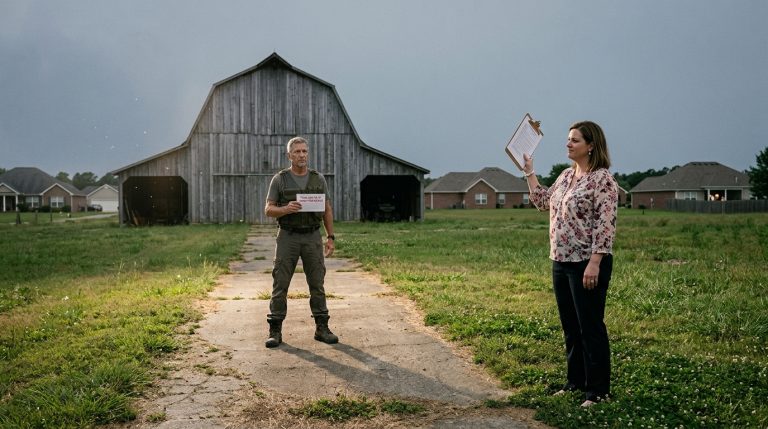
The Iron Boundary: How Meticulous Records, Quiet Endurance, and Unyielding Patience Dismantled a Suburban Tyrant
CHAPTER 1: THE LINE IN THE DIRT
The sound carried across the acreage long before the figure came into focus. It was a sharp, grating rattle of entitlement—a voice accustomed to unchallenged command echoing through the timberline.
I did not turn immediately from the crossbeam I was leveling. My hands, callused and grayed with pressure-treated dust, steadied the spirit level against the galvanized steel bolt. Fifty yards inside my property marker, suspended in the forks of a stubborn old oak, the deer stand felt like a fortress. It was overengineered, bolted down with the heavy-duty precision I had learned to respect in places far less forgiving than a suburban fringe.
“That illegal structure comes down today, or I call the sheriff.”
She was marching across the manicured turf of Whispering Pines, her floral print windbreaker a bright, discordant splash against the muted browns of the late-October brush line. Her face was flushed, her breath pluming in the chill air like an engine struggling to turn over in winter. She pointed a thick, trembling finger directly at my cathedral of solitude.
I stepped down the ladder slowly, letting my boots hit the leaf-strewn earth with a dull, deliberate thump.
“Ma’am,” I said, keeping my voice flat and low, stripped of any rising inflection that might invite an argument. “You’re past the boundary. This is private property.”
She didn’t stop marching. She halted at the orange survey tape fluttering from a sapling, her small, hard eyes scanning the bolted framework as if calculating its worth in code violations. “I am Karen Peterson,” she said, as if the name carried the weight of a royal patent. “President of the Whispering Pines Board of Directors. Section Seven, subsection B of our master covenant explicitly prohibits unapproved external structures visible from the association’s perimeter.”
The air between us smelled of dry grass and faint, sweet cinnamon gum. I looked past her shoulder toward the sprawling asphalt and beige siding of the subdivision—a world of straight lines and clipped lawns that ended abruptly where my ten wild acres began.
“Your jurisdiction stops at that tape,” I said, pointing down at the bright nylon strip. “My deed is recorded at the county seat. This land was zoned rural residential before your developer ever poured a foundation.”
Karen scoffed, a dry expulsion of air that lacked humor. “The county records are re-evaluated by our architectural committee every three years. Your junkyard treehouse lowers property values along the border. You have forty-eight hours to dismantle it before the fines double.”
She turned on her heel, her sneaker heels digging viciously into the damp turf, and started back toward her gleaming white SUV parked a quarter-mile away.
I stood motionless beside the trunk of the oak, watching the stiff, robotic rhythm of her retreat. My fingers brushed against the pocket of my canvas jacket, where a small digital voice recorder sat cold against my palm. I clicked it off, the tiny mechanical click swallowed entirely by the rustle of dry leaves overhead.
She had given me her first timestamp, but as I looked down at the frayed orange tape fluttering in the autumn wind, I noticed something small and wrong in the leaf mold just inches inside my boundary line—a discarded plastic violation notice fluttering like a dropped glove, bearing a date that hadn’t even arrived yet.
CHAPTER 2: THE FIRST SALVO
The paper was thick, cream-colored, and cold to the touch. I picked it up off the damp kitchen floor where it had slipped from my hand, the embossed golden pine cone at the top gleaming under the pendant light. It was dated for three days in the future—a careless clerical error born of a bureaucratic machine that ran too fast on pure, unadulterated spite.
Maria was already at the table, her ceramic mug of black coffee cradled between both palms, watching the steam curl against the oilcloth surface. A nurse by trade, she had a quiet radar for fractures in people, but her eyes were fixed on the document in my grip with a cold, analytical sharpness.
“She’s pre-dating the violations now,” Maria said, her voice low. “That isn’t just petty, Jack. That’s a paper trail built on a glitch. She’s manufacturing a timeline.”
“She’s building a case she expects me to forfeit before I even see it,” I replied, pulling out a wooden chair and sitting down. The wood groaned under my weight, a dry, protesting sound that matched the tension in the room.
I didn’t throw the notice away. In the military, you didn’t toss out anomalous intel; you logged it, cross-referenced it, and waited for the enemy’s next predictable pivot. I reached for the thick 3-ring binder sitting beside the sugar bowl—a heavy, utilitarian thing stuffed with county surveyor plats, deed descriptions, and high-resolution photographs of my southern property line.
Opening the binder revealed the tab marked Phase One: Notifications. I slid Karen’s pre-dated slip into a clear plastic sleeve, pressing out the air bubbles with the edge of my thumb. Beside it lay the certified mail receipt from the county clerk confirming my parcel’s rural residential zoning, entirely severed from the Whispering Pines subdivision charter.
“She thinks this is a neighborhood squabble over aesthetics,” I said, unscrewing the cap of a black archival ink pen. “She looks at that deer stand and sees a blight. She thinks it’s about the paint or the timber.”
“And what is it about?” Maria asked, leaning forward, her gaze steady.
“Control. But control requires a budget. And a budget requires compliance.” I tapped the edge of the binder. “A woman who spends her mornings patrolling property lines with pre-dated stationery isn’t just protecting her hydrangeas. She’s protecting something structural. People don’t weaponize bylaws this aggressively unless they’re terrified someone will look too closely at the machinery behind them.”
I began to write the log entry for the morning encounter, the scratch of the pen nib sounding loud in the quiet kitchen. October 12th, 0942 hours. Unsolicited contact at southern boundary. Physical evidence recovered: pre-dated violation notice bearing signature of K. Peterson, HOA President.
The strategy was simple, stripped of emotional static. We wouldn’t scream back across the fence line. We wouldn’t tear down her notices or retaliate with petty property defacements. We would build an archive so dense, so legally airtight, that when the weight of it finally shifted, it would crush every arbitrary rule she had ever written.
My phone buzzed against the wood—a single text message from a local contractor friend who lived three streets down inside the subdivision, someone who preferred to remain nameless for now. Careful, Jack. She’s been asking the board secretary about your deed history at the county annex. She thinks you’re hiding an easement.
I looked at the screen, a slow, grim satisfaction settling into my chest. Let her look. Let her spend her afternoons digging through public records that only proved what I already knew: she had no power here.
“She’s going to escalate,” Maria said quietly, reading the shadow on my face. “Paper isn’t going to satisfy her much longer if you don’t blink.”
“Let her try,” I said, closing the binder with a heavy, final snap. “A fortress isn’t built to stay quiet. It’s built to hold the line.”
CHAPTER 3: THE UNIFORMED TEST
The heavy snap of the 3-ring binder echoing through the kitchen still hung in the air when the sound replaced it—the distinct, heavy crunch of tire tread biting into the gravel service road outside.
I didn’t rush. Movement born of panic is a tactical error. I simply stood up from the wooden chair, the legs scraping softly against the floorboards, and walked out the back door into the crisp, biting air of late October. The sky overhead was the color of a wet slate shingle, holding the threat of an early frost in its grey belly.
Down by the boundary line, where the golden leaves of the maple grove gave way to the dense, tangled underbrush of my ten acres, a gleaming white SUV was idling. Its exhaust plumed in thick, greasy white clouds against the damp earth.
Karen Peterson stood beside the driver’s side door, her floral-print windbreaker puffed out like the plumage of an aggressive bird. She was gesturing wildly toward the timberline, her arm sweeping across the air with theatrical finality. Beside her, leaning against the fender of a state-issued green pickup truck, stood a man in the heavy canvas uniform of the state wildlife and fisheries department.
I closed the distance between my back deck and the tree line at a steady, measured pace. Every step was calculated, my boots finding purchase on the root-laced soil. I knew the weight of what was coming. A property dispute handled with local paperwork was one thing; dragging a state law enforcement officer into a personal vendetta was an escalation designed to inflict maximum friction.
“Right over here, officer,” Karen’s voice cut through the rustle of dry oak leaves like a rusty saw blade. “This is the illegal structure I was telling you about. He’s clearing timber without a permit, and I have reason to believe he’s baiting wildlife right on the suburban perimeter.”
The game warden—a broad-shouldered man with sun-weathered skin and mirrored aviator glasses—did not nod. He stood completely still, his arms crossed over his chest, his gaze fixed upward on the bolted framework of my deer stand nestled fifty yards into the brush. He was listening to the cadence of her panic, filtering out the hysteria to find the facts.
I reached the orange survey tape, stopping just short of it. I kept my hands loose at my sides, my posture relaxed but alert, mirroring the defensive economy I had practiced a thousand times in different fields under different skies.
“Morning, officer,” I said, my voice carrying cleanly across the clearing. “Anything I can help clear up?”
Karen spun around, her face mottled a furious shade of pink and white. “Don’t you dare interrupt,” she hissed, taking a sharp step forward before checking herself against the state vehicle. “This official is here to inspect your poacher’s box. You’re violating state wildlife buffer zones, and I’ve documented every single infraction.”
The game warden slowly tilted his head back, the grey lenses of his sunglasses reflecting the overcast sky. He didn’t look at Karen. He looked at me, a faint, recognizable twitch at the corner of his mouth breaking the stoic line of his jaw.
He reached up, unhooked the aviator glasses, and slipped them into his breast pocket.
“Morning, Jack,” Dave said, his low, gravelly rumble carrying a familiar weight that made Karen’s breath catch in her throat. “Fancy seeing you out here. Looks like you finally got those crossbeams braced.”
My shoulders dropped an inch, the thin film of tension evaporating into a wide, slow grin. “Dave. You old son of a gun. What are you doing out in this sector?”
“Official business, apparently,” Dave said dryly, turning his head toward Karen. The transformation in her expression was instantaneous. The triumphant, vindicated smirk cracked down the middle, her jaw going slack as she watched me duck under the orange survey tape, stride across the property line, and clasp forearms with the man she had summoned to destroy me.
“Ma’am,” Dave said, his tone shifting into the flat, unyielding register of state authority. “You reported an illegal hunting structure and active poaching violations.”
Karen stammered, her fingers clawing nervously at the sleeve of her windbreaker. “I—yes. That structure is a public hazard. It’s within the visual easement of Whispering Pines. It has to come down.”
Dave walked past her, ignoring the protest entirely. He approached the base of the massive oak, placing a thick, callused hand against one of the pressure-treated 6×6 posts sunk deep into concrete. He shook the ladder firmly, testing the shear strength of the galvanized steel bolts. He pulled a small, ruggedized GPS unit from his belt, flicked the screen awake, and checked the coordinates against his digital plat map.
For three agonizing minutes, there was absolute silence in the woods save for the wind hissing through the high branches.
Dave clicked the GPS unit off, clipped it back to his belt, and turned around. The friendliness was completely gone from his eyes.
“This is one of the cleanest private builds I’ve inspected all season,” Dave said loudly, his voice engineered so Karen could miss none of it. “It clears every state safety code by a margin of fifty yards. It is situated squarely on a ten-acre private residential parcel, well outside any municipal or association jurisdiction. It is entirely legal.”
He stepped back across the line, looking directly at the woman who was now trembling with impotent rage.
“Now,” Dave continued, stepping right into her personal space with heavy, deliberate authority. “Filing a false report with a state conservation officer is a Class 1 misdemeanor. It wastes state resources and pulls personnel away from actual emergencies. I am going to let you off with a verbal warning today because my friend here has better things to do than press charges. But if my office receives another unsubstantiated call from this address, I won’t just write a citation. I’ll let the magistrate handle the paperwork.”
Karen stood frozen, her mouth opening and closing like a landed fish. The color had completely drained from her cheeks, leaving her looking old and brittle against the backdrop of her manicured subdivision. Without uttering a single syllable, she turned sharply on the heel of her sneaker, marched back to her white SUV, and slammed the door with a force that rattled the chassis.
The tires churned up gravel in a violent spray of dirt as she threw the vehicle into reverse, peeling away down the service road without looking back.
Dave watched her tail-lights disappear around the bend, letting out a slow, heavy breath through his nose. He turned to me, a dry smile touching his lips.
“You’ve got a real fan club out here, Jack.”
“She’s just getting started,” I said, looking down at the scuff marks her tires had left on the edge of my dirt road. “She doesn’t know how to lose, Dave. Which means she’s going to make a mistake.”
“Well,” Dave said, patting the pocket of his uniform jacket where his citation pad rested. “Next time she does, you won’t even have to call me. I’ll already be in the neighborhood.”
CHAPTER 4: THE SURVEILLANCE PIVOT
The sound of Dave’s truck engine faded into the hum of the autumn wind through the upper canopy, leaving behind an abrupt, heavy silence. I remained standing near the base of the oak, looking out over the boundary where the white SUV had fled. A tactical retreat rarely meant a permanent surrender; it only meant the enemy was recalculating angles.
I walked back up the trail toward the house, my boots crunching rhythmically against the dry gravel of the access road. As I rounded the corner of the back deck, a sudden flash of reflected sunlight caught my eye—a sharp, metallic pinprick of light cutting through the hazy afternoon grey.
I stopped instantly, my eyes locking onto the second-story eaves of Karen Peterson’s house two hundred yards away.
Mounted high under the pale beige overhang, stark and obtrusive against the clean siding, was a large dome-style security camera. Its dark hemispherical housing sat like an unblinking mechanical eye, tilted downward and angled with absolute, unmistakable precision. It wasn’t pointing at her own driveway. It wasn’t sweeping the municipal cul-de-sac. The lens was locked dead-center onto my back deck, the path to the woodpile, and the precise trajectory leading toward the tree line.
The irony hung thick in the cold air, smelling faintly of dry earth and rust. The woman who had marched across my property to protest the visual blight of a natural wood deer stand had just bolted the ugliest piece of industrial hardware in the county to her own roof. The crusader against unapproved external fixtures had just violated every aesthetic rule she claimed to enforce.
Maria stepped out onto the back deck, holding a mug of cooling tea. She followed my line of sight, her brow furrowing deeply as she caught sight of the dark dome gleaming in the overcast light.
“Is that… is she pointing that directly at us?” Maria asked, her voice dropping into a tight, controlled register.
“Twenty-four-seven surveillance,” I said quietly, keeping my movements deliberate. “She couldn’t get the state or the county to shut down the stand, so she’s trying to establish a digital perimeter.”
“Can she legally do that? Point a camera straight into our private living space?”
“It’s a grey line on property boundaries, but the placement tells me everything I need to know,” I answered, stepping up onto the wooden planks. “She’s not gathering evidence anymore. She’s trying to manufacture intimidation. Every time you walk out on this deck, she wants you to feel watched.”
Instead of a hot flash of anger, a cold, methodical clarity settled into my chest. In twenty years of service, I had learned that an opponent who abandons concealment to establish an observation post has given away their position. Karen had stopped hiding behind proxy letters and pre-dated notices. She had staked her paranoia to her own wall.
I walked inside, retrieved my heavy documentation binder from the kitchen table, and opened it to a fresh section. I pulled out my phone, fired up the telephoto lens, and spent the next twenty minutes capturing high-resolution photos of her new installation from multiple fixed angles on my own property. I documented the exact tilt, the housing mount, and the clear line of sight intersecting my back door.
Then, I went back to the master text of the Whispering Pines architectural covenants we had downloaded weeks ago. Flipping through the dense legal prose, my finger stopped at Section 11, paragraph four.
No antenna, satellite dish, or other fixture shall be attached to the exterior of any dwelling without prior written approval of the architectural control committee.
I let out a dry, humorless breath. According to Arthur Henderson, the architectural control committee consisted entirely of Karen signing her own name in empty rooms. But even her own fabricated bylaws required documentation in the board’s meeting minutes—paperwork she almost certainly hadn’t bothered to forge for a rushed spite-project.
I picked up my phone and dialed Sarah, the young attorney handling Arthur’s files.
“Sarah,” I said the moment she picked up. “Karen just escalated from paper to hardware. She mounted a dome camera on her second-story eave, pointed straight at our back deck.”
There was a brief pause on the other end of the line, followed by the faint rustle of papers, and then a low, sharp laugh. “A camera? On the exterior wall?”
“Right under the roofline. Unshielded, unapproved by her own architectural rules, and aimed squarely across our boundary line.”
“She is handing us a masterclass in self-incrimination,” Sarah said, her voice picking up a brisk, energized cadence. “A targeted surveillance rig aimed at a non-member’s private property doesn’t just violate association bylaws; it demonstrates a persistent state of targeted harassment. Document the angles. Get me time-stamped images.”
“Already done,” I said, looking out the kitchen window toward the dark, unblinking dome across the gap.
“Good. Keep logging everything,” Sarah instructed. “We’re almost ready to push the collective demand. Let her watch all she wants; every frame she records is just another exhibit for the judge.”
I hung up the phone and walked back out to the edge of the deck. The mechanical eye across the way stared back, silent and cold. Let her keep watching. The more visible her obsession became, the narrower her walls were getting.
CHAPTER 5: THE GATHERING OF SHADOWS
The distance from my back deck to Arthur Henderson’s front door measured exactly four hundred yards as the crow flies, but navigating it meant stepping out of my quiet timberland and back into the rigid, oppressive grid of Whispering Pines.
The wind had picked up, dragging dry maple leaves across the asphalt in scratching, erratic circles. I kept my collar turned up against the chill, walking the edge of the street where the manicured lawns gave way to uniform curbs. Every mailbox I passed looked identical—matte black iron posts stamped with gold numbers, anchored in beds of river rock. It was an environment designed to eliminate deviation.
Arthur’s house stood near the cul-de-sac’s dead end, a modest brick structure partially shaded by an aging sycamore. When I stepped onto his concrete porch, the front door swung inward before I could raise my knuckles to rap on the wood.
Arthur stood in the dim entryway, his frail shoulders slightly stooped, clutching a ceramic mug with both hands. His watery blue eyes darted nervously past my shoulder toward the street before he pulled me inside, sliding the deadbolt home with a dry, metallic click.
“She’s been driving past the cul-de-sac every twenty minutes since noon,” Arthur said, his voice dropping to a cautious whisper as we moved into the small, sunlit kitchen. “Ever since the game warden incident, she’s checking the perimeter like a warden in a cell block.”
The kitchen table was already cleared, stripped of its usual clutter. Resting in the center was a battered, grease-stained shoebox tied loosely with twine. It looked entirely out of place amid the gleaming, modern appliances of a suburban home, acting instead like a box of unexploded ordnance recovered from an attic.
“You brought the rest of it?” I asked, pulling out a chair and sitting down.
Arthur untied the twine with trembling fingers and lifted the lid. Inside lay a compressed mountain of cream-colored paper slips, handwritten fine notices, canceled checks, and threatening memoranda spanning half a decade. It smelled of old newsprint and dry dust—the tangible physical residue of calculated systemic exhaustion.
“Every single notice,” Arthur said, sliding the box toward me. “I didn’t throw a single one away, even when my daughter told me I was losing my mind. Five years of gnomes, garbage cans, and unapproved trim colors. She didn’t just fine me, Jack. She kept a separate ledger. I found it tucked behind the breaker panel in the garage last night when I was looking for spare fuses.”
He reached into his shirt pocket and placed a single, dog-eared sheet of ledger paper on the table. It wasn’t an HOA violation notice. It was a handwritten financial breakdown tracking the community improvement fund—the pool of money generated entirely by the aggressive, punitive fines levied against him and three other targeted homeowners.
I leaned closer, my finger tracing the columns of figures. The math didn’t balance. Thousands of dollars collected under the guise of architectural enforcement had bypassed the association’s official bank account entirely, funneled instead through a secondary routing code that matched no municipal record.
“She’s not just using the rules to bully people,” I said quietly, the puzzle pieces clicking into place with the heavy friction of steel gears. “The fines are a revenue stream. She treats the association treasury like an open drawer.”
“She told the board last year that the surplus funds were tied up in escrow for paving maintenance,” Arthur murmured, shaking his head. “We never saw a single receipt. Whenever anyone asked to inspect the ledger, she threatened them with emergency assessments or architectural violations until they backed down.”
This was no longer a localized property dispute over a hunting blind or a camera angle. The deer stand and the surveillance lens were just smoke screens—tactical distractions designed to keep the neighbors looking outward at their own fences while the vault door sat unattended in the back room.
I pulled out my phone, snapped a series of macro-resolution photos of the handwritten ledger, and transmitted them directly through an encrypted channel to Sarah’s law firm.
“She thinks she’s untouchable because she controls the committee,” I said, locking the phone and slipping it back into my pocket. “She doesn’t realize that building a fortress out of petty rules leaves you entirely blind to what’s crawling up from the foundation.”
“What do we do next?” Arthur asked, his knuckles whitening around his coffee mug as a spark of long-suppressed defiance flickered in his eyes.
“We stop playing defense,” I said, tapping the edge of the shoebox. “We take her ledger, we combine it with my documentation of her harassment, and we serve her a reality she can’t fine her way out of.”
CHAPTER 6: THE LEGAL BROADSIDE
The fluorescent tubes of Sarah’s downtown office hummed with a low, sterile vibration that felt entirely removed from the rust and damp earth of my ten-acre timberline. Yet the papers spread across her mahogany conference table carried the distinct scent of friction and ongoing war.
I stood beside the window, watching wet snowflakes begin to streak against the glass panes high above the street, while Sarah methodically squared a stack of cream-colored violation notices against the polished wood. Arthur Henderson sat across from her, his hands resting quietly over the worn leather of his briefcase.
“The metadata on these ledger photos confirms what Mr. Henderson suspected,” Sarah said, her voice crisp and measured as she tapped a legal brief with her pen. “This isn’t merely an administrative overreach regarding lawn ornaments and boundary lines. The secondary routing codes point directly to an unmonitored commercial account managed under an executive waiver that expired three years ago.”
She looked up, her sharp eyes meeting mine across the table. “She’s been treating the community improvement reserve as a private revolving credit line. Every time she levied a punitive fine against Arthur or threatened your property line, she was balancing an invisible deficit in her own ledger.”
“And the camera?” I asked, stepping away from the glass.
“The camera is the physical manifestation of a cornered predator,” Sarah replied, sliding a formal document forward. “It gives us the leverage for an immediate injunction on grounds of targeted harassment. But we aren’t going to file piecemeal motions. We strike all at once.”
She turned the document around so it faced the empty chair at the head of the table—the virtual seat reserved for the opposition. It was a comprehensive legal broadside drafted on firm letterhead, addressed formally to the Whispering Pines Board of Directors, with copies destined for the municipal clerk and the district investigator’s desk.
The demands laid out within were absolute: an immediate, permanent cease-and-desist regarding any communication or surveillance directed at my property; a formal retraction of all pending fines against Arthur Henderson and the expanding neighborhood coalition; and, most lethally, a mandatory, independent third-party forensic audit of the association’s financial records spanning the last seven years, backed by the signatures of forty percent of the subdivision’s homeowners.
“If she complies, she exposes the missing funds,” I said, reading the clauses line by line. “If she fights it, she triggers a court-ordered receivership that strips her of authority overnight.”
“She won’t comply,” Arthur whispered, staring down at the grain of the wood. “Karen doesn’t know how to step back. To her, admitting an error is the same as handing over the keys to her kingdom.”
“Then let her fight,” Sarah said, her tone hardening into absolute professional resolve. “We serve this via process server tomorrow morning at first light. I want a licensed courier standing on her front porch while she’s in her bathrobe, ensuring she has to take the paper with her own hands.”
I nodded slowly, feeling the heavy, cold friction of the strategy locking into place. The days of petty mailbox notes and pre-dated slips were over. We had moved past the boundary line and deep into the machinery of her control.
“Make sure the process server logs the delivery time down to the exact second,” I instructed, pulling my coat collar tight against the chill of the office air-conditioning. “She’ll try to claim she never received it. Let’s make sure the receipt is ironclad.”
Sarah initialed the bottom corner of the brief and slipped it into a heavy manila envelope. “It will be, Jack. The next move belongs to her.”
CHAPTER 7: THE ANNUAL MEETING
The parking lot outside the Whispering Pines community clubhouse was choked with vehicles long before seven o’clock. Headlights cut through the wet December evening air, bouncing off the hoods of sedans and SUVs packed into every available strip of asphalt. Usually, these annual gatherings were ghost towns—drafty, perfunctory affairs where a handful of residents signed off on a pre-approved script and drifted home within twenty minutes.
Tonight, the air carried a different kind of friction.
I sat quietly in the back row next to Sarah, keeping my posture neutral. As a non-member whose ten acres sat outside the association’s boundary, I had no vote and no floor privileges, but my presence served as a silent anchor for the coalition. Arthur Henderson occupied a seat near the front, clutching his clipboard like a soldier checking his kit before an advance.
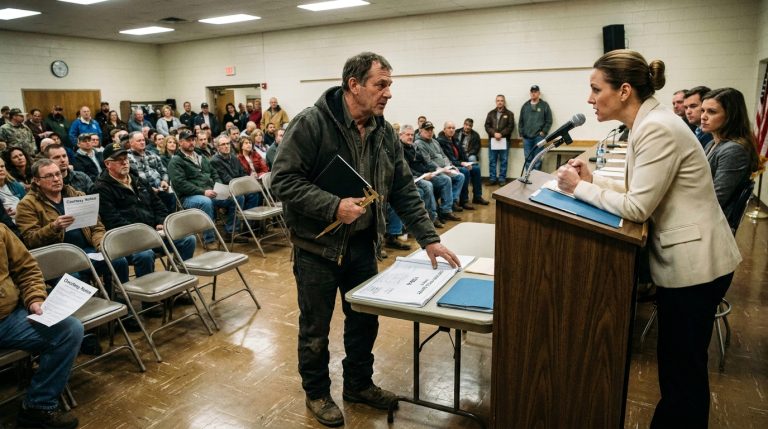
At precisely seven o’clock, the side door clicked open. Karen Peterson walked in, flanked by her two board cronies who had flown back from Florida to maintain quorum. She wore a tailored beige blazer, her hair styled with rigid precision, carrying a stack of papers and an expression of absolute, unyielding sovereignty.
She strode to the podium at the front of the room, expecting the usual sparse gathering of five or six apathetic faces. Instead, she lifted her eyes and stopped dead.
One hundred pairs of eyes stared back at her from packed rows of folding chairs and bodies lining the walls. The room was thick with a heavy, simmering quiet—the kind of silence that precedes a structural collapse. The collective weight of years of silent fines, arbitrary restrictions, and suppressed frustration hung in the air like dust before a storm.
Karen’s professional smile faltered, her jaw tightening as she tapped the metal gooseneck microphone. The feedback shrieked, a sharp, metallic squeal that bounced off the cinderblock walls.
“Welcome,” Karen began, her voice pitching slightly higher than usual. “To the annual meeting of the Whispering Pines Estates Homeowners Association. We have a packed agenda, so let’s move directly to the budget review—”
Before she could finish the sentence, Arthur Henderson stood up. The scraping of his folding chair against the linoleum floor sounded like a starting pistol.
“Point of order, Madam President,” Arthur said. His voice was steady, carrying a clear, resonant authority that caught the entire room by surprise. “According to association bylaws, Article Three, Section Four, a petition signed by forty percent of the active membership has been legally submitted to amend the order of business. The first item on tonight’s docket is a motion for an independent forensic audit of all association accounts.”
A low murmur rippled through the rows of homeowners. Karen’s face instantly mottled into a deep, furious crimson—the exact shade I had seen that first morning at my property line.
“That motion is out of order!” Karen snapped, her knuckles whitening as she gripped the edges of the wooden podium. “The agenda was locked by executive committee vote forty-eight hours ago. We will not be sidetracked by unauthorized procedural stunts.”
“It is entirely in order,” Sarah said, standing smoothly from her seat in the back row. She didn’t raise her voice, but every syllable cut through the ambient tension like a razor. “My name is Sarah Jenkins, counsel for Mr. Henderson and the property coalition. The petition complies with every statutory requirement. The floor belongs to the members.”
Karen’s eyes widened in sudden, stark disbelief as she realized the trap had sprung. The procedural walls she had built over five years to isolate her authority weren’t protecting her anymore; they were locking her inside a room with the people she had taxed, fined, and cornered.
The meeting fractured instantly into open confrontation. One by one, residents stood at the secondary microphones the coalition had brought, laying bare the mechanics of her rule. The young father spoke of the fine levied against his family’s baby stroller left on their own porch. Mrs. Gable recounted the arbitrary citation issued against her decades-old bird feeder. Each testimony dropped another heavy stone onto the foundation of Karen’s authority.
When Arthur finally stepped forward to introduce the motion of censure and the vote of no confidence, the tension reached its breaking point. He clicked a remote, and a high-definition projector flashed a pair of stark, contrasting images onto the white wall behind the podium: my sunlit deer stand on the left, and Karen’s obtrusive, unapproved dome camera staring down from her eaves on the right.
The visual juxtaposition was devastating. Murmurs of disbelief rolled through the crowd, quickly turning into open, cold laughter.
Karen stood paralyzed at the podium, her defense mechanisms entirely stripped away by the raw weight of the evidence. When the vote for her removal was called, a forest of hands shot into the air across the room. Only two hands remained down—her Florida cronies, who sat staring fixedly at their laps, refusing to meet anyone’s gaze.
The gavel slipped from her fingers, clattering against the wood as she abandoned the podium, storming down the center aisle without looking left or right. As she passed our row, her eyes met mine for a brief, hollow second—the look of an architect whose entire bridge had just given way beneath her feet.
The heavy exterior door swung shut behind her, sealing the silence of a community that had finally taken back its own ground.
CHAPTER 8: THE DUSTY GRAY SETTLEMENT
The heavy oak door of the community clubhouse clicked shut behind Karen, but the silence she left in her wake did not feel empty. It felt like the settling of dust after an old wall has finally been kicked down.
Arthur Henderson picked up the brass gavel she had abandoned on the podium, his hand steady as he tapped it once against the wood to call the fractured room back to order. Within minutes, the motion for the independent forensic audit passed unanimously. The machinery of control that had dictated the subdivision’s daily life for half a decade was dismantled in less than an hour, replaced not by a new tyrant, but by the slow, grinding gears of accountability.
Two weeks later, the results of the forensic audit landed on Sarah’s desk and rippled outward through the municipal channels. The independent CPA from downtown didn’t just find discrepancies; they uncovered a multi-year architecture of systematic financial evasion. The community improvement fund—fattened by years of predatory fines levied against Arthur and other compliant homeowners—had served as Karen’s personal clearinghouse. Receipts for lavish personal expenses were filed under common-area maintenance, while fake consulting fees routed thousands of dollars into accounts tied to her unemployed relatives.
Faced with the compiled evidence from the forensic audit and the district attorney’s office, the choice was stripped of any grey ambiguity. The option to settle quietly evaporated under the weight of felony embezzlement charges.
The white SUV disappeared from the subdivision driveway within forty-eight hours, replaced by a drab, utilitarian moving van. I stood near the property line by the southern edge of my ten acres, watching through the thinning autumn brush as Karen directed a pair of hired movers loading cardboard boxes. Her floral-print windbreaker was gone, replaced by a dark, nondescript coat. She looked smaller against the backdrop of the beige siding she had fought so hard to curate, her authority reduced to a pile of stacked crates on an asphalt apron.
There was no sense of triumph in watching her leave—only the heavy, dry recognition that systems built on pure friction always eventually grind themselves to dust. She had fought a war for control over land she did not own, and in doing so, she had exposed the hollow core of her own kingdom.
The house sold quickly at a court-ordered auction to cover the restitution owed to the association treasury. The new owners, a quiet couple with a pair of golden retrievers, tore down the obtrusive security camera from the second-story eaves on their very first afternoon, replacing the metallic dome with an empty bracket of fresh air.
Within a month, Whispering Pines began to change its texture. The rigid, uniform beige across the street started giving way to the messy, vibrant realities of neighborhood life. Mrs. Gable’s garden burst into an unapproved riot of color, and Arthur Henderson’s small army of ceramic gnomes returned to their post around the bird bath, standing guard over a terrace that finally breathed easy.
On my ten acres of raw woodland, the transition was simpler, marked only by the shifting seasons.
The frost had finally set in by late November, coating the fallen oak leaves in a brittle, glittering glaze. I climbed the ladder of my deer stand, the galvanized steel bolts cold and solid beneath my gloved hands. Up in the fork of the massive oak, fifty yards inside my recorded boundary, the world opened up across the valley in sharp, clear lines.
I settled onto the wooden bench, unhooking the latch of my thermos and pouring a cup of dark coffee. The steam rose into the crisp morning air, mixing with the scent of damp earth, iron, and dry pine.
A sound from the trail below broke the quiet—the steady, crunching cadence of boots on frozen gravel. I looked down through the overhead canopy and saw Dave making his way through the brush line, dressed in heavy canvas camo with a rifle slung over his shoulder. He stopped at the base of the oak, tilted his head back, and let out a low whistle.
“Still standing, I see,” Dave called up, his voice carrying the familiar gravelly rumble. “Room for an extra set of boots up there?”
“Always,” I said, reaching down to grab the spare insulated cup from my pack and pouring a second measure of coffee.
Dave climbed the ladder with practiced ease, settling onto the bench beside me. We sat in silence for a long time, watching the morning mist burn off the distant ridgeline as the sun climbed higher into the pale winter sky. We didn’t talk about Karen, or the HOA bylaws, or the thick binder of documentation sitting securely on my kitchen shelf. There was no need. The war was over, the ledger was balanced, and the boundary lines were quiet.
My fingers brushed against the smooth metal of the thermos, engraved with a single, unyielding phrase: Govern yourself accordingly.
I took a slow sip of the coffee, feeling the warmth settle into my chest. The deer stand was no longer just a tactical outpost or a line drawn in the dirt. It was simply a cathedral in the woods, and the sunrise had never looked more permanent.