The Weight of Quiet Skies: A Reckoning of Faded Ink and Generational Honor
CHAPTER 1: THE SILENT GROUND
The rock was gray, jagged, and caked in dry San Diego clay. Derek balanced it in his palm, his knuckles white against the dust, his eyes locked on the unmoving bundle of olive-drab canvas beneath the interstate overpass. The heat rising from the asphalt smelled of spent fuel and parched earth, a thick, suffocating weight that pressed against the chest. The old man hadn’t shifted an inch since the first stone chipped the concrete pillar three inches from his temple. He lay with his back against the rough, stained foundation wall, his breathing so shallow the frayed wool of his jacket barely registered the movement.
“Hey, bum,” Derek called out, his voice cracking slightly before he reclaimed the hard, empty cadence he used when his friends were watching. “I know you’re awake. Look at me when I’m talking to you.”
The old man opened his left eye. It wasn’t the bloodshot, unfocused gaze Derek expected from the regulars who drifted along the base fence line. It was dry, clear, and exceptionally still. For three seconds, the eye held Derek’s reflection in the gray-blue iris, measuring the distance, the velocity of the boy’s breath, and the trembling tension in his raised elbow. There was no anger in the look—only a profound, freezing calculation that made the two boys standing behind Derek take a slow, involuntary step backward into the weeds.
The silence stretched, vibrating with the low, distant whine of a turbine engine warming up across the airfield at Miramar. Derek’s throat went dry. The silence felt heavy, like the atmospheric drop before a flash flood. He mistook the lack of movement for a surrender. He needed the story; he needed his friends to see him break the stillness of the old man who never begged. Derek pulled his shoulder back, the rock catching the glare of the descending sun.
“Drop it.”
The voice didn’t come from the shadow of the bridge. It came from twenty feet behind them, flat, mechanical, and absolute.
Derek spun around. His boots skidded on the loose gravel of the embankment. Four men stood on the access path, their flight suits unzipped to the waist in the midday heat, green cloth dark with sweat marks beneath their heavy gear harnesses. The speaker was a staff sergeant, his chest broad, his face hardened into an expression that treated the teenagers as nothing more than a minor obstacle on a logistics route. In his right hand, a paper coffee cup remained perfectly level, the dark liquid inside without a single ripple.
The rock slipped from Derek’s fingers, thudding uselessly into the dead grass. “We were just messing around,” he muttered, his chest tightening as the four Marines closed the distance without a sound, their boots moving in an unthinking, synchronous rhythm. “He’s just some guy.”
The staff sergeant didn’t look at Derek. His eyes passed over the teenagers entirely, focusing instead on the figure beneath the concrete beam. The old man was rising now. The motion was slow, a succession of heavy, deliberate alignments that looked less like a man getting up and more like an old piece of machinery clicking back into its tracks. His boots, though scuffed at the toe, were laced with an exact, parallel precision that left no loose slack in the black leather cords. As his sleeve pulled back against the concrete wall, the fading sunlight caught the dark, thick lines of old ink embedded deep into the weathered skin of his forearm—an eagle, a globe, and an anchor, its borders blurred by fifty years of skin and sun, but its shape unmistakably clear.
“Go home,” the staff sergeant said quietly to the boys, his eyes never leaving the tattoos.
Derek didn’t look back. He and his friends scrambled up the dirt incline toward the suburban street, their footsteps fading into the rush of the traffic above.
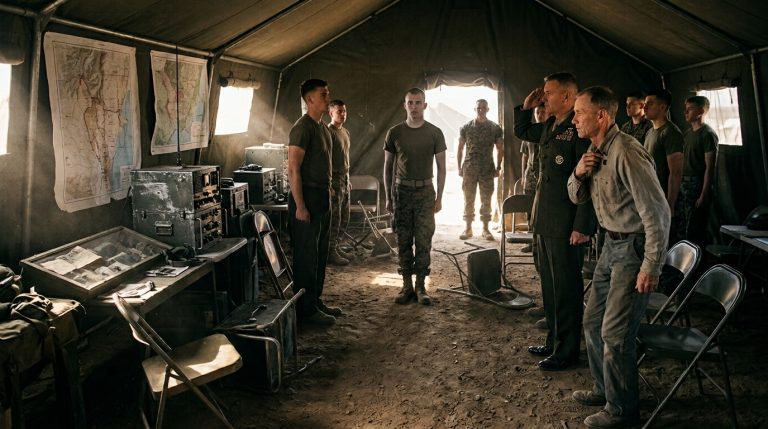
The four Marines stepped under the shadow of the overpass. The air here was cooler, smelling faintly of old rain and iron. The staff sergeant stopped five feet away, his posture straightening by a fraction of an inch as he observed the old man standing at an easy, instinctive parade rest.
The youngest of the group, a lance corporal with grease beneath his fingernails, leaned closer, his eyes widening as he caught the scent of clean gun oil rising from the old man’s gear bag. “Sarge,” he whispered, pointing toward the right arm. “Look at the hat on the skull.”
Beneath a long, puckered scar that split the muscle of the old man’s forearm, a faded black silhouette of a skull wore a distinct, wide-brimmed bush hat, the words Death from Above curved into the skin below it like an old brand. The staff sergeant’s hand tightened on his coffee cup until the paper buckled.
“Sir,” the staff sergeant said, his voice dropping into a register reserved for the interior of a command tent. “You served.”
The old man looked at the four young faces, his gray beard trimmed short, his expression completely blank. He gave a single, slow nod that seemed to carry the weight of an entire afternoon. “Long time ago,” he said, his voice like stones rolling in a dry creek bed. “Different world.”
The lance corporal stepped forward, a small, testing smile on his face. “What was your MOS, sir? Support? Logistics?”
The old man didn’t blink. The silence returned, thick and unyielding, before he spoke a single string of digits that caused the staff sergeant’s fingers to completely let go of his cup.
“0317,” the old man whispered.
The cup hit the concrete. The hot coffee splashed across the sergeant’s boots, steaming in the cool shadow of the bridge, but nobody moved.
CHAPTER 2: THE REVERBERATION OF THE NUMBER
The stain expanded across the dry gray concrete, a dark, jagged island of steaming liquid that swallowed the dust between the staff sergeant’s boots. The smell of cheap, scorched chicory coffee rose sharply into the stagnant air beneath the overpass, mixing with the underlying stench of old rust and diesel exhaust. Nobody moved to clean it. Nobody looked down. The lance corporal’s eyes remained locked on the old man’s face, his lips parted slightly as if the digits 0317 were still hanging visibly in the air between them.
The staff sergeant, Michael Torres, kept his arm suspended in the empty space where the paper cup had been just a second prior. His fingers remained slightly curved, frozen in the exact shape of the cardboard cylinder he had allowed to slip away. His gaze didn’t wander; it anchored itself to the gray-blue eye of Thomas Walker with an intensity that seemed to pull the distant roar of the Miramar flight line down into absolute nothingness.
“Say that again,” Torres said. His voice had lost its authoritative, transactional edge. It was lower now, thick and granular, the tone of a man trying to steady a weight that had suddenly shifted in his hands.
The old man didn’t blink. He stood at that effortless, unyielding parade rest, his heels together at a perfect forty-five-degree angle, his thumbs lined up precisely along the seams of his faded, grease-stained trousers. The position looked so natural on his frame that it seemed to have structurally altered his bones over the decades. The frayed cuffs of his civilian jacket stayed pulled back, exposing the blurred ink of the eagle, globe, and anchor.
“0317,” Thomas repeated quietly. The gravel in his throat didn’t shake. “First Recon. Before the designation changed, before the world got clean.”
The two other Marines in the back, who had been shifting their weight on the gravel incline, went entirely still. The casual, testing posture they had assumed when the lance corporal asked his question evaporated. The air under the bridge became restrictive, crowded with the unseen presence of things that weren’t recorded in standard operational logs. To an outsider, a string of numbers was just arithmetic; to the men standing in the green flight suits, it was a ledger written in blood and heavy iron.
Torres took a single step forward. His heavy flight boots didn’t crunch on the loose gravel; he placed his weight down deliberately, as if navigating a sector that hadn’t been cleared for mines. His eyes moved down the old man’s right forearm, tracking the puckered, jagged line of the scar tissue where it split the faded ink of the skull in the bush hat. The words Death from Above were partially swallowed by the pale, raised skin of the old wound, but the silhouette of the wide brim remained intact.
“The skull,” Torres said, his eyes rising back to the old man’s face. “The hash marks on the sleeve. You aren’t just a veteran who stayed behind the wire.”
“Nobody stayed behind the wire in the places they sent us, son,” Thomas murmured. His eyes didn’t look at Torres; they looked through him, focusing on the distant chain-link fence line that marked the perimeter of the air station, where a line of F/A-18 Hornets sat like silent gray predators on the heat-shimmering tarmac. “The wire was a luxury for people who had names.”
The lance corporal swallowed hard, the youthful bravado completely gone from his face. He looked at the staff sergeant, then back at the old man’s canvas bag, which lay against the concrete pillar like a discarded piece of ballast. “Sarge,” he whispered, his voice cracking against the quietness. “The call sign. My dad told me about the names they didn’t put in the papers. He said there was one…”
“Shut up, Miller,” Torres cut him off, though his voice wasn’t angry. It was simply defensive, the instinctive reaction of a man trying to protect a boundary before it broke entirely. He turned his full attention back to Thomas, his chest rising and falling beneath the heavy nylon of his harness. “What was the call sign they gave you in the valley, sir?”
The old man turned his head slowly, the leather of his weathered neck creaking against the collar of his shirt. A faint shadow of a smile—something small, ancient, and entirely devoid of joy—passed over his cracked lips. He looked down at the dark stain of the spilt coffee between their feet, watching the steam thin out into the dry wind.
“The North Vietnamese called us the ghosts who don’t leave tracks,” Thomas said, his voice dropping into a register that was barely audible above the distant rumble of the highway traffic. “But the logbooks at Dong Ha had a different name for the team. They called us Reaper Storm.”
A physical shudder seemed to pass through Torres’s shoulders. The staff sergeant didn’t step back, but his posture fractured for a fraction of a second, his weight shifting to his back heel as if he had just received a concussive blow to the chest. The other Marines looked at each other, the confusion on their faces turning into a deep, heavy sobriety as they recognized the absolute transformation in their leader.
“Reaper Storm,” Torres whispered, the syllables leaving his mouth like a confession. “The spider hole at Khe Sanh. Three days in the clay while the artillery tore the trees into splinters.”
Thomas’s left hand, which had been resting flat against the side of his thigh, tightened into a fist. The skin over his knuckles turned a sharp, bloodless white, the old skin stretching until the faded ink of a small cross between his thumb and forefinger distorted. He didn’t answer with words; he simply closed his eyes, his breathing flattening into a long, slow exhalation that smelled faintly of salt and the dry earth of the ditch.
“You’re him,” Torres said, his voice rising in volume as the reality settled into the small space beneath the bridge. “You’re the man my father talked about every November until the day his heart stopped.”
Thomas opened his eyes, and for the first time, the cold calculation in his gaze was replaced by something softer, something frayed and heavy with the dust of an old century. He looked at Torres’s face, studying the line of the jaw and the specific, deep-set placement of the eyes beneath the utility cap.
“Your father,” Thomas said, his voice losing its gravel, sounding suddenly clear and distant. “Tell me his name, Staff Sergeant.”
CHAPTER 3: THE COLD WEIGHT OF RECOGNITION
“Michael Torres,” the staff sergeant said, his voice dropping an octave until it was a low vibration beneath the sound of a transport plane climbing into the low clouds above. “Staff Sergeant Michael Torres. Second Battalion, Twenty-Sixth Marines.”
Thomas did not move his head. His eyes remained fixed on the line of the younger man’s jawline, but something behind his pupils shifted, like dark water clearing after an oarsman stops pulling. The name hit the concrete wall of the overpass and seemed to sink straight into the gray stone. A sudden phantom of memory—the sharp, copper taste of rain mixed with cordite, the wet, yellow-clay banks of a trench line where the jungle had been stripped to black toothpicks by artillery—flashed through his mind. The heat beneath the bridge suddenly felt identical to the stifling humidity of the green valley floor fifty winters ago.
“Little Mike,” Thomas said. The words came out thin, dry, and clean, devoid of the performance people expected when old men talked about old wars. “He used to carry three extra cans of peaches in his pack. Not for him. He gave them to the children near the perimeter wire at the church. Even when the supply lines were cut and we were down to salt tablets and hard crackers, he kept one hidden in his sock for the little girl with the torn smock.”
Torres’s fingers dropped to his sides, his hand no longer mimicking the shape of the coffee cup he had let go. He stared at Thomas, his chest frozen mid-breath. “He told me about the peaches,” he whispered. “He told me he only survived because someone from the high ridge kept the trench clear for seventy-two hours while the relief trucks were burning on Route Nine.”
“The ridge was high enough to see the mortar tubes,” Thomas murmured, his left thumb rubbing against the frayed edge of his pocket seam, tracking the rough weave of the canvas material. “If you saw the flash, you had three seconds to find the operator. Your father had a picture of a girl with a blue ribbon in her hair tucked into the band of his steel pot. He used to look at it every time the signal flares went green.”
“That was my mother,” Torres said. He reached down into the collar of his flight suit, his fingers pulling at a thin steel chain until two worn, notched silver tags slipped out from beneath the olive cloth. They jingled softly against his zipper, a light, metallic sound that seemed entirely too delicate for the space they occupied. “He kept them. He gave them to me when I finished the loop at Pendelton.”
The lance corporal, Miller, took half a step backward, his boots clicking against a piece of glass in the gravel. The two other Marines behind him had completely uncovered their heads, their utility caps tucked tightly under their left arms as if they had suddenly stepped out of the drainage ditch and into a chapel. The heat of the afternoon sun was beginning to drop, casting long, purple shadows from the highway stanchions across the embankment, painting the old man’s graying beard in ribbons of dull gold.
Thomas looked down at the silver tags dangling between the staff sergeant’s fingers. He didn’t reach out to touch them. His eyes were trained on the small notch at the end of the metal plate—the old style, designed to hold the wire in place. He knew the weight of those plates; he had cleared enough of them from chests that had stopped moving to know exactly how much noise they made when three men were moving through high elephant grass in absolute silence.
“He talked about the family he wanted to have,” Thomas said, his voice dropping into a steady, flat rhythm that carried no sentimentality, only the hard truth of an accounting. “When the night was dark enough to hide the smoke, he’d sit in the mud and talk about a house with an oak tree in the front yard. Somewhere where the ground didn’t shake when the clouds came over. I’m glad he got to build it.”
“He built it in Escondido,” Torres said, his eyes turning slightly glassy as the wind from the highway blew a small cloud of gray dust across his face. “The tree is still there. He died under it four years ago. Clean shirt, quiet room. He always said he was living on time that had already been paid for by a man who didn’t want any change back.”
The old man turned his gaze back to the base perimeter fence, where the wire ran straight and true toward the salt flats. His canvas bag sat undisturbed at his heel, its strap tucked under the iron heel of his boot. Beneath the canvas layer, tucked into a small grease-cloth sleeve, lay a single yellowed envelope he had carried through three states—a letter written by Michael Torres’s father forty years earlier, a page containing a confession that had never been mailed, detailing the one choice at Khe Sanh that neither man had ever been able to wash out of their clothes.
“He was a good Marine,” Thomas said softly, his hand dropping back to his side, his posture remaining locked in that effortless, permanent parade rest. “He didn’t leave anything in the mud that he needed to carry home. You have his eyes, Staff Sergeant. See to it that you carry the rest of him the same way.”
Torres didn’t answer right away. He stood in the settling dust of the drainage ditch, his boots stained with the dried mud of the access road, his fingers still holding the silver tags against his chest as the shadows of the overpass lengthened until they swallowed them both.
CHAPTER 4: THE FRAGMENTS LEFT BEHIND
The tags dropped back against the heavy olive nylon of Torres’s flight suit with a faint, clean click. The small sound seemed to break the invisible circuit holding the four Marines motionless in the dusty ditch. A low, cool draft swept through the concrete gap, scattering a few dry sycamore leaves across the patch of gravel where the sergeant’s coffee had already sunk into the porous stone, leaving only a dark, irregular shadow.
Thomas looked down at his own hands. The knuckles had unlocked, the old skin smoothing out over the tendons, though the small blue cross near his thumb remained slightly misshapen. He slowly shifted his weight, his worn boot heel pressing down on the heavy strap of his canvas bag. He did not mean to hide it; it was an old habit of defense, a physical reflex from a time when an unsecured piece of equipment meant an absolute compromise of position.
“You should get back inside the gate, Staff Sergeant,” Thomas said, his voice dropping into that rhythmic, flat quietude that offered no room for argument. “The sun is below the hills. The watch changes at 1800, and your people are missing their evening check.”
Torres looked at the old man for three long seconds, his jaw setting into a hard, professional line that struggled against the raw weight of the stories he had carried since childhood. He did not step back. Instead, he unclipped a small, black tactical pen from his sleeve pocket, pulled a scrap of grid paper from his flight log, and pressed it against the cold concrete pillar. The scratch of the metal tip against the paper was the only noise beneath the bridge for six seconds.
“This is my personal line,” Torres said, extending the folded slip toward Thomas. He didn’t drop it. He held it in the air between them, waiting for the old man to take the weight of it. “It doesn’t go through the base switchboard. If you need a roof, if you need a meal that didn’t come out of a cardboard sleeve, or if you just want to sit under that oak tree in Escondido… you use it.”
Thomas stared at the paper. His fingers didn’t move toward it. “I’ve had my meals, son,” he murmured. “And the sky out here doesn’t shake anymore. That’s enough for what’s left.”
“My father lived forty-four years because you stayed in that hole,” Torres said, his hand remaining absolute, his fingers unmoving. “Take the paper, sir. For him.”
The mention of the older Torres seemed to act like a physical lever. Thomas’s arm rose slowly, his hand moving with an incremental, practiced stiffness until his dry fingertips brushed against the paper. He took it, folding it twice with his thumb before slipping it into the deep breast pocket of his jacket, right next to the stiff, oil-cloth sleeve that held his own secrets.
As his fingers cleared the pocket, they caught on the worn zipper of the small canvas bag at his feet. The coarse teeth of the brass slide gave way by an inch, just enough for the shifting gray light of the sunset to catch a pale, yellowed fragment inside. It wasn’t a weapon or a medal. It was the fibrous, brittle edge of an unmailed envelope, its corner marked with a faint, purple postmark from a military field office that had ceased to exist in 1972. Tucked beneath the flap of that ancient parchment, visible only as a dark silhouette through the thin paper, was a hand-drawn blueprint grid—a partial sketch of a specific coordination point near the eastern boundary of the old Miramar salt flats.
Torres’s eyes dipped down, tracking the movement of Thomas’s hand, his gaze lingering for a fraction of a second on the pale edge of the document before the old man smoothly pulled the canvas flap closed with his boot toe. The sergeant didn’t question it. In the reconnaissance community, a man’s gear was his own territory, and some files were never meant to be opened by anyone who hadn’t shared the mud.
“We’re clear, Sarge,” Lance Corporal Miller said from the path, his voice low and respectful as he adjusted his utility cap. “The transport driver is idling by the hangar.”
Torres gave a single, imperceptible nod to his men, then turned back to Thomas. He brought his right hand up to the brim of his cap—not the quick, casual salute of an airfield detail, but the crisp, locked-elbow alignment reserved for an inspection by the commandant. He held it there, his boots planted firmly in the gray dust, until Thomas slowly raised his own hand in return, his fingers steady despite the tremor of his age.
“Keep the faith, Reaper Storm,” Torres said quietly.
“Carry his heart, Mike,” Thomas replied, using the father’s name for the son without realizing it.
The four Marines turned and walked up the gravel incline, their boots rhythmic and synchronous as they moved toward the high chain-link fence of the air station. Thomas watched them go until their green flight suits dissolved into the long, dark shadows of the perimeter hangers. When the twilight had turned the concrete overhead into a solid block of slate, he sat back down, his spine meeting the rough stone, his hands reaching into the canvas bag to trace the geometric lines of the drawing he had guarded for fifty years.
CHAPTER 5: THE ENCROACHING MIST
The final echo of the transport driver’s shifting gears faded into the low drone of Interstate 15. As the dark silhouettes of the four Marines dissolved completely into the hangar shadows near the flight line, a thick, cold layer of Pacific fog began to spill over the eastern ridge line. It wasn’t a gentle mist; it was heavy, wet, and smelled faintly of sea brine and aviation fuel, rolling across the dry brush of the canyon like thick smoke. Within minutes, the sharp edges of the Marine Corps Air Station Miramar perimeter fence became soft, gray, and indistinct.
Thomas sat perfectly still in the expanding dark, his back supported by the cold, damp concrete stanchion. The temperature plummeted with the arrival of the fog, the moisture instantly binding to the dust on his trousers and turning the worn wool of his jacket stiff. His fingers stayed buried inside the coarse fabric of his canvas bag, his thumb pressed flat against the geometric grid lines of the hidden drawing. The paper felt different now—cold and slightly limp from the humidity, its fragile texture matching the fraying edge of the unmailed envelope next to it.
He didn’t need to look at the drawing to see the coordinates. They had been burned into his memory long before he ever chose this specific concrete pillar as his outpost. But the physical presence of the document was a anchor. Every night for fifty years, his internal compass had pointed toward that exact intersection near the salt flats—the place where the final unfulfilled order of his platoon commander remained buried beneath six inches of coastal clay.
A sharp click echoed from the gravel path forty yards away.
Thomas’s breathing flattened instantly. His eyes didn’t widen; they narrowed, his focus slicing through the gray wool of the fog toward the approach route. His hand slipped away from the drawing, his fingers tracking the seam of his coat until they brushed against the heavy steel utility tool tucked into his belt. It wasn’t a weapon by design, but fifty years prior, he had learned that anything with weight and a hard edge could change the geometry of a confrontation if the spacing was correct.
The sound came again—the wet crunch of a heavy boot pressing down on a decomposed granite stone, followed by the dull rattle of a chain-link gate swinging on a rusted hinge. It wasn’t the active-duty detail. The active-duty men moved with an unthinking, synchronous cadence that gave their positions away a quarter-mile before they arrived. This movement was deliberate, broken into uneven, cautious segments, the spacing of a tracker trying to balance momentum against visibility.
Through the shifting ribbons of fog, a wide, low shape materialized near the base perimeter wire. It wasn’t a patrol vehicle. It was a civilian utility truck, its lights entirely extinguished, its engine cut so early that it had rolled to a stop on the service path purely by its own remaining velocity. A door click sounded—muffled by a thick rag held against the mechanism—and a figure stepped down into the tall weeds.
Thomas didn’t rise. He remained in the deep shadow of the overpass, his body completely matching the gray-black contour of the concrete base. He allowed the mist to settle over his shoulders until his silhouette was indistinguishable from the masonry. He watched the figure move toward the fence line, carrying a long, canvas-wrapped bundle that lacked the clean, parallel lines of standard military gear.
The stranger stopped ten feet from the wire, his head turning in a slow, mechanical arc as he surveyed the empty drainage ditch. The fog obscured his face, but the light from a distant, orange sodium lamp on the hangar wall caught the edge of a thick, civilian jacket and the faint, cold gleam of a heavy brass padlock tool held in his gloved left hand. He wasn’t looking for the old man. He was tracing the exact alignment of the surveyor’s stakes that ran along the eastern flats—the very markers Thomas had spent the last three months watching from his concrete perch.
A sudden, deep thrum rattled through the ground as an F/A-18 taxied onto the taxiway half a mile away, its engines invisible behind the gray wall of the mist. The sound was deafening, a wall of vibration that shook the loose gravel in the ditch and rattled the iron bolts in the bridge structure overhead.
In that exact micro-second of maximum noise, the stranger raised the tool and pressed it against the ancient brass lock that held the maintenance gate secure. He didn’t rush. He used the roar of the turbine to mask the sharp, metallic fracture of the internal pins.
Thomas felt a cold sensation settle in the pit of his stomach—not fear, but the old, tactical clarity that always arrived when a perimeter was compromised. The letter from Torres’s father, still tucked into his breast pocket, seemed to grow heavy against his chest. The stranger wasn’t a trespasser looking for scrap iron; he was navigating by the same grid lines that Thomas carried in his bag. The layer of defense he had maintained in complete silence for decades was beginning to buckle under the weight of someone else’s arrival.
The stranger pulled the chain away from the gate post, the heavy iron links slipping through the wire mesh with a low, wet hiss that was entirely swallowed by the fog. He stepped through the gap, his face turning toward the dark recess beneath the overpass where Thomas sat unmoving, the cold Pacific mist settling between them like a curtain of gray slate.
CHAPTER 6: THE WEIGHT OF THE GRID
The intruder didn’t rush. He moved with a calculated, sluggish grace that suggested he was just as affected by the dropping temperature and the thick, suffocating wall of fog as Thomas was. He stood near the open maintenance gate, his silhouette a jagged, dark hole in the shifting gray mist. He seemed to be listening, his head tilted at an angle that ignored the nearby thrum of the jet engines, tuning instead to the local acoustics of the overpass.
Thomas felt his muscles coil. He didn’t tighten his grip on the tool at his belt; he kept his fingers loose, a trick he’d learned in the high ridge country where any visible tension in the arm would manifest as a twitch that could be spotted in the dark. He remained a statue against the concrete. The fog dampened the sound of his breathing, turning every inhalation into a soft, internal rustle that felt louder than the wind.
The intruder took two steps into the ditch, the mud sucking at his soles with a wet, sticky sound. He was looking at the ground, his eyes scanning the clay as if he were hunting for a specific landmark—a piece of buried debris or a change in the soil density that shouldn’t be there. He halted three feet from the pillar where Thomas sat. The old man could smell the sharp, chemical odor of new plastic and grease coming off the bundle the stranger carried—a contrast to the smells of old rust and damp earth that clung to the overpass.
“The soil here is too loose,” the stranger said. His voice was flat, carrying no regional lilt, his tone the clinical, deadened sound of a man who spent his life analyzing data rather than speaking to people. He reached into his coat and produced a high-lumen, filtered flashlight. He didn’t point it toward the overpass; he angled it downward, creating a small, intensely focused circle of pale, cold light on the bank.
The beam washed over the dirt, revealing the subtle indentations where the brush had been cleared away. It moved closer. Thomas watched the edge of the light creep toward his boots, the fibers of his canvas bag catching the glare like a beacon. The intruder’s boot stopped inches from the bag’s leather-reinforced corner.
“I know you’re here, Thomas,” the man said. The name wasn’t spoken with malice; it was spoken like a file entry.
Thomas felt a chill that had nothing to do with the fog. He had spent decades as a ghost, a name erased from every official roster, an absence in the military records of the Pacific command. To hear his name spoken in this desolate strip of land between the highway and the base was to feel the perimeter of his life suddenly collapse. He slowly straightened his legs, the motion as quiet as a sliding bolt.
“You’re about fifty years too late for an extraction,” Thomas said. His voice was a dry, raspy scrape that seemed to startle the man in the light.
The stranger didn’t jump. He pivoted, his movement fluid and defensive, the flashlight beam cutting a jagged, strobing path through the mist until it landed on Thomas’s chest. The old man didn’t shield his eyes. He sat unmoved, his gray beard matted with moisture, his eyes reflecting the cold, artificial light with an unnerving, vacant stillness.
“I’m not here for an extraction,” the stranger said. He reached down and opened the canvas bundle he carried. It wasn’t a weapon. It was a specialized, ground-penetrating mapping device—a folding array of sensors that looked like a spider’s web of carbon fiber. “I’m here to finalize the survey. The Department of the Interior has a project for the expansion of the eastern runway. This sector is marked as a clean zone. I’m just making sure the record is accurate before the graders arrive next month.”
The words hit Thomas with more impact than a physical blow. The runway expansion. The systematic erasure of the very terrain he had been guarding. If they started the grading, the heavy machinery would tear through the soil, churning up the remnants of the Khe Sanh cache he had spent half a century protecting. The letter, the blueprint, the heavy, metallic silence of the things he had left in the mud—they would be exposed, labeled, and discarded by a construction crew that wouldn’t know the value of a single rusted casing.
“This sector is closed,” Thomas said, his hand finally moving to the steel tool at his belt.
“It’s government land, Thomas,” the man said, taking a step closer, the cold, white light blinding and absolute. “And you’re just a squatter. You’ve been playing guard for a long time, but the mission ended in 1973. It’s time to let the ground go.”
Thomas didn’t answer. He watched the man, his mind rapidly calculating the distance to the fence and the weight of the tool against the man’s tactical reach. The fog surged, a massive, cooling cloud that momentarily swallowed the flashlight’s glare, plunging them both back into the deep, heavy dark of the overpass.
CHAPTER 7: THE LAST SUNRISE
The silence was absolute, heavier than the roar of the turbines that had preceded it. In the sudden dark of the overpass, Thomas didn’t rely on sight. He relied on the vibration of the air. He felt the minute shift in the stranger’s weight—the subtle tightening of the thighs, the preparation for a sudden, lunging move that would leverage the superior mass of the younger man against the old man’s frame. Thomas pivoted, his back sliding just a fraction of an inch against the concrete pillar, his hand finding the grip of his utility tool with a fluid, learned motion that hadn’t betrayed him since the late sixties.
The intruder moved first. He surged forward, his hands grasping for the neck of Thomas’s jacket, hoping to pin the old man against the stone. But he underestimated the precision of the ghost. Thomas didn’t fight the leverage; he stepped inside the arc of the man’s reach, his arm swinging in a short, tight, circular motion. He didn’t use the tool to strike; he used it to anchor himself against the man’s center of gravity, shifting his own hips until the younger man was momentarily off-balance.
There was a wet, metallic sound as the tool caught the edge of the man’s jacket—not flesh, but the heavy, synthetic weave of a hidden gear-pack. The man stumbled back, his boot catching on a loose piece of concrete rubble. He landed hard on the gravel, the impact forcing a sharp, jagged intake of breath from his lungs. The flashlight skittered away, its beam dying against a patch of dead, dry weeds.
“You’re not a surveyor,” Thomas said, his voice quiet, steady, and utterly devoid of fear. He stood over the man, his silhouette a dark, immovable shape against the backdrop of the bridge. “A surveyor doesn’t move with a combat-ready stance, and he certainly doesn’t bring a thermal-mapping array to a site he claims is empty.”
The intruder scrambled backward, his gloved hands feeling through the mud. His fingers brushed against his kit, and in the thin, pale light filtering through the fog, Thomas saw the glint of a secondary device—a compact, high-frequency signal scrambler, its small, green LED light pulsing with a rhythmic, illegal frequency. The man wasn’t just here to map the land; he was here to monitor the perimeter for something that had been hidden in the ground for nearly five decades.
“You’re a scavenger,” Thomas said, the realization settling into his chest like cold iron. “You’ve been tracking the radio signatures of the site, haven’t you? The buried relics in this sector—they weren’t just discarded metal. There were communication packets. Encoded logs.”
The man went still. He didn’t deny it. He sat in the mud, his breathing ragged, his hand slowly reaching toward the signal device. “The logs are national property, Thomas. Everything from that sector was classified, even the stuff that never made it into the official reports. There’s a bounty for the recovery of those packets. People have been looking for the Reaper Storm cache for thirty years.”
Thomas looked down at the man, his expression unreadable in the dim, gray light. The history he had protected—the burden of his brothers, the unmailed letters, the raw, ugly reality of Khe Sanh—wasn’t just a weight he carried for his own soul. It was a target for people who lived in the light and treated history as a transaction.
He reached into his pocket and pulled out the old, oil-cloth sleeve. He didn’t look at the letter inside; he gripped the entire bundle, his hand steady. He had spent his life waiting for the ground to be torn up, waiting for the peace of his own guard to be shattered by the noise of the world. He realized now that he couldn’t stop the machinery of the base expansion, but he could ensure that the history didn’t become a digital asset for a scavenger.
“The packets you’re looking for were destroyed in the fire,” Thomas said, his voice dropping into a register that sounded like a final, unarguable report. “If you want to dig, you’ll find nothing but clay and broken glass. I buried the signal days ago in a place you’ll never reach.”
The intruder started to retort, but Thomas took a step forward, his shadow looming over the man with an authority that belonged to a different age. The man saw something in the old man’s eyes—a depth of focus, a lack of self-preservation that was more dangerous than a gun. The scavenger’s hand dropped away from the signal device. He knew he was looking at the end of a line, a barrier that no amount of mapping technology could penetrate.
Thomas walked past him toward the maintenance gate. He pulled the rusted chain, the links groaning in the damp air, and stepped out onto the open salt flats. The fog was finally beginning to lift, revealing the first, pale violet stripe of dawn in the eastern sky. He wasn’t running. He was heading for the final grid coordinate on the map—the place where he would commit the last of his memories to the ground, not for the sake of the base, but for the sake of the men who had shared his rations in the mud.
CHAPTER 8: THE FINAL POST AT WALKERS WAY
The salt flats were a flat, monochromatic expanse of gray and silver, shimmering under the weak, pre-dawn light. Thomas’s boots made a soft, crunching sound as he stepped off the gravel and onto the packed, saline earth. Every motion was deliberate, his body stripped of the adrenaline that had fueled his confrontation at the bridge. He was moving toward the specific coordinate he had memorized in 1972—a small, nondescript hummock of clay that lay just outside the projected boundary of the airport’s new runway.
Behind him, the distant, frantic motion of the base awakened. Sirens began to wail, not for an attack, but for the start of the morning watch. He ignored them. He reached the center of the flats, the place where he had spent weeks of his life as a young man, shielding the cache from the encroaching development of the military’s expansion.
He knelt, his joints protesting with a dull, rhythmic ache. He set his canvas bag down and pulled the heavy steel tool from his belt. He didn’t dig like a man desperate to hide evidence; he dug like a man clearing a path. He worked the clay, the cool, wet substance clinging to his fingernails, until the edge of his tool struck something hard. A rusted, secondary canister, sealed with heavy industrial wax.
Inside was not gold or weaponry. It was the physical record of the “Reaper Storm” operations—a collection of field logs, hand-drawn maps of NVA troop movements, and, most importantly, the letters of the men who hadn’t come home. And beneath the logs lay the final, unfulfilled order: a radio-encrypted relay device that had been supposed to signal the end of the operation, left behind when the withdrawal orders were suddenly accelerated, leaving Thomas’s team behind the line to be forgotten.
He felt a hand on his shoulder. It wasn’t the scavenger. It was Staff Sergeant Torres.
Torres had tracked him, his face pale in the rising sun, his eyes wide as he looked at the open canister. The younger man didn’t reach for his radio; he didn’t call for security. He knelt beside the old man, his knees sinking into the damp salt flats.
“They’re coming, sir,” Torres said, his voice quiet. “The surveyors are coming. They’ll find this.”
“No,” Thomas said, his breath hitching as he pulled the letter he had been carrying—the confession from Torres’s father—and placed it into the canister with the logs. “They won’t find anything but history.”
Thomas took the encrypted relay device and, with a final, firm motion, pressed it deep into the soft, wet clay of the trench he had dug. He filled it in, tamping the ground down until the surface was indistinguishable from the surrounding salt flats. The truth of what he had done—the tactical necessity he had carried for fifty years—was now finally part of the earth.
Torres reached out and placed his hand over Thomas’s. “My father was a good man,” he whispered. “He knew you stayed behind to hold the line so he could get home to the oak tree. He spent his life trying to live up to that. He didn’t need to write a confession. He needed you to know he never stopped being a Marine.”
Thomas looked at the younger man, the first real tears of his adult life tracking through the dust on his cheeks. He felt a sudden, profound lightness, as if the gravity of the battlefield had finally lost its hold on his bones.
The denouement came slowly. The base police arrived, their blue lights rotating in the brightening sky, but they did not approach with weapons drawn. They stood at the edge of the flats, watching as Staff Sergeant Torres helped the old man to his feet. Thomas handed Torres the canvas bag—it was empty now, save for the boots that had traveled across the world and back.
In the weeks that followed, the base commander recognized Thomas Walker with full honors, not for the classified shadows he had worked in, but for the man he had been in the daylight. The stretch of road near the overpass was named Walker’s Way, and a simple granite marker was placed at the site of his watch. Thomas passed away peacefully at the base hospital, with Torres at his bedside, the silence between them no longer heavy with secrets, but full of the peace of a mission finally, quietly closed.
The final pillars of the story were set: the antagonist’s scavenger plot collapsed when he was apprehended near the perimeter fence by base security—a failure born of his own arrogance. The physical object, the old canvas bag, was placed in the small memorial museum on the base, a testament to a man who had served with everything he had.
When the Marines performed their morning PT, they ran past the granite marker and gave a sharp, crisp salute. Thomas had spent his life guarding the truth of those who fell, and in the end, he was finally seen. The war, the jungle, and the ghosts of the valley were gone, and all that remained was the quiet, steady rhythm of the morning sun rising over a field that was finally at rest.