A Ghost in the Kitchen: The Quiet Redemption of the Valley’s Most Lethal Sniper
CHAPTER 1: The Scent of Change
The air in the range tower was stale, filtered through decades of dust and the metallic tang of brass casings. Outside, the desert heat shimmered, turning the distant steel target into a liquid, wobbling mirage. Saul felt the familiar pressure of the floorboards beneath his worn boots—a foundation that hadn’t betrayed him since 1972.
He didn’t need the binoculars. He felt the crosswind against his weathered skin, a whisper that told him the air was heavier than the automated sensors suggested.
“It’s not just the velocity,” Saul murmured, his voice a dry rasp that seemed too quiet for the gravity of the room. “It’s the canyon shelf. The air drops two hundred feet at the midpoint, creating a thermal pocket. You’re firing into a ghost of the wind that existed five seconds ago.”
Captain Miller stood stiff, his hands balled into fists at his sides. The arrogance that usually defined his posture had eroded, replaced by a frantic, analytical hunger. He looked at the screen, then back at Saul, his eyes darting to the star-shaped burn on the old man’s forearm. The sleeve had slipped, a small mistake in an otherwise perfectly curated life of invisibility.
“The sensor data says ten knots,” Miller pressed, his voice strained. “We’ve checked it three times. The computer doesn’t lie.”
Saul stepped toward the window, his movements slow, deliberate, the gait of a man who knew the cost of haste. He poured the last of the coffee from a battered thermos into a paper cup. The steam curled upward, a thin, white ribbon of warmth in the oppressive dry heat.
“The computer measures what is,” Saul said, watching the steam dissipate against the glass. “It doesn’t understand the shape of the land. It doesn’t know the canyon remembers the heat.”
Suddenly, the radio on the table crackled. General Sterling’s voice cut through the silence, crisp and demanding. “Miller. We’re losing the light. If that target isn’t tagged in ten minutes, the entire operation moves to secondary status.”
Miller looked at Saul, a silent plea hanging in the air. The weight of the mission—the lives of the men he led—pressed down on him. He wasn’t asking for a command anymore; he was asking for permission to be wrong.
Saul felt the familiar, cold tug of the memory—a ridge in the Valley of Tears, the smell of damp earth and fear, the way his finger used to rest on the trigger of an older, crueler rifle. The ghost didn’t want to come back. But looking at Miller, Saul saw the reflection of a younger, terrified man he hadn’t thought about in fifty years.
“Move aside,” Saul said softly.
He didn’t move toward the rifle. He moved toward the window, his eyes fixing on a lone, gnarled scrub bush five hundred yards to the left of the target. He wasn’t looking at the target. He was looking at the way the dust kicked up around it.
“There’s a flaw in your baseline,” Saul said, his voice sharpening, losing the tremor of the cook and finding the steel of the sniper. “You’re aiming for the kill. You need to aim for the truth.”
The door behind them creaked open. General Sterling stepped inside, his boots heavy on the concrete. He stopped dead, his gaze locking onto Saul’s forearm before moving to the rifle laying on the mat. He didn’t say a word, but the air in the room grew heavy with the weight of unsaid history. Saul didn’t turn around, but he felt the General’s eyes tracking the scar, recognizing the mark of a man who had been dead to the world for half a century.
CHAPTER 2: The Weight of the Ghost
The air in the range tower remained unnervingly still. General Sterling did not move, and Saul remained turned toward the window, his hand still gripping the cold, metallic rim of his coffee cup. He could feel the General’s gaze like a needle prick against the back of his neck, searching for the man who had vanished into the mountains of 1972.
Saul’s mind, usually as orderly as a well-maintained rifle, flickered. For a split second, the dust-choked desert air vanished, replaced by the damp, metallic stench of the Valley of Tears. He could hear the low, rhythmic thrum of rotors in the distance—the sound that had signaled the end of his duty and the start of his exile. The intrusive memory of his spotter’s body, cooling in the mud while the mortar fire turned the ridge into a hellscape, pressed against his consciousness. He shoved it down, anchoring himself in the present by the sensation of the rough, grease-stained apron tied around his waist.
“General,” Saul said, his voice flat, stripped of the cadence of the legend Sterling was hunting. He finally turned. He kept his eyes lowered, focusing on the scuffed boots of the man who held his future in his hands. “The coffee is getting cold.”
Sterling’s expression didn’t soften. He walked past Captain Miller, his presence commanding the cramped space. He reached out, not to strike, but to settle his hand on the heavy tactical rifle resting on the mat. He checked the bolt, his movements practiced and rhythmic.
“It’s not the coffee I’m interested in, Saul,” Sterling replied, his voice low, intimate. “It’s the mathematics of a man who doesn’t exist. You’ve been here for months. I’ve seen the reports—the way you move, the way you clear the range before the sun hits the horizon. You’re not a cook. You’re a tactical asset currently wasting his life in a mess hall.”
Miller shifted, uncomfortable. “Sir, I didn’t mean to—I didn’t know the connection until you mentioned it.”
“Nobody knows the connection, Captain,” Sterling snapped, his eyes never leaving Saul’s face. “Because it’s classified. Or it should have been.” He turned back to the window, watching the heat shimmer rise from the ridge. “We have a problem in the High Sierras. A specialized cache—reconnaissance data that cannot fall into the wrong hands. It’s sitting at an altitude that makes most modern targeting systems useless. The air up there is thin, and the wind behaves exactly like the wind in the Valley.”
Saul felt a cold chill trace the line of his spine, despite the blistering heat radiating through the glass. He knew that terrain. He knew the specific, treacherous geometry of those peaks. “There are other men, General. Men who have been training for this.”
“They don’t have your eyes,” Sterling countered. “And they don’t have the phantom calm you showed on the range today. I need someone to lead the team to that cache. Someone who understands that when the physics fail, the survival instinct is the only thing left.”
Saul looked at his hands. They were knarled, scarred, and covered in the faint, oily residue of his daily labor. They were the hands of a ghost who had found a comfortable grave in a kitchen. “If I go, I’m not a soldier,” he said, the words feeling like glass in his throat. “I’m a man who wants to be left alone.”
“Then do it for the men, Saul,” Sterling said, his voice dropping to a near whisper. “Do it so they don’t end up like the forty-seven men you pulled out of the fire fifty years ago. Because if you don’t help them, the mission will be a suicide run. I know you. You won’t let them walk into a grave.”
The room seemed to shrink. Saul looked at Miller, whose face was pale, reflecting the weight of the potential failure. Saul didn’t want the responsibility. He didn’t want the blood, the calculations, or the haunting silence of the scope. But as he looked at the open door, at the desert waiting for him, he knew the decision had been made for him the moment he took that first shot on the range.
“I’ll need my own gear,” Saul said, his voice barely audible. “And I don’t wear a uniform. I’m a cook.”
Sterling’s corner of his mouth twitched, a shadow of a smile. “You wear whatever you want, Sergeant Major. Just make sure the job gets done.”
CHAPTER 3: The Classroom of Scars
Saul spent the next three hours in the armory. It was a space designed for cold, clinical efficiency, but to him, it smelled like an interrogation room. He sat on a metal stool that groaned under his weight, the rhythmic snick-slide of his cleaning cloth the only sound. Captain Miller was supposed to be supervising the inventory, but he had spent the last twenty minutes hovering in the doorway, watching Saul’s hands.
Saul didn’t look up. He didn’t have to. He could feel the younger man’s confusion. Miller was looking for a teacher, and Saul was currently just an old man rubbing a piece of flannel over a cold, black-oxide barrel.
“You’re not checking the torque on the scope mounts,” Miller said, his voice hesitant, finally breaking the silence.
Saul stopped. He held the rifle up, the light from the overhead fluorescent strip catching the dust motes dancing in the air. “Mounts don’t matter if the operator doesn’t trust the weight. You spend all your time worrying about the specs, Captain. You treat this weapon like it’s a math problem that has a single correct answer.”
“It is a math problem,” Miller stepped into the room, his boots clacking on the concrete. “Windage, elevation, coriolis effect, muzzle velocity. That’s the baseline.”
Saul stood up. His joints popped—a dry, brittle sound that seemed to mock the precision Miller worshipped. He walked over to a workbench cluttered with discarded parts and laid the rifle down. “Baseline is a crutch. If you rely on the math, you die when the world shifts. And the world always shifts.”
He looked at Miller, his eyes clouded, momentarily losing focus. He was looking through Miller, back at a different room—a cramped, candle-lit bunker in ’72. He remembered the smell of wet wool and the taste of metallic iron in the air. He remembered the feeling of his own finger, steady as stone, waiting for a heartbeat he wasn’t sure he still possessed. Was his memory of that shot accurate, or had his mind rewritten the physics of the valley to make the tragedy seem more like destiny? The uncertainty, the V-4 variance of his own aging, unreliable perspective, gnawed at him. He caught himself, refocusing on the present, on the younger man’s expectant face.
“Get them to the range,” Saul commanded, his voice shifting, shedding the grandfatherly rasp for something sharper, leaner. “The whole squad. And don’t bring the optics. We’re doing this with iron sights.”
Miller’s face went slack. “Sir, we’re training for a long-range recovery. We can’t—”
“If you can’t hit it with iron sights, you’re just a spectator behind a computer screen,” Saul interrupted. He walked toward the armory door, his pace slow, his shoulders slightly hunched again. He needed to be the cook again. He needed to be invisible. But as he passed Miller, he leaned in, his voice dropping to a low, serrated edge. “The cache isn’t just about data, Miller. It’s about what you lose when you stop paying attention. If you want to find it, start by looking at where the ground is broken, not where the laser tells you to look.”
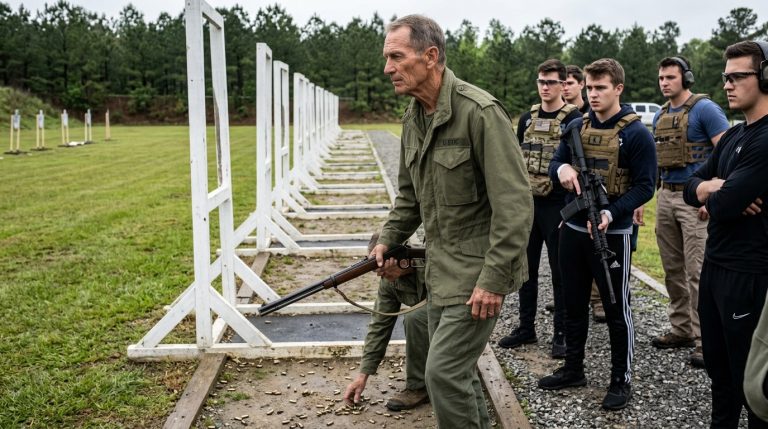
The walk to the range was a gauntlet of curious, judgmental stares. The soldiers were already lined up, their postures perfect, their gear pristine. They saw the apron, the stains, the hunched gait, and they saw a joke. Saul felt the weight of their scrutiny—a physical pressure that felt like the heavy, humid air before a storm. He didn’t care. He was looking at their feet. They stood too wide, their balance centered on their heels. They were braced for an impact that wasn’t coming, ignoring the subtle, uneven slant of the gravel under their boots.
“Form a line,” Saul said, his voice barely rising above the wind.
He didn’t head for the command hut. He walked to the center of the line, his hand brushing the rough, rusted metal of a nearby support pillar—a tactile connection to the stability he was about to rip away. He looked at the furthest target, a dark silhouette against the shimmering heat haze, and realized the distance was exactly the same as the ridge where he had buried his life.
“Twenty rounds each,” Saul said, watching them fumble with their optics. “And remember, if you miss, don’t look at your computer. Look at your own shadows. They’ll tell you more about the wind than any sensor ever will.”
As they began to fire, the sharp, rhythmic reports echoing against the canyon walls, Saul stood back, his arms crossed over his stained apron. He wasn’t watching the targets. He was watching the men. He saw the tension in their shoulders, the way they flinched at the recoil, the way they desperately wanted to be right. They were trying to conquer the world with math. He knew better. The world didn’t care about their numbers. The world only cared about the silence that followed the shot, and the burden you carried back to the kitchen.
CHAPTER 4: The Midnight Kitchen
The mess hall at 0200 hours was a place of ghosts. The fluorescent lights hummed with a low, electric irritability, casting long, stark shadows across the stainless-steel surfaces. Saul sat at the end of a long table, a solitary cup of black coffee cooling before him. He was supposed to be resting, but his mind refused to settle. Every time he closed his eyes, he saw the ridge in 1972, not as a memory, but as a map—a set of coordinates burned into the back of his eyelids.
He reached into the pocket of his apron, his fingers brushing against a piece of paper he had pulled from the back of an old filing cabinet earlier that evening. It was a single, brittle page from a personal diary he’d kept during the ’72 operation. He hadn’t touched it in decades.
He flattened the paper on the scarred wood of the table. The ink was faded, the handwriting jagged—the script of a man who had been awake for seventy-two hours straight. It wasn’t the reconnaissance data the General was hunting, but it was a key. It detailed a location—a small depression in the earth near the peak, where he had cached not just his rifle, but a satchel containing letters he had written to a family he never dared to contact.
A sound broke the silence—the soft, deliberate click of a boot on tile.
Saul didn’t move. He kept his hand flat over the diary page, shielding it from view. The shadows near the entrance to the kitchen shifted, and Miller stepped into the light. He looked exhausted, his eyes rimmed with red, his uniform crumpled.
“The men are talking, Saul,” Miller said, his voice unusually soft. “They aren’t talking about the math anymore. They’re talking about you. They want to know why you stay here. Why a man like you, with that kind of history, chooses to spend his time peeling potatoes and scrubbing grease.”
Saul looked up, his expression unreadable. He saw the curiosity in Miller’s eyes—a dangerous, probing light. “Maybe I like the simplicity,” Saul said, his voice devoid of emotion. “Maybe I’m just tired of the noise.”
Miller walked closer, pulling out a chair and sitting opposite him. The movement was slow, deliberate—an attempt at a connection that Saul wasn’t ready to offer. “General Sterling isn’t looking for a cook. He’s looking for someone to lead them into that mountain range. He knows something about that cache that he’s not telling us. He called it ‘reconnaissance data,’ but I’ve been looking at the aerial scans. There’s nothing there but rock and ice.”
Saul felt a flicker of tension in his chest. So, Miller was smarter than the others. He had been looking at the scans. “If you think the mission is a lie, Captain, you have the right to challenge it.”
“I don’t want to challenge it,” Miller said, his voice dropping to a whisper. “I want to understand it. Why did you really stay behind in ’72? The story says you were MIA. It says you were lost. But you’re sitting here, in front of me, five decades later.”
Saul felt the phantom itch of the star-shaped scar on his forearm. He didn’t answer immediately. He stared at the coffee, at the reflection of the light in the dark, swirling liquid. He realized then that the decoy—the reconnaissance cache—was a double-edged sword. It was the bait the General was using to pull him out of his silence, but it was also the trap that would force him to confront the reality of his own choosing. He had stayed hidden not because he was dead, but because he was afraid that if he returned, the ghosts would follow him home. And now, they were standing right in front of him, asking questions he couldn’t answer without destroying the fragile peace he had built.
“Go to sleep, Miller,” Saul said, his voice heavy with a sudden, weary finality. “The mountain doesn’t care about your curiosity. It only cares about whether you’re ready for the cold.”
Miller hesitated, looking at the hand that still covered the diary page. He wanted to ask more, he wanted to reach out, but the look in Saul’s eyes—a chilling, predatory stillness—stopped him cold. He stood up, nodded once, and walked back into the darkness of the hallway.
Saul was alone again. He picked up the diary page, his fingers trembling as he folded it back into his pocket. The secret wasn’t the cache. The secret was the fact that he was finally, after fifty years, going to have to walk back into the valley to retrieve the only part of himself he had ever truly loved.
CHAPTER 5: The Ascent of Shadows
The trailhead was not a path, but a scar on the side of the Sierra range. Saul stood at the base, his heavy boots sinking into the loose, scree-laden slope. He wasn’t wearing a tactical uniform. He wore the same charcoal-gray sweater he’d donned to stir vats of stew, its wool matted and worn at the elbows. Over it, he had pulled a faded, oil-stained field jacket—a relic of a war that had never officially ended for him.
Captain Miller and three other snipers stood behind him, fully kitted. They looked like creatures of the future, all composite plating and high-tech optics, while Saul looked like a man who had walked out of a history book to remind them of the cold.
“Pressure’s dropping,” Saul said, his voice clipped and dry. He didn’t look at the sky; he looked at the way the pine needles were swirling in tight, unnatural vortices near the ground. “Wind’s going to whip through the draw in ten minutes. We don’t have time for the standard ascent path.”
“The standard path is the safest,” Miller countered, shifting his weight. “We have the recon drones mapping the safest—”
“The drones see the rock,” Saul interrupted, already beginning to traverse the incline at an angle that looked dangerously unstable to the younger men. “They don’t see the ice beneath the surface. If you follow the path, you’re just a target for the mountain.”
He started to climb. He didn’t use trekking poles; he used his hands, his movements fluid and strangely effortless despite his age. He tested each handhold with a tentative, rhythmic pressure, his eyes tracking not the ascent, but the subtle, micro-shifts in the texture of the stone.
Five minutes later, the mountain changed. The air went from biting to brutal. A wall of white-out conditions slammed into them, a localized blizzard that turned the world into a chaotic, swirling void of gray. Visibility dropped to less than three feet.
“Form up!” Miller shouted, his voice muffled by the roaring wind. “Check your HUDs! We need to maintain the perimeter!”
Saul stopped. He was crouched behind a jutting outcrop of granite, the rock face offering a sliver of shelter. He didn’t pull out a compass. He didn’t check a tablet. He leaned his forehead against the cold, rusted-orange surface of the stone and closed his eyes. He listened. The wind howling through the canyon was a familiar language—the same whistle, the same erratic, thrumming pitch as the Valley of Tears.
“They’re going to get separated,” Saul muttered to himself, the realization hitting him with the force of a physical blow. He turned to look at the line of men. They were clutching their gear, their eyes glued to the glow of their tactical displays, completely blind to the reality of the terrain. They were fighting the storm with technology, and the storm was dismantling their cohesion with every gust.
“Miller!” Saul yelled, his voice cutting through the gale. “Forget the electronics! If you don’t tether, you’re going to lose them to the drop!”
Miller scrambled toward him, his face covered in a fine layer of frost. “We can’t stop! The cache is another three miles up!”
“The cache is a lie, Miller!” Saul grabbed the Captain by the reinforced strap of his vest, pulling him close until their faces were inches apart. The cold was so intense it felt like a burn. “You think you’re here for data? Look at the ridge. We’re in a funnel. If we don’t move into the lee of that overhang, the wind is going to push us off the shelf.”
He didn’t wait for Miller to agree. Saul surged forward, moving into the white-out with a confidence that defied the conditions. He navigated the treacherous slope by the feel of the ground beneath his feet—the subtle transition from solid granite to loose, unstable shale. He was leading them into the heart of the mountain, but as he climbed, the weight of the satchel in his memory grew heavier. He had promised himself he would never return to this altitude, to these conditions, because he knew that in the silence of the high peaks, there were no secrets left.
As the wind roared, Saul realized that the failure wasn’t coming from the outside; it was coming from within. The snipers were panicked, their training faltering under the pressure of an environment they couldn’t calculate. He was the only one who knew how to lose himself in the cold, how to become a ghost again. But to save them, he would have to reveal the one thing he had fought for fifty years to keep hidden: he wasn’t just a teacher. He was the only one who had survived this peak once before.
CHAPTER 6: The Encounter with the Past
Saul didn’t wait for Miller to answer. He pushed forward, his breath hitching in his chest—not from the exertion, but from the realization that they were standing exactly where the mortar fire had once turned the earth into a grave. The terrain here was unnaturally flat, a ledge carved out of the mountain’s spine by wind and history. Even under a foot of fresh, blinding powder, he recognized the geometry of the ridge.
“Stay low!” Saul shouted, his voice barely audible over the gale. “The shelf is unstable!”
He felt a hand grab his shoulder—Miller, struggling to keep his footing, his tactical HUD flickering and dying as the electromagnetic interference from the storm climbed to critical levels. The younger man’s eyes were wide, reflecting the panic of a leader who had run out of data points.
“We’re off-course!” Miller yelled, gesturing at his blackened wrist display. “The cache coordinates—they were supposed to be another five hundred meters to the east!”
“There is no cache, Miller!” Saul’s voice snapped, a whip-crack in the frozen air. He didn’t turn to look at him. He was staring at a specific, jagged protrusion of rock jutting out from the ice, a formation that looked like a broken finger pointing toward the abyss. “There is only the mountain. And the mountain doesn’t keep records for the Pentagon.”
He stumbled, his knee hitting a hard, metallic object buried beneath the snow.
The vibration traveled up his leg—a cold, sickening jolt. He dropped to his knees, his hands clawing at the frozen crust, the skin of his palms splitting in the biting chill. He wasn’t digging for reconnaissance data. He was digging for a ghost.
As he cleared the snow, the surface of a rusted, rectangular container appeared. It wasn’t standard-issue; it was a field-expedient storage bin, the kind he had fashioned himself out of spare ammunition plating in the final hours of the retreat. A shiver, deeper and more profound than the cold, tore through him.
“What is that?” one of the other snipers called out, crawling toward them through the swirling white.
“It’s not the cache,” Saul whispered, his voice trembling.
He gripped the frozen, rusted handle. As he pulled, the metal groaned—a high-pitched, metallic scream that seemed to harmonize with the wind. He remembered the spotter’s voice, a ghost of memory that hit him with the force of a physical phantom: Don’t look back, Saul. Just keep the crosshairs steady.
The lid creaked open. Inside, preserved by the sub-zero temperatures, was the satchel. It wasn’t filled with intelligence or maps. It was filled with bundles of letters, their edges yellowed, tied with a piece of wire he had salvaged from a destroyed radio.
Saul stared at them, his heart hammering against his ribs like a trapped bird. The truth of his self-imposed exile crystallized. He hadn’t stayed hidden because he had lost his purpose; he had stayed hidden because he couldn’t bear to see who he would become if he ever acknowledged that he had walked away from the only life that mattered. He had built his existence around the myth of his own death to protect a wife and daughter who had, for fifty years, lived in the shadow of a man they believed had died in a blaze of glory.
“Saul?” Miller leaned over, his flashlight cutting through the gloom, focusing on the bundle of letters. “Those aren’t classified documents. Who are these people?”
Saul slammed the container shut, the sound echoing like a gunshot. He felt a sudden, violent shift in the wind—a change in pressure that signaled the storm was entering its final, lethal phase. He looked up at Miller, his face a mask of iron-gray fatigue.
“The mission is compromised,” Saul said, his voice cold, final. “The mountain isn’t letting us go back the way we came.”
“What are you talking about?” Miller stood up, drawing his sidearm, the movement instinctive, defensive. “You led us into a trap. This wasn’t about the recon data. You brought us here for something else.”
Saul stood, his height seeming to increase, his posture losing the hunch of the cook and reclaiming the lethal, predatory stillness of the Ghost. The storm began to tear at the shelf, the ground beneath them vibrating with an impending slide. He realized then that the only way to get them off the mountain was to finish what he had started in 1972. He had to lead them down through the path of the ghosts, even if it meant breaking his own cover completely.
“I didn’t bring you into a trap, Captain,” Saul said, watching the snow begin to avalanche toward them. “I brought you into the only truth this mountain has ever told. Now, if you want to live, stop looking at your screens and start watching the way the shadows fall. The ghosts are moving, and they’re not going to like us being here.”
He turned away from the cache, his hand moving to the small, hidden strap of a survival knife tucked into his boot. The time for the cook was over. The legend was all that remained.
CHAPTER 7: The Moral Reckoning
The slide had settled, leaving a silence that was more terrifying than the storm. They were huddled in a natural crevice, the wind screaming past the narrow opening. Miller was slumped against the frozen wall, his tactical helmet cracked, his breathing shallow. He was staring at the satchel that Saul had pulled from the metal bin.
“You said… you said it was recon,” Miller wheezed, his voice raw. He reached out with a trembling hand, pushing aside a stack of yellowed letters to reveal the bottom of the bag. There were no maps. No encrypted drive. No tactical schematics. There were only photographs—blurred, black-and-white snapshots of a woman and a young girl standing in front of a house with a white picket fence.
Saul didn’t try to hide them. He sat on his haunches, his hands working to keep a small, wind-starved candle flame alive with his last strike of a lighter. The meager, flickering light danced across the rusted surface of his field-expedient container and illuminated the hollow, exhausted faces of the three snipers.
“The reconnaissance,” Saul said, his voice quiet, stripped of the bravado of the range, “was for my own peace of mind. Fifty years ago, I convinced myself that if I stayed dead, they would be safe. I thought the enemy would stop looking if there was no one left to find.”
“You used us,” the youngest sniper hissed, his voice breaking. “You used a classified mission to come back to your own grave.”
Saul looked at him. The boy was shivering, his gear useless against the sheer, biting reality of their survival. “I didn’t use you to find these. I used you because I didn’t want to die alone. The General didn’t care about these letters. He knew I would lead you here because he knew the terrain. He gambled on the only thing he knew about the Ghost of the Valley—that I couldn’t walk away from a mission that involved saving a life.”
“Why?” Miller asked, his eyes fixing on the photograph of the young girl. “Why the kitchen? Why the apron?”
“Because in a kitchen, you don’t have to watch for the muzzle flash,” Saul replied. He picked up one of the photographs, his thumb brushing the grainy image. “In a kitchen, the only thing you kill is time. I spent fifty years killing time, waiting for the day I could look at these again without feeling like I was betraying the world.”
The ground beneath them groaned—the mountain was shifting again. The overhang wouldn’t hold through the night.
“We’re not getting out of here with the cache,” Miller said, his tone turning pragmatic, the survival instinct overriding the shock. “If we move now, we can descend through the western pass. We leave the kit behind.”
Saul looked at the letters, then at the snipers. He felt the weight of his decision—the penance he had chosen versus the lives currently shivering in the dark. He stood up, his knees popping, and tucked the satchel into the lining of his field jacket.
“We don’t leave,” Saul said. He looked toward the mouth of the cave, where the wind was dying down, revealing a narrow, treacherous ledge that hugged the sheer face of the peak. “If we go west, we go straight into the slide path. We climb. There’s a signal relay at the summit, built by the surveying teams. It’s an impossible route, but it’s the only way up.”
“That’s suicide,” the youngest sniper protested.
“It’s physics,” Saul corrected, his eyes locking onto his team. He felt the cold iron of the knife in his boot, the steady, rhythmic beat of a heart that had finally stopped waiting for the end. “The wind is shifting. If we time the ascent with the gust cycles, we can reach the relay before dawn. Miller, gather the gear. We’re climbing as a unit, or we aren’t climbing at all.”
He realized then that the decoy of the mission had been stripped away, and all that remained was the hard, rusted truth of the climb. He wasn’t the cook, and he wasn’t the Ghost—he was the man who had realized that redemption didn’t come from staying hidden, but from the simple, terrifying act of moving forward when every instinct screamed to stay still.
CHAPTER 8: The Final Dish
The wind had died, leaving the summit in a state of absolute, ringing stillness. Saul collapsed against the base of the relay tower, his chest heaving. The air was thin, tasting of ice and ozone. Beside him, Miller and the remaining two snipers were sprawled on the steel grating, their faces gray, their breathing ragged. They were alive. They had paid for it with every ounce of their remaining strength, but they were breathing.
Saul pulled the satchel from his jacket. The letters were safe, the edges crinkled by the frost. He looked out over the horizon, where the sun was beginning to bleed orange across the jagged Sierra peaks—a sight that felt uncomfortably like the sunrise over the Valley of Tears.
“The cache,” Miller whispered, his voice cracking. He sat up, his movements stiff. “The General… he wanted this data. He said it was critical. Are we going to transmit it?”
Saul didn’t answer. He looked at the relay control panel—a complex, exposed cluster of wires and transmitters. He thought about the General, the man who had seen the scar on his arm and recognized the ghost, the man who had gambled the lives of his best men on the hope that Saul would finally stop running. He looked at the satchel, at the photographs of the life he hadn’t dared to claim.
He stood up, his legs trembling, and walked to the relay. He didn’t connect a drive. He didn’t input coordinates. He picked up the heavy, iron wrench hanging from the relay’s maintenance hook—a rusted tool that felt perfectly weighted in his hand. With one violent, precise motion, he smashed the transmitter’s antenna. The hum of the machine died instantly, swallowed by the vast, uncaring silence of the mountain.
“There is no data,” Saul said, turning to face them. He was still wearing the grease-stained field jacket, his face etched with the grime of the climb, but the predatory stillness that had defined him for fifty years had finally evaporated. He looked like nothing more than a tired, old man. “The reconnaissance was a test, Captain. The General wanted to know if the ghost was still capable of choice. And I’ve chosen.”
Miller stared at the ruined relay, then back at Saul. There was no anger in his eyes—only a dawning, heavy understanding. “They’re going to come for you, Saul. You’ve destroyed a black ops communication node.”
“Let them come,” Saul said. He pulled the photograph of the woman and the young girl from the satchel. He stood there for a long moment, the wind tugging at the paper, and then he tucked it carefully into his breast pocket, right against his heart. “I’ve spent fifty years hiding from a war that ended before I even laid down my rifle. It’s time to go home.”
The descent took the rest of the day. They didn’t speak. The silence wasn’t the heavy, tactical silence of the range; it was the quiet of men who had seen the edge of the world and decided to step back. When they finally reached the base, the support vehicles were already waiting. General Sterling stood by the lead truck, his uniform immaculate, his face unreadable.
He looked at the broken, weary men, then at Saul. He saw the satchel tucked under the old man’s arm and the way Saul stood—no longer hunched, no longer hiding.
“You didn’t transmit, Sergeant Major,” the General said.
“There was nothing to send,” Saul replied. He walked up to the General, his gait steady, the rust of his past finally flaking away. “I’m resigning, General. Effective immediately.”
Sterling looked at him for a long moment, then slowly, deliberately, he raised his hand in a final, crisp salute. It wasn’t the salute of a subordinate to a commander, but of a man acknowledging a legend who had finally found the peace he deserved. Saul returned it—a simple, reflexive motion that felt, for the first time in his life, entirely unforced.
Saul walked to his old, rusted mess hall cart, which had been left near the edge of the perimeter. He reached into his pocket, pulled out his apron—grease-stained, frayed, and smelling of tomato sauce and burned onions—and dropped it into the dirt. He didn’t look back. He started the long walk toward the distant highway, the satchel tucked against his chest, the weight of the mountain behind him, and the unknown, beautiful texture of a new morning lying ahead. He wasn’t a ghost anymore. He was just a man, finally ready to flip the page.