The Weight of Quiet Shadows: A Legacy Restored in the Heart of Heritage Hall
CHAPTER 1: The Threshold of Silence
The morning light in Ellsworth’s Heritage Hall was too clean, stripping the warmth from the air and leaving the room feeling like a stage set for a play that hadn’t quite started. Walter Hayes paused near the entrance. He wasn’t looking at the rows of empty chairs or the microphones waiting for a voice; he was looking at a faded photograph pinned to a display case—a crew of men standing beside an aircraft that had long ago turned to rust in some forgotten corner of the world.
He didn’t notice the younger airmen moving around him with frantic, practiced efficiency. He only noticed the way the sun caught the edge of the glass, highlighting the faces of men who were currently frozen in a state of perpetual, eternal youth.
“Old-timer,” a voice clipped the air, sharp and polished like a new blade. “Before you settle up front, what was your rank?”
Walter turned slowly. The voice belonged to a man whose uniform looked like it had been pressed by a machine, every button catching the overhead glare with an aggressive brightness. Captain Ryan Whitaker didn’t just stand; he occupied the space, his pride radiating off him like heat from a radiator.
Walter felt the familiar, heavy pull of a memory he kept tucked behind his teeth. It was a memory of high-altitude cold, of a radio voice cracking through static, and of the weight of a man he had pulled from a burning cockpit. He looked at the captain’s clean, eager face—a face that had never known the smell of ozone and terror—and he felt a profound, aching pity.
“I was here with men who did not make it into many programs,” Walter said, his voice the sound of dry leaves skittering over pavement.
The captain gave a short, dismissive laugh, a sound that rippled through the small group of lieutenants standing behind him. “That’s poetic, but this section is reserved for officers of distinction.”
Walter didn’t protest. He didn’t tighten his grip on the silver patch near his collar; he simply let it be. He looked past the captain, past the polished rows, and back to the photograph. The discrepancy was subtle—a missing name on the plaque below the frame, a detail that the official record had smoothed over for the sake of a cleaner history.
He moved toward the back of the hall, his leather shoes making soft, uneven marks on the pristine floor. He didn’t mind the distance. The back was where the light changed, where the dust motes danced in the shafts of sun that didn’t reach the front row. He sat beneath a folded flag, his hands resting on his knees.
As he settled, he felt the cool, hard texture of the silver patch against his skin. It wasn’t jewelry. It was a witness. And as the microphones began to crackle and the room began to fill with the nervous energy of a ceremony about to begin, Walter looked at his hands, realizing that for the first time in fifty years, he wasn’t just holding his history—he was waiting for it to be seen.
CHAPTER 2: The Friction of Pride
Captain Ryan Whitaker didn’t move. His hand remained hooked into the wood of the podium, his knuckles pale, the skin stretched tight. He had expected a simple, orderly morning, a clean execution of protocol where his own authority would be mirrored back to him by every rank in the room. Instead, he felt the floorboards beneath his polished shoes seem to lose their rigidity.
Walter Hayes did not look at him. The old man remained sitting in the last row, his back straight, his hands resting on his knees. He was looking at the back of the lieutenant’s neck—the young man who had been sent to collect his coat. The air around the last row had curdled, turning from neutral space into a pocket of intense, suffocating stillness.
Ryan’s pulse hammered a frantic rhythm against his collar. He had to say something. The silence was becoming a character of its own, whispering things he didn’t want to hear.
“The ceremony,” Ryan began, his voice lacking its earlier practiced resonance, “is designed to honor those who follow the rules. It is designed for those who understand the chain of command.”
He glanced at the lieutenants standing off to the side, hoping for a sign of support, but they were looking at the floor, their faces flushed with a sudden, sharp clarity. Ryan’s eyes flickered to the silver patch on the chair—that small, dull emblem. It seemed to grow larger in his vision, a taunt in metallic thread.
“Sir,” the young lieutenant, Mark Ellison, said softly, his voice trembling just enough to be noticeable. “Perhaps we should just… continue with the introduction?”
Ryan ignored him, stepping off the low stage. His footsteps were loud, too loud, echoing off the high, sterile ceiling of Heritage Hall. He marched down the center aisle, his pride demanding that he re-establish the boundaries. He stopped a few feet from Walter. Up close, the old man’s coat looked even more worn, the fabric thinning at the elbows, the color a muddy, forgotten gray.
“Mr. Hayes,” Ryan said, trying to force the sharp edges of his authority back into his tone. “You are causing a disruption. This event is about the present. It is about the standards we maintain today. Your… keepsakes have no place in this setting.”
Walter finally turned his head. His eyes were pale blue, steady, and terrifyingly calm. They didn’t show anger; they showed the kind of patience that only comes from having seen things that render a captain’s ego insignificant.
“The present is only the shadow of what came before it, Captain,” Walter said. His voice was soft, roughened by age, yet it cut through the hum of the air vents with surgical precision.
The sound of the ventilation system felt suddenly louder, a rhythmic drone that reminded Walter, in a sudden, sharp flash, of the old radio static from a cockpit over an endless, darkened landscape. The smell of hot wiring and ozone flared in his mind, vivid and stinging, triggered by the proximity of the microphone wires coiled near the aisle. He blinked, the red glow of the cabin light fading back into the dull fluorescent hum of the hall.
“I am not here to disrupt,” Walter continued, his fingers brushing the fabric of his own sleeve where the patch had been. “I am here because someone has to remember the math. The real math. Not the version you put on the programs.”
Ryan felt a cold, metallic prickle at the back of his neck. He wanted to demand an explanation, to order the old man out of the room, but he saw Master Sergeant Price standing by the sidewall. Price’s posture had changed—he wasn’t just standing guard, he was standing as if he were waiting for an order from a superior officer he hadn’t known was in the room.
“The math?” Ryan scoffed, though the sound was hollow. “This is an Air Force base, not a laboratory.”
“Is it?” Walter asked. He shifted his weight, his old leather shoes creaking. “You speak of standards as if they are permanent things, Captain. You think they are built of brass and polish. But they are built of choices made when the radio goes dead and the sky is falling.”
Ryan opened his mouth to retort, to tell the old man that he was out of line, that he was talking about things he couldn’t possibly understand—but then his gaze dropped. He saw the way Emily Carter, the records coordinator, had frozen at her desk. She was staring at her screen, her hands trembling as she hovered over the keyboard. She wasn’t looking at him. She was looking at the old man, and for the first time, Ryan realized that he had become the only person in the room who didn’t know what was happening.
“The program is starting,” Ryan said, his voice now a desperate, brittle attempt at command. “We are resuming.”
He turned on his heel, his movements jerky, the confident stride he had used only minutes before now replaced by the hurried, awkward gait of a man trying to outrun his own shadow. He headed back toward the podium, but every step felt like he was wading through water.
He didn’t see the way Price’s eyes followed him—not with hatred, but with a growing, cold disappointment. Ryan climbed the steps to the stage, his hands finding the podium again, but the wood felt different now. It didn’t feel like a position of authority; it felt like a cliff’s edge.
He looked out at the room. People were waiting. The air felt heavy with the scent of floor wax and the static of a secret he was beginning to realize he had been foolish to ignore.
“We will… continue,” Ryan announced, his voice cracking slightly. He reached for his notes, but they were just paper now. Just lines of text that had no power here.
In the back, Walter Hayes didn’t look at him. He was looking at the empty chair where the patch lay, waiting for the light to catch it again.
CHAPTER 3: The Unraveling
Emily Carter kept her eyes fixed on her laptop screen, even as she felt the shift in the room’s gravity. The air around the registration desk had turned thin and charged, humming with the electric tension of the standoff still playing out in the aisles. She ignored the captain’s hurried steps toward the podium and focused entirely on the small, flickering cursor. Her fingers, usually steady, betrayed a slight tremor as she moved the mouse over the restricted archive icon.
The system was designed to protect. It was a digital wall, built to keep curiosity out and history in, tucked away behind layers of bureaucratic permission. But as she entered her credentials, a series of internal codes she had inherited from her predecessor, the wall didn’t just open—it groaned under the weight of an inquiry that had been dormant for decades.
Access limited. Contact base historical office.
Emily’s breath hitched. She didn’t look up when she heard the heavy, measured footsteps of Master Sergeant Daniel Price approaching. She felt his presence at her shoulder before he spoke—a solid, grounding force in a room that suddenly felt very fragile.
“What are you seeing, Emily?” Price’s voice was a low rumble, barely audible over the hum of the air vents.
Emily didn’t answer immediately. She clicked through a secondary sub-menu, bypassing the initial warning. A new window snapped open, revealing a fragmented file, a remnant of a larger, lost narrative. It wasn’t a list of ranks or a summary of awards. It was a log of flight paths and recovery efforts, dated over fifty years ago, marked with a single, repeating phrase: Operation High Lantern.
“It’s not just a record, Daniel,” she whispered, her voice tight. “It’s a recovery order. They weren’t just flying. They were searching for something that wasn’t supposed to exist.”
Beside her, Price went still. She could feel him staring at the screen, his gaze tracing the lines of text that had been deliberately obscured.
“High Lantern,” he breathed, the name carrying a weight that seemed to suck the warmth out of the immediate air. “My old supervisor wasn’t lying. It was a detachment, but it wasn’t listed on any standard rotation.”
Emily looked toward the last row. Walter Hayes was sitting in the same posture—hands on knees, eyes forward, a man who had survived the very history they were now peering into. He looked impossibly small against the backdrop of the massive, empty hall, yet he seemed to hold more gravity than the entire stage combined.
“Why is he here?” Emily asked, her fingers hovering over the print key. “If this was restricted, why would he come to an event that celebrates the exact kind of protocol that silenced him?”
“He didn’t come to be celebrated,” Price said, his voice hardening. “He came to see if the institution still remembered the cost.”
The hall shifted. A group of junior officers, prompted by Whitaker’s earlier panic, began whispering near the side entrance, their eyes darting between the podium and the old man in the last row. The facade of the perfect ceremony was cracking, revealing the raw, unpolished machinery beneath.
Emily saw the warning box reappear on her screen, but this time it wasn’t a request for credentials. It was an alert: Unauthorized access detected. Connection traced to local terminal.
Her heart hammered against her ribs. She looked at Price, her eyes wide. “They know,” she said.
“Let them,” Price replied, his gaze locked on the podium where Ryan Whitaker was attempting to regain his footing. “The truth is already in the room, Emily. It’s been here since he walked through the door.”
He tapped her desk, his touch firm and reassuring. “Keep digging. Don’t look at the podium. Look at the data. If this is what they were hiding, we need to know why.”
Emily turned back to the screen. The flickering cursor seemed to blink in time with her own pulse. She realized then that the archive wasn’t just a collection of documents; it was a map of a broken promise. She felt a sudden, sharp clarity wash over her—a realization that the history they were honoring wasn’t a static image behind glass, but a living, breathing burden that Walter Hayes had been carrying for half a century.
She opened the next sub-file. A series of names scrolled past, listed in thin, impersonal type. Most of the entries were struck through, but one remained clear, lingering at the bottom of the page like a final, desperate ghost.
Lieutenant Colonel W. Hayes.
She looked at Walter again. He didn’t look at her, but he shifted his hands, his fingers brushing the silver patch on his collar. It was as if he knew she was reading the names, as if he were granting her permission to acknowledge the weight he was no longer carrying alone.
The room seemed to tilt. Ryan Whitaker began to speak again, his voice echoing from the podium, but it was just noise now—an empty vessel trying to fill a space that had already been claimed by the past. Emily didn’t care about the ceremony anymore. She cared about the men who had been left in the dark, and the one man who had stayed long enough to bring them home.
She took a breath, the air smelling of dust and ozone, and began to read.
CHAPTER 4: The Anchor Drops
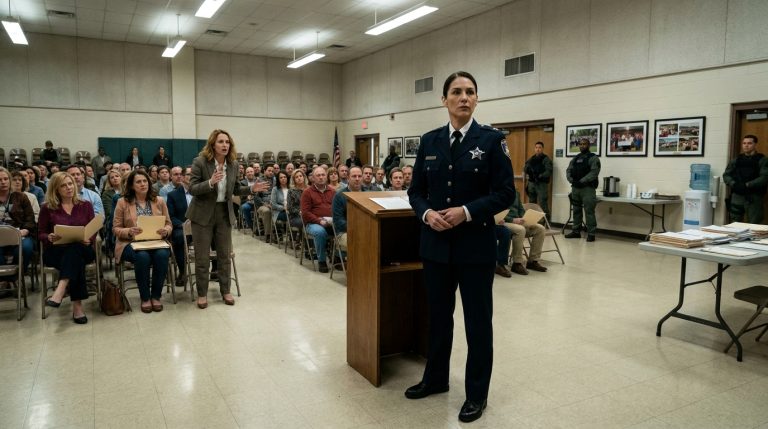
The doors of Heritage Hall swung open with a violence that made the glass cases vibrate. A gust of South Dakota winter, dry and biting, swept into the room, instantly thinning the stagnant, wax-scented air. Every person in the hall—from the junior airmen near the entrance to the senior officers at the front—felt the pressure drop as General Thomas Aldridge stepped across the threshold.
He didn’t stride; he arrived. His presence was not a performance like Whitaker’s, but a physical fact that forced the room to recalibrate its internal geometry. Two aides trailed behind him, their expressions neutral, but their eyes scanning the hall with the practiced precision of soldiers accustomed to finding trouble before it grew too large.
Emily Carter’s hand slipped from her mouse. She didn’t close the laptop; she couldn’t. The record of the High Lantern detachment, that half-erased ghost of a file, remained glowing on the screen, a beacon of unauthorized truth in the sudden, freezing hall. Master Sergeant Price stood beside her, his body acting as a screen, his eyes fixed on the general.
“He’s here,” Price whispered, his voice stripped of all casualness. “And he’s not here for the ceremony.”
Across the aisle, Captain Ryan Whitaker had collapsed into a semblance of professional posture, but his face had gone a sickly, waxen shade. He looked like a man watching his own funeral procession walk through the door. He reached for the microphone, his fingers twitching, but no sound emerged. The authority he had banked on—the rigid, paper-thin power of the ceremony—had been obliterated the moment the General entered.
General Aldridge didn’t acknowledge the stage. He didn’t acknowledge the captain. He began his walk down the center aisle, the rhythm of his boots deliberate, like a gavel strike against the floor.
Walter Hayes, still sitting in the last row, didn’t stand. He didn’t cringe. He simply watched the general approach, his pale blue eyes reflecting the bright, harsh overhead lights. As the general drew closer, the room seemed to shrink, the rows of uniforms blurring into a singular, silent backdrop for the meeting of two men who were separated by a generation but connected by a silence that both had been forced to guard.
When Aldridge reached the last row, he stopped. He looked down at the empty chair beside Walter—the chair where the silver patch had lain—and then he looked at the old man. The silence that fell over the room was absolute, a vacuum that even the high-altitude hum of the HVAC couldn’t fill.
“Colonel,” Aldridge said. The title hit the room like a physical blow.
Captain Whitaker, standing at the podium, seemed to stumble, his hand catching the edge of the wood to keep from falling. He looked at Walter—really looked at him—and for the first time, he saw the man underneath the gray coat. He saw the set of the jaw, the eyes that had navigated a sky that no longer existed, and he saw the terrifying, undeniable reality of someone who had survived everything the military could throw at him.
“General,” Walter replied, his voice low, steady, and entirely devoid of the frailty Whitaker had mocked.
Aldridge came to a crisp, perfect attention. The motion was an echo of a time before protocols became performances. He raised his hand in a salute that was as much a plea as it was a sign of respect.
“I have the report, Colonel,” Aldridge said. “It took fifty years to find the right desk, but it has arrived.”
“Then you know,” Walter said, his voice barely audible, yet carrying to the front row. “You know it wasn’t a loss. It was an extraction.”
Emily felt a jolt of ice move down her spine. An extraction. The records she had seen—the fragments of the High Lantern file—suddenly made sense. It wasn’t a record of failure; it was a record of what they had been told to forget. She looked at Price, who was staring at the General with a mixture of awe and dawning dread.
“I know,” Aldridge confirmed, his hand still held in the salute. “And I have come to make sure the record reflects the truth.”
Around them, the hall began to stir. The “anchor” had dropped. The performative nature of the ceremony was dead. A lieutenant colonel in the second row, a man who had spent his career believing the official history of the base, stood up. He didn’t look at the podium; he looked at the two men in the back. Then, a major rose. Then, the rest of the room followed, a wave of blue wool and brass, rising not for a guest, not for a veteran, but for the man who had been the repository of the base’s oldest, darkest secret.
Whitaker stood on the stage, the forgotten center of a world he no longer commanded. He looked around him, his chest heaving, realizing that the protocol he had wielded as a weapon was now the very thing that had anchored him to his own obsolescence.
Walter Hayes finally stood. He didn’t look triumphant. He looked exhausted. He reached up, his fingers touching the silver patch on his collar, and for the first time, the texture of his history became visible to everyone. The thread was worn, frayed, and utterly real.
“General,” Walter said, “the ceremony can wait. The history, however, is long overdue.”
Aldridge lowered his hand, his eyes scanning the room. He wasn’t looking at the officers; he was looking at the truth. “The ceremony is over, Colonel,” he said. “The debriefing begins now.”
CHAPTER 5: The Quiet Horizon
The word “debriefing” was not meant for the room. It was meant for the man standing on the stage, the man whose perfectly pressed uniform suddenly looked like a costume. Captain Ryan Whitaker heard it, and the sound seemed to sever the invisible wires that had kept his posture rigid. He stepped back from the podium, his hand finally releasing the wood. He didn’t look at the crowd; he couldn’t. He looked only at the space between General Aldridge and the old man in the gray coat.
Walter Hayes did not move to take the stage. He remained standing in the aisle, the silver patch resting against his collar, catching the harsh overhead light and softening it into something dull and enduring. The hall, which had felt impossibly large and sterile all morning, now felt intimate, contracted around the silent exchange between the past and the present.
General Aldridge turned slightly, not to address the crowd with the polished cadence of a commander, but with the quiet, devastating clarity of a man settling a long-standing debt.
“The High Lantern detachment,” Aldridge began, his voice devoid of echo, landing flat and heavy in the room, “was not erased because they failed. They were erased because they succeeded in a place where success was not supposed to be possible. They brought men back from the dark, Captain.” Aldridge’s eyes finally found Whitaker. “And they did it knowing that the institution they served would never acknowledge the risk they took.”
Whitaker swallowed hard, the sound audible in the profound silence. He opened his mouth, perhaps to offer the apology he now knew was required, but the words withered before they reached his lips. The realization was crashing into him, not as a sudden revelation, but as a slow, agonizing crushing of his own worldview. The rules he had worshipped, the neat categories of rank and privilege he had used as a shield, were meaningless against the raw, unpolished weight of actual sacrifice.
“I… I didn’t know,” Whitaker managed, the phrase tasting like ash.
“No, you didn’t,” Walter said softly. The old man stepped forward, the soft scrape of his leather shoes breaking the stillness. He didn’t walk with the brisk, entitled stride of an officer; he walked with the careful, measured pace of a man who had spent a lifetime carrying a heavy load over uneven ground. “But you didn’t ask, Captain. You only looked at what was missing, not at what was left behind.”
Walter reached the front of the hall, stopping a few feet from the stage. He looked up at Whitaker, and there was no malice in his pale blue eyes, only a profound, exhausting sadness.
“The files,” Walter continued, his voice barely a murmur, yet commanding absolute attention, “they record the extraction. They record the grid coordinates and the fuel expended. But they don’t record the silence.”
He paused, his gaze drifting past Whitaker to the black-and-white photograph on the wall—the young men, frozen in the sun, oblivious to the decades that would follow.
“They don’t record what it costs to come back when the men beside you do not,” Walter said, the words finally unlocking the core truth he had carried into the room. “The secret wasn’t the mission, Captain. The secret was that we lived. And when you live, and they don’t, you spend the rest of your life trying to find a place to put the guilt. You don’t put it in a glass case. You don’t put it in a program.”
He touched the silver patch one last time. “You wear it.”
The admission settled over the hall like a thick, settling dust. The air, which had been tight with tension, suddenly felt heavy with an almost unbearable empathy. Master Sergeant Price lowered his head, his broad shoulders slumping slightly as if a physical weight had been transferred to him. At the registration desk, Emily Carter closed her laptop, the click of the screen shutting sounding like a final punctuation mark. The glowing fragments of the High Lantern file were gone, but the reality of them was now permanently etched into the room.
Whitaker descended the steps of the stage. He moved slowly, mechanically, his polished shoes no longer striking the floor with authority. He stopped in front of Walter, the distance between them feeling less like physical space and more like a chasm of experience.
The Captain, who had built his career on the assumption that respect was commanded from above, now understood that it was forged in the dark, in places where rank offered no protection. He didn’t offer his hand. He didn’t offer a crisp salute. He simply bowed his head, a gesture of absolute, unscripted humility.
“I am sorry, Colonel,” Whitaker whispered, the title finally earned, not by protocol, but by comprehension. “I was a fool.”
Walter looked at the young man, really looked at him, and saw not the arrogant officer who had insulted him, but a man whose foundation had just cracked. The Kintsugi logic of the moment—the finding of beauty in the brokenness—was not lost on him. The hall was fractured, but it was honest.
“A fool learns, Captain,” Walter said gently. “A coward does not. You have time to choose which one you will be.”
Walter turned away from the stage, away from the General, and walked back down the center aisle. The room remained standing. Nobody moved to stop him. Nobody offered empty platitudes. They simply watched the old man in the faded gray coat walk toward the exit, his shadow long in the harsh light.
As Walter pushed open the heavy main doors, the cold South Dakota wind greeted him again. He paused on the threshold, looking out at the sprawling concrete of the base. The weight he had carried for fifty years hadn’t vanished—it would never truly vanish—but as he stepped into the pale winter sun, he felt the smallest, most profound shift. He was no longer carrying it alone. The hall behind him held the silence now.
He reached into his pocket, his fingers brushing against a small, smooth stone he had picked up near a runway decades ago—a habit, a grounding mechanism. He turned it over in his hand, feeling the worn, familiar edges, and for the first time in a very long time, he felt the tight knot in his chest begin to loosen. The history was finally, truly, out of his hands.