A Singular Shadow Over the Canyon: A Sniper’s Silent War Against Silence and Stone
CHAPTER 1: THE WEIGHT OF A GHOST
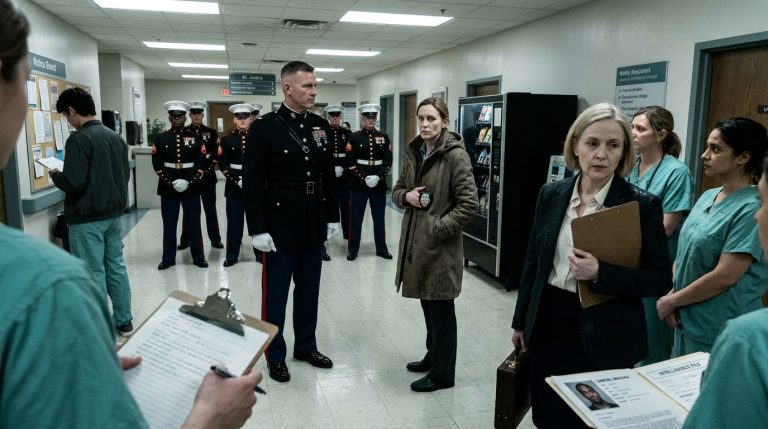
The air in the hospital ward was stagnant, smelling of sterile plastic and the metallic tang of dried blood. Carter sat on the edge of the cot, her left side screaming in protest as she moved to adjust her sling. The light from the hallway, thin and clinical, sliced across the floor, catching the dust motes dancing in the silence.
Mercer hadn’t said a word when he entered. He hadn’t needed to. His presence was an anchor, heavy and demanding, dragging the atmosphere of the room down with him. He slapped the thin manila folder onto the sheet, his jaw tight, eyes searching hers for the same cold clarity that had saved his team forty-eight hours ago.
“The after-action report is being purged, Carter,” Mercer said, his voice a low rasp that didn’t travel past the foot of the bed. “They’re scrubbing the mentions of the ridge-line positions. They’re scrubbing the mortar team.”
Carter looked at the folder, then up at his hand, which still rested on the bedframe. The knuckles were raw, purpled from the same rock she had been climbing. She didn’t flinch. She felt the silence of the room—a vacuum waiting to be filled with the truth.
“They’re painting over the cracks,” she said, her voice steady, stripped of the fatigue that usually clung to her lungs.
Mercer leaned in. The mask of the commander slipped, revealing the jagged edge of a man who had stared into the abyss and realized it was looking back at him from inside his own command. “The mission to retrieve the aid workers wasn’t just a failure of intel, Specialist. It was a targeted deletion. Someone fed those militants our exact coordinates and the frequency of our encrypted channel. They wanted that team gone.”
He tapped the folder. Inside, she knew, were the names of the men they had lost—the ones who hadn’t made it to the helicopter.
“Why tell me?” she asked.
“Because you’re the only one who didn’t look at the map and see a path,” Mercer replied, his eyes narrowing, reflecting the harsh fluorescent glare. “You saw the mountain. You saw the kill zone. And now, you’re the only one who can see the shadow moving behind the command chain.”
He turned to leave, but stopped at the door, his silhouette framed by the harsh hallway light, a dark, sharp edge against the white paint. “Someone missed a piece of evidence at the extraction site, Carter. A file, encrypted, left in the mud. If you’re as good at finding things as you are at losing yourself on a mountain, find it. Before they realize the ghost of Hill 350 is still watching.”
He disappeared into the corridor, leaving the folder vibrating with the weight of unsaid things. Carter reached out. Her fingers hovered over the clasp. The information gap hit her—a sudden, sharp realization that the ambush hadn’t been a defeat; it had been a transaction. She opened the folder, and as she read the first page, the context of the entire operation fractured, leaving her staring at a name she knew all too well—a name that belonged to the man who had authorized her deployment.
CHAPTER 2: THE ADHESIVE OF BETRAYAL
Carter’s hand felt like a stranger’s limb—heavy, unresponsive, and stained with the faint, dried remnants of the mountain’s shale. The air in the ward hadn’t moved, but the room felt colder, the clinical white of the walls now appearing more like the interior of a sarcophagus. She looked down at the name typed on the mission authorization form. It wasn’t just a signature; it was a ghost.
Colonel Vane. The man who had been the architect of her career, the one who had cleared the path for her sniper attachment to the task force. She felt the file’s adhesive—a sharp, chemical smell of aging glue—and it triggered a vivid, intrusive memory. It was the smell of the motor oil on her grandfather’s hands, back in that dusty field outside Lach, when he’d told her that the most dangerous men weren’t the ones in the open with rifles, but the ones behind the desk holding the ink.
She stood up, ignoring the way her ribs protested, a sharp, white-hot line of fire tracking from her side to her shoulder. She moved with deliberate, agonizing caution toward the window. Outside, the base was a grid of pale, artificial light, humming with the low-frequency vibration of generators that never slept. She had to move, but not because she was told to. She had to move because the information in her hand had made the room too small to contain the oxygen she needed to think.
She didn’t put on her uniform. She pulled on a loose-fitting tactical hoodie, the fabric soft against the angry red line of her stitches, and tucked the folder beneath it, hard against her ribs. Every step in the hallway was a tactical exercise. She checked the corners of the corridors, the way she had checked the ridge lines from the summit of Hill 350. The rhythm of the base was different at 0200 hours; it was the quiet, predatory rhythm of security details and maintenance crews.
She bypassed the main guard station, sticking to the shadows of the secondary supply routes. The scent of jet fuel and dry sand was thicker here, clinging to the industrial machinery of the base. She needed to know if Vane was still on-site, or if he had been pulled after the “failure” of the rescue mission.
Her mind was a steady, rhythmic loop of cause and effect. If Vane authorized the mission, he knew the route. If he knew the route, he knew the canyon was a trap. If it was a trap, he wasn’t looking for aid workers. She paused near a junction of pipes, pressing her back against the corrugated steel. Her breathing was shallow, controlled, and she felt the persistent, phantom weight of the Barrett system still strapped across her back, a phantom limb that demanded she scan the horizons she couldn’t see.
She heard voices. Low, metallic, and precise. Two MPs were walking a perimeter path that crossed her trajectory toward the comms relay. She dropped into a crouch, her boots barely making a sound on the gravel. This was the hunt, but the landscape had shifted. It wasn’t rock and wind anymore; it was authority and bureaucracy. She watched the MPs, noting the way they walked—unaware, comfortable, the way people move when they believe they are the ones defining the perimeter of reality.
She waited until their heels clicked into the distance, then moved. She reached the door of the administrative annex, a small, nondescript structure that housed the terminal servers. It wasn’t locked. None of it was locked because no one expected the ghost of Hill 350 to be walking the halls at 0300. She slipped inside, the hum of the servers a stark, electronic contrast to the silence of the desert.
She sat at the terminal, her fingers dancing over the keys with the same economy she’d used to assemble the Barrett. She searched for Vane’s flight logs. The screen flickered, a pale blue glow reflecting in her pupils. There. The flight manifest didn’t list a return for him. It listed a transfer to a private aircraft, a contractor tail number that didn’t appear in the standard military database.
Her heart didn’t race. It settled. This was the logic of the mountain again. The variables were clear. The target wasn’t the militants in the canyon; the target was the paper trail. She copied the manifest to an encrypted drive, her pulse slowing, her mind sharpening into the clinical, cold focus of a sniper finding the range. She wasn’t just a soldier anymore; she was the variable they hadn’t calculated. She turned away from the screen, the blue light fading as she killed the power, and stepped back into the shadows of the hallway, the folder and the drive tucked against her ribs like a bullet that hadn’t been fired yet.
CHAPTER 3: THE FREQUENCY OF LIES
Carter stepped out of the administrative annex, the sharp, refrigerated air of the night hitting her like a slap. The drive was a tangible pressure against her side, a physical reminder that she had crossed the line from soldier to scout in a war she was only just beginning to map. The base was still, save for the occasional sweep of a roving patrol’s spotlight, a thin, white blade slicing through the darkness. She needed to get back to her quarters without triggering a sensor sweep.
Her movement was instinctual now, a ghost-like drift through the architecture of the base. She kept to the service conduits, the shadows her only consistent ally. Her side throbbed—a reminder of the mountain—but she pushed the pain into the compartment she kept for everything that threatened her focus. She wasn’t just walking; she was recalculating. If Vane was the source, the entire command structure of the Task Force was compromised. Every directive she had received, every mission parameter, was filtered through a lens of potential sabotage.
She reached her barracks, a corrugated metal structure that echoed with the snores and restless shifts of sleeping men. She slipped into her room, the small space smelling of stale gear oil and the faint, sweet scent of the antiseptic the hospital had used on her hands. She locked the door, the click of the latch sounding unnaturally loud in the narrow confines of the room. She didn’t turn on the light. She sat on the edge of her cot, the darkness a comfortable, protective blanket.
She pulled the encrypted drive from beneath her hoodie. It was small, a sliver of brushed aluminum that held the secrets of a commander. She didn’t have a secure terminal here, but she had her own kit—a modified handheld diagnostic unit she’d jury-rigged during her time in the field. It was intended for hardware troubleshooting, but it had enough processing power to read the file headers. She connected the drive, the unit’s screen casting a pale, sickly green light onto her knees.
The files were heavily obfuscated, masked by layers of standard military logs. It was a classic misdirection—hide the truth in the mundane. She began to strip back the layers, her eyes tracking the lines of code with the same patience she had used to track the mortar crew on the north wall. The mountain had taught her that the truth was often the thing that didn’t move when everything else did.
She found it under a sub-folder labeled ‘Logistics – Routine’. It wasn’t just a flight manifest. It was a digital map of the canyon’s communication nodes. Every point, every radio relay, had been tagged. Vane hadn’t just allowed the trap to happen; he had optimized it. He had provided the frequency-hopping patterns that the SEAL team’s encrypted comms relied on, effectively blinding them before they even entered the kill zone. The realization hit her with the weight of a physical blow. The mission wasn’t a failure of intelligence; it was a demonstration of power.
She stopped. Her fingers hovered over the screen. There was a signature appended to the file. It wasn’t Vane’s. It was an institutional tag from a private security firm, ‘Cerberus Logistics.’ She knew the name from the dark corners of the web, the kind of entity that didn’t exist until it needed to disappear something.
A floorboard creaked in the hallway.
Carter’s hand moved instantly to the sheathed knife on her bedside table, her muscles coiled, ready to pivot. She went perfectly still, her breathing slowing until it was almost non-existent. The sound didn’t repeat. It could have been the building settling, or it could have been a patrol checking the rooms. She watched the door, her eyes adjusting to the interplay of shadows.
She realized then that her presence in the server room had likely triggered an audit alert—an automated, silent alarm that a system administrator would eventually see. She didn’t have time to be careful anymore. The ghost of Hill 350 had become an active variable, and the enemy was starting to see her footprint. She disconnected the drive and shoved it into a hollowed-out compartment in her rifle case, a space no one would check because no one would expect a specialist to hide a digital file in a gear case.
She needed an ally, someone who wasn’t tied to the command chain Vane had corrupted. Wade. He had stood up for her in the mess hall. He had acknowledged the debt. But was Wade compromised? The thought felt like a betrayal of the small, fragile trust they had built in the desert. She had to test the frequency. She had to see who was still listening to the same truth.
She stood up, her side aching, and moved to the small, grimy mirror bolted to the wall. She looked at herself—pale, bloodless, the ghost of a soldier who had climbed a mountain to survive, only to find the mountain was the safest place she’d ever been. The base around her was a honeycomb of secrets, and she was the only one with the key. She looked at the door, her reflection steady, eyes hard. If they wanted a war, she would provide the target.
CHAPTER 4: THE FRAGILITY OF ALLIANCE
The common room was dimly lit, the fluorescent tubes overhead flickering with the rhythmic fatigue of a base that had seen too many long nights. Carter paused in the threshold, her hand instinctively brushing against the hidden weight of the drive beneath her hoodie. Inside, the usual collection of off-duty operators was scattered across the mismatched furniture. Kellerman was hunched over a deck of cards, his red hair a bright, messy stain against the backdrop of darkened screens, while Wade sat in the corner, his gaze fixed on the doorway with an intensity that made Carter’s skin prickle.
Wade’s eyes flicked to hers, then downward, scanning for a tell. He didn’t speak, but the subtle tilt of his head was an invitation—or a warning. Carter moved deeper into the room, the scent of stale, burned coffee and industrial soap heavy in the air. She could feel the stares of the men who had been at the table with her the night before; they were quieter now, the irreverence of the card game replaced by a watchful, almost guarded respect.
“You’re late for the game, Carter,” Kellerman said without looking up, his voice gravelly. “Wade’s been cleaning us out. He’s got some kind of luck tonight that doesn’t feel entirely organic.”
“Luck is just physics that you haven’t accounted for yet,” Carter replied, pulling out a chair at the edge of the circle. She kept her movements fluid, concealing the stiffness in her ribs. She needed to know where Wade stood, but she couldn’t ask. She had to observe, to track the micro-expressions of a man she was beginning to view as the only true North in a compass spinning wildly.
As she sat, she caught a glimpse of something on the coffee table: a stack of paper manifests. They were standard issue, the kind used for equipment tracking, but her eyes narrowed as they hit a specific, handwritten mark in the margin. It was a stylistic flourish—a small, angular star drawn beside the authorization code. She’d seen that mark before. It was on the mission folder Mercer had dropped on her bed.
She froze. The mark wasn’t Vane’s, and it wasn’t Mercer’s. It was the signature of the base logistics officer, a man who, according to the files she’d skimmed, was supposed to be on leave in the states. A chill that had nothing to do with the air conditioning settled in her marrow. If the logistics officer was here, the “black-market cleanup” wasn’t just a mission; it was an ongoing operation, and she had just walked into the staging ground for the next phase.
“Everything alright?” Wade asked, his voice low, sliding a chair slightly closer to hers. He wasn’t playing cards anymore; his full focus was on her, the easy-going confidence of the soldier replaced by the sharp, analytical gaze of the operator.
“I was just thinking about the gear,” Carter lied, her voice devoid of inflection. “The mountain took a lot out of the equipment. I was wondering who’s signing off on the replacements.”
Wade’s expression didn’t change, but his eyes shifted to the manifest on the table. A flicker of something—disdain, perhaps, or a deep, seated anger—rippled across his face. “The replacements are coming from sources I wouldn’t trust to secure a latrine, let alone a rifle system. Things are… messy right now, Carter. The command chain is leaking from the top down.”
He lowered his voice further, leaning into her space, his shadow stretching long across the floor. “I’ve been making inquiries. The extraction helicopter that came for us in the storm? Its flight plan wasn’t logged through standard channels. It was a private contractor hire. I don’t like private contractors when I’m bleeding.”
Carter felt the drive against her side, a burning coal of truth in a room full of manufactured lies. Wade wasn’t just suspicious; he was already digging. The realization brought a strange, sharp clarity to her chest. She wasn’t alone, but she was in the middle of a minefield.
“I need to talk to you,” she whispered, the words barely audible over the clatter of Kellerman shuffling the cards. “Not here. Somewhere where the walls aren’t listening to the logistics manifest.”
Wade didn’t look at her, but he gave a single, curt nod. “The old radio shack on the perimeter. 0400 hours. The patrols skip that sector because the sensors are ‘malfunctioning’.”
Carter stood up, her joints protesting, the weight of the night pressing down on her. She had a plan, she had the drive, and she had the only man on the base who might still be capable of treason against the corrupt—but she also had the growing, nauseating certainty that the trap was closing. She turned to leave, but as she reached the door, she saw a figure standing in the hallway—a shadow that didn’t belong to any of the operators. It was a man in the crisp, starched uniform of an administrator, his face obscured by the darkness, his hand resting on a clipboard that looked suspiciously like the one she’d seen Vane holding in her memory. He vanished before she could focus on him, leaving behind nothing but the cold, lingering echo of polished heels on concrete. The game was no longer being played with cards; it was being played with lives, and the stakes were shifting from tactical to absolute.
CHAPTER 5: THE PERIMETER OF TRUST
Carter didn’t look back. She kept her stride measured, a fluid, predatory movement that bypassed the main thoroughfares and clung to the periphery of the base’s internal structure. Every shadow was a potential witness, every flicker of distant light a potential lens. The encounter with the administrator—if that was even who he was—had shifted the baseline of her operation. She was no longer just scouting a traitor; she was being hunted by the administration itself.
The walk to the old radio shack at the perimeter was a gauntlet of tactical necessity. She avoided the main power grid, keeping to the jagged, unlit ground where the base’s perimeter fencing met the desert floor. The wind was picking up again, a low, mournful whistle that rattled the dry scrub against the chain-link, providing a natural mask for her approach. She felt the encrypted drive pulsing against her ribs, a heavy, discordant weight.
As she neared the shack, the temperature plummeted, the desert night reclaiming the space with a sudden, biting frost. The structure stood like a rusted tomb, a relic of an era when communication was wired and brittle. She moved to the side, checking the perimeter for sensors. As she predicted, the arrays here were dead, their indicator lights dark. She reached the door, the hinges groaning in protest as she nudged it open.
Inside, the air was thick with the scent of ozone and decaying insulation. She clicked a low-lumen tactical light, the beam cutting through the dust, illuminating a derelict bank of radio equipment. She checked the corner; Wade was already there, a silhouette leaning against the equipment rack. He didn’t move as she approached, his hand resting near his sidearm in a reflex that wasn’t a threat, but a statement of the current reality.
“The perimeter is clean for now,” Wade said, his voice low, lacking his usual casual cadence. “But the base is locked down tighter than a vault. Vane is moving assets. He’s liquidating logs, wiping access, and shifting the command structure under the cover of the ‘re-assessment’ period.”
“He’s not just erasing his tracks,” Carter said, pulling the drive from beneath her hoodie and sliding it onto the rusted metal table between them. “He’s deleting the entire mission from the server memory. If we don’t have this, we don’t have the proof of the communication nodes he sold to the militants.”
Wade’s eyes caught the light as he leaned down to look at the drive. “Cerberus Logistics. I looked them up before I left the common room. They aren’t a firm; they’re a shell. They’re a holding company for a private syndicate that’s been operating in the borderlands for months. Vane isn’t just a traitor, Carter. He’s a middleman.”
Suddenly, the shack’s overhead fluorescent light sputtered, a bright, dying glare that washed the room in a harsh, strobe-like effect. The bank of radios hummed—a deep, jarring whine—and then the entire system flatlined. The sudden, unnatural darkness that followed was complete, suffocating.
“They found the tap,” Wade said, his voice instantly dropped to a whisper, his posture shifting into a defensive crouch. “The shack is wired for remote monitoring. We’re compromised.”
Carter felt the shift in the air—the sudden, sharp ozone scent that preceded a surge. They hadn’t just been monitored; they had been tracked from the moment she exited the annex. The external door creaked. It wasn’t the wind. She heard the distinct, rhythmic click of heavy, tactical boots on the concrete floor outside. Not a patrol—a sweep team.
“The back exit,” Carter whispered, her hand moving to her knife, her eyes scanning the shadows of the racks. She wasn’t thinking about the drive anymore; she was thinking about the physics of the engagement. Two of them, maybe three, moving with the cold, professional synchronicity of a kill team.
“They want the drive,” Wade breathed, moving to the secondary exit, a panel of rusted grating that led to the drainage ditch outside. “If they get it, we’re ghosted before sunrise.”
The shack door flew inward, the force of the kick tearing the latch from the wall. A flood of blinding, white light filled the room, erasing the shadows, turning the dust into a swirling wall of grit. Carter didn’t wait. She moved, not toward the exit, but toward the side rack, throwing her weight into the heavy metal shelving. The rack groaned and toppled, a chaotic, metallic shriek that crashed into the intruders, momentarily buying them a handful of seconds.
She felt the impact of a bullet against the wall near her shoulder, the spray of plaster stinging her face. The friction of the moment was absolute—no room for theory, no room for hesitation. She reached the grating, the rust cutting into her palms as she pried it loose. Wade was already through, his silhouette a dark, frantic blur against the desert night.
Carter slipped into the drainage ditch, the sudden, sharp drop into the cold, damp earth rattling her ribs, the pain sharp enough to make her gasp. She didn’t stop. She crawled through the dark, the sound of boots and shouts behind her, the base around them suddenly coming alive with the piercing, frantic blare of an alarm that tore the night wide open. The mission had escalated from an investigation to a retreat, and she knew that if she didn’t find a way to verify the data before they reached the base’s internal security center, the truth would be buried with them.
CHAPTER 6: THE ARCHITECTURE OF ESCAPE
The drainage ditch was a narrow, claustrophobic vein of sludge and debris, its walls slick with the condensation of the desert night. Carter felt the grit of the mountain’s collapse still trapped in the fibers of her gear, a gritty, abrasive reminder that the terrain was the only thing she truly understood. Above, the base’s floodlights swung in panicked, erratic arcs, a desperate geometry seeking to catch the two shadows that had vanished into the earth.
“Stay low,” Wade whispered, his voice barely audible over the thrumming alarm. His hand found the back of her tactical vest, steadying her as they moved.
Carter focused on the rhythm of his movement. He was moving with the practiced ease of an operator, but she could see the way he favored his right leg—the injury from the canyon wasn’t gone; it was just silenced by the adrenaline. She felt the encrypted drive in her pocket, its hard, unforgiving corners pressing against her hip. It was the mission now. The aid workers, the canyon, the mortar team—those were just the preamble to this specific, high-stakes exposure.
They reached a junction where the ditch intersected with the base’s primary storm-water runoff. It was a cavernous, concrete tunnel, echoing with the drip of distant water. The alarms grew muffled here, but the sense of being hunted intensified. She felt a wave of dizziness, the product of her concussion and the adrenaline drop, turning the tunnel walls into blurred, swirling textures. She reached out, steadying herself against the concrete, the rough grit biting into her palms. Her perception flickered; for a heartbeat, she thought she saw her grandfather standing at the far end of the tunnel, his presence as real and grounding as the rifle she was missing. She blinked, and he was gone—just a shadow cast by a distant vent.
“We can’t head toward the main gate,” Wade said, his voice hard. “They’ve got the perimeter on full lockdown. If we go for the transport hub, we’re walking into a kill box.”
“The maintenance hangar,” Carter countered, her voice regaining its steady, cold focus. “Vane’s private aircraft is listed for a midnight departure, but he’s holding it until the lockdown clears. If he’s the middleman, that plane is the transport for the ledger. If we can get to the hangar, we don’t need to exit the base; we just need to intercept the data.”
Wade looked at her, his eyes assessing her through the darkness. The unreliability of her own senses was a dangerous variable, but she suppressed it, forcing her mind to lock onto the structural reality of the base’s layout. She saw it all in her head—the hangars, the fueling lines, the vulnerability of the aircraft’s staging area.
“That’s a suicide run,” Wade said, though there was no hesitation in his stance. “The hangar is the most secure point on the base.”
“It’s secure because they think they’re the ones holding the perimeter,” Carter said. “They aren’t looking for someone already inside the fence.”
They moved through the tunnel, their progress slow, methodical, the sound of their boots muffled by the silt. She kept her eyes on the darkness ahead, the V-4 variance making her doubt the distance—was that a guard, or just a pile of discarded industrial pipe? She slowed, her hand instinctively going to her knife, her pulse finding the steady, rhythmic beat of a shooter in a hide.
She saw a light—a faint, amber glow emanating from a ventilation grate near the hangar floor. She signaled to Wade, and they crept to the opening. Through the slats, she saw the hangar. It was a cavern of steel and shadow, dominated by the sleek, black silhouette of a private jet. Vane was there, standing with the logistics officer, their figures silhouetted against the plane’s open hatch. They were arguing, the logistics officer’s hands gesturing sharply toward a briefcase.
Carter felt a spike of cold, crystalline focus. This was it—the decoy secret. The manifest she’d retrieved wasn’t the target; it was the bait. The real truth, the reason for the canyon ambush, was being loaded into that briefcase right now. She had to get to the plane, but she had to get past the security detail—a squad of professional private contractors, their movements too disciplined to be standard base security.
She turned to Wade, her voice barely a breath. “We don’t need to fight them. We need to distract them. If you can trigger the fueling system’s fire suppression, the entire hangar will drop into a containment seal. It’ll force an emergency egress. They’ll have to pull the plane to the ramp.”
Wade nodded, his jaw set. He didn’t ask how she knew the base systems that well; he simply checked his sidearm. “I’ll handle the fuel line. You get to the plane.”
She felt the weight of the drive—the proof of a betrayal that had claimed the lives of men she had learned to respect. She was the ghost of Hill 350, and ghosts didn’t follow the rules of the living. She watched Wade vanish into the shadows toward the fueling bay, then she moved toward the grate, her hand gripping the edge of the metal. The endgame was in sight, and she felt the mountain’s patience settling back over her, cold and absolute. She wasn’t just surviving anymore; she was finishing the work.
CHAPTER 7: THE TERMINAL TRAJECTORY
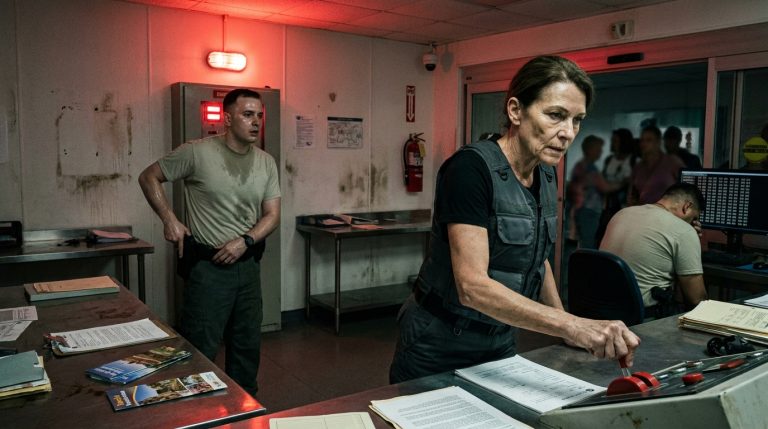
The hangar didn’t just feel dangerous; it felt predatory. The roar of the fire suppression system—a rhythmic, percussive deluge of chemical foam and inert gas—transformed the hangar into a white, swirling void. Carter crouched behind the landing gear of a transport truck, the chemical foam slick on her boots, the air so thick with particulates it tasted like copper and old dry-rot.
The emergency egress had worked, but it had also leveled the tactical field. The private security detail was scattered, their infrared optics blinded by the gas, their communications fractured by the sudden drop in hangar pressure. Carter wiped a smear of foam from her rifle case—which she had retrieved in the chaotic rush—and scanned the hangar floor.
She saw Vane. He was near the boarding ramp, his suit ruined by the white chemical coating, his face a mask of furious, unrefined panic. He wasn’t the commander who had dismissed her in a briefing room; he was a man cornered by his own logistics. He held the briefcase tight to his chest, his eyes darting toward the plane’s cockpit, where the engines were already spooling up with a low, bone-deep thrum.
“Wade!” she shouted, her voice struggling against the roar of the engines.
There was no answer, only the sound of suppressed gunfire from the far side of the hangar. Wade was occupied, pinned down by the security squad near the fuel lines. She was alone.
Carter stood, ignoring the screaming protest of her cracked ribs. She didn’t think about the strategy; she thought about the canyon. She moved with the silent, predatory grace that had once made her an invisible fixture of the mountain. She bypassed the main floor, climbing the maintenance scaffolding that hugged the hangar wall. It was a climb—not as steep as Hill 350, but infinitely more lethal. Her hands, still wrapped in the torn remnants of hospital gauze, found purchase on the cold steel struts.
Every movement was a calculated risk. A guard turned, his weapon leveled at the scaffolding, but the white foam and the dim emergency lights turned his optic into a liability. Carter held her breath, becoming a part of the steel, a shadow in the iron rafters.
When she reached the level of the jet’s wing, the heat radiating from the turbines was a physical barrier. She swung down, catching the edge of the boarding ramp just as it began to retract. The hydraulic whine was a high-pitched, mocking note that signaled the end of the mission. She landed on the ramp with a controlled, heavy thud, the impact shooting a fresh line of pain through her ribs.
Vane whipped around, his eyes widening as he recognized her. He didn’t reach for a weapon; he reached for the latch of the briefcase. “You’re an anomaly, Specialist,” he shouted over the rising scream of the jet engines. “A data point that refused to be deleted. Do you really think that folder changes anything?”
“It doesn’t change the past,” Carter said, her voice eerily calm, the mountain’s silence echoing in her chest. “But it changes the trajectory.”
She didn’t reach for her knife. She reached for the flight control panel near the ramp, her fingers finding the manual release for the hydraulic lock. She knew the design—a standard emergency safety feature for ground maintenance. If she engaged it, the ramp would stop, the plane would fail its pre-flight check, and the ground crew would be forced to intercede.
Vane lunged, his hand slamming into her shoulder, the force nearly throwing her off the ramp. He was stronger than he looked, fueled by the desperate, clawing instinct of a man whose black-market lifeline was being severed. She twisted, using his own momentum to pin him against the bulkhead, her forearm driving into his throat. She didn’t feel rage; she felt the cold, hard logic of a mission objective.
“The canyon,” she said, her voice barely a whisper against his ear. “Fourteen men for a ledger? Was the price worth it?”
Vane’s eyes rolled, his breath hitching. He clawed at her arm, but she held him fast, her fingers finding the manual release lever. She jammed it down.
The plane shuddered. A deafening, mechanical groan echoed through the fuselage as the hydraulics fought against the emergency stop. The jet, caught in the friction of the stall, lurched, the turbines cutting out in a sudden, violent silence that left the hangar ringing.
The ramp halted, leaving them suspended in the gap between the ground and the sky. The security team, alerted by the stall, began to converge on the ramp, their weapons raised. But she had the briefcase, and she had the lever. She looked at Vane, then at the hangar floor where Wade was emerging from the shadows, his weapon raised, his eyes locking onto hers with a silent, iron certainty. The decoy secret was shattered. The terminal trajectory of Vane’s betrayal had hit the ground, and for the first time since the canyon, Carter felt the cold weight of the mountain fall away, replaced by the crushing, inevitable reality of the truth.
CHAPTER 8: THE WEIGHT OF THE TRUTH
The hangar’s silence was heavy, a physical pressure that forced the breath from her lungs. Below, the security team had stopped their approach, their weapons wavering as they watched the scene on the ramp—the ghost of Hill 350, her hands stained and bleeding, pinning a man whose suit was as ruined as his reputation. Vane looked up, his eyes searching hers, looking for a crack, a doubt, a reason to negotiate. He found nothing but the cold, clear reflection of his own defeat.
“It wasn’t just logistics, was it?” Carter asked, her voice steady, echoing off the hangar’s vaulted steel ceiling. She pushed her forearm deeper into his throat, feeling the pulse of his fear—a frantic, uneven beat. “The aid workers. The ambush. It wasn’t about the militants. You were clearing the board for the syndicate. You were selling the entire sector for shipping rights to the black market, and you needed a massacre to justify a permanent security presence.”
Vane struggled, his face turning a mottled shade of red, but he couldn’t move. She had the leverage—not just of the moment, but of the truth. “The aid workers were killed because they saw the logistics manifest,” Carter continued, the realization clicking into place with the terrifying precision of a rifle bolt. “They weren’t hostages; they were witnesses.”
Vane gave a choked, desperate laugh. “You think you’ve won, Specialist? You’re a footnote. You’re a statistical anomaly. When they find this, they’ll bury you. They’ll bury us both.”
“They won’t find it,” Carter said, pulling the briefcase from his grasp and shoving him back against the bulkhead. “Because the record is already in transit to command, and it isn’t coming from me.”
At the hangar entrance, the shadows parted. Mercer stepped out, his side still bandaged, his face a landscape of hardened resolve. He wasn’t alone. He was flanked by a platoon of military police—not the base security she had evaded, but a tactical unit from the regional command, led by an officer whose insignia shimmered in the harsh hangar lights. Wade stood behind them, his weapon slung, his expression one of grim, quiet vindication.
“The audit triggered,” Mercer said, his voice carrying the weight of a final verdict. “We received the transmission you sent to the external node, Carter. Every file, every communication link, every name associated with Cerberus Logistics.”
Vane’s composure shattered. He slumped against the ramp, the panic finally draining the color from his skin. The security team, seeing the arrival of the regional unit, began to lower their weapons, their loyalty to Vane evaporating the moment the wind changed.
The next ten minutes were a blur of cold, mechanical efficiency. Vane was restrained, his hands zip-tied with the same impersonal, brutal finality he had applied to the lives of those aid workers. The regional commander took the briefcase, his eyes meeting Carter’s with a look of professional, austere respect—a look that acknowledged she had done the impossible not once, but twice.
The hangar began to clear. The roar of the jet was replaced by the low, mechanical whine of troop transport trucks. Mercer approached the ramp, standing at the base where she had first taken his hand. He looked at her, then up at the ramp where she had pinned Vane. “You were right, Carter. About the canyon. About the risk. About the cost.”
He reached up, offering his hand again, but this time it wasn’t an invitation through a door. It was an equal’s greeting. “Torres is asking for you again. He’s going to be fine. We all are.”
Carter took his hand, the grip solid and unwavering. She stepped down from the ramp, her boots hitting the concrete floor with a finality that felt like the closing of a chapter. She looked toward the hangar entrance where the desert sky was beginning to pale, a sliver of indigo light on the horizon—the approach of a day that didn’t feel like the ones that had come before.
She walked out into the cool desert air, leaving the hangar’s artificial, suffocating atmosphere behind. She stopped at the edge of the tarmac and looked toward the mountain range to the south. Hill 350 was no longer a target; it was a memory, a physical testament to a version of herself that no longer existed. She reached into her pocket, fingers brushing the small, jagged piece of shale she had unconsciously tucked away during the climb. She held it for a moment, the rough, abrasive surface a grounding, tactile reminder of where she had been and what she had done.
She turned and began the walk back to the barracks. She was tired—a deep, cellular exhaustion that would take weeks to mend—but as she walked, she noticed the way the morning light touched the desert floor, the way the shadows of the mountains stretched long and sure across the sand. She wasn’t carrying the mountain anymore; she was carrying the truth. And for the first time in seven years, the weight of it felt exactly like what she had always been built to hold.