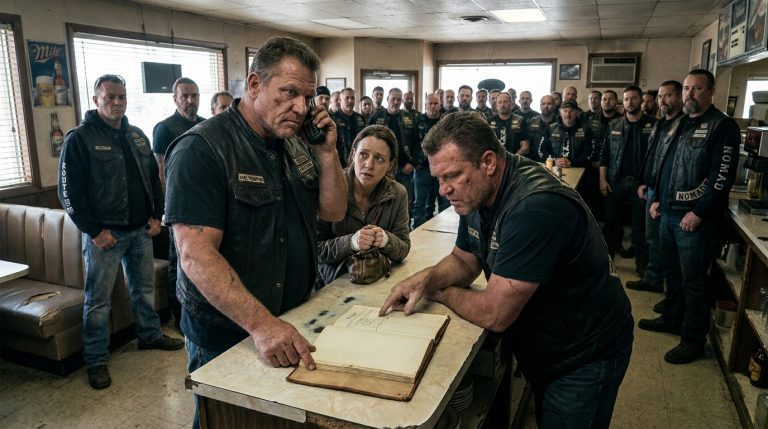
When an Invisible Boy Bleeds for an Outlaw, a Brotherhood Rewrites the Code of Retribution
CHAPTER 1: THE COLD ASPHALT
The heavy iron gate of the Sunnyside compound creaked as I oiled the top hinge, the metallic smell of WD-40 cutting through the oppressive July heat.
Across the dirt yard, Charlotte sat on an overturned wooden crate, her blonde pigtails bobbing as she drew a lopsided sun on the concrete with pink sidewalk chalk.
“Look, Daddy, it’s smiling,” she called out, her small voice carrying over the low rumble of an idling V-twin engine across the fence line.
I wiped my grease-stained thumb against the denim of my jeans and smiled back at her. “That sun needs a hat, bug. It’s a hundred degrees out here.”
I reached into my front pocket, fingers wrapping around the cool, scarred brass of my Zippo lighter. I thumbed the loose hinge open with a soft, familiar click, rolling the flint wheel twice without lighting the flame just to feel the mechanical rhythm.
Beyond the chain-link fence separating our lot from the rusted single-wides of the trailer park, a skinny six-year-old boy in an oversized t-shirt sat on a discarded plastic milk crate, watching us through the wire diamond mesh.
Luca didn’t make a sound; he never did. He just sat there every afternoon with his thin arms wrapped around his knees, watching Charlotte draw.
I gave the kid a brief nod, the same quiet greeting I offered him every day.
The boy’s eyes widened slightly, but before he could even shift his weight on that plastic crate, a low, metallic hum drifted down the dusty access road.
A dark Suburban rolled around the corner off the main asphalt, its tinted glass up and its engine creeping with a slow, predatory quiet that didn’t belong in Oildale.
My thumb froze on the brass casing of the Zippo.
The rear passenger window slid down two inches, revealing the dark, cylindrical steel of a gun barrel protruding into the glare of the sun.
“Charlotte, down!” I bellowed, dropping the oil can as my boots slammed into the gravel.
She didn’t move fast enough; she just stood there blinking in confusion, her chalk suspended in mid-air.
Twenty feet separated us, a distance that suddenly felt like three miles of wet concrete.
Before the first crack of automatic fire shattered the quiet afternoon, a flash of faded blue denim launched over the chain-link fence from the dumpster side.
Luca didn’t call out or hesitate.
His small, fragile frame hit the dirt hard, his bare sneakers skidding across the gravel as he hurled his whole eight-year-old weight directly into Charlotte’s waist.
They went down together in a heap of dust and chalk just as a spray of lead tore through the wooden crate behind them, sending splinters flying into the dry air.
The Suburban’s tires shrieked against the hot pavement, burning rubber as the driver floored the accelerator and sped away down the access lane.
I hit the ground beside the two children, my chest heaving as I pulled Charlotte against my ribs.
She was crying, terrified and covered in grey dust, but her skin was unbroken.
“I’m okay, Daddy, I’m okay,” she sobbed, burying her face into my leather vest.
I let out a jagged breath, then turned my head to look at the boy lying on his back in the dirt three inches away.
Luca’s wide blue eyes were fixed on the sky, his thin chest rising in shallow, rapid hitches that rattled deep inside his ribcage.
Dark, heavy crimson was spreading rapidly across the front of his faded t-shirt, soaking through the cotton and pooling on the scorching asphalt beneath his shoulder.
I slid my hand under his back to support his neck, my calloused palm immediately running wet with warm blood.
The boy looked at me without a tear in his eye, his jaw trembling as he tried to form a single word.
“Is… is she safe?” he whispered, his raspy voice barely louder than the hum of the cicadas in the dry brush.
I pressed my heavy hand firmly over the chest wound, feeling the fierce, erratic thudding of his heart fighting against the damage.
“She’s safe, kid,” I said, my voice dropping into a tight, absolute line. “She’s safe because of you.”
CHAPTER 2: THE STERILE LINE
The fluorescent lights of the Bakersfield ICU corridor hummed with a flat, sterile buzz that ate away at what little patience I had left.
I sat on a low plastic chair, my hands rested on my knees, staring at the dark, dried blood flaking off my knuckles and settling into the grain of my jeans.
Charlotte slept on a cot in a side office, wrapped in a fleece blanket while one of our local mechanics’ wives kept a quiet eye on the door.
A sharp clatter of heels sounded against the linoleum, cutting through the heavy quiet.
Doctor Harrison Miller pushed through the swinging double doors, wiping a hand across his forehead and leaving a streak of pale sweat.
“He’s stabilized, Jasper,” Miller said, his voice dropped to a low raspy murmur. “Missed the heart by less than half an inch. The pelvic fracture is pinned, but the boy’s severely malnourished—his body was already running on empty before the lead hit him.”
I leaned forward, my boots grinding against the tile. “Is he going to walk?”
“Physically? Yes,” Miller said, pulling a clip of medical charts close to his chest. “But the state is already moving. CPS was notified the second a gunshot victim under eight hit my table. Given his home address, they’re dispatching a social worker to process him as a ward.”
I reached into my vest, pulled out my scuffed brass Zippo, and flicked the hinge open with a harsh, metallic clack.
“He isn’t going to a state home,” I said, thumbing the cold flint wheel without lighting it. “He bought my daughter’s breath with his own blood.”
“I don’t make the custody laws, Jasper,” Miller replied, his eyes dropping to the bloody imprint of my hand still visible on my shirt. “Unless someone with legal standing signs those papers, the county takes him the second he leaves this room.”
Before I could answer, the outer double doors swung wide, admitting a disheveled woman pulled along by Ghost’s heavy grip on her elbow.
Brenda looked like a ghost that had been dragged out of a bar light—her hair matted, her mascara running in dark tracks down her pale, nervous face.
She shrank back the moment her eyes met mine, her cheap plastic purse clutched against her stomach like a shield.
“Is he… is Luca dead?” she whimpered, her voice shrill enough to set my teeth on edge.
I stood up, my six-foot-four frame blocking the harsh overhead light and casting a shadow straight over her boots. “He’s breathing. No thanks to the hole you left him in.”
“I didn’t ask for this!” she shrieked, backing into the door frame as Ghost cut off her exit. “I can’t pay for hospital bills! I can’t have cops coming to my door every five minutes because he was hanging around your fence!”
She looked past me at Doctor Miller, her arms shaking violently. “Do whatever you want with him. Make him a ward. I’m signing nothing that puts my name on a bill. I’m done.”
She turned to bolt toward the glass doors leading to the parking lot.
Ghost took one step to intercept her, his jaw set like iron, but I held up a single, bloody hand to stop him.
“Let her walk,” I said, the words coming out cold and flat. “We don’t force trash to stay where it isn’t wanted.”
I turned back to Miller, my thumb snapping the Zippo lid shut with a sound like a rifle shot. “Get Ronan Sloan on the line. Tell him to bring the emergency guardianship filings directly to the night judge.”
Miller hesitated, looking at the blood drying on my skin. “Sloan? That’s a high-priced corporate defense attorney, Jasper. He doesn’t do county family court.”
“He does when I pay him,” I said, my voice dropping into an absolute line. “The state isn’t taking that boy. He’s mine.”
CHAPTER 3: TRACING THE PHANTOM
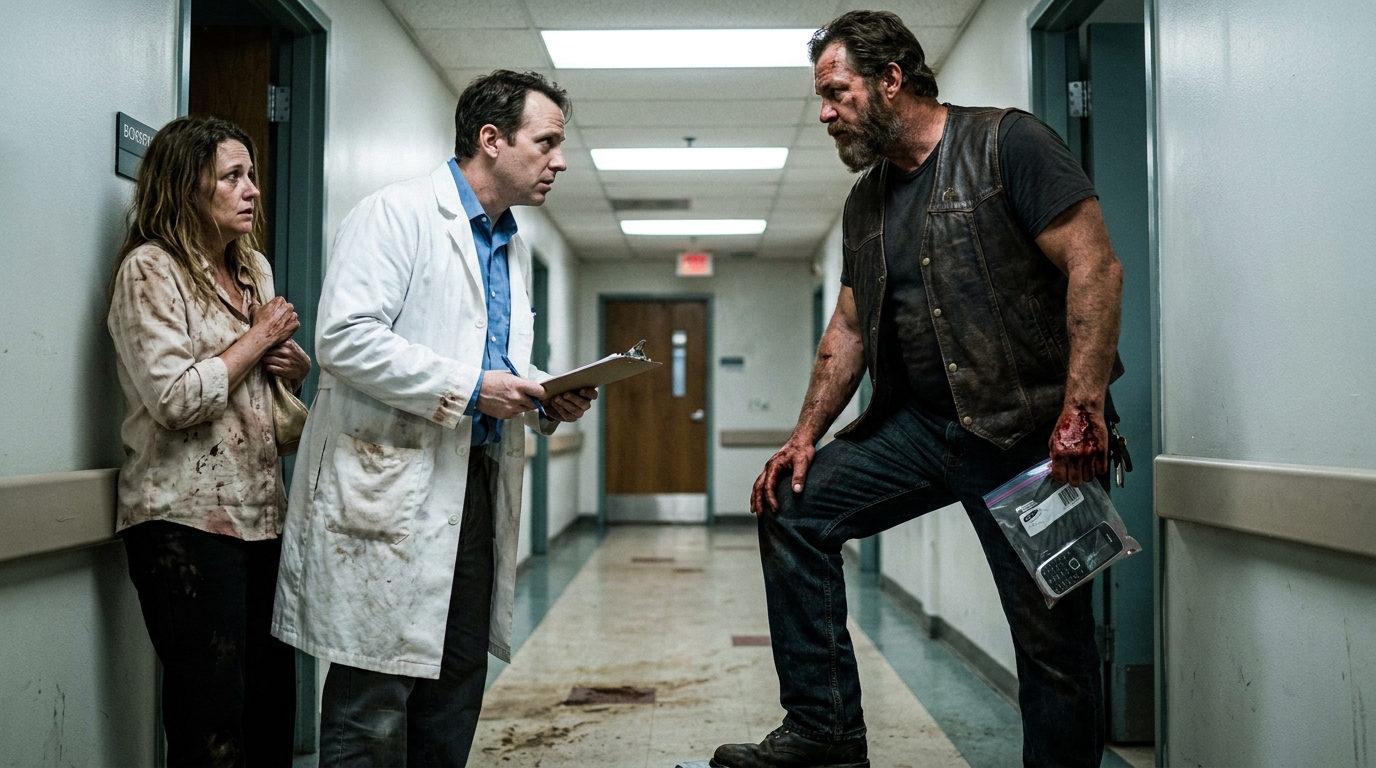
Ghost didn’t say a word at first; he just handed me a cheap, clear plastic sandwich bag containing a cracked flip phone.
I took the bag, the smooth plastic cold against my calloused palm. “Where’d you pull this?”
” Hector’s shop off the bypass,” Ghost murmured, his eyes scanning the empty hospital corridor before locking onto mine. “The Suburban was sitting under a blue tarp in his bay, half-wiped with industrial bleach. They paid him ten grand in cash to torch the engine block.”
I brought the plastic bag up under the harsh fluorescent light, turning the cheap plastic shell over in my grip.
On the plastic casing right beneath the battery latch, a tiny, pristine bar code sticker sat untouched—unblemished by grease, dirt, or bleach.
“Hector didn’t cut it up?” I asked, my thumb pressing against the rigid plastic edge of the Zippo still sitting in my leather vest.
“He was about to,” Ghost said, his jaw tightening until a muscle leaped along his cheek. “The driver was a Fresno shooter named Reggie. But Reggie didn’t pick the time out of the air, Jasper. He knew the gate schedule.”
I stopped turning the plastic bag. “The gate was only unchained for the keg delivery.”
“At one-fifty-five p.m., five minutes before the black truck turned down our lane, a text hit Reggie’s burner,” Ghost said, his voice dropping into a harsh, sandpaper whisper. “Sent from inside our fence.”
I didn’t answer right away. I pulled the Zippo from my pocket, flipped the brass hinge open with a loud, solitary click that rang down the empty hallway, and stared at the flint wheel.
“Someone inside sold the window,” I said.
“Hector said Reggie was running his mouth while counting the money,” Ghost said, leaning in until his breath hit my shoulder. “Said an insider owed fifty grand on underground tables in Fresno. The hit was the trade to erase the paper.”
“We don’t call in fifty bikes to drag the street, Ghost,” I said, setting the Zippo back into my pocket without lighting it. “No runs, no circus. We find the hand that typed the text.”
Ghost hesitated, his boots shifting on the linoleum. “If the charter finds out we’re looking inside before we hit the Vipers—”
“The charter does what I order,” I interrupted, my eyes cutting straight through him. “Get Ronan Sloan to verify the store that sold this cheap unit. I want the cash receipt, not a beatdown.”
Ghost swallowed hard, his hand dropping to his belt, but he gave a single, rigid nod. “I’ll get the paper.”
I turned back to the window of room 312, watching the small, pale chest under the heavy white blanket rise and fall in shallow, fragile beats.
Whoever traded that kid’s blood to clear a gambling card was going to answer to me on clean linoleum, not in the dark.
CHAPTER 4: THE HOLLOW OATH
The air in the room felt thick enough to choke on, smelling of harsh floor disinfectant and stale coffee.
Ghost didn’t hesitate. He pulled a printed sheet of store security stills from inside his leather cut and tossed it onto the table right beside the clear plastic bag.
“Liquor store off Highway 99,” Ghost said, his voice dropping into a raspy, flat line. “Bought with cash three weeks ago. The guy on the counter camera has a very distinct skull and wrench tattooed right up the side of his neck.”
Wrench stepped back, his heavy boots squeaking against the slick tile flooring.
His hands began to tremble, his bloodshot eyes darting from the paper on the table up to my face. “Jasper… Jasper, listen to me—”
“You sold the gate schedule,” I said, my voice dead calm. I reached into my pocket, fingers wrapping around the scuffed metal of my Zippo, but I didn’t pull it out.
“They had markers on me!” Wrench shouted, tears cutting dirty trails down his tattooed cheeks as his tough posture completely caved. “Fifty grand from the tables in Fresno! They said they were going to burn my house with my ex-wife inside! They swore it was just a drive-by to scare the club, Jasper—they said nobody was supposed to take lead!”
Ghost stepped behind him, blocking the heavy wooden door without drawing a single weapon.
“You traded Charlotte’s breathing room to settle your card,” I said, every word hitting the room like iron dropping on concrete.
“I didn’t know the kid would be there!” Wrench sobbed, dropping straight to his knees on the hard floor, his fingers clutching at the hem of my jeans. “I swear to God, Jasper, when I saw that six-year-old go down, I wanted to put a barrel in my own mouth!”
I didn’t step back. I looked down at the man who had sat at my dinner table, the man who had stitched custom leather for my daughter.
“A kid took three rounds of lead because you couldn’t keep your hands off the cards,” I said softly.
I looked over at Ghost and gave a single, imperceptible nod.
Ghost stepped forward, his heavy fingers gripping the collar of Wrench’s vest. He drew his serrated blade, the steel catching the cold neon glare overhead, and sliced through the top seam of the back patch in three clean, deliberate pulls.
The leather tore away with a sharp, ugly rip.
“You’re stripped of your colors,” I said, watching the shredded leather fall to the tile. “You leave Oildale before sundown. If your name hits my ear in California again, you won’t get to walk out of the room.”
Wrench stayed on his knees, clutching the ragged shreds of his unstitched jacket to his chest, choking on his own breath as Ghost dragged him backward through the open doorway.
I stood alone by the laminate table, turning the cheap plastic bag containing the burner phone over in my palm, staring at that unblemished bar code sticker.
Wrench was a coward, but a fifty-thousand-dollar card debt didn’t buy a coordinated strike across county lines unless someone bigger was holding the leash.
CHAPTER 5: THE CORNERED RAT
“You took a long drive for a dead phone, Jasper,” Miller, the regional transport operator for the Fresno syndicate, said, his mouth curling into a flat, condescending smirk.
He didn’t look like a street gunman. He wore a crisp dress shirt under an expensive wool jacket, standing on private commercial pavement like he owned the whole zip code.
“Wrench cleared his tab,” I said, stepping onto the edge of the concrete ramp. “The trouble is, Wrench didn’t have the juice to clear a transport permit for county routes.”
Miller’s smirk tightened, a subtle twitch pulling at the corner of his jaw. “I don’t know what you’re talking about. You got an internal problem in Oildale, take it up with your own people.”
I reached into my vest and pulled out my brass Zippo, flicking the hinge open with a sharp, echoing click. “The burner had a retail tracking sticker on the frame. Ronan Sloan ran the commercial ledger on the bulk sale.”
Miller’s hands stayed in his pockets, but his posture went rigid. “Sloan’s a corporate lawyer. He doesn’t hold any jurisdiction on private freight lots.”
“He doesn’t need to,” I said, thumbing the cold flint wheel twice. “The liquor store that sold the unit sits on state land earmarked for the county transit expansion. The same land your syndicate filed a private lease takeover for three months back.”
“You’re fishing, Lawson,” Miller snapped, taking half a step toward the office door behind him. “You bring a mob to my dock, county deputies will have you in zip-ties before your kickstands hit the dirt.”
“Look around the alley, Miller,” I said softly, letting the silence stretch between us. “No bikes. No muscle. Just me, a lawyer’s paper trail, and state tax auditors sitting down the block with the county sheriff.”
Miller’s eyes darted past my shoulder toward the street corner, where a dark sedan sat idling quietly under the street lamp.
His face drained of color as the leverage he thought he held shattered into plain, unyielding enforcement.
“You think you can pin a drive-by on a land filing?” Miller snarled, his voice rising into a sharp, desperate rage as he pulled a thick envelope from inside his coat. “This is private commerce! You’ve got nothing that connects my desk to the shooter!”
“The text pinged off the tower on your lot at one-fifty-four p.m.,” Ghost said, stepping out from the shadow of the freight door behind him, holding a certified copy of the dispatch log. “And your signature’s on the commercial lease.”
Miller backed against the heavy corrugated steel of the bay door, his hands shaking as he clutched his envelope, refusing to step off the dock. “You can’t prove intent! I’ll tie this up in administrative hearings for five years!”
“Try six months,” I said, snapping the Zippo lid shut with a sound that ended the debate. “The county revoked your access permit five minutes ago.”
CHAPTER 6: THE IRON COVENANT
The quiet hum of the heart monitor filled the room, its steady rhythm peaceful and uncluttered.
Luca’s wide blue eyes focused on me, his breathing shallow but even under the clean white bedsheets.
Charlotte sat on the foot of the mattress, holding a fresh sheet of paper and her pink chalk, watching him with a wide, bright smile.
“Hey, buddy,” I said, my gravelly voice kept low. I set the small vest gently beside his arm, the white stitched lettering Blood Brother visible against the smooth leather. “You feeling alright?”
Luca looked at the vest, then up at my face, his small jaw trembling slightly before he managed a faint, nod. “Am I… am I in trouble?”
I reached out, my heavy, calloused hand resting gently against his uninjured shoulder. “You’re never in trouble here, kid. You’re home.”
Ronan Sloan pushed open the door, stepping inside without a sound and placing a sealed manila envelope onto the bedside table.
“Guardianship is signed and filed with the county clerk,” Sloan said, giving me a concise nod. “The mother signed the release in Barstow. The state file is closed permanently.”
Luca looked from Sloan back to me, his brow furrowing as he tried to understand the paper on the table. “I don’t have to go back across the fence?”
“That fence doesn’t exist anymore,” I said, pulling my scuffed Zippo from my front pocket.
I thumbed the loose brass hinge open with a soft, familiar click, letting the cool metal rest in my palm without spinning the wheel.
Charlotte reached over, gently patting Luca’s good hand. “My daddy made you a vest, Luca. You get to ride in the front now.”
Luca’s hand slid across the cotton sheet, his small fingers resting against the thick leather edge of his new vest. “For real?”
“For real,” I said, slipping the unopened Zippo back into my denim pocket for good. “Nobody touches my family, kid. Not from the outside, and not from the inside.”
Outside the open window, the soft, low idle of a single V-twin engine drifted up from the parking lot—steady, grounded, and entirely at peace.