A Ghost in the Sheet Metal: The Forgotten Debt of a Soldier’s Last Drive Home
CHAPTER 1: The Weight of Steel
The barn doors shrieked open, a rusted metal protest that set Harold’s teeth on edge. The air inside was heavy, smelling of damp straw, decades of pigeon rot, and the unmistakable, biting tang of iron. Eric, a man whose hands were already calloused by a life of loss, gestured at the vehicle huddled in the shadows.
“She’s a relic,” Eric said, his voice flat. “Doesn’t run. Eight hundred, and she’s out of your hair before the frost.”
Harold didn’t breathe. He leaned his weight against the oak cane, the wood digging into his palm, and hobbled toward the Willys MB. He didn’t see the rust or the missing glass. He saw the geometry of his own nightmares. He reached the rear fender, dropped to his knees—the joint screaming—and clawed at the dust. His thumb tracked the lines of a stencil, the white paint ghosts of a unit that hadn’t existed on any official map.
He knelt there for two minutes, the silence in the barn stretching until it felt like a physical pressure against his eardrums. When he finally looked up, his hand was vibrating, a fine tremor that rattled the metal fender.
“Put your money away, son,” Harold whispered, his voice catching on the stale air. “And sit. Because what I have to tell you about the man who raised your father—and what I have to tell you about the morning of June 6th—is going to burn every memory you have to the ground.”
Eric frowned, shifting his weight, but the gravity in Harold’s eyes forced him toward the workbench. Harold pulled a photograph from his wallet, his fingers moving with a frantic, desperate precision. He slid it across the splintered wood, but as he did, his sleeve caught on a sharp protrusion beneath the Jeep’s seat frame.
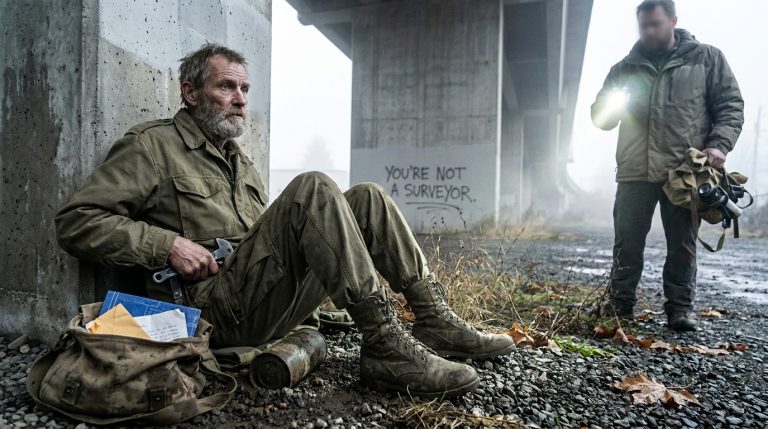
There was a metallic snick—a hidden panel, released by the accidental tug of his jacket. A small, water-damaged bundle of papers slipped out from the hollow of the seat, hitting the dirt floor with a heavy, final sound. Harold froze. He reached down, his fingers brushing the edge of a map stained with something darker than motor oil. It wasn’t just the Jeep he had found. It was the proof of everything he had spent sixty years trying to bury.
Harold looked at the papers, then up at Eric. The information gap hit the room like a physical blow. The Jeep hadn’t been hidden for decades because of grief. It had been hidden because of what was tucked inside the upholstery.
CHAPTER 2: The Geometry of Guilt
The map was fragile, a ghost of vellum and ink that felt ready to disintegrate under the pressure of Harold’s skin. The blood-stain on the corner had oxidized into a rusted, dark brown that seemed to bleed into the map’s grid lines. Eric stood over him, the toothpick still hanging precariously from his lower lip, his eyes darting from Harold’s rigid, trembling frame to the document.
“What is that?” Eric asked, his voice tighter than it had been a moment ago. “That’s not service records.”
Harold didn’t look up. He couldn’t. His vision blurred, not with the weakness of age, but with the sudden, sharp return of adrenaline—a familiar, icy spike that traveled from the base of his spine to the back of his throat. He smoothed the map against his knee. It was a topographical chart of the Normandy coast, but the ink marks were wrong. They weren’t standard military notation. They were precise, calculated vectors, and one specific set of coordinates had been circled in a red that looked agonizingly like dried blood.
“Your grandfather,” Harold started, his voice a jagged rasp, “wasn’t just driving a transport. He was a courier, Eric. But not for the army.”
Harold felt the barn shift. The draft from the eaves seemed to chill the very air between them. He turned the map slightly, angling it toward the pale, dusty shaft of light. The coordinates circled in red didn’t correspond to any landing zone. They pointed directly toward a sector of the French hedgerows where a secondary, off-the-books extraction had occurred—a place that officially never existed in the history of the 1st Infantry.
“I didn’t know,” Harold lied. The words tasted like ash. He knew exactly what these coordinates represented, but the realization was a trapdoor opening beneath him. If these papers were here, in the seat of this rusted Jeep, it meant Walter hadn’t just saved his life. It meant Walter had been holding onto something that had been worth killing for—and potentially, something that still was.
Eric reached out, his hand hovering over the map. “My grandfather was a farmer. He didn’t have secrets. He raised me to believe that a man’s word was his bond, and he didn’t have anything to hide.”
“Everyone has something to hide,” Harold snapped, the sharpness of the tone surprising them both. He felt the weight of the cane leaning against the workbench, a symbol of his frailty, but for a moment, he felt the ghost of a rifle in his hands, the weight of a pack that had held his entire world. He pushed the map toward Eric. “Look at the red ink, boy. Look at the date. That was the morning of the 7th. That wasn’t a supply run. That was an evacuation of something that didn’t have a name.”
Eric took the paper, his fingers shaking as he traced the lines. The barn was silent, save for the rhythmic, distant tapping of a branch against the siding—a sound like a clock ticking down.
“If this is here,” Eric whispered, his eyes widening, “why did he keep it? Why didn’t he burn it?”
“Because,” Harold said, standing up with a groan of protest from his knees, “he wanted to be found. Or he was waiting for someone to come back for it. And now, you and I are holding it.”
Harold looked around the barn. The Jeep, once a memory of loss and grace, now looked like a predator. The olive drab paint was no longer a symbol of service; it was a camouflage for the truth. He felt the cold iron of the seat frame near his hand, the hidden compartment clicking back into place with a sound that felt like a lock snapping shut. He realized with a sudden, sinking dread that by finding these papers, they had moved from the realm of personal history into something far more dangerous.
He looked at Eric. The man’s face was pale, his eyes wide with a dawning realization that the grandfather he had worshiped was a stranger to him. Harold realized he was no longer just the old man sharing a story; he was the primary witness to a crime that had been kept silent for over six decades. He had intended to provide comfort, but instead, he had lit a fire that might burn them both.
“We need to see what else is in that compartment,” Harold said, his voice steadying into the cold, calculated tone he hadn’t used since 1944. “Before anyone else comes looking for it.”
He didn’t wait for Eric to agree. He reached back toward the seat, his hands moving with a sudden, fluid grace that belied his age. He wasn’t a retired clerk in Iowa anymore; he was a runner on a beach, calculating the distance between safety and oblivion, and he knew that every second they spent in this barn was a second they were being measured by shadows he had hoped were dead.
CHAPTER 3: Echoes in the Iron
Harold’s fingers hovered just inches from the upholstery. The metal frame of the seat was cold, the kind of biting, deep-winter cold that seeped into the marrow. He didn’t pull back. Instead, he forced his hand forward, his touch deliberate, searching for the catch he had felt minutes before. His heart hammered against his ribs—a frantic, uneven rhythm that echoed the thrumming in his temples.
Eric stood back, his shadow stretching long across the dirt floor as the sun dipped behind the western hayloft. He was watching Harold, not with the casual interest of a seller, but with a wary intensity. The silence in the barn had evolved; it was no longer the quiet of a resting vehicle, but the pressurized silence of a room where a bomb was ticking.
“Harold,” Eric said, his voice hesitant. “If there’s something else in there… maybe we should wait. My dad’s lawyer is coming by tomorrow to go over the estate. We could have someone present.”
Harold ignored him. He found the latch—a small, rusted lever tucked into the webbing of the seat base. He pulled it. There was no clean click, only the dry, grating sound of corroded steel resisting movement. Then, the frame gave way with a sickening snap. A second compartment opened, dropping not just papers, but a heavy, canvas-wrapped bundle that landed in the dust with a thud that felt far too substantial for a mere souvenir.
He didn’t open the bundle immediately. He reached out to stabilize the Jeep, his palm smearing the dust on the fender, and his gaze snagged on the ignition switch. It was a simple, toggle-style switch, long since seized by rust, but in that second, the dim barn light flickered, and the sound of the metal turning seemed to amplify in his head. Click-thrum. It wasn’t the sound of an engine in an Iowa barn. It was the roar of a Higgins boat engine at full throttle, the deafening, soul-crushing sound of the surf, and the sharp, rhythmic snap of mortars landing in the wet sand.
Harold swayed, his knees buckling, the cane clattering to the dirt. He wasn’t in the barn. He was back in 1944, standing in the surf, staring at the back of Walter Mercer’s head as the sergeant yelled orders that were swallowed by the ocean. He remembered the specific, agonizing smell of wet wool and cordite. He remembered the way the water felt—not like water, but like liquid lead against his boots.
“Harold? Hey, breathe.”
Eric’s voice cut through the memory like a blade. Harold gasped, his eyes flying open to find the barn returned to its dusty, static state. His hands were still locked onto the Jeep’s seat frame, white-knuckled and trembling. He looked at Eric, seeing a flash of the boy’s grandfather in the set of his jaw.
“I’m here,” Harold whispered, though he wasn’t entirely sure of it. “I’m here.”
He turned his attention back to the canvas bundle on the floor. It was tied with a piece of heavy-duty paracord, the knots tied with a specific, military-issue precision that Harold recognized instantly. It was a ‘bowline’—the knot Walter had taught him to tie in the dark, in the hold of the troopship, so they wouldn’t lose their gear in the chaos. The sight of it felt like a ghost touching his skin.
He pulled the cord, the fibers fraying under his fingers. As the canvas fell away, it revealed a leather-bound logbook, its pages brittle and yellowed, and a stack of black-and-white negatives that had been carefully shielded from the light.
“These aren’t documents,” Harold murmured, leafing through the first few pages. His breath hitched. It was a flight log, but not for an aircraft. It was a tactical record of the 1st Infantry’s movements, marked with times, locations, and personnel IDs that were supposed to have been purged after the beachhead was secured.
“What does it say?” Eric asked, stepping closer, his boots kicking up a small cloud of dust.
Harold didn’t answer. He was staring at an entry dated June 7th, 1944. It was his own name—’Whittaker, H.’—followed by a note written in Walter’s sharp, frantic script: ‘The kid saw the signal. The kid saw the marker.’
Harold felt the blood drain from his face. He had spent his entire life believing the marker had been an enemy flare, a piece of battlefield chaos he had misunderstood. He hadn’t just ‘seen’ it. He had been the one to report it. He had been the one to signal the position, thinking it was a beacon for their own artillery, not realizing that by doing so, he had handed the coordinates of their own command post to the enemy.
The realization sat in his chest like a stone. He hadn’t been saved by Walter. He had been protected by him. Walter had taken the secret of that mistake to his grave, and he had spent his life keeping Harold close, not out of friendship, but out of a desperate, agonizing need to ensure that the boy who had doomed the unit never discovered the truth.
“It’s just records,” Harold said, his voice flat, dead. He began to close the logbook, but Eric’s hand shot out, grabbing his wrist.
“That’s not ‘just records,’ Harold. You’re shaking. And that look on your face—that’s not grief. That’s fear.”
Harold looked at the boy, then at the Jeep, and finally at the map on the floor. He realized he was standing at the edge of a precipice. He could lie, he could walk out of the barn, he could drive his truck back to Davenport and let the past stay buried. But the truth was out in the open, laid bare in the light of the setting sun.
“You want the truth, Eric?” Harold whispered, his voice gaining a hard, brittle edge. “The truth is that your grandfather didn’t save my life because he was a hero. He saved me because he was the only one who knew I was the one who destroyed the unit. He carried that secret for forty years, and he kept this Jeep, and these papers, as a penance for a war that never actually ended for him.”
Harold pulled his hand free. The barn seemed to shrink around them, the shadows deepening into jagged, accusing shapes. He knew, with a sudden, sinking certainty, that Eric wouldn’t let this go. And for the first time in his life, Harold didn’t want him to.
CHAPTER 4: The Sound of Fractures
The silence that followed Harold’s confession was absolute, save for the distant, low-frequency rumble of a storm rolling in from the plains. Outside, the sky had turned a bruised, sickly purple, and the air in the barn had grown thick, charged with the ozone of a pending electrical discharge. Harold remained on one knee, his hand still resting on the rough, uneven concrete, feeling the grit of decades under his palm. He had finally said it—the confession that had been a splinter in his mind for sixty-two years—and yet, the expected relief never came. Instead, there was only the cold, hard reality of Eric’s reaction.
Eric hadn’t moved. He stood over the Jeep, his eyes fixed not on Harold, but on the black-and-white negatives splayed across the workbench. He looked as if he were trying to reconstruct his entire family tree, and finding that the roots were rotten.
“You’re saying he didn’t just know,” Eric said, his voice dangerously level. “You’re saying he orchestrated the environment that allowed you to survive.”
“I am saying,” Harold retorted, his voice raspy, “that your grandfather was a man of terrible, silent burdens. He didn’t orchestrate my survival, Eric. He accepted the reality of a war where mistakes were measured in lives, and he chose to live the rest of his days paying for a moment of panic that I caused.”
The first crack of lightning slammed against the earth, a sound so close and violent that the entire barn frame shuddered. Dust rained down from the rafters, coating the Jeep in a fine, gray veil. The storm had arrived, and with it, the necessity of deciding their next move. Harold knew they couldn’t stay here. If these papers were truly of the caliber he suspected—if they contained the raw, unredacted coordinates of the disaster that had defined his youth—they were no longer in an old man’s barn. They were in the crosshairs of history.
“We have to get these out of here,” Harold said, struggling to his feet. His legs, weary from the tension, protested with sharp stabs of pain. He gripped his cane, his knuckles white. “Now.”
“Why?” Eric asked, finally turning to look at him. “If this is the truth, why does it matter if the world knows? Why bury it again?”
“Because,” Harold said, his eyes scanning the barn’s exterior, “some truths aren’t meant to be public property, Eric. If the people who were in charge of that sector—the ones who sanctioned that ‘off-the-books’ operation—find out this log exists, they won’t just come for the Jeep. They’ll come for the story. And they will erase everything your grandfather built to protect it.”
A gust of wind hammered the barn doors, forcing them inward. The hinges screamed in protest. Harold didn’t wait for Eric’s permission. He gathered the negatives and the logbook, shoving them into the inner pocket of his heavy coat. The paper felt like a live wire against his chest.
They moved toward the door, the storm now a cacophony of driving rain and howling wind. Every step Harold took was a gamble against the floorboards and his own failing balance. He felt the weight of every year he had spent in Iowa, every Sunday morning he had spent in his truck, every moment he had spent trying to be a man worth remembering. The logic of his survival—the therefore/but of his life—had led him here, to a barn in the dark, with a man whose bloodline he had both preserved and destroyed.
“If we leave,” Eric said, his hand on the heavy iron latch of the barn door, “there’s no going back. You understand that, right? My life, my farm, my family’s name—it all changes the moment we walk out of this barn with these.”
Harold reached out, placing his hand over Eric’s on the latch. The metal was freezing, vibrating with the intensity of the storm. “I’ve spent sixty years running from the moment I signaled that marker. I’m done running, Eric. If we have to burn it all down to make sure your grandfather’s legacy isn’t stolen by the people who sent him to that beach to die for nothing, then we do it.”
Eric didn’t pull away. He looked at the old man, his expression hardening into a mirror of the resolve Harold had seen in Walter’s eyes on the morning of the 6th. He pulled the latch. The door swung open, revealing a world of thrashing trees and blinding, horizontal rain.
The transition was jarring. They stepped out into the mud, the cold water instantly soaking through Harold’s trousers. They were no longer in the quiet sanctuary of the barn; they were exposed, vulnerable, and moving toward a target they couldn’t see. Harold led the way toward his truck, his eyes fixed on the sliver of headlight that cut through the darkness. He knew the path forward was going to be difficult, that the evidence he carried would be a beacon for others, but for the first time in his life, the weight in his chest felt lighter. The truth was out. The ghost was walking beside him. And for the first time since the war, he felt like a soldier in his own life.
CHAPTER 5: The Shattering of the Signal
The interior of the truck smelled of old vinyl, wet wool, and the faint, metallic scent of the documents tucked into Harold’s coat. The rain didn’t just fall; it battered the pickup, turning the world outside the windshield into a blurred, monochromatic smear of gray fields and dark hedgerows. Harold gripped the steering wheel, his knuckles swollen and pale, his eyes fixed on the ribbon of gravel ahead. He felt the cold iron of the logbook pressing against his ribs, a constant, abrasive reminder of the weight he was carrying.
“Turn here,” Eric said, his voice cutting through the drumming rain. He pointed toward a narrow, overgrown lane that Harold had barely noticed in the darkness.
Harold hesitated. The lane looked like a wound in the landscape, choked with briars and mud. “That’s private land, Eric. That leads to the old substation.”
“I know,” Eric replied, his gaze locked on the road ahead. “My grandfather owned that land. He bought it in the early fifties, right after he bought the Jeep. I never understood why, but I think I do now.”
Harold turned the wheel. The truck groaned, the tires slipping on the saturated clay before catching and pulling them into the shadows of the overgrowth. The headlights cut through the gloom, revealing the skeletal remains of a concrete structure, vine-choked and crumbling. It was a place that felt discarded by time, a silent monument to a decision made in another world.
As they rolled to a stop, Harold felt a sudden, violent jolt of vertigo. The pattern of the trees, the way the wind bent the long grass—it triggered a flicker in his memory, a strobe-light flash of the French countryside on that morning in 1944. The marker. He saw it again, not as a flare, but as a lantern, a distinct, rhythmic pulse of light that had drawn the German artillery toward them. He had been the one to point it out. He had been the one to call it in. The realization, long-suppressed, hit him with the force of a physical impact, making his chest cavity ache with a phantom pressure.
He didn’t realize he had stopped the truck until Eric reached over and grabbed his arm. “Harold? You’re shaking.”
Harold looked at his own hands. They weren’t just trembling; they were twitching, a nervous response from a nervous system that had lived for six decades on the assumption of a lie. “It wasn’t a flare, Eric. It was a lantern. A signal. I saw it, and I pointed it out, and I remember the way the sergeant’s face looked when I told him. He knew. He knew the moment I said it what I had done.”
He stared at the substation ruins, his breath coming in shallow, ragged hitches. The reality of Layer 1—the documents, the logbook, the strategic cover-up—suddenly seemed trivial compared to the crushing emotional weight of Layer 2. The documents were just the proof. The betrayal was the wound. He had spent his life admiring a man who had not only protected him but had done so while living with the constant, daily evidence of Harold’s culpability.
“If we go in there,” Eric said, his voice hushed, “we find out if he was involved. My grandfather. Was he the one who set the signal?”
Harold looked at the boy, his heart heavy. “He was the sergeant, Eric. He was the one responsible for the entire unit. If he set the signal, he did it to save the rest of the army by sacrificing his own squad. If I was the one who signaled it, he was just cleaning up the mess.”
They stepped out of the truck, the rain instantly plastering their clothes to their skin. The cold was absolute, a sharp, metallic bite that seemed to penetrate the very fabric of reality. They moved toward the ruins, the crunch of gravel under their boots sounding like shattering glass. Every step felt like a breach of contract, a violation of the silence that had held their families together for generations.
Harold approached the heavy, rusted steel door of the substation. It was partially off its hinges, a gaping, dark mouth that led into the heart of the secret. He felt a sudden, overwhelming urge to turn back, to leave the past to the dust and the rain, but he knew that wasn’t an option. He had been a runner on a beach; he had been the one to signal the doom of his own brothers; and he would be the one to see the truth through to the end.
He shoved the door. It moved with a screech of tortured metal, revealing a dark, cavernous space that smelled of wet concrete and something deeper—something ancient and bitter. They stepped into the darkness, the only sound the steady, rhythmic drip-drip-drip of water hitting the floor.
Harold pulled the logbook from his coat. The pages were damp, the ink beginning to bleed, but the text was still legible. He flicked to the last entry, his fingers finding the final, damning note: ‘The kid saw the marker, but he didn’t set it. I did. And I will burn in hell for it so he never has to.’
Harold froze. The words seemed to vibrate in the silence. He hadn’t caused it. He had been the scapegoat, and Walter Mercer had been the architect. The betrayal wasn’t Harold’s—it was the war’s. He felt the cold iron of the book in his hand, and for a moment, the world stopped moving. The guilt, the sixty years of self-loathing, the phantom sounds of the beach—they all fell away, leaving behind a hollow, aching void where his entire identity had once resided. He wasn’t a traitor. He was just a ghost, living in a story written by a man who had sacrificed his own soul to keep the child he loved from knowing the truth.
CHAPTER 6: The Final Accounting
The silence in the substation was no longer oppressive; it was heavy with the weight of sixty years of borrowed time. Harold stood paralyzed, the logbook held open in his hands like a death warrant. The dampness of the room, the scent of stagnant water and cold concrete, seemed to focus his senses into a singular, agonizing clarity. He had spent his life under the crushing architecture of a guilt that wasn’t his, a structure built by a man who had sacrificed his honor to shield the one boy he truly loved.
“He didn’t just protect you,” Eric whispered, his voice trembling in the cavernous dark. He moved closer, the beam of his flashlight cutting through the gloom to illuminate the frantic, desperate scrawl of his grandfather’s handwriting. “He lived a life of silence so you could have a life of peace. He wasn’t a hero, Harold. He was a martyr.”
Harold looked up, his eyes meeting Eric’s. The shock was subsiding, replaced by a cold, resonant strength he hadn’t possessed in decades. He realized that the “debt” he had been trying to pay was nothing more than an echo of Walter’s own burden. The payoff wasn’t vengeance, and it wasn’t exposure—it was the acknowledgment of the cost.
“He died every day,” Harold said, his voice quiet but steady. “Every day I walked into his shop, every day he looked at this Jeep, he was seeing the ghosts of the unit he traded to save me. He didn’t do it because he was a monster, Eric. He did it because he knew I was the future, and he was the past.”
The antagonist of this truth—the war, the command, the impossible choice—was finally defeated by the simple, raw evidence of the logbook. Harold moved with purpose now, his joints loose, his grip on the cane firm as he turned toward the entrance. They had the evidence; they had the truth. The people who had kept the “off-the-books” operations buried were long gone or powerless, and the truth of Normandy would finally exist not as a lie, but as a testament to the real, human cost of survival.
They walked out of the substation and into the waning, gray light of the storm’s wake. The world was sodden, dripping, and quiet. Harold stopped by the truck, his movements measured. He took the logbook, carefully wrapped it back in its canvas, and handed it to Eric.
“This belongs to you,” Harold said. “And the Jeep belongs to you. Not as a trophy, but as a monument. Your children, your grandchildren—they need to know that their bloodline is one of sacrifice. Not the kind they put on medals, but the kind that hurts.”
Eric took the bundle, his hands steadying as he held the weight of his family’s history. “What about you, Harold? What happens when you go back to Davenport?”
Harold looked at his truck—the rusted, Sunday-only pickup that had been his refuge for so long. He felt a sudden, profound shift in the gravity of his own existence. He wasn’t the man who signaled the marker anymore. He was the man who had seen the truth, and he was finally, truly, free.
He climbed into the truck, his motions fluid and deliberate. He didn’t look back at the substation. He didn’t look back at the Jeep. He started the engine—the old motor turning over with a steady, reliable rhythm—and felt the chill of the evening air against his skin. It was a cold, sharp, and clean sensation.
He drove away from the farm, the gravel crunching beneath the tires, the sound rhythmic and final. As he passed the gate, he saw the flagpole in his mind’s eye, the flag still caught in the wind. He thought of the names on the plaque, the boys he had carried off that beach, and the man from West Virginia who had given him everything.
He stopped the truck a mile down the road at a small, roadside stream. He got out, his legs feeling strong, his posture straight. He walked to the edge of the water, and he reached into his pocket. He pulled out the old, folded photograph—the one of him and Walter, the creases soft and worn—and he stood there for a long moment, watching the water swirl over the stones. He didn’t throw it away. He kept it, tucking it into his breast pocket, right over his heart.
He went back to the truck and sat in the driver’s seat. He reached over and picked up a wrench from the floorboard—a small, simple tool he had kept for emergency repairs—and he held it, the weight of it familiar and grounding. He had spent his life waiting for someone to fix the past, but he realized now that the past wasn’t something to be fixed. It was something to be lived through, until you came out on the other side.
He started the truck and began the long drive back home. The silence in the cab was no longer a weight; it was a sanctuary. He was Harold Whittaker, a man who had lived to tell the truth, and that, he realized, was more than enough. The world was quiet, the storm had passed, and the road ahead was finally, for the first time in sixty-two years, his own.