The Dusty Deed And The Concrete Wall That Tried To Swallow Forty Acres Of Texas Soil
CHAPTER 1: THE ESCALADE IN THE CLAY
The dust hadn’t even settled on the caliche drive before the polished chrome of the SUV caught the glaring Texas sun.
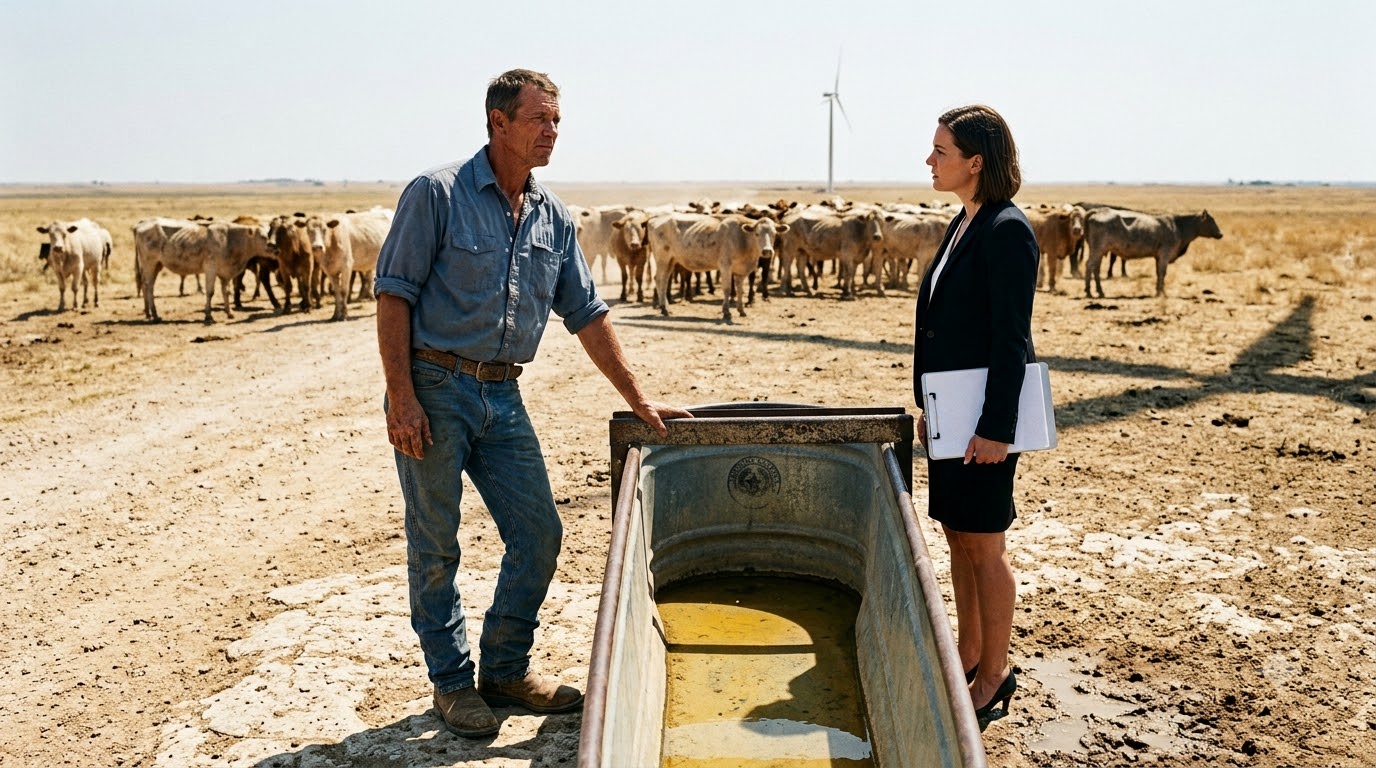
I stood by the watering trough, my hand resting on the scarred iron rim, watching the expensive heels sink straight into the damp clay.
Delilah Thornberry didn’t bother looking at the dry grass or the rib-showing cattle standing in the distance.
She held a crisp white clipboard high against her chest like a shield, her designer blazer smelling faintly of expensive perfume and cold air-conditioning.
“Shut it down today,” she said, her voice cutting right through the low hum of the wind turbine.
She didn’t wait for a greeting or an invitation past the cattle guard.
“Cap it in forty-eight hours or face five hundred dollars a day in penalties.”
I didn’t blink.
The heat radiating off the ground was enough to make a man dizzy, but the coldness in her delivery was sharper than any weather.
She spoke with the easy cadence of someone who had never sweated for a living, treating my livelihood like an inconvenient weed growing through her pristine sidewalk.
“This well feeds forty head of cattle,” I said, my voice rough from a morning of hauling feed. “You don’t have jurisdiction past the county road.”
“Pinehaven Estates annexed this entire corridor last quarter,” she snapped, tapping a laminated notice against her fingernail. “Your pump violates the aesthetic and environmental covenants of our master-planned community. Consider this your final warning before we slap a lien on your gate.”
She turned on her heel, the expensive leather crunching against the limestone gravel as she headed back to her idling motor.
I didn’t chase her.
I just watched the vehicle kick up a cloud of grey dust on its way out, leaving me alone with the silent heat and a dry trough.
CHAPTER 2: THE DRY TROUGH REALITY
I shoved the heavy copper float down until the water hissed through the line, coughing and sputtering before a thin, yellowish stream finally hit the bottom.
The cattle crowded around the far end, their ribs looking like split rails beneath dusty hides.
Forty head of stock living on borrowed time because a piece of paper from a suburban office building said my water was an industrial hazard.
I wiped a sleeve across my forehead, tasting salt and old dust, and checked the ledger I had shoved into my back pocket.
The penalty notices weren’t a joke.
Five hundred dollars a day added up faster than calf crop prices ever could.
At that rate, a single month of administrative stubbornness would cost me the entire south pasture and half the equipment shed.
The gate crunched behind me, and I didn’t even have to turn around to know the heavy, dragging footsteps.
Tom Patterson walked up the slope, his Stetson pushed back, holding a fistful of white envelopes that looked identical to the ones Delilah had dropped at my truck.
“They mailed out the special assessment notices to the whole ridge this morning,” Tom said, tossing a crumpled envelope onto the flat edge of the tank. “Every single homestead within two miles got hit with a community defense fee.”
“Defense against what?” I asked, keeping my hand on the shivering valve lever. “We aren’t in their subdivision.”
“Try telling that to the bank holding Betty Morse’s mortgage,” Tom muttered, spitting a bit of dust into the dirt. “They classified her goat pasture as a commercial runoff hazard. She’s talking about selling off her south acreage just to pay the legal retainers.”
The wind picked up, carrying the dry, rasping scent of dead Johnson grass across the fence line.
I looked down at the envelope Tom brought, noticing something strange right away.
The return address stamp for the Pinehaven association had a smeared ink smudge right across the notary seal, like it had been hurriedly pressed with an old stamp pad that ran dry halfway through.
It was a tiny flaw, but out here, flaws meant someone was rushing to cover their tracks.
“Betty’s been on that land since the fifties,” I said quietly, letting go of the valve as the tank finally filled to a pathetic half-inch below the rim. “They aren’t just trying to shut down my well. They’re trying to clear out every acre between the county road and the highway.”
“And they’re using our own money to do it,” Tom said, his voice dropping into a dangerous, flat register as he pointed a grease-stained finger at the papers in his hand. “These special assessment fees aren’t going to landscaping. I talked to the county clerk before I drove out here. The association’s corporate filing lists a legal retainer paid out to a firm three counties over that specializes in corporate asset seizures.”
CHAPTER 3: THE BROKEN LEDGER
Tom slid a stack of green-bar computer printouts across the scarred laminate table, his fingernails drumming a nervous, irregular beat.
The paper curled at the edges, smelling faintly of stale toner and damp concrete.
“Look right here at the quarterly maintenance line,” Tom muttered, pointing a thick finger at a column of figures. “They billed the neighborhood association eighteen thousand dollars for legal contingency fees last month alone. But when I cross-checked the state bar registry, the firm they supposedly retained doesn’t even exist under that name.”
I squinted at the numbers, the heat of the small room pressing down on the back of my neck.
This wasn’t just about an overzealous neighborhood board writing arbitrary fines for a cattle well.
It was a systematic paper-shuffling machine designed to bleed independent property owners dry through fabricated legal costs and forced assessments.
“They’re using phantom retainers to drain the accounts,” I said, my voice dropping into a flat, hard register. “And then they turn around and use those same drained accounts to fund private investigators and environmental scare tactics against anyone with an acre left.”
The door behind us clicked open, and Janet Mills, the county health inspector, stepped inside with a thick manila folder tucked under her arm.
She didn’t smile, her expression set in the grim mold of someone who had spent twenty years cleaning up other people’s bureaucratic messes.
“You boys are digging into accounts you shouldn’t be touching,” Janet said, tossing her folder onto the table right beside Tom’s printouts. “And Delilah’s office has already filed an emergency injunction with the county health board claiming your livestock well is leaking heavy runoff into the community drainage ditch.”
“That ditch hasn’t run water since the drought of ninety-eight,” I said, leaning back against the metal folding chair as it groaned under my weight.
“Doesn’t matter what the ditch is doing,” Janet replied, tapping a pen against her clipboard with a sharp, rhythmic click. “It matters what their paperwork says it’s doing. They’ve got three pages of affidavits from suburban residents claiming your pump smells like sulfur and oil.”
CHAPTER 4: THE INSPECTION WALL
Janet popped the brass latches on the testing kit with a sharp snap, pulling out a row of glass vials that rattled against the foam lining.
She didn’t look at me or the thirsty cattle milling fifty yards away.
She stared hard at the PVC pipe rising out of the concrete wellhead, her jaw set tight against the glare of the midday sun.
“The association filed an emergency petition this morning claiming your pump is discharging industrial contaminants directly into the public easement,” Janet said, her fingers moving briskly over a set of digital litmus meters.
“There isn’t a public easement within a mile of this trough,” I said, leaning my palms against the tailgate and feeling the grit of dry soil under my fingers. “They redrew the boundary lines on a napkin and called it municipal property.”
“Doesn’t change what’s on my clipboard,” Janet replied, unscrewing a collection flask with a quick, practiced twist. “If I sign off on their contamination claim, the county health board has to issue an immediate mandatory shutdown order within twenty-four hours.”
She dipped the flask into the running stream of water as I cranked the valve, watching the clear liquid swirl against the glass.
I didn’t say a word, keeping my eyes fixed on the way her expression shifted from professional boredom to genuine confusion.
She held the vial up to the harsh light, turning it slowly between her thumb and forefinger while the digital meter beside her hummed softly.
“That’s impossible,” Janet muttered, staring at the readout on the screen.
“What is?” I asked.
“This water exceeds state purity standards by a margin I haven’t seen in this county in ten years,” she said, her voice dropping as she tapped the glass against her knuckle. “There isn’t a trace of sulfur, oil, or runoff. If I file this report, their contamination claim is dead in the water.”
CHAPTER 5: THE MEETING ROOM AMBUSH
I walked down the center aisle of the municipal hall, the worn soles of my boots clicking against the linoleum floor.
Roughly sixty residents sat packed into folding chairs, their faces taut with the nervous energy of people who had been fed a steady diet of manufactured panic for months.
Up front, Delilah Thornberry stood behind the mahogany podium, her designer jacket smoothed to perfection as she gestured toward an oversized poster board displaying a photograph of my rusted pump.
“We are talking about community survival,” Delilah announced, her voice echoing off the high ceiling with theatrical resonance. “Unregulated extraction threatens every single property value on this ridge.”
I didn’t wait for her to finish before dropping a thick stack of county health reports right onto the front row table with a dull thud.
“The only thing threatening this neighborhood is the false narrative coming out of that podium,” I said, my voice cutting through the murmurs without raising a single octave.
Delilah’s smile flickered, replaced instantly by a sharp, venomous glare as she gripped the edges of the microphone.
“Mr. Caldwell is violating municipal codes and endangering our water table,” she snapped, her cheeks flushing a bright, angry crimson under the stage lights. “He refuses to comply with safety standards because he thinks rustic stubbornness puts him above the law!”
“I had the county health inspector pull samples straight from the wellhead yesterday,” I replied, pulling the official document from my pocket and holding it out toward the crowd. “The water exceeds every state purity standard on the books—with zero contamination.”
A heavy, suffocating silence fell over the room as the neighbors looked back and forth between us, the manufactured certainty in Delilah’s posture finally beginning to crack.
“That report is falsified,” Delilah hissed, stepping out from behind the podium with her hands trembling slightly against her skirt. “He’s manipulating the board, and we will pursue emergency legal injunctions to shut his operation down permanently tonight!”
CHAPTER 6: THE PAPER COLLAPSE
Delilah slammed her leather portfolio down onto the intake counter, her breath coming in sharp, shallow gasps as the sheriff’s deputies flanked the doorway.
“This is an absolute miscarriage of justice,” she hissed, her fingers clawing at the fabric of her sleeve as she looked around the crowded municipal annex for a friendly face. “You cannot let these backwoods operations shut down master-planned suburban development!”
“Nobody is shutting down development, Mrs. Thornberry,” Tom Patterson said, stepping forward from the group of local residents with a thick ledger of bank statements clutched in his hand. “We just audited the association accounts you forced us to pay into for the last two years.”
The room fell dead silent, the weight of the financial disclosures pressing down on the linoleum floor.
Tom dropped the bound printouts right beside her portfolio, exposing the unauthorized wire transfers, the fake legal retainers, and the thousands of dollars funneled directly into private accounts for retaliatory harassment.
Delilah’s face lost every trace of color, her mouth opening and closing soundlessly as she realized every single layer of her administrative fortress had completely caved in under its own weight.
“I just wanted the farms gone,” she whispered, her voice cracking as the reality of the impending investigation finally settled over her shoulders.
The deputies stepped closer, the heavy jingle of handcuffs breaking the quiet tension of the hallway.
There were no grand speeches left to make, no more loopholes to exploit, and no more artificial fines to levy against a thirsty pasture.
I turned away from the desk, pushing my hands deep into my pockets as the morning sun began to cut through the high windows of the county building.
The heavy iron gate back home swung open smoothly on well-oiled hinges, no longer burdened by notices or threats.
I walked out to the stock tank by the south fence, turning the valve with a steady hand and watching the clear, steady stream fill the trough to the brim while the cattle crowded close in quiet contentment.