The Weight of a Single Hug: How One Broken Family Reclaimed Its Soul in the Quiet Heat of Austin
CHAPTER 1: THE WEIGHT OF SILENCE
The autumn sun hung low over Zilker Park, casting long, bruised shadows across the dry grass. Marcus and Denise Thompson walked with their seven-year-old daughter Riley, their boots crunching against fallen oak leaves after a long shift at the community center. Riley skipped between them, her small hand slipping free as she froze mid-step.
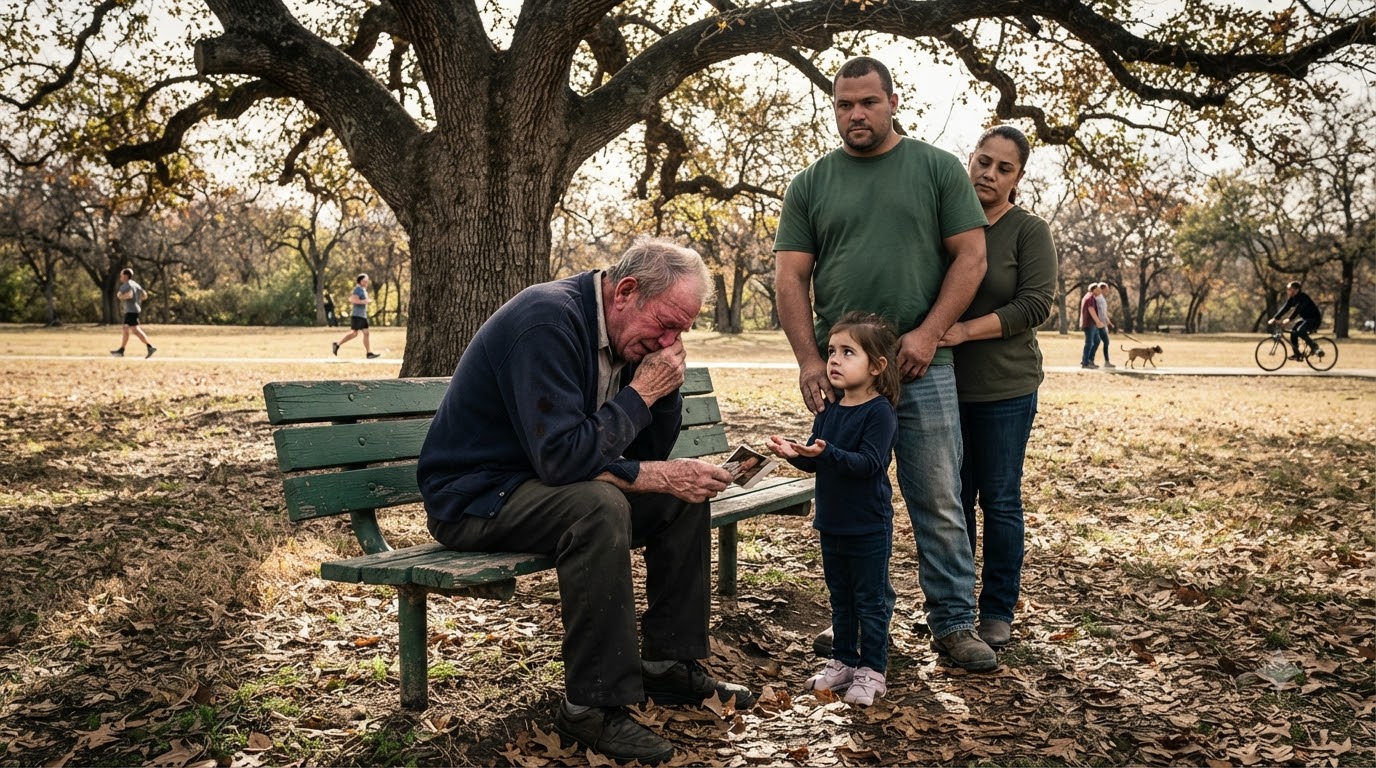
“He’s crying,” Riley whispered, pointing toward a green painted bench beneath a massive oak tree.
An elderly man sat hunched over, his shoulders trembling beneath a navy cardigan that showed a small stain on the sleeve. One weathered hand pressed against his face while the other clutched a small, dog-eared photograph. Marcus felt his protective instincts spike, his palm resting heavily on Riley’s shoulder to keep her back.
“Come on, baby girl,” Marcus murmured, his voice tight with the familiar caution of a father who knew the world could be harsh. “Let’s give the man his privacy.”
“But Daddy,” Riley insisted, her brown eyes wide with an unfiltered gravity that cut straight through his defenses. “What if he’s all alone and nobody knows he needs help?”
Denise knelt beside their daughter, her gaze meeting Marcus’s in a silent, loaded exchange built on twelve years of shared understanding. They knew what it meant to grieve in an empty room, to search the silence for a voice that would never answer.
They approached the bench slowly, the ambient noise of the park fading into the background. William Patterson lifted his head, his face blotchy and red-rimmed, caught off guard in his rawest moment. Before Marcus could offer a standard polite excuse, Riley stepped forward and bridged the impossible gap.
“I think you need a hug,” the little girl said softly, her voice trembling but sure. “Can I hug you?”
William stared at them—a hardworking black couple and their small daughter—and the defensive reflex died in his throat. The heavy, suffocating silence of his empty house rushed back, but for the first time in eight months, it was met with an open hand.
CHAPTER 2: THE BITTER CUP
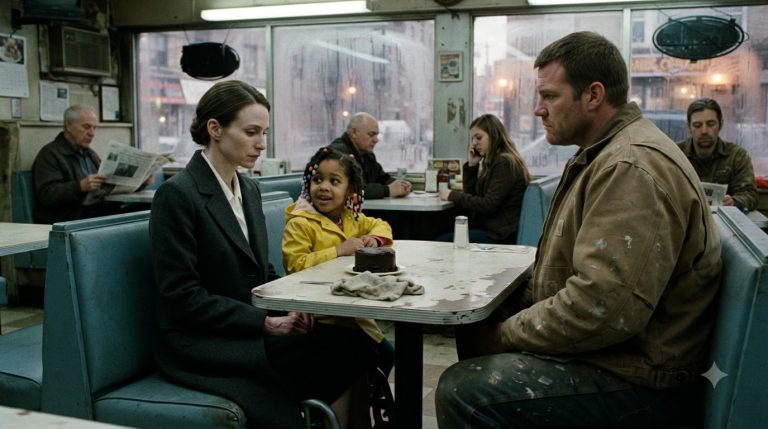
The small neighborhood coffee shop hummed with the steady drone of morning chatter and the hiss of the espresso machine. William stared down at the scarred laminate table, his fingers tracing the rim of his paper cup like a man holding onto a lifeline.
“You don’t have to carry it all by yourself, Mr. Patterson,” Denise said, sliding a napkin across the table with quiet finality.
Marcus sat beside his wife, his massive frame relaxed against the booth, offering a steady, grounding presence that demanded nothing in return. Across from them, seven-year-old Riley smoothed out a crumpled coloring page of butterflies, sliding a box of crayons toward William without a word.
“I’m not used to talking about her,” William muttered, his voice cracking against the dry air. “Not without someone checking their watch or telling me time heals everything.”
“Time doesn’t heal a damn thing,” Marcus replied bluntly, his voice carrying the weight of his own mother’s passing three years prior. “Time just gives you more room to rattle around inside your own head.”
The micro-mystery of the missing wedding band—the faint, pale indentation on William’s left ring finger—went unmentioned, yet the absence spoke louder than any sentence. William felt the protective armor of his seventy-four years cracking open, exposing raw, ugly grief to the harsh, fluorescent lights overhead.
He looked up, meeting Denise’s steady, compassionate gaze, and for the first time in eight months, he spoke his wife’s name without choking on the syllable. Catherine’s absence wasn’t a secret anymore; it was a physical weight they were all sharing across the sticky laminate table.
Riley looked up from her butterflies, her brown eyes locking onto William with unblinking seriousness. “My daddy says sad days get smaller when you share them out loud,” she whispered, pushing an emerald-green crayon into his trembling hand.
CHAPTER 3: THE EMPTY PEW
The main hall buzzed with the chaotic clatter of mismatched folding tables and loud neighborhood chatter. William stood frozen on the welcome mat, his fingers clutching a tin container of walnut cookies like a shield against a room full of strangers.
“You made it!” Riley’s voice cut through the noise before he could take a breath.
The little girl darted between two folding chairs, grabbed his coat sleeve, and dragged him past the threshold with unstoppable momentum. The air smelled of vinegar cleaner, old wood, and the rich, greasy comfort of a Friday night potluck.
Miss Dorothy caught his eye from the corner table, her tiny frame wrapped in a hand-knitted shawl as she patted the empty folding chair beside her. “Don’t just stand there blocking the doorway, William,” she called out, her voice sharp as a tack. “Sit down before all the good drumsticks vanish.”
Marcus materialized behind him with a stack of paper plates, dropping a heavy hand onto William’s shoulder. “See? Told you nobody’s checking attendance records at the door.”
William exhaled slowly, the forced stiffness in his neck easing just a fraction under the steady warmth of the room. Back in his quiet suburban house, the silence was a physical weight that pressed against his chest every evening. Here, the noise was thick, messy, and entirely alive.
He slid into the empty seat beside Miss Dorothy, placing his tin of cookies squarely in the center of the table. Across the room, the wall clock ticked steadily toward six, reminding him of the empty dining chair waiting for him at home.
Miss Dorothy leaned over, her frail hand brushing against his sleeve as she pointed toward the serving trays. “A house gets too quiet when you stop fighting the silence, William. Good thing you walked out of it.”
CHAPTER 4: THE MIDNIGHT ALARMS
William gripped the edges of the porcelain sink, his knuckles turning chalk-white against the cold ceramic. The left arm ached with a dull, sickening heaviness that defied simple heartburn or exhaustion.
He fumbled for his cell phone on the counter, his fingers slipping twice against the slick plastic casing. A stubborn wave of pride whispered that he shouldn’t bother anyone at this hour, that he could tough it out alone in the dark.
Instead, his thumb pressed Marcus’s speed dial with desperate familiarity.
“William? Talk to me, man,” Marcus’s voice cut through the ringing instantly, heavy with sudden, sharp alertness.
“My chest,” William gasped, sliding down the bathroom wall until his knees hit the cold tile floor. “It won’t stop tightening. I can’t catch my breath.”
“Stay on the line,” Marcus ordered, the sound of movement and muffled instructions echoing in the background as Denise called emergency services. “We’re right behind them, William. Do not hang up that phone.”
The next twenty minutes dissolved into a terrifying blur of flashing red lights outside the window, heavy boots on the hardwood floor, and clipped paramedic voices assessing vitals. William stared up at the ceiling paramedics while the oxygen mask hissed over his face, realizing too late that isolation was a silent killer.
He hadn’t wanted to be a burden, but as the ambulance doors slammed shut, locking out the empty suburban night, he knew he couldn’t hide behind his front door ever again.
CHAPTER 5: THE CORPORATE WALL
David Patterson stared blindly at the glowing screen of his cracked phone, the jagged line of shattered glass distorting his father’s caller ID. The crack had been there for months, a minor annoyance he kept meaning to fix but never did, just like the skipped Sunday visits.
“David, is the Singapore timeline confirmed?” Sarah, his COO, asked from across the sprawling glass conference table, pen poised over the printed contracts.
He didn’t answer. He picked up the phone, the cold metal digging into his palm. “Dad?”
“David, I’m fine.” William’s voice was thin, raspy, stripped of its usual quiet dignity. “Before you panic. But I had a cardiac episode last night. I’m in the hospital.”
The multi-million dollar contracts on the table suddenly looked like useless scrap paper. David stood up so fast his ergonomic chair slammed into the credenza behind him. “What hospital? I’m leaving now.”
“David, you don’t need to—”
“I said I’m leaving.” David cut him off, his voice cracking with a sudden, suffocating panic. He didn’t wait for his father’s polite protests. He ended the call, the silence of the Dallas skyline pressing against the floor-to-ceiling windows.
He looked down at his phone, his thumb tracing the jagged crack across the screen. For years, he had operated under the delusion that success was a shield, that building an empire meant his father was safe in that quiet suburban house. He had wired money, paid for the best insurance, and called every Sunday like clockwork.
It was all a convenient lie.
“Cancel Singapore,” David said flatly, grabbing his suit jacket from the back of the chair.
Sarah frowned, standing up. “David, we close this deal tomorrow. The investors are already in the air.”
“Let them land. Then cancel it.” David didn’t look back as he pushed through the heavy glass doors of the boardroom. He had built a fortress of wealth to protect his family, only to realize he had locked himself outside of it while his father suffocated alone on the inside.
CHAPTER 6: THE LIGHT SWITCHERS
David gripped the doorframe, his knuckles aching from the three-hour drive and the sudden, jarring reality of what he had missed. William looked up from his pillows, his face lighting up with a genuine, unburdened smile that David hadn’t witnessed in years.
“David, you came,” William said, his voice steady.
Marcus stood up slowly from the chair, extending a heavy, calloused hand toward the corporate executive without a hint of intimidation. “You must be David. I’m Marcus Thompson. I was just keeping your dad company.”
David looked down at Marcus’s hand, then past him to his father’s tired eyes, realizing the terrifying truth. These strangers had done what twenty years of corporate success and wire transfers never could: they had shown up when the lights went out.
“Thank you,” David muttered, his throat tightening as he grasped Marcus’s hand. “For being here when I wasn’t.”
The foundation they built months later didn’t rely on cold numbers or distant checks; it operated on the messy, beautiful reality of shared grace. William traded his silent, empty house for a small place just blocks away from the Thompsons, finally exchanging existence for life.
On a crisp November afternoon three years later, the community center buzzed with the laughter of over five hundred families anchored by the Catherine Patterson Foundation. Riley, now ten years old, tugged on William’s sleeve, pointing toward a new family walking through the front doors.
“Look, Mr. William,” Riley whispered, her brown eyes bright with conviction. “Another light.”
William smiled down at her, resting his hand on his chest where the memory of Catherine lived alongside the warmth of his chosen family. He didn’t need to look at an empty chair anymore because the doors swung wide, and nobody in this room was ever walking the dark alone again.