The Iron Ledger: A Hardworking Girl’s Cold Mechanical Reckoning Against Small-Town Tyranny
CHAPTER 1: RUSTED LIFELINE
The heat coming off the cracked asphalt of Route 99 felt like standing over an open oven door. My left forearm throbbed beneath a filthy grease rag, blood seeping through where Carl’s ring had caught me before I landed the skillet across his jaw.
Fifty-five dollars sat crumpled in my pocket next to a notched half-inch steel wrench. I didn’t look back at the plume of dust down the road; I knew Carl’s Ford pickup was already turning its ignition back at the house, and Sheriff Dawson wouldn’t be more than two miles behind him.
Garrett Sullivan didn’t even stand up from his sagging porch chair when my boots hit the gravel of his scrap office. He just pulled another drag off a yellow-filtered cigarette, his fingernails caked in black grease.
“Yard’s closed, kid.”
“I need wheels,” I said, my chest burning as I slammed the crumpled bills onto the rusted rim of an oil drum between us. “Fifty-five bucks. Anything with an engine that breathes.”
Garrett spat into the dust, his eyes drifting over the purple bloom swelling across my cheekbone. “Carl’s work?”
I didn’t answer. I just tapped the steel wrench against the iron rim. Clang.
“Fifty bucks buys you a broken radiator cap in this lot,” Garrett grunted, rubbing his stubbled jaw. “Unless you count the dead iron buried under the tin sheet out back. Guy left it six years ago. Wiring’s rotted, carb’s full of varnish, and the rear main seal leaks like a stuck pig.”
He pointed a calloused thumb toward the rear fence line where a heap of corrugated siding lay smothered under a rotting green tarp.
“It’s a seventy-eight Harley Shovelhead,” Garrett muttered. “It’s a anchor. You’ve got twenty minutes before Carl comes asking where you ran.”
I didn’t waste breath saying thanks. I sprinted across the sun-baked dirt, my boots kicking up clouds of orange dust until I reached the tarp. I hauled the stiff canvas back, wincing as dry rot tore across the seam.
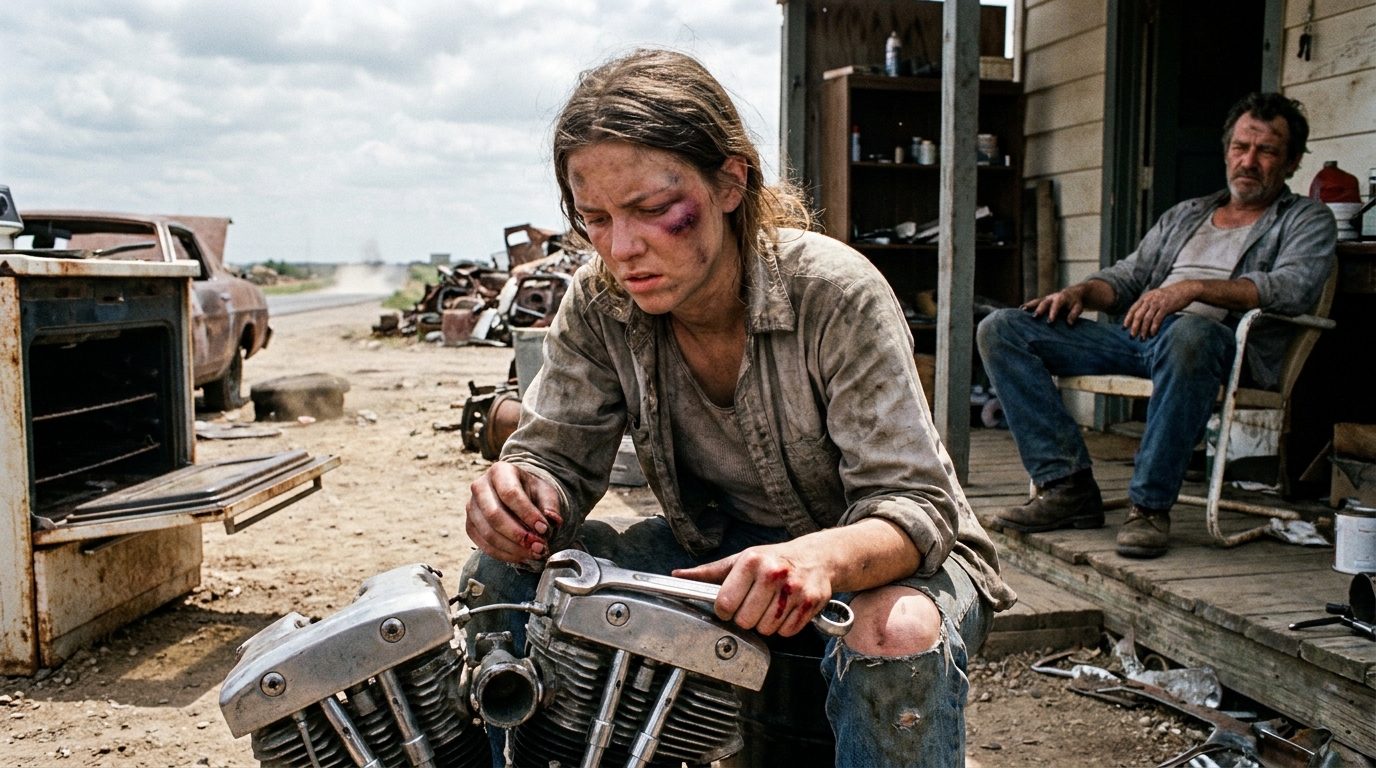
The machine underneath was massive, oxidized to a dull, chalky black, with rust eating the chrome headers like dry rot. I dropped to my knees in the dirt, ignoring the sharp rocks digging into my shins, and pulled the steel wrench from my pocket.
My fingers worked on instinct—the rhythm my biological father had hammered into my head before his heart gave out ten years ago. I pulled the front spark plug. Black carbon crust covered the electrode. I scraped it raw against a jagged piece of granite from the dirt, my breathing shallow and fast.
I sliced the rotted rubber fuel line with the sharp edge of the wrench handle, stripping the clogged section down to clean hose, then jammed it back onto the petcock with a zip-tie Garrett threw over from the porch.
“Ten minutes!” Garrett called out from the office shadow.
I drained the foul, sour fuel from the float bowl straight onto the dirt, wiping the main jet clean with the hem of my shirt. Sweat mixed with oil ran into my eyes, burning like acid.
I hauled a discarded three-gallon jug of stale gas from a dead Chevy sedan nearby, dumped it into the Shovelhead’s tank, and straddled the cracked leather seat. The steel felt massive and unyielding beneath me.
I set the choke, opened the throttle a quarter-turn, and brought my right boot down on the heavy kickstart lever.
Clunk. Nothing. Just dead mechanical resistance.
Gravel crunched out at the main gate. The unmistakable rattle of Carl’s rusted Ford pickup echoed against the corrugated office walls.
“Come on,” I whispered, setting my teeth until my jaw popped. “Come on.”
I stood straight up on the pegs, threw my entire hundred and fifteen pounds of weight into the lever, and drove my heel down.
The engine didn’t just start; it shattered the afternoon heat with a guttural, earth-shaking roar that rattled the loose tin sheets on the scrap piles around me. Black smoke belched from the straight pipes, coating my work boots in soot as the V-twin settled into a heavy, uneven thrum.
Carl’s truck skidded to a halt forty yards away, the driver’s door slamming open as he stepped into the dust with an iron tire iron in his fist.
I jammed the foot clutch down, slapped the hand shifter into first, and twisted the throttle wide open.
The rear tire bit into the loose gravel, showering Carl’s windshield in a hail of stone and dirt as the heavy iron surged past him onto the open asphalt of Route 99.
CHAPTER 2: COLD ASPHALT
The cold wind coming off the Sierra Nevadas sliced straight through my grease-soaked shirt.
Behind me, the orange glare of Carl’s headlights vanished into the swirling dust of Route 99, but the adrenaline that had carried me out of Sullivan’s yard was already turning into a dull, agonizing ache. Blood from my forearm had dried into a stiff crust against the leather seat, gluing my jeans to my thigh.
I kept my eyes pinned to the narrow beam of the flickering headlight. The 1978 Shovelhead thundered beneath me like a wounded bull, its frame shuddering every time the front tire caught a seam in the asphalt.
By midnight, the highway had emptied out into a vast, empty stretch of dark desert. Highway 50.
Then the sound changed.
A sharp, metallic clack-clack-clack echoed from the lower engine block. The oil pressure gauge on the custom dash didn’t just drop—it dead-ended against the pin.
I barely had time to pull the clutch before the rear wheel locked with a terrifying screech. The heavy iron machine skidded sideways across the center line, throwing its massive weight against my balance as I fought the handlebars, my boots dragging through the loose shoulder gravel until the dead bike finally keeled over onto its kickstand.
Silence slammed down on the desert like a solid wall.
The only noise left was the fast, ticking contraction of hot iron and the distant, hollow howl of the wind across the salt flats. I dropped onto the cold dirt beside the smoking engine, my breathing ragged as I pulled the half-inch steel wrench from my pocket and tapped it against the exhaust pipe just to hear something solid.
Clang.
A pair of high-beam headlights crested the dark rise half a mile back, moving slow and steady.
I stood up, waving my good arm once before dropping it back to my side. A rusted flatbed tow truck ground to a halt on the shoulder, air brakes squealing like a dying pig.
The door creaked open, and a heavy-set man stepped out into the dust, his greasy work shirt bearing a faded name patch that read Wayne. He smelled of stale beer and old tobacco, his eyes sliding right past the dead Harley to settle on my torn jeans and the dark bruise swelling on my cheek.
“Well now,” Wayne drawled, his voice thick and wet. “Ain’t you a long way from home, little girl? Out here all alone in the dark?”
“Engine seized,” I said, stepping back until my heel hit the Shovelhead’s primary cover. My right hand slid into my jacket pocket, fingers locking around the cold weight of the wrench. “I need a lift to the nearest service bay. I’ve got cash coming.”
“Ain’t no bays open for fifty miles,” Wayne said, taking two deliberate steps into my personal space. His dirty fingers twitched toward my arm. “But the cab’s warm. Why don’t you hop up inside and we can figure out how you’re gonna pay me for the tow?”
“I said stay back.”
When his thick hand lunged for my shoulder, I didn’t scream. I swung the steel wrench in a short, brutal arc, cracking the solid iron square across his knuckles.
Wayne let out a choked roar, stumbling backward into the dust while cradling his right hand against his chest. “You crazy little bitch!”
He reached behind his back, unclipping a heavy four-cell flashlight from his leather belt, his face twisting into an ugly, violent sneer as he stepped back toward me.
Before he could swing, the ground beneath our boots began to hum.
It started as a low, deep vibration in the gravel, vibrating straight up through the soles of my work boots. Over the western horizon, a single, blinding halogen beam cut through the desert blackness.
It wasn’t a fleet. It wasn’t a gang.
It was a single, low-slung custom chopper, its heavy V-twin firing in a rhythmic, thunderous cadence that swallowed the desert wind whole.
Wayne froze, his flashlight beam wavering in the dirt. He took one look at the massive silhouette rolling to a stop on the shoulder, swore under his breath, and scrambled back into his tow truck. The flatbed’s engine whined in panic as he slammed it into gear and tore off down the highway, leaving a cloud of diesel grit in the air.
The lone rider kicked his stand down, the heavy iron machine settling with a quiet, metallic clatter. He stood easily six-foot-four, wearing a faded leather cut with silver-streaked hair spilling over a broad, scarred forehead.
He didn’t look at me. He didn’t pull a weapon.
His cold, gray eyes were locked entirely on the oxidized, oil-splattered tank of the dead Shovelhead resting in the dirt.
Slowly, the giant pulled off a heavy leather glove and reached out, his thick thumb wiping away six years of road grime near the filler cap. Beneath the dirt, a faded custom insignia emerged: a crying skull pierced by a single black rose wrapped around a banner.
The tall man stood frozen in the desert dark for a long, heavy moment. When he finally turned his head to look at me, his voice sounded like dry gravel grinding beneath a wheel.
“Where the hell,” he rumbled, “did you get Dutch’s bike?”
CHAPTER 3: THE BROTHERS IRON
“I bought it,” I said, my voice raspy from dust and dry heat. “Fifty-five dollars at Sullivan’s salvage in Oildale. Owner said a guy left it under a tarp six years ago.”
Grizzly didn’t blink. His thick jaw flexed beneath his silver beard, his heavy boots crunching forward a single inch into the dirt.
“Dutch didn’t leave it,” he said, the words heavy and flat as iron plate. “My younger brother died six years back on a back road two counties over. We found him, but we never found his machine.”
He reached past me, his massive leather-clad arm brushing my shoulder as he picked up the dead Shovelhead by its frame, lifting the heavy steel out of the dirt with a single grunt and balancing it back on its stand.
“You got this pile of rust running?”
“I bypassed the fried ignition switch and wired the stator straight to the coil,” I said, wiping oil off my chin with my greasy sleeve. “It ran hot until the rear shaft bearing seized up. The block isn’t cracked.”
Grizzly stared at me for three long seconds. He didn’t offer a hand, and he didn’t offer a ride.
He just jerked his chin toward a flatbed trailer attached to his chopper. “Load it. We’ve got a shop ten miles out.”
The shop sat behind an unpainted tin garage in the desert foothills, surrounded by chain-link and quiet dark. Inside, fluorescent tubes flickered awake, casting harsh white light across state-of-the-art hydraulic lifts and rolling tool chests.
Grizzly rolled the dead Shovelhead onto a center lift, popped a mug of black coffee from a pot on the workbench, and leaned back against a steel cabinet.
“Lead guy who looks at my fleet says the engine’s fused,” Grizzly rumbled, watching me pull my half-inch wrench back out. “Says it’s scrap. Wants to mount the tank on the wall.”
“He’s wrong,” I said flatly.
I stepped up to the lift, my hands working before my head even asked for permission. I unbolted the rocker box covers, the steel cold and slick under my fingers.
“The rocker box gaskets blew out from head pressure,” I muttered, pointing the tip of my wrench at the brown, baked residue near the valves. “That’s why it spit oil everywhere. The seized bearing is in the transmission main shaft, not the pistons. I can rebuild the casing and set the timing in three hours if you’ve got a puller.”
Grizzly didn’t move, but his grey eyes narrowed slightly as he took a slow sip of coffee.
“Tools are in the red cabinet,” he said. “Parts room is through that door. You’ve got until sunrise.”
I didn’t waste time asking questions. I pulled the puller tool, grabbed a fresh roll of shop towels, and went to work on the primary drive.
My fingers were bleeding again by 3:00 AM, the cold air in the unheated garage biting into the tear in my forearm. Every time the ratchet clicked, the image of Carl standing in Sullivan’s driveway with that iron tire iron flashed behind my eyelids.
He wasn’t going to stop looking. Oildale was small, but Sheriff Dawson had county lines on his side, and Carl had three years of untamed rage built up.
I pulled the transmission main shaft out with a sharp pop.
A tiny metallic glint caught the overhead light inside the hollow frame housing right above the transmission mount. I reached two fingers deep into the grease-caked recess, expecting a sheared pin or a broken lock-washer.
It wasn’t a washer.
My fingers brushed against a heavy brass key ring tucked deep behind the frame lug. I pulled it out into the light.
Hanging from the oxidized brass loop was a notched copper ignition key—stamped cleanly on its flat head with two tiny initials: J.D.
My heart hit my ribs like a hammer. John Davis. My biological father’s initials.
I stared at the copper key in the palm of my greasy hand, the room suddenly feeling dead quiet. Dutch hadn’t just bought this bike; my father had cut the ignition key for it before he died.
The shop door screeched open on dry hinges, freezing me in place.
CHAPTER 4: CORNERED AT THE FENCE
Carl’s battered Ford pickup sat idling just outside the perimeter fence, its high beams cutting through the predawn fog. Next to it was Sheriff Dawson’s county cruiser, its roof rack flashing silently.
Sheriff Dawson stepped up to the chain-link gate, a megaphoned bullhorn resting in his right hand. His uniform shirt was stretched tight over his gut, his boots gleaming with fresh polish.
“Harper Davis!” Dawson’s amplified voice rattled the metal tin roof above my head. “Step out to the fence with your hands where I can see them. You’re under arrest for grand theft auto and felony assault.”
Carl stepped up beside him, clutching a rusted tire iron, his lip split open where my skillet had caught him eighteen hours ago. He grinned through his yellow teeth, glaring straight at me.
“You’re done running, girl,” Carl yelled across the gravel. “Hand over the keys and get in the truck before I let the sheriff take you in.”
Grizzly didn’t move fast. He wiped his greasy hands on a blue shop towel, set his coffee mug down on the workbench, and walked out into the cool morning air, stopping ten feet short of the iron gate. I followed right behind his shoulder, my fingers still wrapped around my steel wrench.
“You’re out of your jurisdiction, Dawson,” Grizzly said, his voice flat and calm. “This county line ends at the culvert three hundred yards back. You’ve got no paper that works here.”
“I don’t need a multi-county warrant for a stolen vehicle recovery,” Dawson sneered, patting the leather holster at his hip. “Sullivan’s yard reported that Harley stolen yesterday afternoon. Carl here holds the lien on her father’s estate. That bike is his property.”
I stepped out from behind Grizzly, resting my forearms against the cold wire of the gate.
“Check the serial on the frame, Sheriff,” I said, my voice steady. “Sullivan didn’t own that machine. It’s been sitting on abandoned county land for six years without a lien filing. And under California Civil Code Section 2080, an unregistered salvage vehicle left on commercial property past three years without a lien sale reverts to public domain.”
Dawson hesitated, his hand freezing over his holster. He looked at Carl, his forehead furrowing.
“I paid Garrett fifty-five dollars in cash,” I continued, pulling the worn receipt Garrett had stamped out of my back pocket and slapping it against the chain-link mesh. “I hold the bill of sale for the scrap iron. You want to charge me with grand theft? You’ll have to explain to a state magistrate why you’re executing a private repossession outside your county line without a judge’s signature.”
Carl’s face turned deep purple. He took a violent step forward, slamming his tire iron against the steel gate post with a deafening clank.
“Don’t give me your courtroom lawyer talk, Harper!” Carl screamed, spit flying from his teeth. “You stole fifty-five bucks out of my kitchen drawer! You hit me with iron! You belong in a cell or back in my house, and Dawson’s opening this gate right now!”
“Touch that latch, Carl,” Grizzly said quietly, leaning his heavy forearms against the gate frame, “and I won’t call a deputy. I’ll call the state inspector to audit Dawson’s impound lot logbooks.”
Dawson’s face drained of color. He took a quick step back from the gate, his eyes darting from Grizzly to Carl.
“Carl,” Dawson muttered under his breath, lowering the bullhorn. “Get back in the truck.”
“What?” Carl roared, turning on the deputy. “You’re gonna let this little brat stand there and talk to you like that? I paid your precinct’s slush fund three thousand dollars last month to keep your eyes off my scrap hauling!”
The silence that followed fell like a lead weight.
Dawson’s jaw clenched so hard a muscle twitched near his ear. “Shut your mouth, Carl.”
“I ain’t shutting nothing!” Carl raged, shaking his tire iron at me through the wire mesh. “She knows too much! She’s got her father’s stubborn streak, and if she thinks she’s keeping that shop or that bike, I’ll tear it down myself!”
I didn’t flinch. I just tapped my half-inch steel wrench against the iron latch, looking straight into Carl’s bloodshot eyes.
“You can try, Carl,” I said. “But the engine’s already running.”
CHAPTER 5: THE HOLLOW HANDLEBAR
The left rubber grip came off with a dry, rubbery squeak. As I tipped the heavy steel bar downward, a faint metallic rattle echoed from inside the hollow tubing.
I set the wrench down on the workbench, grabbed a needle-nose pliers from Grizzly’s red cabinet, and reached into the dark pipe. The jaws clamped onto a piece of cold brass.
With a sharp pull, I extracted a tightly capped brass cylinder no larger than a cigar.
Grizzly walked over from the workbench, his boots heavy on the concrete, his gray eyes narrowing as I unscrewed the threaded brass cap. Inside, rolled tight as a cigarette, lay four sheets of micro-printed waterproof ledger paper.
I unrolled them under the harsh fluorescent shop light.
“This isn’t bike parts,” I whispered.
The pages listed dates, serial numbers for industrial generators, county land parcel numbers, and bank account routing codes. Right next to Sheriff Dawson’s signature on a monthly payout sheet was Carl’s handwritten ledger—tracking stolen farm machinery fenced across three county lines over seven years.
But at the bottom of the second page, dated two weeks before my mother died, was a property transfer filing. Carl had forged my biological father’s signature to hand over the title of our home workshop directly to Dawson’s brother.
“Dutch found this,” Grizzly said softly, his thick thumb tracing the top margin. “Six years ago. He hid it in his bars before they ran him off the road.”
“Carl didn’t just take my father’s tools,” I said, my teeth clenched so tight my jaw hurt. “He killed my mother for the insurance payout to clear the lien on that shop.”
“We take this to the district attorney across the state line,” Grizzly said, his voice hard. “It ends him.”
Gravel crunched out front. A heavy crash echoed from the garage door as an iron bumper slammed straight into the tin siding.
Carl didn’t wait for Dawson this time. He kicked the side pedestrian door off its latch, his face twisted in pure, unhinged fury as he stepped into the shop holding an opened bottle of industrial solvent in one hand and a road flare in the other.
“Give me those papers, Harper!” Carl screamed, his eyes bloodshot, smelling of cheap gin and fresh exhaust. “You ain’t ruining my life over old dirt! I built that yard! I earned that shop!”
“You stole it, Carl,” I said, stepping between him and the Shovelhead, holding the brass cylinder in my right hand while my left fingers closed around my steel wrench. “You stole everything.”
“I’m burning it all,” Carl spat, striking the flare against his boot. A blinding red spark erupted in the dim garage. “I’m burning this pile of iron, and I’m burning you with it!”
CHAPTER 6: THE FINAL TORQUE
Carl didn’t get the chance to throw the flame.
Before he could tip the bottle, I reached sideways to the welding cart, grabbed the brass striker, and popped the valve on the oxygen-acetylene rig. Snap-crackle.
A three-foot blue needle of pressurized flame roared to life straight from the tip, hitting the concrete two inches from Carl’s boots.
Carl shrieked, dropping the glass bottle as the thermal blast scorched his leather work shoes. He scrambled backward through the open doorway, tripping over his own heels into the morning dust outside.
Grizzly didn’t hit him. He just stepped out into the doorway, his massive frame blocking the light, holding a thick manila envelope stamped by the State Attorney General’s regional investigator.
Two white state patrol units were already sitting parked behind Carl’s truck, their doors open, officers standing behind their side panels with clipboards and badge numbers visible.
“They’re not here for a stolen bike, Carl,” I said, stepping out onto the gravel beside Grizzly, turning off the torch flame with a quiet hiss. “I faxed the ledger from Dutch’s handlebars to the State Bureau at four this morning.”
Carl scrambled onto his knees in the dirt, his face pale, his breath coming in ragged, desperate gasps as he pointed a trembling finger at me. “She forged it! Sheriff Dawson’s got the real land records back at the county office! She’s lying!”
“Dawson’s already in custody at the district precinct,” one of the state officers said, stepping forward with open handcuffs. “His assistant deputy turned over the secondary logbook twenty minutes ago.”
Carl’s mouth opened, but no sound came out. His shoulders slumped as the state trooper pulled his arms behind his back, clicking the steel cuffs tight over his wrists.
He didn’t get a dramatic exit. He just got loaded into the back of a plain white sedan, his knees hitting the door frame as the vehicle pulled out onto the road toward county jail.
The morning sun finally cleared the ridge, warming the cool metal of the garage doors.
I walked back inside, picked up my half-inch steel wrench from the bench, and slid the notched copper key into the Shovelhead’s newly wired ignition switch.
I turned the brass tumbler.
The V-twin fired instantly on the first turn—a smooth, steady potato-beat thrum that filled the clean shop without a single drop of oil hitting the floor.
Grizzly walked up beside the lift, setting a clean set of registration papers down on the gas tank, stamped directly in my name.
“She runs quiet,” Grizzly rumbled, a faint ghost of a smile touching his eyes beneath his silver beard.
“She runs right,” I said, wiping a thumb across the polished chrome air cleaner. “My dad built things to last.”
I tightened the top riser bolt one final quarter-turn until the steel locked solid, set the wrench neatly inside the red tool chest, and leaned back against the workbench to listen to the engine breathe.